
What is Countersteering? Motorcycle Physics & MSF Riding Guide
This post contains affiliate links. As an Amazon Associate, we earn from qualifying purchases.
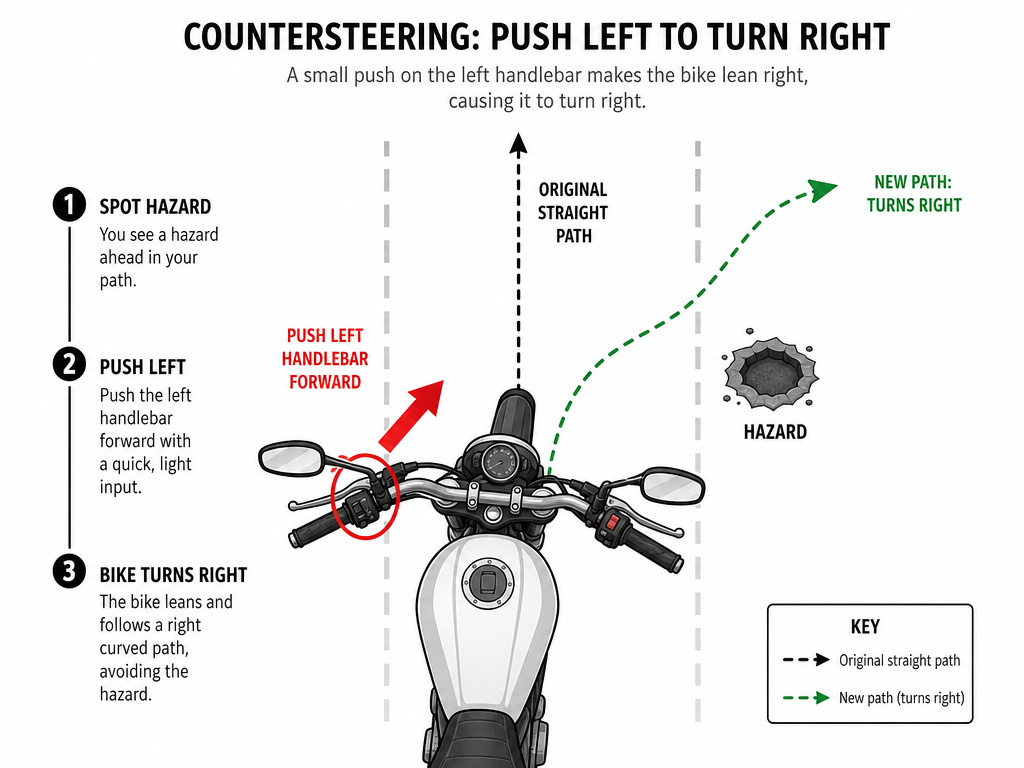
Countersteering on a motorcycle is the conscious act of pressing the handgrip in the direction you want to turn, which momentarily steers the front wheel slightly opposite, causing the bike to lean into your intended direction. This is the only way to initiate a controlled turn at speeds above 10 km/h (about 6 mph). The Motorcycle Safety Foundation teaches it as the PRESS technique: Press Left, Lean Left, Go Left.
That initial press creates a physical mismatch that the bike’s geometry and physics must correct. This is the direct consequence of how a two-wheeled vehicle’s contact patches interact with the road when it’s moving with stability.
What follows is a walk through the physics that makes it non-negotiable, the critical speed threshold where it kicks in, and the documented risks of riders who never learn it. You’ll also see how it differs completely from how you steer a car or even a motorcycle at walking pace.
Key Takeaways
- Countersteering is mandatory for turning above 10 km/h. Below that, you use direct steering and counterbalancing.
- The mechanism is centrifugal torque: pushing the right grip makes the front wheel track left, shifting the bike’s mass right of its support line, which forces a lean to the right.
- Official manuals like the Washington State DOL guide and the Motorcycle Safety Foundation handbook explicitly teach it as a life-saving skill.
- The Hurt Report found riders who couldn’t countersteer lacked a primary crash-avoidance maneuver.
- Trail, the distance the front tire contact patch trails behind the steering axis, is the key geometric feature that makes the bike self-correct once leaned.
Why You Can’t “Just Lean” at Speed
Where this goes sideways: Trying to turn a motorcycle by leaning your body alone at 50 km/h. The bike will resist, wander wide, and you’ll run out of road before the turn tightens.
Forget what you’ve seen in movies. At any speed above a fast walk, a motorcycle is a gyroscopically stabilized, dynamically balanced system. It wants to go straight. The faster it goes, the more it fights any change in direction.
You can demonstrate this on a bicycle. Ride briskly and try to turn right by only throwing your hips right. Nothing happens, or the bike wobbles. Now, gently press forward on the left handgrip. The bike dips right instantly. That press is the countersteering input.
This stability comes from three main effects: gyroscopic forces from the spinning wheels, the massive trail built into the front-end geometry, and the sheer inertia of several hundred pounds of metal wanting to stay on its current path. These are the same effects that make a rolling coin stay upright. To overcome them and place the bike into a lean, you must create an imbalance. Countersteering is the efficient, controlled way to do that.
How Countersteering Works: The Physics in Motion
The Washington State Motorcycle Operator Manual states that above approximately 12-15 mph, motorcycles steer through countersteering. The Motorcycle Safety Foundation’s PRESS technique is the same instruction.
The sequence for a right turn breaks down into physical stages.
| Step | Rider Input | Bike’s Physical Response |
|---|---|---|
| Initiate | Press forward on the right handgrip. | Front wheel steers slightly to the LEFT (out-tracks). |
| Imbalance | Bike’s mass is now to the RIGHT of the front wheel’s new path. | Centrifugal force throws the bike’s mass LEFT, creating a lean to the RIGHT. |
| Recovery | Release or ease pressure on the grip. | The bike’s trail geometry makes the now-leaned front wheel steer INTO the turn (right) to regain balance under the center of gravity. |
| Stabilize | Maintain or adjust lean with light pressure. | Bike carves a stable arc, with gravitational pull balancing centrifugal push. |
Pressing the right handgrip steers the front wheel left, causing the motorcycle to momentarily turn left. This creates a centrifugal force that throws the combined center of mass of the bike and rider to the right of the tire contact patches, inducing a lean to the right. Once leaned, the motorcycle’s steering geometry (trail) causes the front wheel to steer into the turn, stabilizing the lean angle.
The initial steering input can be tiny, research notes it may need as little as 0.125 seconds, which is why many riders do it without realizing. The Berkeley physics bicycle steering study confirms that while gyroscopic effects exist, the primary lean comes from this out-tracking and centrifugal torque.
This is also why you must be careful riding near a curb or edge. To move away from it, you must first steer toward it. Your instinct says otherwise, which is why these situations feel unnerving.
Countersteering vs. Low-Speed Steering: Two Different Worlds
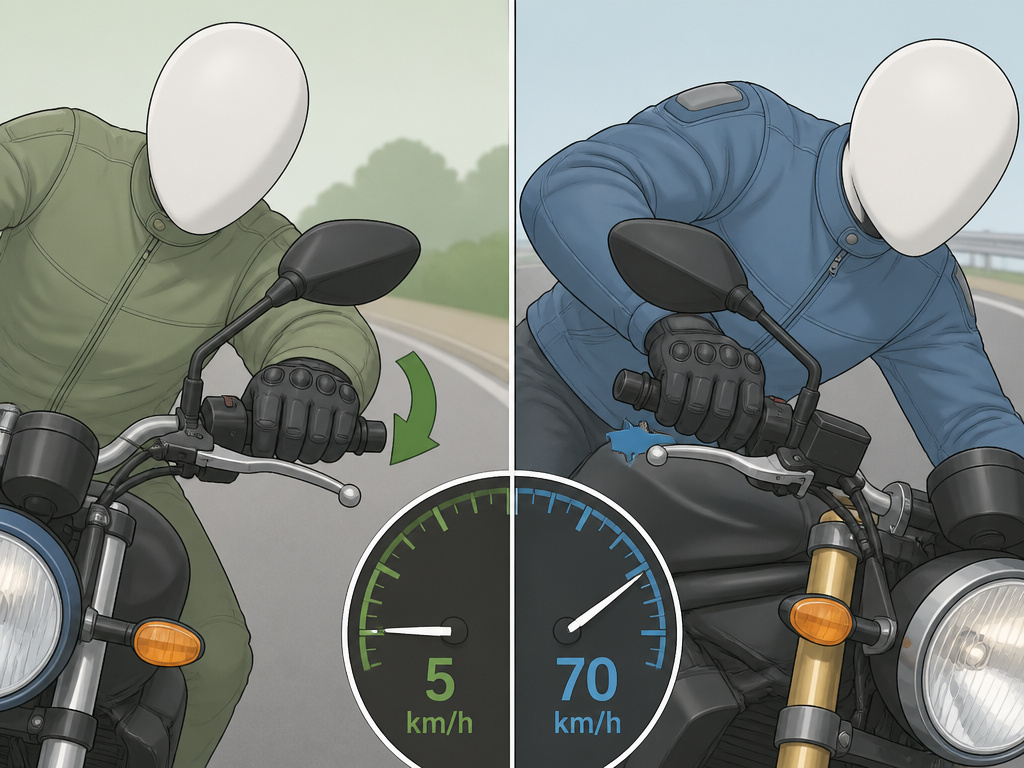
The rule changes completely below the 10 km/h threshold. Here, the bike is unstable, not stable.
Low-Speed & Parking Lot Maneuvers
- Technique: Direct steering. Turn the handlebars in the direction you want to go.
- Body Position: Counterbalancing. Keep your body upright or even leaned slightly OUTSIDE the turn to keep the bike’s center of gravity low and manageable.
- Why: At these speeds, gyroscopic and inertial forces are minimal. The bike is top-heavy and wants to fall over. Leaning it without counterbalancing requires more steering correction and risks a drop.
Road Speed Cornering (Above 10-15 km/h)
- Technique: Countersteering. Press the grip in the direction of the turn.
- Body Position: Leaning with the bike. Your torso and the motorcycle lean at the same angle.
- Why: The bike is now stable. You must force it to lean to overcome its desire to go straight. This is where that steering wheel replacement mindset from cars will wreck you, car steering is direct, motorcycle steering is counter-intuitive.
Common mistake: Applying parking-lot body steering to a highway off-ramp. If you try to counterbalance at 70 km/h, you’ll run wide because the bike can’t achieve sufficient lean angle with your weight shifted the wrong way.
The Stakes: What Happens If You Don’t Know How
These consequences are recorded in crash statistics and rider training gaps.
The Hurt Report, a seminal motorcycle accident study, highlighted a critical finding: many riders in collisions over-braked the rear wheel, under-used the front brake, and lacked the ability to countersteer and swerve. In an emergency, the instinct to just lean or brake hard is not enough. Swerving requires a deliberate, practiced countersteering input.
This is why state licensing agencies embed it in their testing. The Washington State motorcycle operator manual explicitly teaches it, and passing a road test often requires demonstrating a controlled, quick turn or swerve that is impossible without countersteering.
Think of it as the difference between stomping on a car’s brake pedal and understanding threshold braking. One is a panic reaction. The other is a controlled skill that saves lives. If your bad wheel bearings are causing a wobble, you address it before it fails. If you don’t know how to countersteer, you’re riding with a fundamental handling failure that’s already present.
Tools, Geometry, and Rider Inputs
Your physical inputs and the motorcycle’s design are partners in this dance.
Trail: This is the single most important geometric factor. It’s the distance the front tire’s contact patch trails behind the point where the steering axis intersects the ground. More trail generally means greater straight-line stability but slower steering response. It’s also what makes the bike “self-steer” into a lean. When you countersteer and the bike leans, trail pulls the front wheel into the turn, reducing the need for you to hold the initial press.
Handlebar Pressure: This is your direct control. A firmer, quicker push produces a faster, more aggressive lean. A gentle, sustained press creates a gradual, sweeping turn. You don’t “turn the bars” in the classic sense; you apply pressure at the end of the grip. This is a distinct feeling from turning the steering wheel in a car, which requires significantly more rotation.
Gyroscopic Precession: A secondary effect. The spinning wheels resist changes in their plane of rotation. When you apply force to lean the bike (via countersteering), the wheels react by trying to turn, which can assist the steering process. As the physics paper notes, this effect is present but minor compared to centrifugal torque.
The relationship is clear in this diagnostic table:
| Symptom While Turning | Likely Cause | Fix |
|---|---|---|
| Bike feels vague, wants to stand up mid-corner. | Insufficient or released countersteering pressure. | Apply firm, sustained press on the inside grip. |
| Turn feels too tight, bike wants to fall in. | Too much countersteering pressure held too long. | Ease off the inside grip slightly; let the bike’s trail stabilize the lean. |
| Severe wobble or instability when initiating a turn. | Possible mechanical issue (e.g., bad head bearings, worn shocks and tires, low tire pressure). | Stop riding and inspect front end, suspension, and tires. |
Practice Drills and Building Muscle Memory
Knowing the theory is one thing. Feeling it is everything. You must drill this in a safe, empty parking lot.
- The Straight-Line Press: At 30 km/h in a straight line, practice pressing the left grip briefly. Feel the bike dip left. Then press the right grip to bring it back upright. Do not try to turn. Just feel the dip-and-recover.
- The Slalom: Set out cones or markers in a straight line. Practice weaving between them using only countersteering presses. Focus on the quick “press-release” rhythm.
- The Emergency Swerve: Pick two points. Accelerate to 40 km/h toward them, then practice a sharp, deliberate press to swerve around an imaginary obstacle, then a press the other way to regain your line.
The goal is to make the press instinctual. In a real emergency, you won’t have time to think “countersteer.” Your body must know that avoiding that pothole means a hard press on the right grip, not a yank on the bars. This is as critical a skill as knowing how to perform a wheel bearing replacement before it seizes, preventative, mechanical knowledge that keeps you safe.
Frequently Asked Questions
Is countersteering the same on a bicycle?
Yes, the physics is identical. However, bicycles are lighter and have less gyroscopic force, so the countersteering input is often subconscious. At speed, pressing the left grip will absolutely make a bicycle lean and turn right.
Do you countersteer in every motorcycle turn?
For any turn above a fast walking pace, yes. The only exceptions are ultra-slow, tight maneuvers like a U-turn in a parking lot, where you use direct steering and counterbalancing.
Can you over-countersteer?
You can apply too much initial pressure, causing the bike to lean too quickly or aggressively. This can be unsettling but is corrected by easing off the pressure and letting the bike settle. It’s better to start with deliberate, firm inputs than tentative ones.
Do three-wheeled motorcycles countersteer?
No. Trikes, sidecars, and reverse trikes (like the Can-Am Spyder) steer via direct steering. You turn the handlebars in the direction you want to go, similar to a car. The dynamics are completely different because they have multiple tracks of stability.
Why don’t I feel like I’m doing it?
Because the initial input is small and quick. You may feel like you’re just “leaning” because the countersteering happens in a fraction of a second, followed by the more noticeable lean. The Wikipedia countersteering entry notes this subtlety often keeps riders unaware of the concept.
The Bottom Line
Countersteering is the fundamental mechanics of how a two-wheeled vehicle changes direction at speed. The Motorcycle Safety Foundation, state licensing manuals, and physics textbooks all say the same thing: press left to go left.
Ignoring it doesn’t mean you won’t turn. It means your turns are slower, less precise, and lack the sharp, emergency-avoidance capability that separates a rider from a passenger on their own bike. It’s as core to handling as understanding how bald tires destroy your grip on rain-slicked roads. You can learn it in an afternoon in a parking lot. That afternoon might be the one that keeps you out of the hurt report.
