
The Real-World Range of an Electric Scooter: A Complete Guide
This post contains affiliate links. As an Amazon Associate, we earn from qualifying purchases.
The range of an electric scooter is the distance it can travel on a single charge, determined by three non-negotiable variables: battery capacity (in Watt-hours), rider weight, and the speed you maintain. A 350W commuter scooter with a 367Wh battery, like the Ninebot F35, delivers about 25 miles for a 165-pound rider at 10 mph. Push that same scooter to its 19 mph top speed, and the range drops to under 15 miles. Manufacturer “maximum” figures assume ideal lab conditions—your real-world mileage will be lower.
That gap between the brochure and the road is where the whole decision lives. Battery chemistry doesn’t lie, but marketing departments do smooth over the details. The spec sheet gives you the ceiling; your weight, your hills, and your throttle hand decide how close you get to it.
What follows: a breakdown of the three variables that actually matter, how to decode any manufacturer’s range claim, and the specific models that tell the truth about their mileage.
Key Takeaways
- Battery capacity in Watt-hours (Wh) is your fuel tank. Divide this number by 20 to get a rough real-world range in miles for an average rider. A 500Wh battery means about 25 miles.
- Speed is the range killer. Riding at a scooter’s maximum speed can cut its rated range in half. The most efficient cruising speed is usually 50-60% of the top speed.
- Temperature is a silent partner. Lithium-ion batteries lose about 20% of their capacity at freezing point (32°F / 0°C). The Ninebot F35’s manual explicitly warns that the scooter won’t charge or accelerate normally outside its 14–104°F operating window.
- “Maximum range” is a lab result. Look for the “typical range” or “tested range” figure, which uses standardized rider weight (usually 165 lbs / 75 kg) and speed (often 10-16 mph). This is your baseline.
- Your weight changes the math. Every 50 pounds over the test rider’s weight can reduce range by 10-15%. Exceed the posted weight limit and you risk damaging the motor and frame.
The Three Variables That Actually Decide Your Range
Forget brand names and glossy ads for a moment. The physics of moving a mass from point A to point B hasn’t changed. Your scooter’s range boils down to an equation with three inputs: energy stored, energy required, and efficiency losses.
The first and most critical is battery capacity, measured in Watt-hours (Wh). Think of this as the size of your gas tank. A higher Wh number means more potential energy. The Ninebot F35 packs a 367Wh battery. The more powerful Ninebot F3 Pro E has a 477Wh pack. That extra 110Wh is the difference between a 25-mile commute and a 35-mile one, all else being equal.
Battery capacity in Watt-hours (Wh) is the total energy available. It is calculated by multiplying the battery’s nominal voltage (e.g., 36V) by its amp-hour rating (e.g., 10.2Ah). A 36V 10.2Ah battery is a 367.2Wh battery.
The second variable is rider weight plus cargo. The motor has to work harder to accelerate and maintain speed with more mass. Manufacturer range tests use a standard weight—commonly 75 kg (165 lbs). If you weigh 200 lbs and carry a 15 lb backpack, you’re 50 lbs over the test benchmark. That extra load increases rolling resistance and inertial mass, which the motor compensates for by drawing more current from the battery. The result is fewer miles per charge.
The third and most deceptive variable is speed. Air resistance increases with the square of velocity. Going twice as fast requires roughly four times the power. This is why the range plummets when you use the sport mode.
| Scooter Model | Battery (Wh) | Tested Range (165 lb rider) | Test Speed | Estimated Range at Max Speed |
|---|---|---|---|---|
| Ninebot F35 | 367 Wh | 25 miles | 10 mph | < 15 miles |
| Ninebot C2 Lite | Not Specified | 5.6 miles | 9.9 mph | < 3.5 miles |
| Ninebot F3 Pro E | 477 Wh | 31 miles | 15.5 mph | ~20 miles |
The C2 Lite’s manual is brutally honest: in Sport mode at max speed, its range is just 5.6 miles. That’s a commuter’s one-way trip, not a joyride.
How to Read a Scooter’s Spec Sheet (And See Through the Hype)
Manufacturer websites are a forest of bold claims. Your job is to find the two numbers that matter: “Typical Range” and the test conditions footnote. If you can’t find the test conditions, the range figure is essentially fiction.
“Maximum Range” vs. “Typical Range”: Maximum range is the best-case scenario, often achieved at a low, constant speed (like 9-12 mph) on a flat surface with a light rider. It’s a theoretical ceiling. “Typical Range” or “Tested Range” is more useful. For example, the Ninebot F35’s typical range is listed as “Approx. 24.9 miles (40 km) tested with 75 kg load, 25°C, at 16±1 km/h on pavement.” That’s a real, repeatable benchmark you can use for comparison.
Check the Test Weight and Speed. This is your calibration point. If a competitor’s scooter claims a 40-mile range but was tested with a 55 kg (121 lb) rider, its real-world performance for a 185 lb adult will be dramatically lower. Always normalize to the 75 kg standard if possible.
Look for the Battery Wh Rating. It’s sometimes buried in the technical specifications or manual. If you see only voltage and amp-hours (e.g., 36V 10Ah), multiply them to get Watt-hours (360Wh). This number allows direct comparison across brands, much like comparing engine displacement in cars.
Where this goes sideways: Buying based on “up to” range claims without checking the battery capacity. A scooter advertising 50 miles with a 300Wh battery is performing physics-defying miracles. For genuine long-range scooters, you need a battery pack of at least 500Wh, and preferably 700Wh or more.
The Impact of Terrain, Temperature, and Riding Style
The spec sheet gives you a baseline for a perfect day. The real world adds friction—literally. Your route and habits are the wild cards that determine whether you beat the estimate or limp home on a dead battery.
Hills are your battery’s nemesis. Climbing a slope requires the motor to deliver peak torque, which pulls maximum current. The Ninebot F3 Pro E can handle a 24% grade, but conquering that hill might consume the equivalent battery power of a mile of flat cruising. If your commute has a significant incline, mentally subtract 10-20% from the advertised range.
Temperature is not a suggestion. Lithium-ion batteries are chemical devices. Cold slows the chemical reactions, reducing the amount of energy they can release. The Ather Energy scooter’s manual specifies an operating temperature, and the Ninebot F35’s dashboard shows a temperature warning if the battery is below 32°F (0°C), at which point performance and charging are inhibited. In freezing weather, expect a 20-30% range loss. This makes proper winter storage critical for battery health.
Your right hand controls the flow. Aggressive, stop-and-go riding with hard acceleration and braking wastes energy. The most efficient technique is smooth, gradual acceleration and maintaining a steady pace. Using the scooter’s eco mode enforces this by capping power and top speed. It feels slower, but it gets you farther.
- For maximum range: Use Eco mode, maintain a steady 10-13 mph, and avoid hard braking.
- What kills range fastest: Riding at top speed (Sport mode), frequent stops/starts, and riding into a headwind.
- The maintenance factor: Under-inflated tires increase rolling resistance. A soft tire can sap 5-10% of your range without you noticing.
Electric Scooter Range by Category and Model
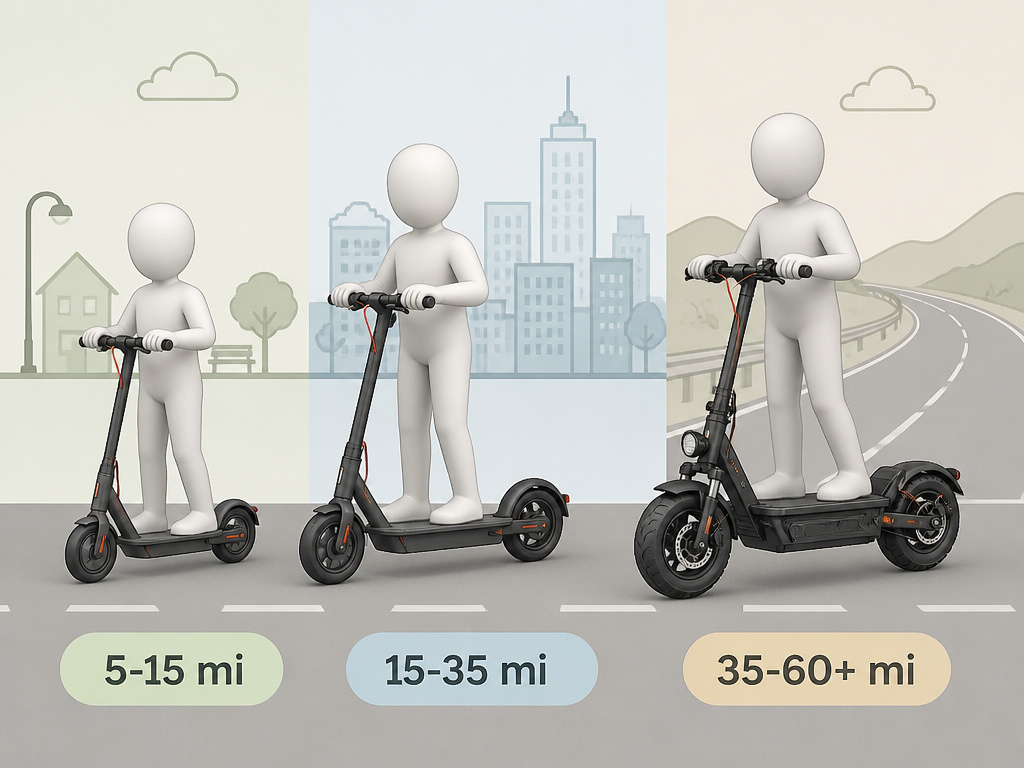
Not all scooters are built for the same job. We can group them into three practical categories based on their design and component choices, which directly dictate their range potential.
Entry-Level / Last-Mile Commuters (Under 20 Miles Real Range)
These are lightweight, lower-power scooters designed for short trips from a train station or a quick campus loop. They often use smaller batteries (250-400Wh) and motors rated at 250-350W. * Example: Ninebot C2 Lite. Its manual lists a maximum range of just 5.6 miles in Sport mode and 8.7 miles in Standard mode. This is a “first and last mile” solution, not a primary vehicle. * Example: Ninebot F35. With its 367Wh battery and 350W motor, it’s a step up. Its 25-mile typical range is honest for a 165 lb rider at moderate speed. * Who it’s for: Someone with a sub-5 mile one-way commute on flat ground, or a secondary vehicle for connecting to transit.
Mainstream Commuters (20-40 Miles Real Range)
This is the most common category for daily adult riders. It features larger batteries (400-600Wh), more powerful motors (500-800W), and better suspension to handle longer rides comfortably. * Example: Ninebot F3 Pro E. The 477Wh battery and 550W motor (1200W peak) are the workhorses here. Its claim of 31 miles at max speed is ambitious, but a 25-30 mile real-world range is achievable for a 180 lb rider. This is a solid choice for a long-range scooter for adults with a 10-15 mile daily round trip. * The Trade-Off: These scooters are heavier (often over 40 lbs) and represent a significant investment. Their performance hinges on diligent battery maintenance.
Performance / Long-Distance Models (40+ Miles Real Range)
These are built for replacing car trips. They boast large battery packs (700Wh+), dual motors for power and redundancy, and advanced features like regenerative braking to recapture energy. * Example: Dualtron models. While specific range depends on the configuration, their higher-tier models are built around extended travel, with some claiming theoretical ranges over 60 miles. * Example: Ather Energy electric scooters. As a vehicle-class scooter, it uses a massive 2.9 kWh or 3.7 kWh battery pack (2900-3700Wh) to achieve its certified 111-150 km (69-93 mile) range. This is in a different league altogether. * Who it’s for: The serious commuter with a 20+ mile daily requirement, or the enthusiast who wants to explore without range anxiety.
| Category | Battery Range | Motor Power | Real-World Use Case |
|---|---|---|---|
| Entry-Level | 5 – 15 miles | 250W – 350W | Short errands, campus transport, connection to public transit. |
| Mainstream Commuter | 15 – 35 miles | 500W – 800W | Daily work commute (5-15 miles each way), urban exploration. |
| Performance | 35 – 60+ miles | 800W – 2000W+ | Car replacement, long recreational rides, hilly terrain. |
How to Maximize Your Electric Scooter’s Range
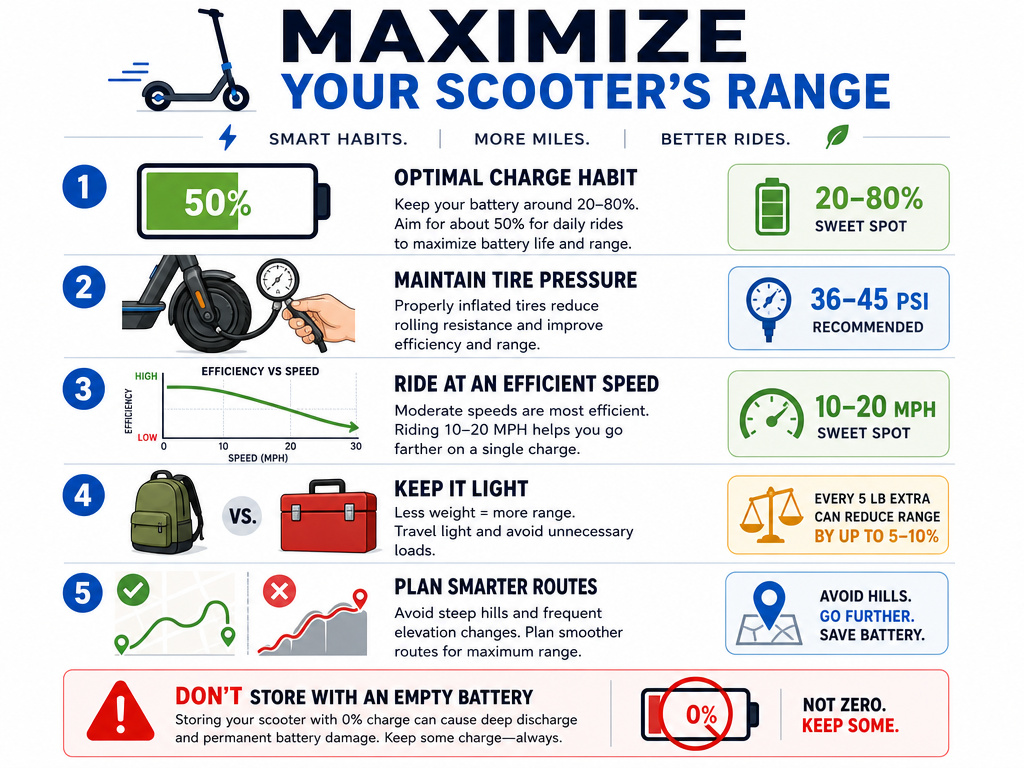
You can’t change your scooter’s battery capacity after purchase. But you can control everything that affects how efficiently that energy is used. These practices are the difference between consistently hitting your range target and getting stranded.
1. Charge Smart. Follow proper charging habits. Don’t routinely drain the battery to 0%. Lithium-ion batteries prefer shallow discharge cycles. Plug in when you hit 20-30% and charge to about 90% for daily use. A full 100% charge is fine for a long trip, but don’t leave the scooter sitting at 100% for days. 2. Maintain Tire Pressure. Check pressure weekly. Tires lose air naturally. Riding on under-inflated tires creates more surface area contact with the road, dramatically increasing rolling resistance. Refer to the manual for the correct PSI (often 40-50 PSI). 3. Adopt a Smooth Riding Style. This is the single biggest user-controlled factor. Jackrabbit starts from every stoplight drain the battery. Anticipate stops and use gentle braking. Use the scooter’s Eco mode to train yourself to be efficient. 4. Reduce Weight. Clean out your under-deck storage. Are you carrying a heavy lock, tools, or other cargo you don’t need for this trip? Every pound matters. 5. Plan Your Route. Use an app to find the flattest, most direct path. Even a slight, consistent incline over a long distance has a major cumulative effect. Avoid rough roads that force constant speed adjustments.
Common mistake: Storing a scooter with a fully discharged battery over the winter. The battery can self-discharge below a safe voltage, causing permanent damage. For long-term storage, charge the battery to about 60% and check it every month.
Implementing these practical tips for increasing electric scooter range turns the manufacturer’s lab-grade promise into your daily reality. For a deep dive on preserving your investment, our guide on essential electric scooter battery maintenance covers the chemistry and long-term care in detail.
Frequently Asked Questions
What is a good range for an electric scooter?
Good minimum range is double your longest expected daily round trip. If your commute is 7 miles each way (14 miles total), look for a scooter with a real-world range of at least 20-25 miles. This buffer accounts for hills, wind, battery aging, and the occasional detour.
How can I calculate my expected range?
Use the manufacturer’s “typical range” as a baseline. Then apply corrections: subtract 1% for every pound you are over the test weight (165 lbs), subtract 10% for a hilly route, and subtract 20% if you plan to ride at top speed. For example: 25-mile baseline – 15% (for 30 extra lbs) – 10% (for hills) = ~19 miles expected.
Why does my new scooter’s range seem low?
Brand new lithium-ion batteries sometimes need a few full charge/discharge cycles to reach their rated capacity. Also, you are likely riding it harder and faster than the test rider did. Give it a few weeks of gentle break-in riding before judging its maximum range.
Does regenerative braking really add range?
Yes, but don’t expect a miracle. Regenerative braking systems recapture some kinetic energy during braking and feed it back to the battery. On a hilly route with frequent stops, it might add 5-10% to your total range. On a flat, open road with few stops, the effect is negligible.
How does rider weight affect speed and range?
Weight directly impacts acceleration and hill-climbing ability, forcing the motor to draw more power. This reduces both top speed and range. Exceeding the scooter’s maximum weight capacity stresses the motor, controller, and frame, leading to premature failure and voiding the warranty. Always respect the limit.
The Bottom Line
An electric scooter’s range isn’t a mystery. It’s a simple math problem with variables you can identify and manage. Start with the battery’s Watt-hour rating. Then be ruthlessly honest about your weight and your need for speed.
The Ninebot F35 gives you an honest 25-mile benchmark. The F3 Pro E offers more power and a larger tank for longer hauls. For true, car-replacing distance, you’re looking at the higher-tier models from brands like Dualtron or vehicle-class options like Ather.
Your job is to match the scooter’s physical capability to your actual journey. Buy for your worst-case commute, not your best-day fantasy. And remember, the best way to extend range is to treat the battery right—charge it properly, store it correctly, and ride it smoothly. The miles will follow.
