
How to Store an Electric Scooter in Winter: A 3-Step Guide
This post contains affiliate links. As an Amazon Associate, we earn from qualifying purchases.
Store your electric scooter for winter by charging the battery to 50-80%, finding a dry indoor spot with stable temperatures between 41°F and 86°F (5–30°C), and plugging it in for a top-up charge every 30 days. Freezing temperatures permanently damage lithium-ion cells, and letting the battery drain to zero kills it for good.
That 50-80% charge target isn’t a guess. It’s the voltage range where lithium-ion chemistry is most stable at rest, pulled straight from OEM service manuals like the one for the Niu N1S. Stray outside that band for four months, and you’re buying a new battery in spring.
What follows is the physical checklist: the three non-negotiable battery steps, the two storage locations that work (and the three that don’t), and the monthly ritual that replaces riding. By the end, you’ll know the difference between a scooter that hibernates and one that dies.
Key Takeaways
- Charge the battery to 50-80% before storage—a full 100% charge stresses the cells during months of inactivity, and 0% guarantees a dead battery.
- Store indoors in a climate-controlled space between 41°F and 86°F (5–30°C). Garages and sheds often fail this test due to humidity and temperature swings.
- Perform a monthly maintenance charge. Connect the charger, let it cycle to full, then unplug it. This counters the battery’s natural self-discharge rate.
- Clean and inspect the scooter thoroughly. Dirt holds moisture, and a cracked tire or loose bolt ignored in November is a bigger problem in April.
- Use a quality lock and cover even in storage. Theft doesn’t take a season off, and dust protection matters.
The 3-Step Battery Rule (Charge, Discharge, Disconnect)
Get the battery wrong and nothing else matters. A motor can sit. Tires can go flat. Electronics won’t care. The battery is the only component that actively degrades when you’re not looking, and winter storage accelerates every failure mode.
Before you start: Lithium-ion batteries can enter a fail-safe state if voltage drops too low, refusing any future charge. The Razor EcoSmart SUP manual states freezing temperatures cause permanent damage. Work in a dry area, use only the manufacturer’s charger, and never charge a battery that feels physically cold to the touch.
Step 1: The Final Ride & Charge
Take the scooter for one last 10-15 minute ride. This isn’t for fun. You’re warming the battery pack to room temperature and using up the last bit of charge from its previous cycle. A warm battery accepts a charge more efficiently than a cold one.
Now plug it in. Your target is a 50-80% state of charge. This is the critical spec most guides get wrong.
| Charge Level | Why It’s Wrong for Winter | The Spring Result |
|---|---|---|
| 100% (Full) | High voltage stresses the anode, accelerating passive capacity loss. | Reduced range, battery feels weaker after 3-4 months. |
| 0% (Empty) | Voltage can drop below the cell’s safe minimum, triggering a permanent protection circuit. | Battery is dead, will not accept a charge, requires replacement. |
| 50-80% | Optimal voltage for long-term chemical stability. Minimizes degradation. | Battery wakes up near its pre-storage capacity. |
How do you hit 50-80%? If your scooter has a percentage display, charge until it reads about 70% and unplug. If it only has indicator lights, charge for roughly half the normal total charging time. For a Segway Ninebot ZING that takes 3 hours, charge for about 90 minutes.
Step 2: The Graceful Discharge (It Happens By Itself)
Once charged, you do nothing. This is where the self-discharge rate takes over. A healthy lithium-ion battery loses about 2-3% of its charge per month just sitting on a shelf. This natural drift is fine; it’s why we don’t store at 100%. The problem is when this slow drain meets extreme cold.
The SoFlow SO3 manual notes the self-discharge rate is faster in cold temperatures. A battery stored at 50% in a 70°F room might drop to 30% in four months. That same battery in a 40°F garage could hit 10%—dangerously close to the zero-volt threshold.
Step 3: The Monthly Maintenance Charge
This is the single most skipped step with the most expensive consequence. Every 30 days, plug in the charger.
- Connect the charger to the scooter and the wall.
- Let it charge until the indicator shows full (or for about 2-3 hours).
- Disconnect the charger completely from the wall.
You are not “topping it off.” You are resetting the clock on the self-discharge cycle, ensuring the voltage never has a chance to sag into the danger zone. The iScooter i9 MAX manual explicitly advises charging every other month to preserve the battery; monthly is safer for winter’s longer stretch. This routine is the core of any long-term electric scooter battery care.
Where to Stash It: The Good, The Bad, and The Damp
Location is a function of temperature and humidity. The ideal is a space you’d also feel comfortable storing a wooden musical instrument or a stack of important paper documents.
The Two Safe Zones
- A Climate-Controlled Basement or Storage Closet: This is the gold standard. Temperatures stay stable, humidity is low, and the environment is dark. The scooter is out of the way but accessible for your monthly check.
- A Heated Garage (with a caveat): Only if the garage is consistently above 41°F (5°C) and you have a dehumidifier running. Garages are thermal bridges—their temperature swings with the outside far more than the house interior.
The Three Failure Zones
Where this goes sideways: Storing a scooter in an unheated shed. Day-night temperature swings cause condensation inside the deck and battery compartment. The iScooter i9 MAX manual warns that in extremely humid environments, condensation can damage the battery rapidly. You’ll see corrosion on connectors by spring.
- Unheated Garages & Sheds: They freeze. They swing from 20°F to 50°F in a day. They trap humidity. All three violate the core storage rules.
- Outdoors Under a Tarp: This is a death sentence. Wind drives moisture under the tarp. UV radiation degrades plastics and tires even in winter. Temperature has no buffer.
- A Car Trunk: Extreme temperature swings, zero airflow, and potential for gasoline fumes or leaks. It’s a sealed box that bakes in the sun and freezes at night.
If your only option is a sketchy space, you must double down on moisture control. Place the scooter on a wooden pallet or rubber mat, not directly on concrete. Use a breathable fabric cover instead of plastic. Consider a rechargeable desiccant dehumidifier bag placed near the scooter. These steps mirror the diligence needed for preparing a vehicle for winter storage.
The Full Pre-Storage Inspection (Beyond the Battery)
A dirty scooter is a deteriorating scooter. Grit holds moisture against paint and metal. A loose bolt becomes a seized bolt. This 20-minute once-over saves hours of repair later.
- Clean It Thoroughly. Use a damp cloth with mild soap. Avoid high-pressure sprays or harsh solvents. Dry it completely, especially around the folding mechanism, brake calipers, and charge port.
- Check Tire Pressure. Inflate to the maximum PSI printed on the tire sidewall. This prevents flat spots from forming as the tires sit. Inspect for cracks or embedded debris.
- Tighten Every Bolt. Go over the handlebar clamp, stem, deck screws, and brake levers with the correct size Allen key or wrench. Don’t over-torque—just snug them up.
- Lubricate Moving Parts. Put a drop of light machine oil on the folding hinge and brake lever pivots. Wipe off any excess.
- Address Any Known Issues. If the brake was rubbing or a light was flickering, fix it now. Problems don’t age well.
This inspection is part of broader essential battery maintenance practices that keep the whole machine ready.
The Monthly 5-Minute Check-In Ritual
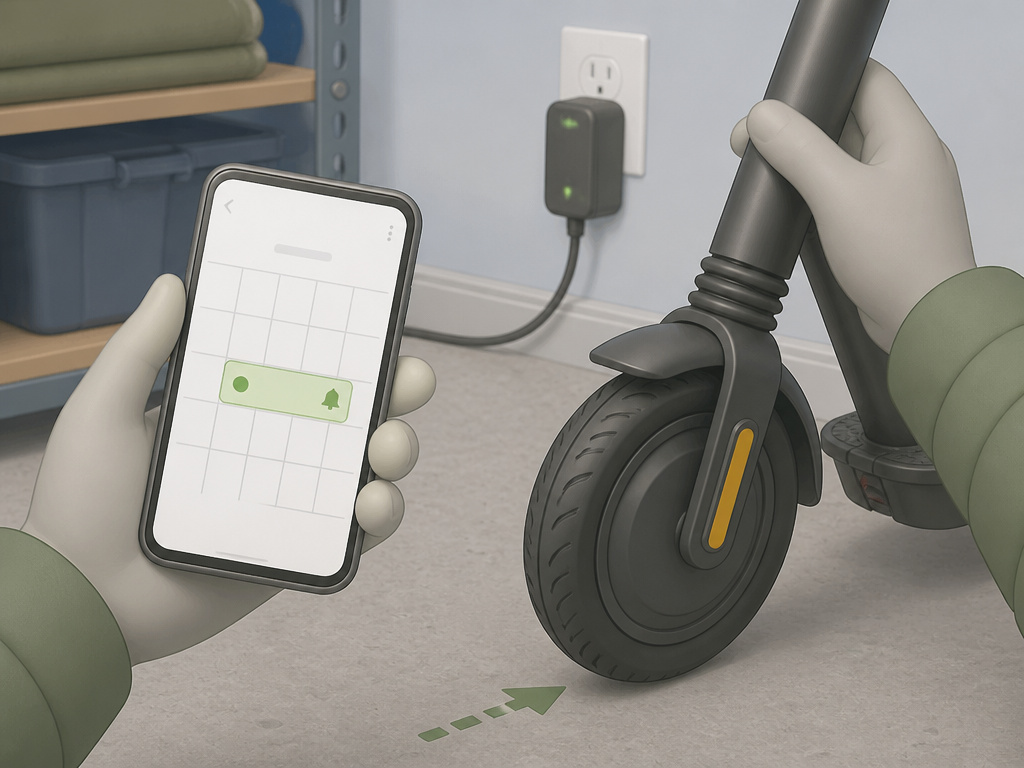
Set a calendar reminder. The first weekend of every month, do this:
- Visual Inspection: Look for any signs of pests, new dust buildup, or moisture.
- Performance Check: Press the power button. Does the display light up? A quick check confirms the battery isn’t dead. Power it off immediately after.
- The Charge Cycle: Plug in the charger, let it run its course, and unplug it.
- Roll It: Move the scooter forward and backward a foot or two. This shifts tire contact points and prevents permanent flat spots.
This ritual is what separates theoretical proper battery storage from actual, working preservation.
Waking It Up in Spring
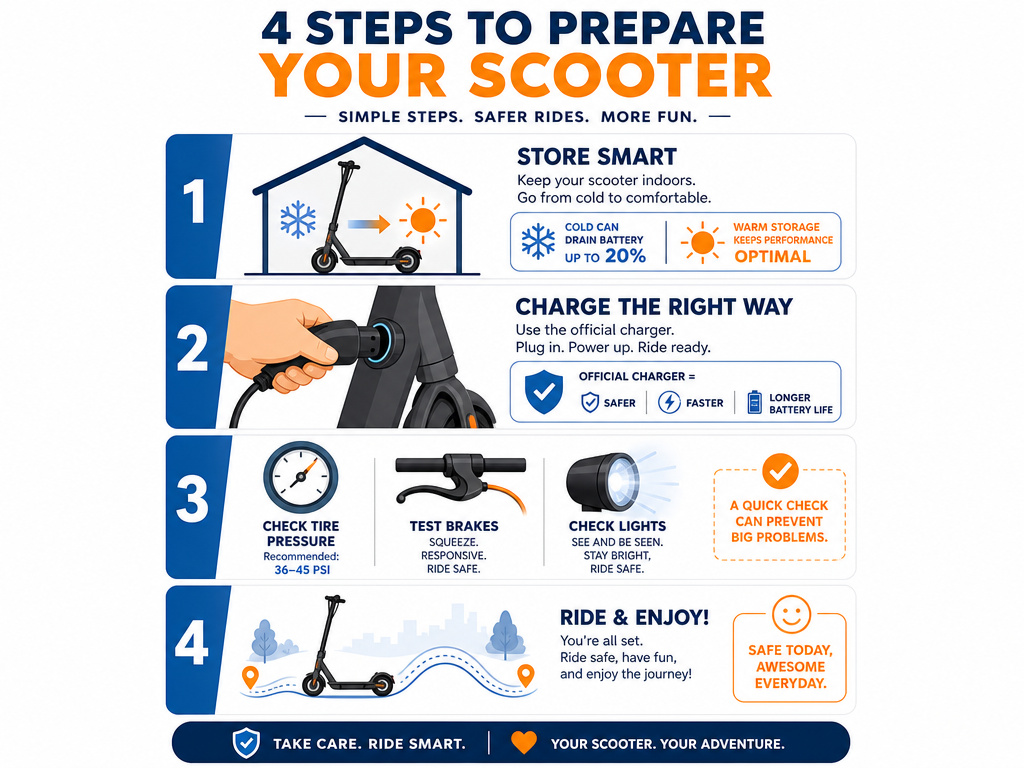
Don’t just hop on and ride. Reverse the storage process with care.
- Give It Time: If stored in a cool place, bring the scooter into a warm room for 24 hours to normalize all components.
- Full Charge: Give the battery a complete, uninterrupted charge with its official charger.
- Physical Re-check: Inspect tires for pressure loss. Test the brakes. Ensure all lights work.
- Test Ride: Take a short, cautious ride in a safe area. Listen for unusual noises and feel for brake responsiveness.
You’re recalibrating the battery management system and your own familiarity. This careful revival protects your investment and is the final step in understanding how long electric scooter batteries last.
Frequently Asked Questions
Can I store my electric scooter in a freezing garage?
No. The Razor EcoSmart SUP owner’s manual explicitly states freezing temperatures will permanently damage the battery. Chemical reactions inside the cells slow and can cause internal plating that ruins capacity. Even if the garage only dips below freezing some nights, the risk isn’t worth it.
Is it better to store the battery fully charged or empty?
Neither. Store it at a partial charge, between 50% and 80%. A full charge accelerates long-term chemical aging. An empty charge risks the voltage falling so low the battery’s protection circuit permanently disables it. The partial charge is the stable compromise.
How often should I charge my scooter during winter storage?
Plan for a monthly maintenance charge. Connect the charger, let it run until the battery is full (the light turns green), then disconnect it. This counters the natural self-discharge rate and keeps the battery voltage within its safe storage window.
Will the tires get flat spots from sitting all winter?
They can, especially if under-inflated. Before storage, inflate your tires to the maximum pressure listed on the sidewall. During your monthly check, roll the scooter forward a few feet to change the tire’s contact point. This is usually enough to prevent permanent flat-spotting on modern rubber.
Do I need to remove the battery for storage?
If your scooter has a removable battery, it’s often the best practice. You can store the battery indoors in a climate-controlled space (like a closet) and leave the scooter frame in a garage, simplifying temperature management. Always check your manual first, as some manufacturers specify storage procedures for detached batteries.
The Bottom Line
Winter storage isn’t about neglect; it’s about planned, minimal intervention. Charge to 70%, find a dry spot inside, and mark your calendar for a monthly plug-in. The scooter that gets this routine wakes up in April with nearly all its range intact. The one left in a damp shed with a dead battery becomes an expensive lesson in chemistry and condensation. Your future self, ready for that first warm-day ride, will thank you for doing it right.
