
How Long Do Electric Scooter Batteries Last? The Full Truth
This post contains affiliate links. As an Amazon Associate, we earn from qualifying purchases.
Electric scooter batteries last between 3 and 7 years with regular use. The exact number depends on three things: the battery’s rated charge cycles (often 500-1000), how you charge and store it, and the environmental conditions it faces. A battery stored at 100% charge in a hot garage loses up to 30% of its capacity per month, while one kept at 50% in a cool, dry place can deliver its full rated lifespan.
That gap between the best-case and worst-case scenario is where your decisions live. The manufacturer’s cycle rating is a lab test under perfect conditions. Your driveway, your charging habits, and your local winter are the real test.
What follows: the specific lifespan numbers from actual scooter manuals, the physical reasons temperature and charge level matter, and the step-by-step storage routine that adds years instead of months. We’ll also break down what a warranty actually tells you about expected battery life.
Key Takeaways
- Manufacturer warranties for batteries are often 12 months, while the scooter’s frame gets 2-3 years—this gap signals the battery is the primary consumable part.
- Store a scooter battery at a 50-70% charge in a cool, dry place. A full charge accelerates chemical degradation, and a near-empty charge risks the battery dipping below its safe voltage cutoff.
- Extreme cold (below -10°C / 14°F) can permanently destroy a cell if it freezes, while heat above 40°C (104°F) rapidly cooks off capacity. Never leave a scooter in a car trunk in summer.
- Using a non-original charger voids warranties and can overcharge or undercharge cells, creating imbalance that shortens overall pack life.
- The rated “cycle life” (e.g., 1000 cycles) means the number of full charge-discharges to about 80% of original capacity—not until the battery is dead.
What Determines Electric Scooter Battery Lifespan?
Battery lifespan isn’t a mystery. It’s a predictable outcome of chemistry and physics. Three core factors set the ceiling: the battery’s built-in cycle rating, your charging discipline, and the environment you force it to live in. Ignore one, and the other two can’t save it.
The cycle rating is your starting point. A lithium-ion battery in a quality scooter like a Joyor model is rated for about 1000 full charge cycles before it holds roughly 80% of its original capacity. That’s a manufacturer fact from their manual. Think of a cycle as using most of the battery’s charge and then refilling it. If you use half the battery one day and recharge, then use half the next day and recharge, that’s one full cycle.
Where this goes sideways: Assuming “1000 cycles” means 1000 charges from a wall plug. It doesn’t. A cycle is the cumulative use of 100% of the battery’s capacity. Partial charges add up to one cycle.
Your charging habits directly control the chemical stress inside each cell. Lithium-ion cells hate living at the voltage extremes. Keeping them constantly at 100% charge creates internal pressure that accelerates wear. Draining them to 0% strains the anode and can trip the battery management system’s (BMS) permanent low-voltage lockout. The sweet spot for daily use is between 20% and 80%.
The environment is the silent killer. Cold doesn’t just reduce temporary capacity; it increases internal resistance. If a cell is at a low charge state in sub-freezing temperatures, the electrolyte can actually freeze, physically destroying the cell. The SoFlow manual states this damage is irreparable. Heat is worse for long-term health. For every 10°C (18°F) above 25°C (77°F), the rate of chemical degradation roughly doubles. A scooter left in a sunny car is baking its own lifespan away.
| Factor | Ideal Condition | High-Risk Condition | Consequence Timeline |
|---|---|---|---|
| Charge Level (Storage) | 50% – 70% | 100% or <10% | Capacity loss of 20-30% per month at 100% charge & high heat. |
| Temperature (Storage) | 10°C – 25°C (50°F – 77°F) | Below -10°C (14°F) or Above 40°C (104°F) | Freezing can cause immediate, permanent cell death. Heat degrades capacity within weeks. |
| Charging Habit | Partial charges (20%-80%) | Frequent 0%-100% cycles | Reduces total cycle count by up to 25% over the battery’s life. |
Battery Lifespan by the Numbers: What the Manuals Actually Say
Forget vague estimates. OEM service manuals and warranty documents give us hard numbers. These aren’t marketing promises; they are the engineering specs that define the product’s expected life. Comparing them reveals the industry’s baseline.
The Joyor S5-Z/S10-S-Z manual is blunt: the average battery lifespan is 1000 cycles. It also specifies a 12-month or 2000km warranty for the battery, whichever comes first. This warranty period is a huge tell. The scooter’s other electrical parts (motor, controller, display) get a 24-month warranty. The battery’s shorter coverage period officially marks it as the primary wear item.
Segway’s warranty structure for the P100S model reinforces this. The battery assembly gets a 2-year warranty, but the built-in charger only gets 1 year. The frame? Three years. This hierarchy—frame longest, battery middle, electronics shortest—is the standard playbook. It reflects the actual failure rates and lifespans they expect.
Real-world data from fleet operators adds another layer. A 2022 analysis of Voi V4 shared scooters (a 2021 model) estimated a battery lifespan of 3.7 years, or about 5,389 km. That’s five times longer than the batteries used in early 2018 shared scooters, which often died within six months. This shows rapid improvement in battery durability, but also frames 3-4 years as a realistic benchmark for intensive, daily commercial use. Your personal, cared-for scooter should beat that.
These numbers set a realistic expectation. Aiming for 5+ years of useful life from a personal scooter battery is a solid goal if you follow proper battery care. Expecting a decade is pushing against chemistry itself.
What Kills an Electric Scooter Battery Fastest?
Some failures are slow drips. Others are sudden stops. Knowing the fast-acting killers lets you build simple habits that prevent them. The top three are voltage extremes, temperature shocks, and using the wrong hardware.
Letting the battery hit absolute zero is a death sentence. Most scooter battery management systems have a low-voltage cutoff around 3.0V per cell to prevent damage. If you store a scooter for months without charge, self-discharge can drag the voltage below this cutoff. The BMS then locks the battery out permanently to prevent a dangerous recharge attempt. As the Segway manual states, an “excessively discharged battery is irreparably damaged.” The fix is a new battery pack.
The part nobody mentions: A “dead” scooter that won’t turn on after winter storage isn’t always a dead battery. The BMS is in protection mode. A specialist with the right equipment can sometimes wake it, but you should never try to force-charge it. That risk is why the manual says “must be replaced.”
Temperature is a violent killer. The Kaabo Mantis manual notes that at around 0°F (-18°C), battery capacity reduces by 50%. That’s temporary. The permanent kill is freezing a cell. This requires a combination of very low temperature AND a low state of charge. The electrolyte liquid inside can freeze, expand, and rupture the internal structure. Once that happens, the cell will never hold a charge again and can become a short-circuit hazard.
Using a non-original or mismatched charger is playing with fire. It’s not just about voltage. Original chargers communicate with the scooter’s BMS to terminate the charge correctly. A cheap aftermarket charger might overcharge individual cells, leading to overheating and reduced lifespan, or undercharge them, creating imbalances. The Joyor manual is explicit: “Always use only the original Joyor charger.” Doing otherwise voids your warranty and introduces a real safety risk, which is a key part of charging properly.
How to Store Your Electric Scooter for Maximum Battery Life
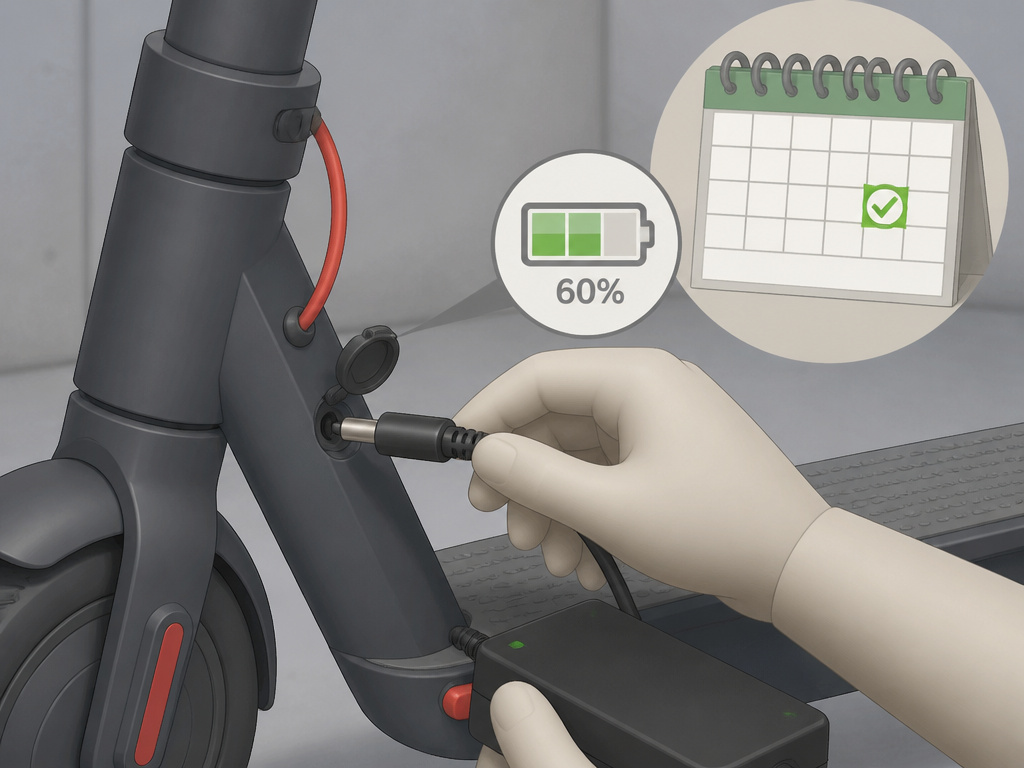
Storage is where good batteries go to die slowly. Or where they hibernate peacefully. The difference is a 15-minute routine. This isn’t just about putting it in the garage; it’s about preparing the battery for a long nap.
First, give the scooter a final ride or run the motor briefly. You want the battery to be warm and active, not cold and dormant from sitting. Then, plug in the original charger. Your target is a 50-70% state of charge. For most scooters, that’s about one to two hours on the charger from a low state. The Joyor manual recommends 70% for storage lasting months. The 50% figure is a common industry standard for long-term lithium-ion health. Both are safe. The critical rule is: NOT 100%, and NOT 0%.
Find the right place. A cool, dry basement is ideal. A detached, uninsulated shed that bakes in summer and freezes in winter is the worst possible choice. The Segway ZING C series manual specifies a storage temperature range of -10°C to 40°C (14°F to 104°F). That’s the absolute survival range, not the ideal range. Aim for the middle.
Set a calendar reminder. Every 8 to 12 weeks, you need to wake the battery. Plug in the charger, bring it back up to that 50-70% range, and let the scooter sit for a few minutes. This prevents self-discharge from creeping toward the danger zone. This simple winter storage ritual is the single most effective thing you can do to ensure your scooter starts up next season.
TL;DR: Charge to 50-70%, store indoors where it’s cool, check it every 2-3 months. That’s the whole game.
When to Replace Your Electric Scooter Battery
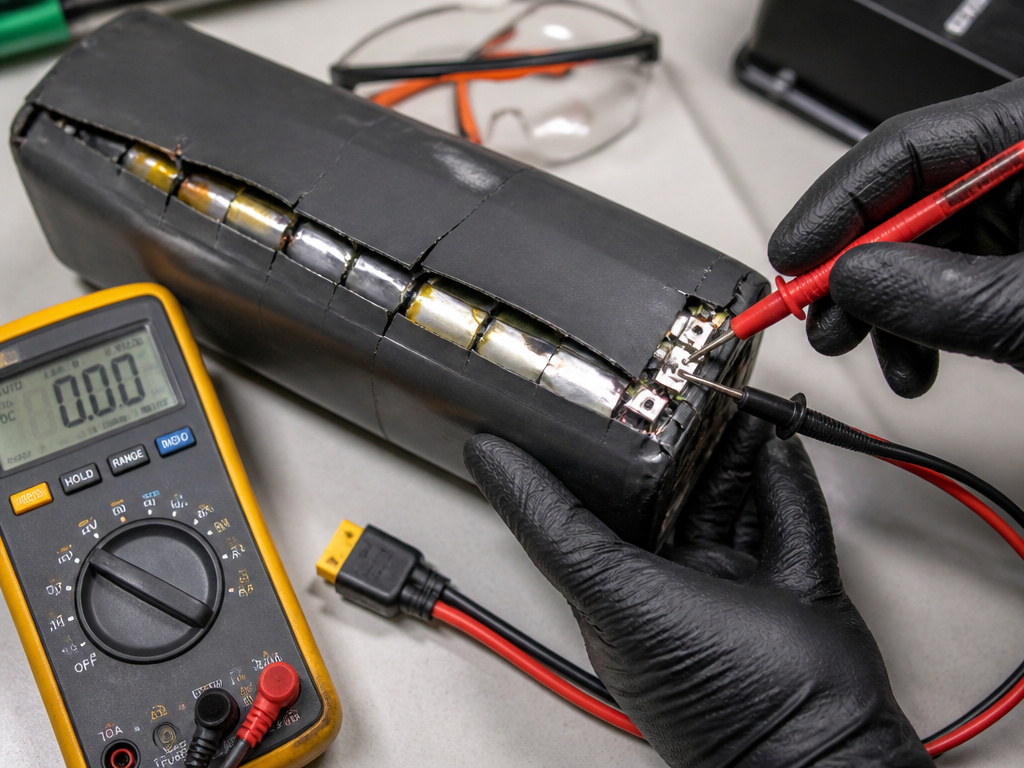
You don’t replace a battery when it’s dead. You replace it when it’s no longer useful. The signs are physical and measurable, not guesswork.
The most obvious sign is drastically reduced range. If your scooter used to get 25 miles on a charge and now struggles to hit 10, the battery is failing. This isn’t just a cold-weather dip; it’s a permanent loss of capacity. You can confirm this with a simple test: fully charge the scooter, ride a consistent route at a moderate speed, and note the distance when the battery indicator hits one bar or the scooter enters a low-power mode.
The battery meter will become erratic. It might show full, then drop to half within minutes, or jump around as you ride. This indicates the cells are out of balance—some are holding charge, others are empty. The BMS can’t provide an accurate reading anymore.
Physical symptoms are the final warning. The battery case should never be swollen, cracked, or leaking. It should not feel excessively hot to the touch after a normal charge. A strange smell, especially a chemical or sweet odor, is an immediate red flag. Stop using it and store it safely away from flammable materials.
Before you start any battery replacement: Always disconnect the main battery cable from the scooter’s controller first. Wear safety glasses and gloves. Lithium-ion batteries store significant energy and can spark or vent if short-circuited. Refer to the Niu N1S scooter service manual or your model’s official guide for the specific disassembly sequence.
Replacement is your last resort. Before that, ensure your loss of range isn’t due to other issues like under-inflated tires, dragging brakes, or a failing controller. A basic electric scooter maintenance guide can help you rule those out.
Electric Scooter Battery Lifespan FAQs
How many years should an electric scooter battery last?
With proper care, expect 3 to 5 years of daily use. For lighter, seasonal use with perfect storage habits, 5 to 7 years is possible. Manufacturer warranties, often 12 months for the battery, reflect a much shorter minimum expectation.
Does frequent charging ruin the battery?
No. Frequent partial charging is actually better than frequent full charging. Lithium-ion batteries have no “memory effect.” It’s less stressful for the chemistry to top up from 40% to 80% than to regularly cycle from 0% to 100%.
Can I leave my scooter plugged in all the time?
No. This is called “float charging” and it’s terrible for battery health. Once the charger light turns green, unplug it. Continuous trickle charging keeps the cells at peak voltage, accelerating degradation. The SoFlow manual explicitly warns that permanent charger connection has negative effects.
What is the best percentage to store an electric scooter battery?
Store it at 50-70% charge. This is the stable, low-stress voltage point for lithium-ion chemistry. It provides enough buffer against self-discharge while minimizing the corrosive effects of holding a full charge.
Do expensive scooters have longer-lasting batteries?
Not necessarily. A more expensive scooter might have a larger capacity (more Watt-hours) or a higher-performance motor, but the fundamental lithium-ion cells are similar. The build quality of the battery pack, the sophistication of its Battery Management System (BMS), and the quality of the charger matter more than price alone. A well-built mid-range scooter often outlasts a cheaply built “high-performance” model.
The Bottom Line
An electric scooter battery is a consumable part, like tires or brake pads. Its lifespan is a contract between the manufacturer’s engineering and your daily habits. The manual’s 1000-cycle rating is the potential; your garage temperature and charging routine are the reality.
Focus on the three guards: keep it away from extreme heat and cold, never let it sit fully charged or fully dead, and use only the charger it came with. That’s it. Those rules add years.
When the range drops by half and the charge meter jumps around, it’s time to plan a replacement. Don’t wait for a total failure. A predictable decline is better than being stranded. Your scooter’s value and your riding enjoyment depend almost entirely on that battery pack. Treat it like the vital, fragile component it is.
