
Understanding Payload Capacity on a Truck: The Real Axle Limit
This post contains affiliate links. As an Amazon Associate, we earn from qualifying purchases.
Payload capacity on a truck is the maximum weight of everything you put inside it, passengers, cargo, and any aftermarket gear, without breaking something. It’s the difference between your truck’s Gross Vehicle Weight Rating (GVWR) and its empty curb weight, and the only place that matters is the yellow Tire Label sticker on your driver’s door jamb, not the brochure.
That number on the sticker is the truck’s maximum payload as it rolled off the assembly line. Everything you add after that, a toolbox, a bed liner, even dealer-installed running boards, eats directly into it. A 2025 Chevy Silverado 1500 Crew Cab might list 2,030 pounds, but load a family of four and a full tank of gas, and you’ve burned 700 pounds before you drop a single bag of mulch in the bed.
What follows: why the advertised number is a lie, how to do the two-minute math for your actual limit, and the three things that change your payload after you drive off the lot. By the end you’ll know exactly how much your specific truck can carry, not what the sales sheet promised.
Key Takeaways
- Your truck’s true payload is on the yellow Tire Label sticker inside the driver’s door jamb, not in marketing materials.
- Aftermarket equipment like toolboxes, bed liners, and even a full tank of gas permanently reduce your available payload.
- Gross Vehicle Weight Rating (GVWR) is the hard ceiling; exceeding it voids warranties and can cause immediate suspension or brake failure.
- Replacement tires with a higher load rating do not legally increase your truck’s GVWR or payload capacity.
- Passenger and cargo weight must be subtracted from your sticker payload to find what’s left for hauling.
Why Payload Capacity Isn’t Just a Number
The brochure says your truck can carry over two thousand pounds. The salesperson repeats it. It feels like a guarantee. Then you load it up for a camping trip and the rear sags, the steering feels vague, and the brakes need a country mile to stop. That’s the gap between advertised payload and actual, usable capacity.
Payload is the pure hauling number. It ignores what’s towing behind you. It’s the stress placed directly on the frame, axles, suspension, and tires. Go over it, and you’re asking components to operate beyond their engineered safety margin. The failure isn’t always dramatic; it’s often a slow grind. Springs fatigue over months. Axle seals weep. Brake rotors warp from the extra mass they can’t dissipate heat from.
Where this goes sideways: Assuming the payload on the window sticker is yours to use. By the time you account for a full tank of gas, a bed liner, and the family, a truck rated for 2,000 pounds might have only 1,200 left for cargo. Load it to the advertised limit and you’re already 800 pounds over your real GVWR.
The real number is a moving target, shrinking with every accessory bolted on. It’s the most abused spec on any truck because it’s the easiest to ignore until something bends, breaks, or simply stops working.
How to Find Your Truck’s Real Payload Capacity
Forget the sales brochure. The only payload figure that carries legal and engineering weight is printed on your vehicle’s compliance labels. Here is where to look and what the terms mean.
Step 1: Locate the Tire Label. Open the driver’s door. On the door’s edge or the B-pillar, you’ll find a yellow and white sticker. This is the Tire Label. It lists the tire sizes, cold inflation pressures, and, critically, the vehicle’s maximum payload. This is the weight the truck was certified to carry when it was built, with all factory options accounted for.
Step 2: Understand the Weight Ratings. The Tire Label will reference two key numbers: the Gross Vehicle Weight Rating (GVWR) and the Gross Axle Weight Rating (GAWR) for front and rear axles. The payload is the GVWR minus the truck’s actual curb weight. Some labels, especially on Ford and Ram trucks, print the “maximum payload” directly.
Step 3: Calculate Your Available Payload. The sticker payload is your starting point. Now subtract the weight of everything not included in that factory curb weight: – Weight of all passengers – Weight of cargo in the cab (coolers, tools, dog) – Weight of any aftermarket equipment (toolbox, tonneau cover, air suspension compressor) – Weight of a full tank of fuel (gas weighs about 6 lbs per gallon)
What’s left is what you can safely put in the bed.
This 50–60 word, third-person, pronoun-free blockquote defines the primary source for payload information. The Tire Label on the driver’s door jamb or B-pillar is the vehicle manufacturer’s stated maximum payload capacity. This figure accounts for the vehicle’s configuration as built and must be reduced by the weight of any added aftermarket equipment, passengers, and cargo to determine the actual available payload.
| Term | What It Means | Where to Find It |
|---|---|---|
| Payload Capacity | Max weight of occupants & cargo | Tire Label (door jamb) or owner’s manual |
| GVWR (Gross Vehicle Weight Rating) | Max allowable total weight of truck + everything in/on it | Tire Label & driver’s door sticker |
| Curb Weight | Weight of empty truck with all fluids & full fuel tank | Rarely on label; calculate via GVWR – Payload |
| GAWR (Gross Axle Weight Rating) | Max weight each axle can carry | Tire Label, often separate for front & rear |
If your truck doesn’t have a Tire Label, some vehicles exported outside the US/Canada don’t, the owner’s manual is your fallback. The math is the same.
Payload vs. Towing Capacity: The Critical Difference
These terms are not interchangeable. Confusing them is how you blow a transmission or snap a frame.
Payload is the weight inside or on the vehicle. This includes you, your passengers, the dog, the week’s groceries in the back seat, and every pound of gravel, mulch, or furniture in the bed. It all presses down through the suspension onto the axles and tires.
Towing capacity is the weight pulled behind the vehicle, supported by its own axles and tires. When you hook up a trailer, most of its weight is carried by its own wheels. The truck’s job is to overcome drag and provide braking force.
The link is the tongue weight. For a conventional trailer, 10–15% of its total weight presses down on the truck’s hitch. That tongue weight counts as payload. This is the trap.
You might have a half-ton truck with a 2,000-pound payload and a 10,000-pound towing capacity. Load a 9,000-pound travel trailer with a 1,350-pound tongue weight. You’ve only used 13.5% of your towing limit, but you’ve consumed 67.5% of your payload before you or a single passenger gets in. Add a family of four and you’re already overloaded.
This is why three-quarter-ton trucks and one-ton models exist. Their dramatically higher payload ratings, often 3,000 to 4,000 pounds more, are for handling that tongue weight, not just for putting more gravel in the bed.
The Three Things That Change Your Payload After Purchase
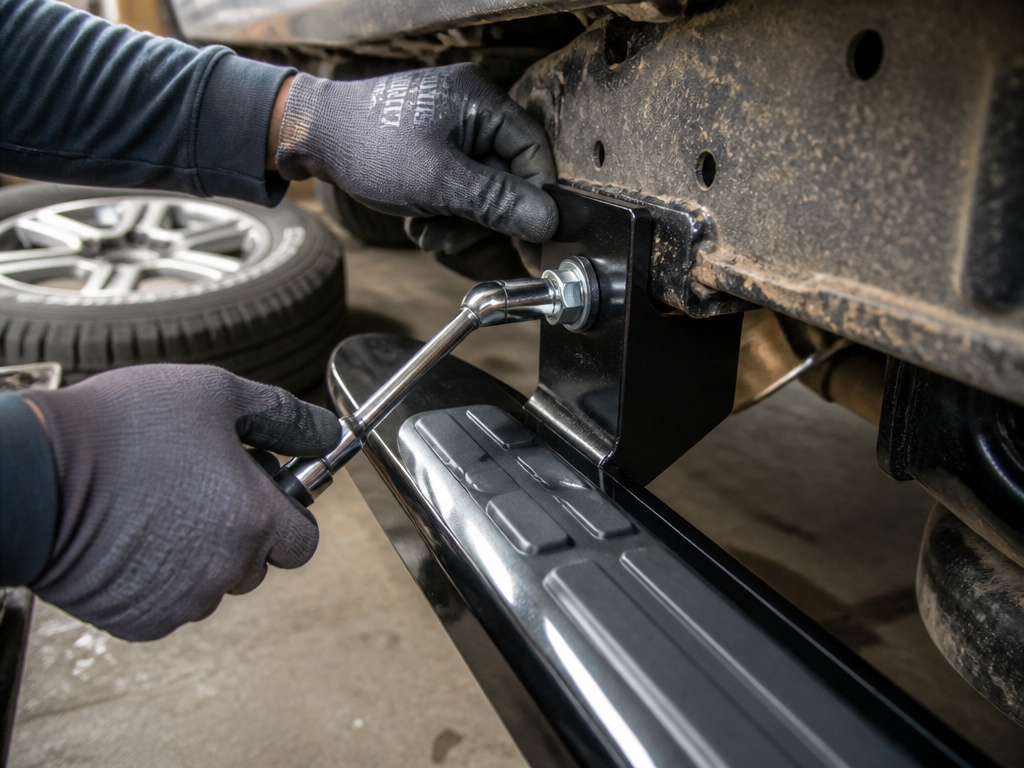
The number on the Tire Label is static. Your real-world payload is not. These are the factors that permanently reduce your truck’s hauling ability.
1. Aftermarket and Dealer-Installed Equipment. This is the biggest shrinker. The Ford Owner’s Manual states it explicitly: the weight of any aftermarket or dealer-installed equipment must be subtracted from the payload on the label. A 150-pound tool chest? Gone. A 60-pound bed liner? Gone. A set of heavy-duty running boards? Gone. These items become part of the new, heavier curb weight.
2. Replacement Tires. This is a critical, misunderstood rule. Installing replacement tires with a lower load-carrying capacity can reduce your vehicle’s GVWR and GAWR limits. However, installing tires with a higher load rating does not increase those limits. Your legal and engineered capacity is set by the factory sticker. A set of 10-ply tires with a higher load index gives you a safety margin on the tire itself, but it doesn’t magically make your axles, springs, or brakes stronger.
3. Wear Items and Degradation. This is the slow creep. Over hundreds of thousands of miles, springs sag, bushings wear, and frame metal can fatigue. The payload capacity doesn’t officially change, but the vehicle’s ability to handle that payload as safely as when new diminishes. This is why inspecting suspension components is part of proper truck loading.
Common mistake: Bolting on hundreds of pounds of gear and assuming the payload sticker still applies. That steel front bumper and winch you added didn’t just cost money; they cost you cargo capacity. You have to do the math again.
The takeaway is simple. The day you modify your truck, your available payload drops. If you don’t recalculate, you will overload it. It’s not a maybe.
What Happens When You Exceed Payload Capacity?
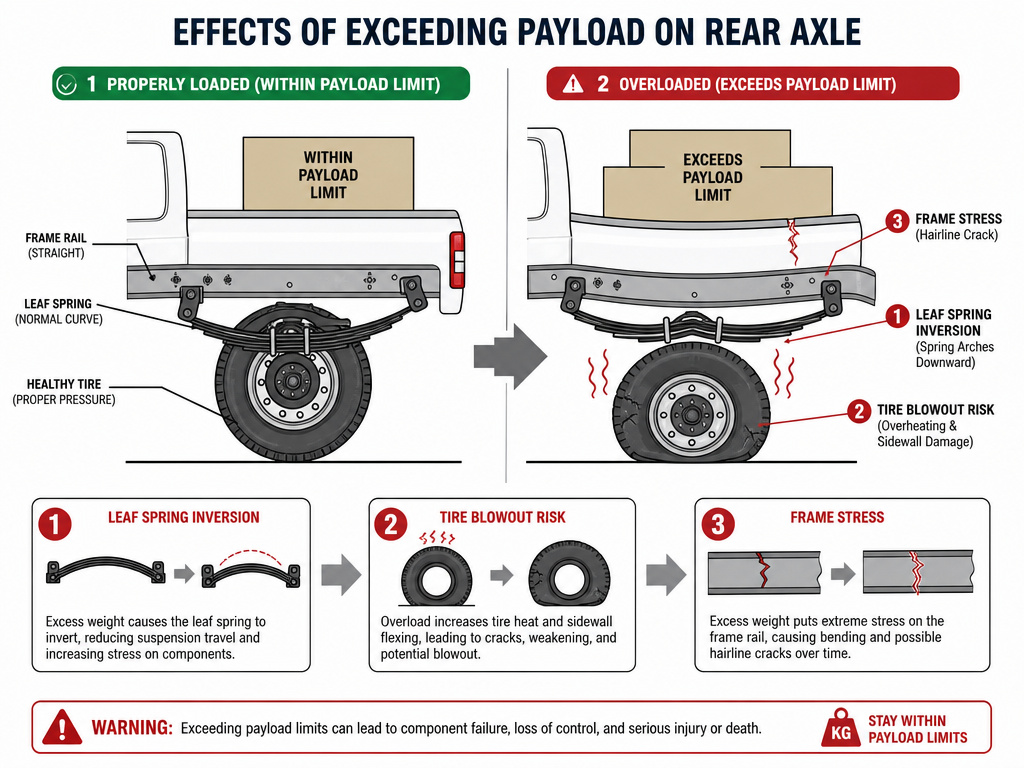
The consequences aren’t always a catastrophic breakdown on the highway. They are a cascade of failures, each with its own timeline and repair bill.
Immediate Risks (Within a single trip):
- Brake Failure: Stopping distance increases exponentially. The factory brakes are sized for the GVWR. Exceed it, and they overheat and fade. In an emergency stop, you simply won’t have the clamping force.
- Suspension Collapse: Overloaded leaf springs can invert or snap. Coil springs can buckle. The truck will bottom out on bumps, causing loss of control.
- Tire Blowout: Tires generate more heat under excessive load. A tire load range mismatch under this stress leads to sidewall blowouts, often at highway speed.
- Handling Mismatch: The steering becomes overly light, the rear suspension squats, and crosswinds can push the truck around dangerously.
Long-Term Damage (Over weeks or months):
- Frame Stress: Chronic overloading can cause frame cracking or twisting, especially near the rear axle and cab mounts. This is often not covered by warranty.
- Drivetrain Wear: The extra mass strains transmission mounts, universal joints, and differential gears, leading to premature failure.
- Suspension Wear: Bushings, shock absorbers, and ball joints wear out far faster under constant excessive load.
Your insurance company will investigate after an accident. If they find you were over the GVWR, your policy may be voided. The manufacturer’s warranty on related components is almost certainly void. The financial liability shifts squarely to you.
How to Properly Load a Truck Bed for Maximum Payload
How you distribute weight is as important as how much weight you carry. A poorly loaded bed makes an already strained truck dangerously unstable.
Rule 1: Heavy Items Over the Axle. The majority of the cargo weight should be positioned directly over or slightly forward of the rear axle. This keeps weight on the front steering axle for control and prevents a dangerous pendulum effect.
Rule 2: Secure Everything. Unsecured cargo shifts during braking or cornering. This sudden weight transfer can cause a rollover or simply rip through a flimsy truck bed cover. Use ratchet straps, cargo nets, or a bed-mounted cargo bar. The force in a 60-mph stop is immense.
Rule 3: Account for Added Weight. Are you using a truck bed extender or hauling with the tailgate down? These change the center of gravity and aerodynamics. Slow down. The same goes for a tall, bulky load that catches wind.
| Loading Mistake | Consequence | The Fix |
|---|---|---|
| Weight all the way at the tailgate | Extreme rear squat, loss of steering control, headlights aimed at sky | Center weight within 2 feet of the cab |
| Weight piled high and unsecured | High center of gravity increases rollover risk, cargo shifts violently | Keep weight low, secure with multiple straps |
| One side loaded heavier than the other | Uneven tire wear, constant steering pull, uneven brake wear | Balance side-to-side weight as evenly as possible |
If you consistently haul loads near your limit, consider upgrades. Helper springs or truck air bags can help restore ride height and stability, but remember, they do not increase your GVWR. They merely help the suspension cope with the weight you’re legally allowed to carry.
Frequently Asked Questions
What is a good payload capacity for a truck?
“good” payload depends entirely on use. For a daily driver that occasionally hauls mulch or furniture, a half-ton truck with 1,500–2,000 pounds is ample. For towing heavy trailers or constant commercial work, you need a three-quarter-ton truck or one-ton with 3,000–4,000 pounds or more. The 2026 Ford Super Duty with the 6.8L Gas V8 offers up to 8,000 pounds of payload for the most extreme needs.
Can I increase my truck’s payload capacity?
No, you cannot legally increase the factory-assigned GVWR or payload capacity. Upgrading suspension, tires, or brakes improves capability and safety within that limit, but the number on your door sticker is a legal certification that does not change. Exceeding it is a violation of federal motor vehicle safety standards.
Does payload include the weight of the driver?
Yes. The driver’s weight, along with every passenger, must be counted against the payload. The factory curb weight includes only the vehicle with all fluids. People are cargo.
Where is payload capacity listed?
It is listed on the yellow Tire Label sticker located on the driver’s side door jamb or B-pillar. It may also be in your owner’s manual. Do not rely on generic model information online; options change the number dramatically.
Does a truck bed cap or topper reduce payload?
Yes, absolutely. A truck bed cap or camper shell adds significant weight, often 200 to 400 pounds, which permanently reduces your available payload. You must subtract its weight from the sticker value. This is a key consideration when deciding if truck cap toppers are worth it for your usage.
What is the difference between GVWR and payload capacity?
GVWR is the total maximum weight limit of the fully loaded truck. Payload capacity is the portion of that weight available for people and cargo, calculated as GVWR minus curb weight. Think of GVWR as the pie, and payload as the slice you get to fill.
The Bottom Line
Your truck’s payload capacity is a finite resource, not a suggestion. The real number is on the door jamb, and it shrinks with every modification. Ignoring it costs you in repairs, safety, and legal liability.
The process is simple: find your Tire Label, subtract the weight of your passengers and gear, and whatever’s left is your truth. Exceed it and you gamble with the truck’s structure. Respect it and the truck will last.
So look up your number tonight. Weigh your common cargo. Do the math. That thirty-second calculation is the difference between a truck that works for years and one that’s a burden.
