
How Much Can a Half Ton Truck Tow? The Real-World Capacity
This post contains affiliate links. As an Amazon Associate, we earn from qualifying purchases.
A half-ton truck can tow between 6,000 and 14,000 pounds, but the real limit is whichever number you hit first: payload capacity, Gross Combined Weight Rating (GCWR), or hitch class. The advertised max — like a Ford F-150’s 14,000 lbs — requires a specific, fully-loaded configuration most owners don’t have. Exceed any one of those three limits and you risk breaking things.
That payload ceiling is where most people get caught. You subtract the weight of passengers, fuel, gear, and the trailer tongue weight from your truck’s payload rating, which is often under 1,500 lbs. Hit zero there, and you’re overloaded even if the trailer is under the tow rating.
What follows: the three real numbers you must find, how to read your door sticker, the engine and package combos that make the difference, and why a heavy-duty hitch is not optional past 5,000 lbs.
Key Takeaways
- Your truck’s real towing limit is the smallest of three numbers: payload, GCWR, or hitch rating. Find all three before hooking up anything.
- Payload is the most common bottleneck. A family of four and a full tank of gas can consume 800 lbs before you even add trailer tongue weight.
- The SAE J2807 towing standard levels the playing field. A truck rated under this standard has been tested under real-world hill climbs and braking scenarios.
- A weight-distributing hitch system is mandatory for trailers over 5,000 lbs to maintain control and protect your truck’s frame.
- Always consult your specific truck’s door jamb sticker and owner’s manual. Online “max towing” charts are for a stripped base model you probably don’t own.
The Three Numbers That Actually Matter
Forget the big, bold number on the brochure. Your safe towing limit is governed by a trio of ratings, each acting as a circuit breaker. Overload one, and the system fails.
First is payload capacity. This is the maximum weight of everything you add to the truck: people, dogs, tools in the bed, the cooler, and the critical 10–15% of the trailer’s total weight that presses down on the hitch (tongue weight). This number is on a yellow or white sticker inside your driver’s door jamb. It’s not a suggestion.
Common mistake: Assuming your trailer’s 7,000-lb rating means you can tow 7,000 lbs. If your payload sticker says 1,440 lbs and you’ve already loaded 1,000 lbs of people and gear, you have only 440 lbs left for tongue weight. That means your actual trailer can only weigh about 4,400 lbs (440 lbs / 10%).
Second is the Gross Combined Weight Rating (GCWR). This is the absolute ceiling for the weight of your entire rig: truck, trailer, passengers, cargo, and fuel combined. It’s set by the manufacturer based on the strength of the frame, brakes, and powertrain. You’ll find this number in your owner’s manual, often in a complex towing chart. Exceeding it stresses every component.
Third is the hitch rating. There are two: the bumper and the frame. Factory bumper hitches are often limited to 5,000 lbs. A proper frame-mounted receiver hitch (Class III or IV) is needed for heavier loads. The hitch itself will have a stamped rating. Never exceed it.
| Rating Type | What It Limits | Where to Find It | What Happens If You Exceed It |
|---|---|---|---|
| Payload Capacity | Everything in the truck + tongue weight | Driver’s door jamb sticker | Rear suspension sags, steering goes light, brakes become less effective. |
| GCWR | Truck + trailer + everything combined | Owner’s manual towing charts | Overheats transmission, overheats brakes, fatigues frame, voids warranty. |
| Hitch Rating | Weight on the hitch receiver | Stamped on the hitch receiver | Hitch or frame can bend or crack; trailer detachment risk. |
| SAE J2807 Rating | Real-world towing performance | Manufacturer’s spec sheet (if compliant) | If not compliant, the truck may not handle the rated load safely on a steep grade. |
The SAE J2807 standard is the fourth, silent watchdog. It’s a set of rigorous tests for acceleration, braking, and hill climbing at specific temperatures. A truck’s rating that is SAE J2807 compliant has proven it can handle that load in the real world. Many older ratings are not compliant, which is why a 2010 truck rated for 9,500 lbs might struggle where a 2024 model rated for 9,000 lbs feels planted. Look for this phrase in the specs.
Match Your Engine & Package (The Configurator Game)
The advertised “max towing” is a marketing trophy earned by a specific, often undesirable, build. It usually requires the largest engine, the highest axle ratio, a specific cab and bed configuration, and a mandatory trailering package.
Take the Ford F-150. Its 14,000-lb claim requires the 3.5L EcoBoost V6, the Max Trailer Tow Package, a specific 3.55 axle ratio, and a regular cab with 2-wheel drive. Almost nobody buys that truck. A more common Crew Cab 4×4 with the 5.0L V8 and standard towing package might be limited to 11,000 lbs.
The Ram 1500 with the 3.0L Hurricane High-Output inline-six can tow up to 9,920 lbs in a top-trim Limited 4×4, but the same engine in a Tradesman trim with different gears will have a different number. The Chevrolet Silverado 1500 hits its peak of 13,300 lbs only with the 2.7L Turbo I4 in a specific RST trim with the Max Trailering Package and 20-inch wheels.
Where this goes sideways: Buying a truck based on the top-line towing number without checking the window sticker for the required packages. The truck on the lot likely doesn’t have the magic combination. You must verify the axle ratio, engine, and the presence of a trailering package (which usually includes a transmission cooler, upgraded radiator, and integrated brake controller).
Here’s how the major players shape up for 2026, based on the highest available factory configuration per manufacturer data:
| Truck Model | Max Towing Capacity | Key Configuration | Max Payload | Key Limiting Factor |
|---|---|---|---|---|
| Ford F-150 | 14,000 lbs | 3.5L EcoBoost, Max Trailer Tow Pkg, Regular Cab 2WD | ~2,238 lbs | Requires lightest cab configuration for max tow. |
| Ram 1500 | 12,750 lbs | 3.0L Hurricane I6 Twin-Turbo, 3.92 axle, specific trim | ~2,300 lbs | High-output engine demands premium fuel. |
| Chevrolet Silverado 1500 | 13,300 lbs | 2.7L Turbo I4, Max Trailering Pkg, RST trim | ~2,280 lbs | Achieved with a 4-cylinder engine, not the V8. |
| GMC Sierra 1500 | 13,200 lbs | 2.7L Turbo I4, Max Trailering Package | ~2,280 lbs | Same as Silverado, different badge. |
| Toyota Tundra | 12,000 lbs | 3.5L Twin-Turbo V6 i-FORCE MAX hybrid | ~1,940 lbs | Hybrid system adds weight, reducing payload. |
| Nissan Titan | 9,760 lbs | 5.6L Endurance V8 | ~1,690 lbs | Older platform, lower overall ratings. |
The takeaway: you cannot talk about towing without talking about payload. A Toyota Tundra might tow 12,000 lbs, but with less than 2,000 lbs of payload, a family and a heavy tongue weight will consume it instantly. Your real-world payload capacity is your starting point for any load calculation.
How to Calculate Your Real-World Limit
Grab a calculator and your truck’s door sticker. This takes five minutes and saves thousands in repairs.
- Find your payload. It’s on the door sticker as “The combined weight of occupants and cargo should never exceed XXXX lbs.” Write that number down. Example: 1,440 lbs.
- Weigh everything going in the truck. This includes all passengers, pets, the bed mat, the toolbox, and a full tank of gas. Estimate high. A family of four and a dog is about 650 lbs. Tools and gear: another 150 lbs. Total: 800 lbs.
- Subtract that from your payload. 1,440 lbs – 800 lbs = 640 lbs remaining.
- Apply the 10–15% rule. Your trailer’s tongue weight should be 10–15% of the total trailer weight. Your remaining payload (640 lbs) is your maximum allowable tongue weight.
- For a 10% tongue weight: 640 lbs / 0.10 = 6,400 lbs max trailer weight.
- For a 13% tongue weight: 640 lbs / 0.13 = 4,923 lbs max trailer weight.
You just found your true towing limit, and it’s likely half the brochure number. This is why understanding weight distribution is non-negotiable.
Now check the GCWR in your manual. Find the chart for your engine, cab, axle ratio, and drive type. If your truck’s curb weight (approx. On door sticker) plus your calculated trailer weight is less than the GCWR, you pass. If not, the GCWR is your new, lower limit.
Finally, check your hitch. If your calculated trailer weight is over 5,000 lbs, you need a weight-distributing hitch. It uses spring bars to spread the tongue weight across the truck’s front and rear axles, restoring stability and preventing the dreaded rear-end sag.
I learned the payload lesson with a load of landscaping stone. The payload sticker said 1,520 lbs. The stone weighed 1,700 lbs. I was only 180 lbs over and figured it’d be fine. The rear bumper was practically on the tires, the headlights pointed at the sky, and the brake pedal felt like a wet sponge. Never again. Now I weigh everything.
When You Need More Than a Half-Ton
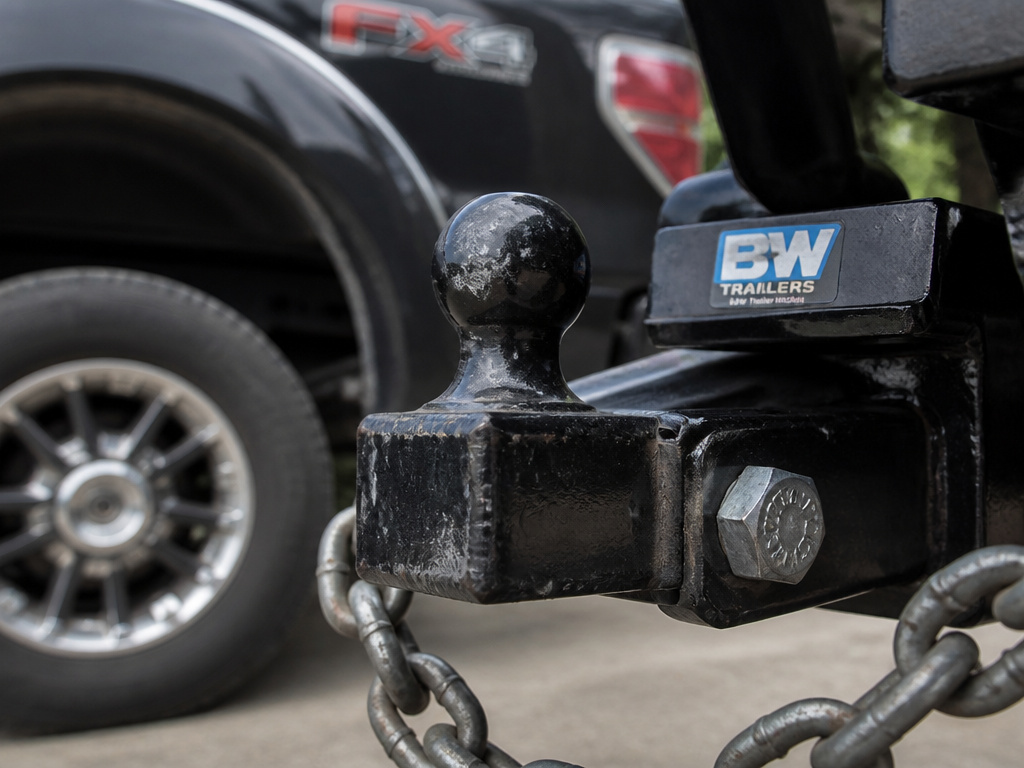
If your calculations point to a trailer over 10,000 lbs, or if your payload disappears with a simple family camping load, you’re looking at the next class up. This is the critical difference between half-ton and three-quarter-ton trucks.
A three-quarter-ton truck (Ford F-250, Ram 2500, Chevrolet Silverado 2500) has a stiffer frame, bigger brakes, a stronger transmission, and a higher Gross Vehicle Weight Rating (GVWR). This translates directly into more payload—often 3,000 lbs or more—and higher GCWRs. It’s the right tool for a large travel trailer or a mid-sized fifth-wheel trailer.
The trade-off is ride quality and cost. A 2500-series truck rides stiffer when unloaded and costs more to buy and fuel. But for towing heavy, it’s in its element where a half-ton is straining.
Essential Towing Gear & Safety
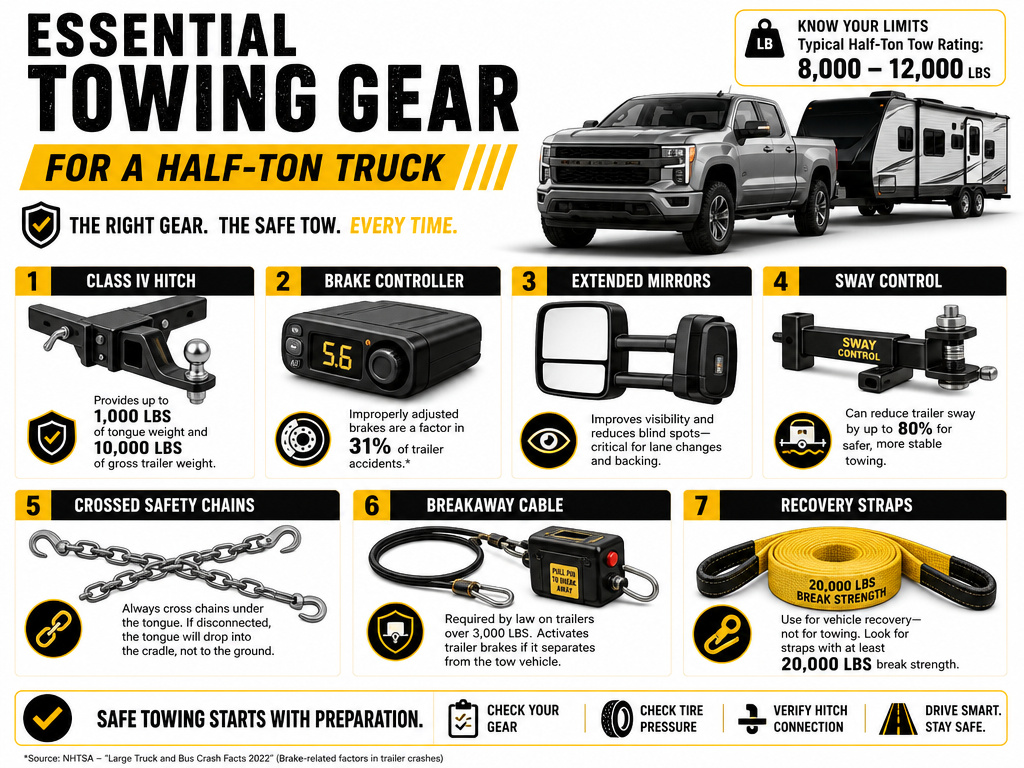
Your truck’s capacity is only as good as the gear connecting it to the load. This isn’t the place for bargain-bin hardware.
- Hitch: Use a frame-mounted Class IV receiver hitch for anything over 5,000 lbs. The hitch ball size must match the trailer coupler exactly.
- Brake Controller: Essential for trailers over 1,500 lbs that have their own brakes. An integrated, dash-mounted controller is best. It allows you to adjust trailer braking force on the fly.
- Mirrors: Extended towing mirrors are legally required if the trailer blocks your view of the rear. Many modern trucks have power-extending mirrors.
- Sway Control: Built into a good weight-distributing hitch system, or as a separate friction bar. It prevents the trailer from fishtailing in crosswinds or when passed by semis.
- Safety Chains: Always cross them under the tongue. They form a cradle to catch the trailer if the hitch fails.
- Breakaway Kit: A legal requirement for trailers with brakes. It applies the trailer brakes if it becomes detached.
- Recovery Gear: Keep a set of heavy-duty tow straps or recovery ropes on hand. You never know when you’ll need to pull someone out of a soft shoulder—or get pulled out yourself.
Before any long trip, do a full tug test. With the trailer hitched and all connections made, pull forward slowly in a straight line, then brake firmly. Listen and feel for any clunks or excessive slack. Check all lights. This two-minute ritual catches 90% of connection problems.
Frequently Asked Questions
What does “half-ton” even mean anymore?
It’s a historic classification that no longer reflects capacity. It originated from the payload capacity of early 20th-century pickups, which was about 1,000 pounds. Today, a “half-ton” truck like a Ford F-150 can have a payload capacity over 2,000 lbs. The term now simply denotes the lightest duty full-size pickup segment (1500, F-150, 1500-series).
Is it bad to tow at the maximum rating all the time?
Yes. It accelerates wear on the truck transmission, brakes, suspension, and engine. Operating consistently near the limit leaves no margin for error in weight estimation or for unexpected road conditions. For frequent heavy towing, a truck rated well above your typical load is a smarter long-term investment.
Do I need a special license to tow with a half-ton truck?
In most US states and Canadian provinces, you do not need a special license as long as the Gross Combined Weight Rating (GCWR) is under 26,000 lbs, which covers all half-ton trucks. However, if your combined weight (truck + trailer) exceeds 26,000 lbs, a Commercial Driver’s License (CDL) may be required. Always check your local regulations.
Can I increase my truck’s towing capacity?
Not legitimately. Capacity is determined by the manufacturer based on the frame, brakes, cooling systems, and axles. While you can add aftermarket airbags to help with sag, or a larger transmission cooler, these do not change the legal ratings on your door sticker (GVWR, GCWR). Exceeding those ratings is illegal and voids your insurance and warranty.
How does a weight-distributing hitch help?
It physically redistributes the tongue weight. Instead of all the weight pressing down on the truck’s rear axle, spring bars lever a portion forward to the front axle and rearward to the trailer’s axles. This levels the truck, restores front-wheel steering traction, and makes the entire rig more stable. It is strongly recommended for trailers over 5,000 lbs.
The Bottom Line
The answer to “how much can a half-ton truck tow” is written on your door jamb and in your owner’s manual, not on a marketing sheet. The payload rating is the silent governor that most often stops the party. Do the math with your actual cargo before you buy a trailer or load up for a trip.
For most people towing a boat, a utility trailer, or a mid-sized camper, a properly equipped half-ton is more than enough. The moment you step into large travel trailers or heavy equipment, the move to a three-quarter-ton truck isn’t an upgrade—it’s the correct tool.
Find your three numbers, invest in the right hitch, and tow with confidence. The road is unforgiving of guesses.
