
Understanding GVWR on a Truck: The Critical Weight Rating
This post contains affiliate links. As an Amazon Associate, we earn from qualifying purchases.
GVWR, or Gross Vehicle Weight Rating, is the maximum allowable total weight of your truck, including the truck itself, all passengers, a full tank of fuel, and any cargo in the cab or bed. This rating is determined by the manufacturer and printed on a certification label, typically found inside the driver’s door jamb. Exceeding it is illegal, unsafe, and voids warranties.
That weight limit is a ceiling built from the weakest link in your truck’s design, the axles, brakes, frame, and tires. The number printed on that sticker is the final word, not the one you see on a dealership website.
What follows is a breakdown of where to find your specific GVWR, how it differs from payload and towing capacity, and the concrete consequences of crossing that line. By the end, you’ll be able to read your truck’s weight labels in ten seconds and know exactly how much you can legally and safely haul.
Key Takeaways
- Your truck’s true GVWR is only on the certification label inside the driver’s door jamb. Online spec sheets are often wrong.
- Payload is what you can add; it’s GVWR minus the truck’s curb weight. Add a tool box or plow, and your available payload drops immediately.
- Exceeding GVWR voids your warranty and most insurance coverage, turning a breakdown into an out-of-pocket disaster.
- Professional drivers treat GVWR as a ceiling they never touch, building in a 10–15% buffer below the limit for real-world loading errors.
- Swapping to tires with a lower load rating reduces your truck’s legal GVWR, even if you install a heavier-duty suspension.
Where Do You Find the GVWR on Your Truck?
Look at the door, not the brochure. The only GVWR that matters for your specific truck is stamped on the Safety Compliance Certification Label. This metal or paper sticker is permanently affixed to the driver’s side door jamb (the vertical pillar where the door latches) or on the door’s edge itself.
The GVWR and GAWR for your vehicle are on the certification label attached to the driver side (or front passenger side) door. Exceeding these ratings can cause an accident or damage to your vehicle. Kia Owner’s Manual
On a Ford, GM, or Ram truck, you’ll find it on the driver’s side B-pillar. The label lists the Gross Vehicle Weight Rating (GVWR) and the Gross Axle Weight Ratings (GAWR) for the front and rear axles. It also shows the vehicle identification number (VIN), tire sizes, and recommended tire pressures for that maximum weight.
Common mistake: Relying on a dealership advertisement or the manufacturer’s build-and-price tool for your GVWR. The same model truck can have different GVWR ratings depending on the cab configuration (regular, crew, extended), drivetrain (4×2 vs. 4×4), and factory-installed options like a snow plow prep package or heavy-duty service suspension. A half-ton truck might be rated for 7,000 lbs in one configuration and 7,600 lbs in another. The label doesn’t lie.
| Vehicle Brand | Label Location | What It’s Called |
|---|---|---|
| Ford, Lincoln | Driver’s side B-pillar or door edge | Tire Label / Safety Compliance Certification Label |
| GM (Chevy, GMC) | Driver’s side door jamb | Certification/Tire Label |
| Stellantis (Ram, Jeep) | Driver’s side door latch pillar | Tire and Loading Information Label |
| Toyota, Nissan | Driver’s side door jamb | Tire Information Label |
| Kia, Hyundai | Driver’s or front passenger side door sill | Certification Label |
If the label is missing, damaged, or looks tampered with on a used truck, walk away. Verifying the VIN matches the label rules out fraudulent label swaps, a red flag for a truck that’s been overloaded or wrecked.
GVWR vs. Payload vs. Curb Weight: The Math That Matters
GVWR is the total. To know how much you can actually carry, you need to understand its two components: curb weight and payload capacity. This is where most owners get tripped up.
Curb Weight is the weight of the truck as it sits ready to drive, with all standard equipment, a full tank of fuel, and all necessary fluids (oil, coolant). It does not include the driver, passengers, or any cargo. Payload Capacity is the maximum weight you can add to the truck. It’s the GVWR minus the curb weight. This number is your real budget for people, gear, tools, and anything else you throw in the cab or bed. A truck with a 7,000 lb GVWR and a 5,200 lb curb weight has a 1,800 lb payload capacity. That 1,800 lbs covers you, your passengers, the weekend camping gear, and the bags of mulch in the bed.
Where this goes sideways: Assuming your payload is fixed. If you install any aftermarket or authorized-dealer installed equipment on the vehicle, you must subtract the weight of the equipment from the payload listed on the Tire Label. Ford Owner Manual
That 200-pound tool box, 450-pound bed cap, or 800-pound snow plow frame mounts permanently to your truck. They become part of the curb weight, directly eating into your available payload. A truck that could carry 1,800 lbs from the factory might only have 1,000 lbs left for cargo after you bolt on your favorite accessories.
How to Calculate Your Real Payload
- Find your GVWR on the door jamb label.
- Find your truck’s actual curb weight. Don’t guess. The only accurate method is to drive it to a vehicle scale, fully fueled but empty of people and cargo. Note the weight.
- Subtract the scaled curb weight from the GVWR. The result is your real, current payload capacity.
- Subtract the weight of any cargo or passengers you plan to carry. If the number goes negative, you’re overloaded.
Why GVWR Isn’t Just a Number. It’s a Safety System
The GVWR is the legal and engineering culmination of your truck’s weakest designed components. Manufacturers determine it by calculating the Gross Axle Weight Rating (GAWR) for both the front and rear axles, based on the strength of the axles, brakes, suspension, and tires.The GVWR is essentially the sum of the GAWRs.
When you exceed the GVWR, you’re overloading one or more of these systems beyond its design limits. The consequences aren’t gradual; they’re catastrophic and often sudden.
Braking distance increases non-linearly. A 10% overload might cause a 20–25% increase in stopping distance because the brakes are engineered to dissipate a specific amount of kinetic energy. More weight means more heat, leading to brake fade and failure. Steering becomes vague and sluggish. The front suspension, designed for a specific GAWR, sags and alters the steering geometry. Response slows, and the truck feels unstable. Rollover risk spikes. A higher center of gravity from a loaded bed, combined with a softened suspension, makes the truck tippy. A sudden evasive maneuver can become a rollover. Tire failure is a matter of when, not if. Every tire has a load index stamped on its sidewall. Exceed the GVWR, and you exceed the tire’s maximum load capacity, leading to blowouts from excessive heat and flexing.
Before you start: Exceeding the GVWR voids the manufacturer’s warranty on drivetrain and suspension components, removes coverage in many commercial insurance policies, and creates personal liability in an accident. Repairs would not be covered by the vehicle warranty. GM Warranty Statement / Industry Standard
The legal exposure is severe. You can be fined, have your truck impounded, and be found negligent in an accident. Staying under the federal gross weight limit for highways doesn’t matter if you’re over your truck’s own GVWR. Both standards apply, and the lower one is your legal limit.
The Pro’s Rule: The 10-15% GVWR Buffer
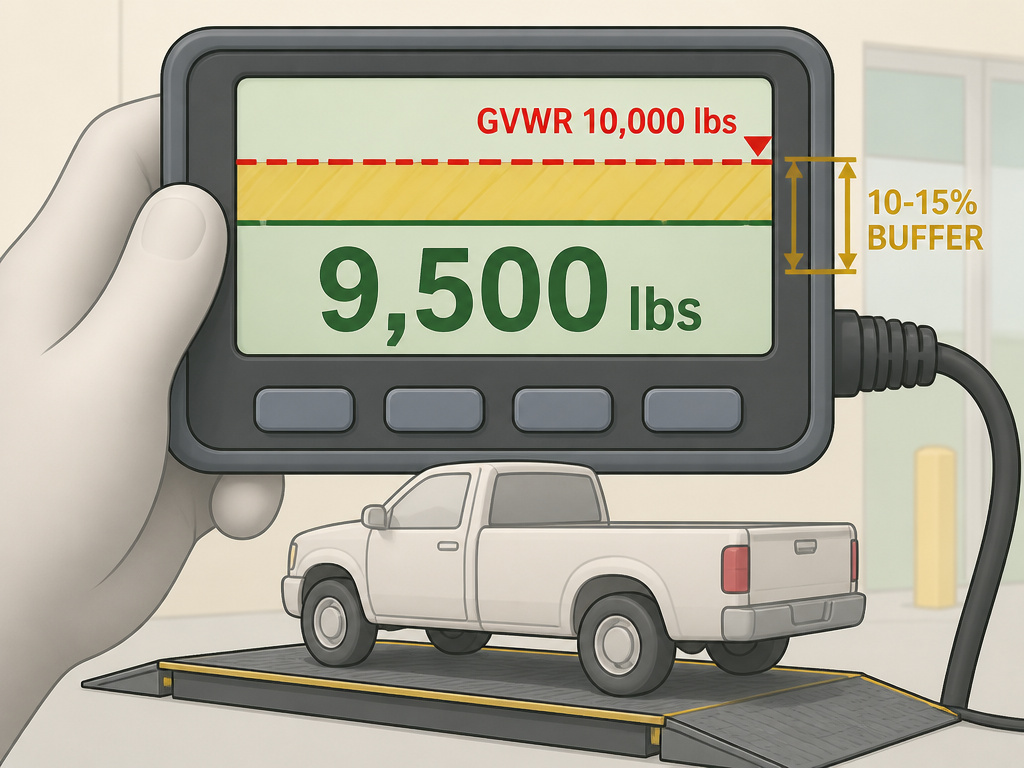
Experienced haulers, from landscapers to RV owners, treat the GVWR as a line they never even approach.
Treat GVWR as a ceiling you never touch, not a target you approach. Build in a buffer of at least 10 to 15 percent below the rated limit to account for weight estimates that are always imprecise in real-world loading. Liberty CDJR Pro Tip
You think your load is 1,200 lbs. Maybe it’s 1,350. That passenger is 180 lbs, not 160. The toolbox has accumulated 50 lbs of random junk. The buffer accounts for this inevitable “weight creep.” It also preserves a margin of safety for the dynamic forces of driving, braking, cornering, and bouncing over potholes, which temporarily increase the load on components far beyond the static number on the scale.
TL;DR: Weigh your loaded truck. If you’re within 200 lbs of your GVWR on a half-ton, you’re already overloaded in the eyes of physics and any pro who depends on their rig.
GVWR, GCWR, and Towing: Untangling the Limits
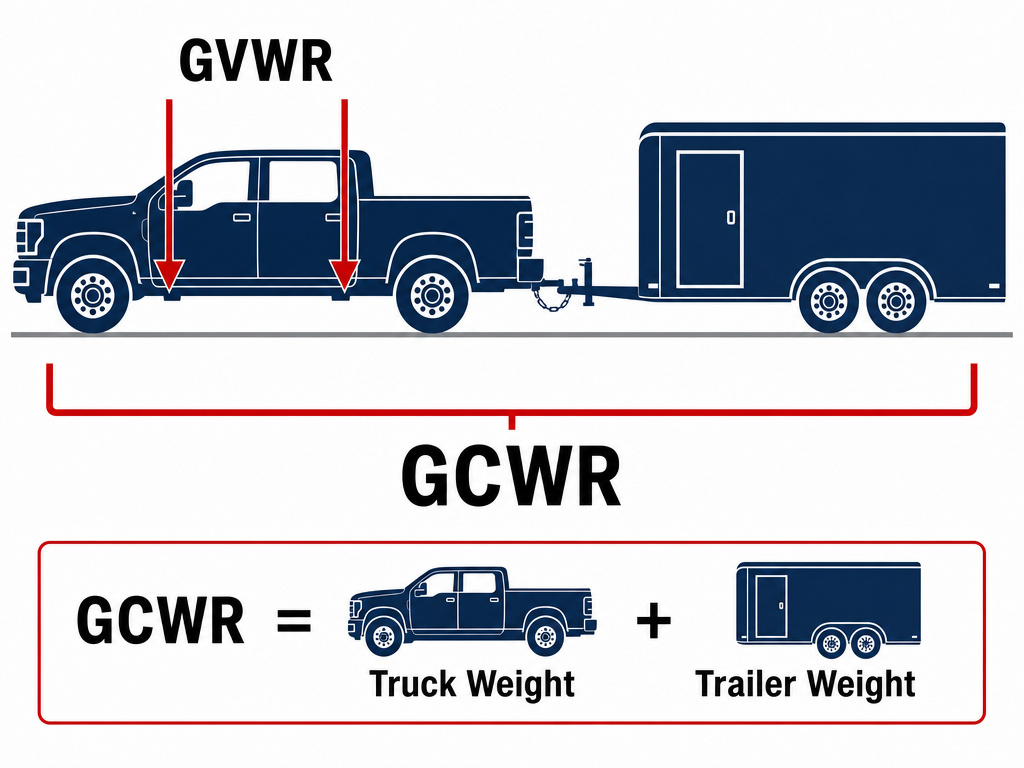
GVWR governs the weight on the truck’s tires. When you hitch a trailer, a new rating takes precedence: the Gross Combination Weight Rating (GCWR). This is the absolute maximum allowed weight of the truck and trailer combined.
Your truck’s towing capacity is a separate calculation, often limited by the engine, transmission, and cooling systems. However, you can hit your GCWR long before you reach the advertised towing capacity.
For example, a 2026 Ford Super Duty might have a towing capacity of 15,000 lbs. But if the truck itself has a GVWR of 10,000 lbs and you load it with 2,000 lbs of people and gear, the truck now weighs 12,000 lbs. If the GCWR is 25,000 lbs, you can only tow a 13,000 lb trailer (25,000 – 12,000 = 13,000), even though the truck is “rated” for 15,000 lbs.
Always check your specific truck’s towing guide for its GCWR. The math is non-negotiable.
FAQ: GVWR on a Truck
Can I increase my truck’s GVWR?
No. The GVWR is a federal certification issued by the manufacturer based on the truck’s design as built. Installing heavier-duty aftermarket axles, suspension, or brakes does not legally increase the GVWR. It might make the truck more durable, but the number on the door sticker remains your legal limit. Conversely, using replacement tires with a lower load carrying capacity than the originals lowers your legal GVWR.
Is GVWR the same as towing capacity?
No. GVWR is the weight on the truck’s tires. Towing capacity is the weight the truck can pull behind it. They are related through the GCWR, but they are distinct ratings. You must comply with all three: GVWR, GCWR, and towing capacity.
My truck feels fine overloaded. Is GVWR just a legal technicality?
No. The “feels fine” sensation is deceptive and deadly. The systems are failing in ways you can’t feel until it’s too late: brake fluid overheating, metal fatigue in the frame, and tire cord integrity weakening. These are silent failures that culminate in a sudden, catastrophic event like a blown tire on a curve or brake fade on a descent.
Where can I weigh my truck?
Look for a local “CAT Scale“ at truck stops or a public landfill scale. Many moving companies and agricultural co-ops also have vehicle scales. The first weigh is often inexpensive or free. Drive on with your typical load, people, full fuel, cargo, trailer, to get your total weight. Subtract the GVWR. A positive number means you’re illegal.
Does a diesel engine change the GVWR?
Not directly. However, diesel engines are heavier than gasoline engines, which increases the truck’s curb weight. Since GVWR is fixed, a diesel truck will typically have a lower payload capacity than an otherwise identical gas model because more of the GVWR is used up by the heavier engine itself.
The Bottom Line
GVWR is the most important number on your truck you didn’t pick. It’s the hard stop engineered into your axles and stamped on your door. Find it, respect it, and build a buffer below it. Your warranty, your insurance, and your safety on the road depend on treating that sticker as law.
For most owners, the takeaway is simple: weigh what you carry, know your real payload after accessories, and never let the gross weight on the scale match the number on the door jamb. That margin is your escape route from a mechanical or legal disaster.
