
Half Ton vs Three Quarter Ton Truck Differences Explained
This post contains affiliate links. As an Amazon Associate, we earn from qualifying purchases.
The difference between a half-ton and a three-quarter-ton truck is the Gross Vehicle Weight Rating (GVWR) and payload capacity. Half-ton trucks (e.g., Ford F-150, Chevrolet Silverado 1500) typically handle a payload of 1,700–2,500 pounds with a GVWR under 8,500 pounds. Three-quarter-ton trucks (e.g., Ford F-250, Chevrolet Silverado 2500) are rated for 3,500–4,200+ pounds of payload and a GVWR between 8,500 and 14,000 pounds.
The GVWR is the hard limit, not the payload number on the sticker. A truck can have room left in the bed but still be over its GVWR when you add passengers, fuel, and a trailer’s tongue weight. That overload bends frames and voids warranties.
What follows: where the “ton” labels came from, the two numbers that actually matter now, and where each class of truck breaks. By the end you’ll be able to read any truck’s doorjamb sticker and know exactly what job it’s built for.
Key Takeaways
- The terms “half-ton” and “three-quarter-ton” are historical marketing labels that no longer reflect actual payload capacity.
- Your truck’s Gross Vehicle Weight Rating (GVWR) is the absolute maximum safe operating weight, including the truck itself, passengers, fuel, and cargo.
- Payload capacity is the GVWR minus the truck’s curb weight, it’s how much you can load into the bed and cab.
- A half-ton truck can be overloaded even if the bed isn’t full, because the GVWR includes everything riding on the chassis.
- For towing heavy trailers, a three-quarter-ton’s stiffer suspension and stronger frame matter more than the engine horsepower.
The Difference Stops Being Abstract With These Two Numbers
You can forget the tonnage labels right now. They are ghosts of 1940s marketing when a Ford F-1 was literally rated for 1,000 pounds in its bed. Today’s payload capacity for a half-ton truck can exceed 2,400 pounds. The real language is printed on the driver’s doorjamb: Gross Vehicle Weight Rating and payload.
The Gross Vehicle Weight Rating (GVWR) is the truck’s total weight limit set by the manufacturer. It covers the vehicle, all fluids, every passenger, and every pound in the bed or on the hitch. It is the ceiling. Exceed it, and you risk everything from premature brake wear to a cracked frame. Your insurance company will also notice if an overload is proven after an accident.
The GVWR includes the entire weight of your truck, the weight of all the passengers, plus the weight of all the cargo. If you are towing something, the GVWR would also include the tongue weight on your tow hitch. You’ll need to add all of those things together to make sure they don’t exceed the GVWR.
Payload capacity is the GVWR minus the truck’s curb weight. It’s the number that tells you how much stuff you can actually haul. If your GVWR is 7,000 pounds and the truck weighs 5,000 pounds empty, your payload is 2,000 pounds. That 2,000 pounds has to cover your toolbox, the deer you’re hauling out, your buddy in the passenger seat, and the 300-pound tongue weight of your boat trailer.
Common mistake: Confusing payload with towing capacity. Payload is weight on the truck (in the bed/on the hitch). Towing capacity is weight behind the truck. A heavy trailer with a light tongue load might be fine for towing but could still overload your payload.
Here’s how these two numbers typically stack up across modern models. The ranges are broad because a basic work truck and a loaded luxury trim of the same model can have very different curb weights.
| Truck Class | Example Models (2024) | Typical GVWR Range | Typical Payload Range |
|---|---|---|---|
| Half-Ton | Ford F-150, Chevrolet Silverado 1500, Ram 1500 | 6,000 – 7,400 lbs | 1,700 – 2,500 lbs |
| Three-Quarter-Ton | Ford F-250, Chevrolet Silverado 2500 HD, Ram 2500 | 8,500 – 11,400 lbs | 3,500 – 4,200+ lbs |
Where the “Half-Ton” Label Came From (And Why It’s Wrong)
In the late 1940s, a “half-ton” pickup was a bare-bones machine. The Ford F-1, Chevrolet 3100, and Dodge B-1 were simple, lightweight rigs designed to carry about 1,000 pounds, half a short ton, in their wooden-floored beds. That was the rating. The terms became marketing shorthand: half-ton, three-quarter-ton, one-ton.
By the 1960s, trucks were getting stronger. By the 1990s, the race for more power and capability meant these labels were pure fiction. A 2024 Ford F-150’s maximum payload is 2,445 pounds. That’s over a full ton. The label stuck because it’s an easy way for salespeople to segment the lineup: 1500, 2500, 3500.
The modern classification is really about Gross Vehicle Weight Rating (GVWR). Regulators like the National Highway Traffic Safety Administration (NHTSA) use GVWR to set safety and equipment standards. A truck with a GVWR under 8,500 pounds falls into a different regulatory bucket than one rated over 10,000 pounds. That’s why three-quarter-ton trucks often have stouter brakes and frames, they’re built to a higher legal threshold.
Payload vs. Towing: What Actually Strains the Truck?
This is where new truck owners get burned. You buy a half-ton with a 12,000-pound towing capacity. You hook up a 10,000-pound travel trailer. The truck pulls it, so you think you’re fine.
The strain isn’t just at the hitch. It’s on the axles, springs, and frame. Tongue weight, the downward force the trailer exerts on the hitch, comes straight out of your payload capacity. A typical travel trailer has a tongue weight of 10-15% of its total weight. A 10,000-pound trailer adds 1,000 to 1,500 pounds to your truck’s payload.
Now do the math. Your half-ton has a 1,800-pound payload. Subtract 1,200 pounds for tongue weight. You have 600 pounds left for you, your passenger, your dog, and the camping gear in the bed. It adds up fast, and you’re overloaded before you leave the driveway. This is the single most common overload scenario.
A three-quarter-ton truck solves this with a higher payload ceiling. Its frame, suspension, and rear axle are built to carry that tongue weight without squatting severely. The ride will be stiffer when empty, but it won’t be overwhelmed when loaded.
| Task | Half-Ton Suitability | Three-Quarter-Ton Suitability |
|---|---|---|
| Daily driving, light hauling (furniture, mulch) | Excellent. Comfortable ride, better fuel economy. | Acceptable but stiff. |
| Towing a boat (< 7,000 lbs) or small camper | Good, with proper payload calculation. | Overkill for most. |
| Towing a large travel trailer (8,000+ lbs) or equipment trailer | Risky. Likely to exceed payload. | Ideal. Built for the tongue weight. |
| Regular heavy bed loads (gravel, landscaping blocks) | Possible but may require multiple trips. | Confident, within rated capacity. |
The 4 Things That Change When You Step Up to a Three-Quarter-Ton
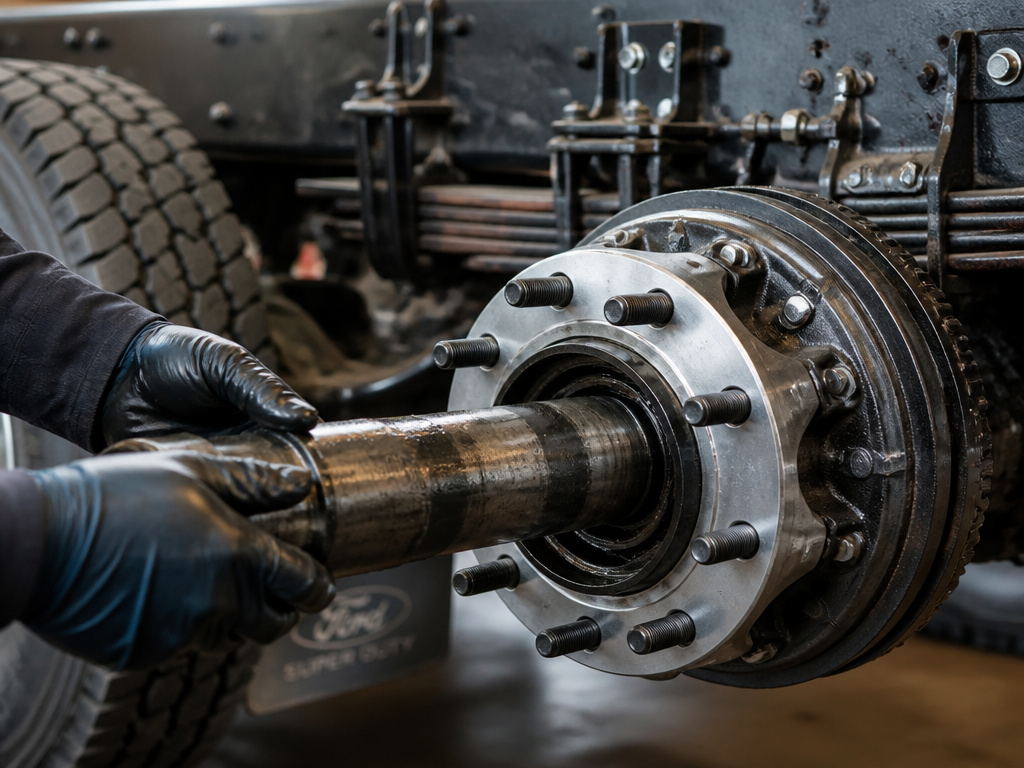
The jump from a half-ton to a three-quarter-ton isn’t just about bigger numbers. It’s a different machine built for different abuse.
- The Frame. A three-quarter-ton frame uses thicker, higher-strength steel. It’s designed to resist twisting under a heavy payload capacity and the leverage of a tall trailer. A half-ton frame is lighter and more flexible for a smoother ride.
- The Suspension. Leaf springs are common in the rear of three-quarter-ton trucks, often with thicker packs and more leaves. Some half-tons use coil springs or lighter leaf packs. The three-quarter-ton setup is built to hold weight, not to cradle passengers.
- The Axles & Hubs. The rear axle on a heavy-duty truck is a full-floating design. The wheel hub carries the vehicle’s weight independently of the axle shaft that delivers power. This is far stronger for towing and hauling than the semi-floating axles in most half-tons. The front hubs are also larger and more robust.
- The Cooling & Electrical. Larger radiators, transmission coolers, and sometimes even a secondary engine oil cooler are standard. The alternator is bigger to power trailer brakes and lights. The wiring harness for the trailer hitches is heavier gauge.
The downside? You feel all that strength when the truck is empty. The ride is jiggly and stiff. Parking lots feel narrower. Fuel economy drops, even with diesel. It’s a tool, not a luxury sedan.
Which One Should You Buy?
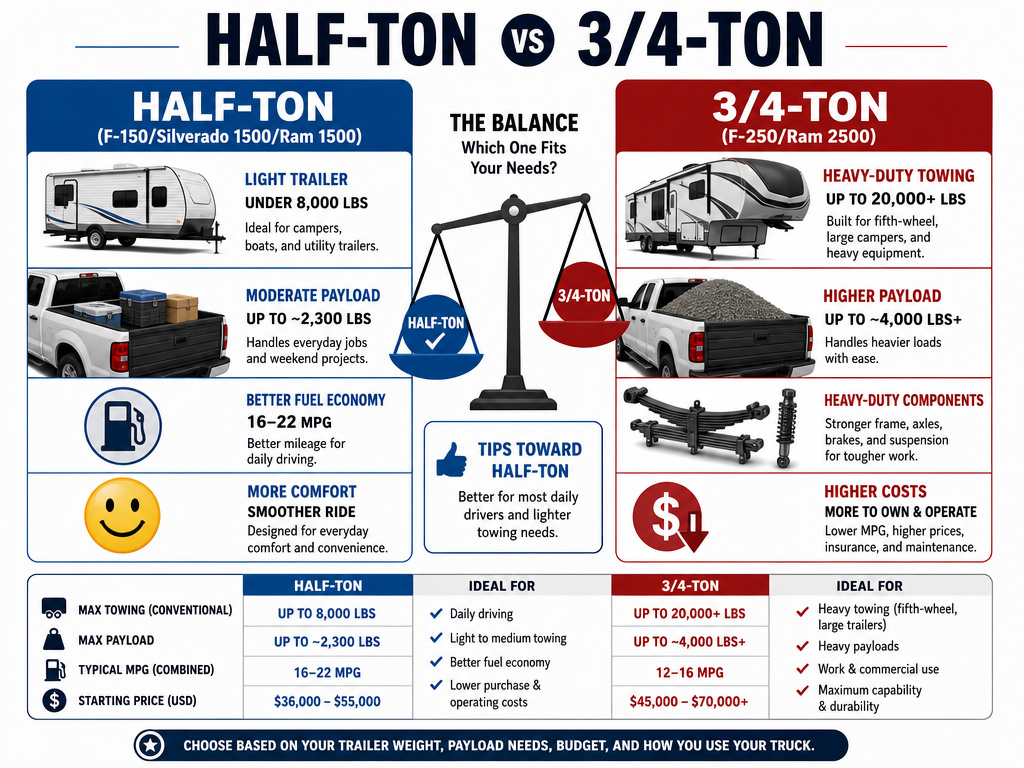
Don’t buy the label. Buy the numbers your job requires.
Stick with a half-ton if: You tow less than 8,000 pounds a few times a year. Your typical bed load is under 1,500 pounds. You commute in it daily and value ride comfort and fuel economy. The Ford F-150, Chevrolet Silverado 1500, and Ram 1500 dominate here for good reason. They are incredibly capable for 95% of personal and light commercial use.
Move up to a three-quarter-ton if:
- Your travel trailer’s Gross Vehicle Weight Rating (GVWR) is over 8,000 pounds.
- You regularly load the bed with over 2,000 pounds of material (gravel, sand, equipment).
- You tow a fifth-wheel trailer, the pin weight is enormous.
- You need the peace of mind that comes with the heavier-duty components, even if you occasionally push the limits.
The Ford F-250 Super Duty and Ram 2500 are the benchmarks here. They cost more upfront, burn more fuel, and ride rougher. They also don’t flinch when you ask them to work.
Skip this if: You’re just buying the bigger truck for prestige. The financial penalty, higher purchase price, worse fuel economy, more expensive tires for a 3/4-ton, and higher registration fees in some states, is real. A half-ton with the right options will do the job and leave money in your pocket.
Frequently Asked Questions
Is a three-quarter-ton truck considered a heavy-duty truck?
Yes. While definitions vary, trucks like the Ford F-250, Chevrolet Silverado 2500 HD, and Ram 2500 are classified as “heavy-duty” by their manufacturers. The Environmental Protection Agency (EPA) often categorizes them as Class 2B or Class 3 vehicles based on their GVWR, which distinguishes them from lighter Class 2A half-ton trucks.
Can I use a half-ton truck for towing a fifth-wheel trailer?
Rarely, and not safely with most modern fifth-wheels. The pin weight (the downward force where the trailer connects in the bed) is extreme, often 2,000 to 3,000 pounds. This consumes almost the entire payload capacity of a half-ton truck, leaving no margin for passengers or gear. A three-quarter-ton or one-ton truck is the standard for fifth-wheel towing.
Do I need a special driver’s license for a three-quarter-ton truck?
In most U.S. States, no. A standard Class C (regular) driver’s license is sufficient for any pickup truck used for personal purposes, regardless of its GVWR. Commercial use may require different licensing if the Gross Vehicle Weight Rating (GVWR) exceeds 26,000 pounds or is part of a combination over 26,000 pounds.
Why is the ride so much stiffer in a three-quarter-ton truck?
The suspension is built for load-bearing, not comfort. Heavier leaf springs, larger shock absorbers, and a stiffer frame are designed to control the mass of a heavy payload, not to soak up small road imperfections. An empty heavy-duty truck will always ride more roughly than an empty half-ton.
What happens if I exceed my truck’s payload capacity?
You risk immediate and long-term damage. The most obvious sign is the truck squatting severely in the rear. This misaligns headlights, strains the front suspension, and can cause unstable handling. Over time, you can fatigue or crack the frame, overload the brakes, and wear out suspension components prematurely. It also voids your warranty if the overload is determined to be the cause of a failure.
The Bottom Line
The half-ton vs. Three-quarter-ton decision starts with your scale, not the badge on the fender. Weigh your typical cargo. Know your trailer’s tongue or pin weight. Then look at the doorjamb sticker, not the brochure.
A half-ton is a brilliant all-rounder. A three-quarter-ton is a specialist. Buying the specialist for a generalist’s job wastes money and comfort. Buying the all-rounder for the specialist’s job breaks your truck and maybe your budget on the side of the road. Do the math once, buy the right tool, and then forget the old “ton” talk forever. It’s about the GVWR now.
