
Are Truck Cap Toppers Worth It? The Truth Most Owners Miss
This post contains affiliate links. As an Amazon Associate, we earn from qualifying purchases.
Truck cap toppers are worth it if you need lockable, weather-resistant storage and your vehicle’s payload can handle the cap’s weight plus your intended roof load. They are not worth it if you expect a waterproof, silent cabin or plan to mount a rooftop tent without verifying the specific cap’s dynamic load rating first.
That weight and load-capacity check is where owners get it wrong. The SnugTop manual states its factory Yakima racks carry 150 pounds, not 300. An overloaded rack voids the warranty, and a cap that reduces your truck’s payload to zero is a liability, not an asset.
What follows is a breakdown of the three specs that decide value: your truck’s factory payload, the cap’s verified roof-load rating, and the real-world gap between “weather resistant” and “dust-proof.” By the end, you’ll know whether your use case justifies the $3,000–$5,000 outlay or if a tonneau cover or soft topper is the smarter stopgap.
Key Takeaways
- Check your door sticker. Your truck’s factory payload rating minus the cap’s weight equals your remaining cargo capacity. Ignore this and you’re overloading the chassis from day one.
- Roof load ratings are specific, not generic. A “fiberglass cap” means nothing; you need the manufacturer’s stated dynamic (moving) and static (parked) load limits for the exact model with its specific crossbars.
- They are weather resistant, not waterproof. Truck beds have drain holes and gaps; a cap is a lid, not a seal. Plan for dust and moisture ingress on gravel roads.
- Modular aluminum caps (like Adrian Steel) offer a repair advantage. A damaged panel can be replaced individually, while a cracked fiberglass shell often requires a full, costly replacement.
- Security is a deterrent, not a guarantee. A locked glass door is far better than a soft top, but a determined thief with a pry bar will get in. Never treat a cap as a safe.
The One-Line Answer You Need First
A truck cap topper adds secure, dry storage at the cost of payload capacity, fuel economy, and a perfect seal. Its worth is determined by your truck’s remaining payload after the cap’s weight and your need for lockable, vertical space versus open-bed accessibility.
The calculus is mechanical, not emotional. Your truck has a Gross Vehicle Weight Rating (GVWR) stamped on the door jamb. Subtract the truck’s curb weight, the cap’s weight, and the weight of everything you plan to carry, including people and fuel. If the result is negative, the cap isn’t worth it; you’ve exceeded the design limits of the frame and brakes.
The $3,000–$5,000 Reality Check
A basic aluminum work cap starts around $800. A color-matched fiberglass shell from a brand like SnugTop or ARE runs $2,200 to $4,500. A modular overlanding system like an OVS Expedition or an Armacap steel topper lands between $3,000 and $5,500. Installation, wiring for a third brake light, and paint matching are extra.
You are not just buying a shell. You are buying into an ecosystem of load ratings, seal maintenance, and compatibility checks. The initial price is the entry fee.
| Cap Type | Best For | Real-World Limitation |
|---|---|---|
| Fiberglass Shell | Daily drivers, camping, clean look | Cracked shell = total replacement; roof load limits vary wildly |
| Aluminum Commercial | Contractors, work trucks, utility | Prone to denting; less insulation; often noisier |
| Modular Aluminum (Adrian Steel) | Fleets, tradespeople, overlanders | Higher initial cost; panel gaps can leak if damaged |
| Manganese Steel (Armacap) | Overlanding, roof-top tents | Heavy; often only in matte black; limited model availability |
Where the Value Gets Fuzzy
The resale argument is real but conditional. A well-kept, popular-color fiberglass cap for a common truck like a Toyota Tacoma or Ford F-150 can retain 60-70% of its value after five years. The catch? It must be undamaged, the seals must be intact, and the paint must still match. A faded, cracked shell sold “as-is” on a niche-model truck is a financial write-off.
Common mistake: Buying for a future rooftop tent without checking the dynamic rating. A fiberglass shell rated for 150 lbs dynamic load (like many factory Yakima setups) cannot safely carry a 150 lb tent plus 150 lb of occupants while moving. Exceeding this stresses the roof panel and voids warranties.
Security is another sliding scale. A hard cap with locking doors is a strong deterrent compared to a soft topper or tonneau cover. But the rear glass is tempered, not laminated. A sharp blow in the right spot gets a thief in. The value is in keeping tools and camping gear out of sight and secure against casual theft, not in serving as a bank vault.
The Two Tests Your Truck Must Pass
Before you even look at cap brochures, run these numbers. Most buyers skip this, and their new cap becomes an anchor.
Test 1: Payload Math. Find your truck’s payload capacity on the driver’s door sticker. A typical half-ton truck might have 1,500 lbs. A fiberglass cap weighs 200-250 lbs. Professional installation and a basic rack add another 50 lbs. That leaves 1,200 lbs for passengers, fuel, and every item in the bed and on the roof. Load it with two adults, a full tank, and 500 lbs of camping gear, and you’re at the limit before the rooftop tent.
Test 2: Roof Load Verification. This is not about the material; it’s about the manufacturer’s stamp. * SnugTop’s factory-installed Yakima racks: 150 lb dynamic load limit. * Westin EXP Modular Cap: 300 lb dynamic, 700 lb static. * Many generic fiberglass shells with no reinforced framing: 0 lb dynamic rating.
If the spec sheet says “roof rack ready” but lists no numbers, call the manufacturer. Assumptions here lead to roof cracks and denied insurance claims.
The Weather-Resistant Lie (And The $200 Fix)
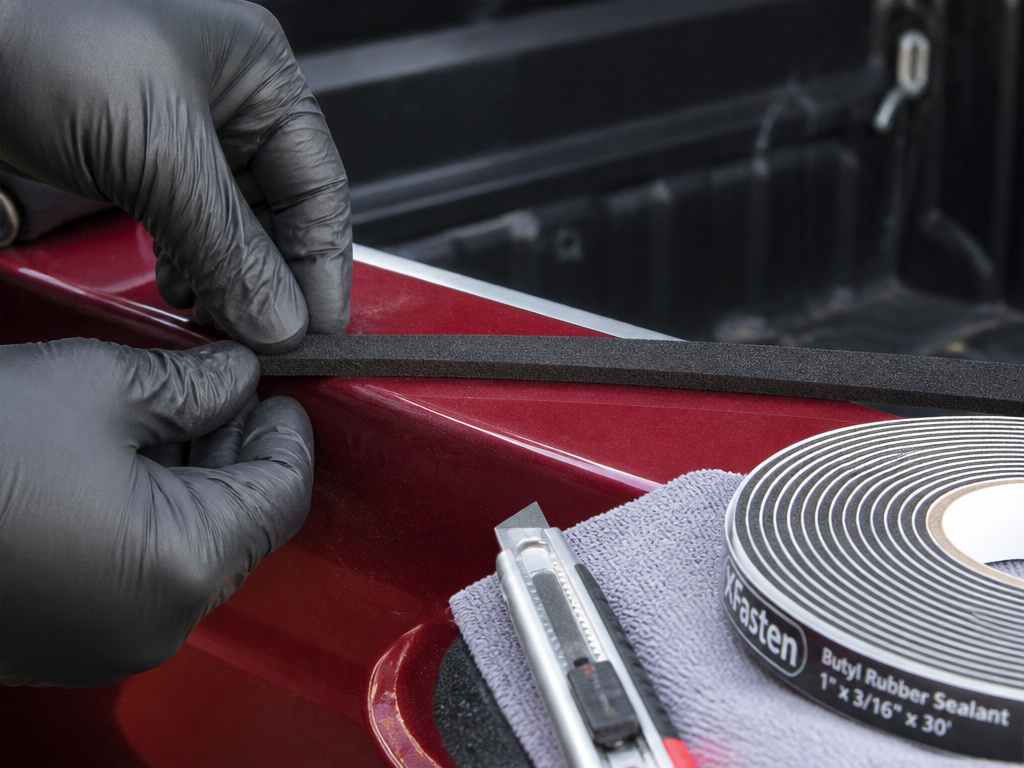
Owners of new caps are often shocked to find a fine layer of dust inside after a gravel road, or water pooling near the tailgate after a car wash. The SnugTop owner’s manual states it plainly: truck caps are “weather resistant but not weatherproof.”
The bed itself is the problem. Factory beds have holes for wiring, drain plugs, and open rail sections. The cap sits on top, creating a lid over a leaky box. At highway speeds, low pressure behind the cab literally sucks dust and moisture into these gaps.
Where this goes sideways: Sealing only the tailgate. Dust enters at four points: the bed rails, the tailgate corners, the tailgate bottom, and the bulkhead. A partial seal just redirects the leak.
The fix is a full bed-seal kit using closed-cell EPDM foam tape and butyl rubber. It’s a 3–5 hour job requiring you to remove the cap, clean the rails, and apply sealant precisely. The reward is a 90% reduction in dust and water ingress. The cost is about $200 in materials and a Saturday afternoon. Skip it, and your “weather-resistant” cap is an expensive dust collector.
Soft Topper vs. Hard Cap: The Security Trade-Off
Soft toppers cost less ($800–$1,500) and can be removed in minutes. They are great for seasonal use or when you need full bed access for tall items. But they fail the two big tests for a permanent solution.
- Security: A knife slices through canvas in seconds. There is no delay.
- Load Capacity: They offer zero structural roof support. You cannot mount a rooftop tent, and even a light rack risks tearing the fabric at speed.
The MPG myth cuts both ways. Some claim a hard cap improves aerodynamics. Others, like a reviewer from TregsTravels, reported a 4–5 mpg drop after switching from a tonneau to a soft topper due to fabric flutter and drag. The reality? Any cap changes airflow, but the net effect on your fuel economy is likely within 1-2 mpg, often lost to the added weight.
I won’t recommend a soft topper for anyone who leaves gear in the truck overnight. The convenience isn’t worth the anxiety at a trailhead or hotel parking lot. A used hard cap provides real security for similar money.
The Verdict: When a Truck Cap Topper Is Actually Worth It
Your truck cap topper is worth the investment if: 1. You need lockable, dry storage for tools or gear that currently fills your cab. 2. You camp in your truck bed and a shell provides the insulated, private space you need. 3. Your payload math works with at least 25% capacity remaining for cargo. 4. You’ve matched a verified roof-load rating to your intended rack load. 5. You accept the maintenance, washing and waxing the finish, lubricating locks, and checking mounting hardware twice a year.
It is not worth it if: 1. You need to haul tall, bulky items (like furniture) more than once a month. 2. You are buying it primarily to improve fuel economy. 3. You expect a perfectly silent, dust-free environment. 4. Your truck’s payload is already limited (e.g., a mid-size truck with a family of four). 5. You are on a tight budget and a tonneau cover would meet 80% of your needs.
For most owners who need secure storage, a mid-range fiberglass cap or a modular aluminum unit is the default pick. Brands like SnugTop set the standard for fit and finish, while Adrian Steel’s modular design is smarter for work trucks. Before you look at specific models, understand your truck’s limits. Then, explore our curated selection of Tacoma truck caps or pickup truck toppers built for payload.
Frequently Asked Questions
Do truck toppers actually keep water out?
They keep most rain out, but they are not waterproof. Truck beds have built-in drain holes and gaps. A cap significantly reduces water ingress, but driving in heavy rain or through deep puddles can force water past the seals. A proper bed-seal kit is recommended for anyone in wet climates or who drives on dusty roads.
Can you sleep in a truck with a topper?
Yes, many people use truck caps for camping. They provide a private, sheltered space. However, ventilation can be an issue, and insulation is minimal unless you add it yourself. For dedicated campers, truck toppers for camping with sliding windows and screen options are a better choice than basic work shells.
Do truck caps ruin your gas mileage?
The impact is usually minor, within 1-2 mpg. The added weight hurts mileage, while the aerodynamic shape can help. The net effect is often negligible. A soft topper, however, can cause more noticeable drag and mpg loss due to fabric flapping and a less rigid shape.
Are truck toppers easy to remove?
It depends on the weight and design. Lightweight aluminum caps can be removed by two people. Heavy fiberglass shells often require three or four people and careful lifting to avoid damage. Most owners who install a cap leave it on permanently due to the hassle of removal and storage.
Can I put a rooftop tent on any truck cap?
No. You must use a cap with a manufacturer-stated dynamic load rating that exceeds the weight of the tent plus the occupants. Many standard fiberglass shells are not reinforced for this load. Always check the specific model’s rating, like the Westin EXP’s 300 lb dynamic limit, before buying a tent.
How long do truck toppers last?
With proper care, regular washing, waxing, and hardware lubrication, a quality fiberglass or aluminum cap can last 15-20 years. The paint may fade, and seals will degrade, but the structure remains sound. Neglect leads to UV damage, seal failure, and latch corrosion within 5-7 years.
The Bottom Line
A truck cap topper is a tool, not a magic box. Its value is measured in dry, secure cubic feet of storage, not in promises. Run the payload math, demand the load ratings, and accept the “weather-resistant” reality. For the right owner, a tradesperson securing tools, a camper building a bed platform, an overlander needing a roof platform, it’s an indispensable investment. For someone who occasionally needs to cover a load, a retractable bed cover or a set of truck bed toolboxes might be the smarter, cheaper play. Know your needs, check your door sticker, and the answer becomes obvious.
