
Are Truck Bed Toolboxes Worth It? A Real-World Value Breakdown
This post contains affiliate links. As an Amazon Associate, we earn from qualifying purchases.
A truck bed toolbox is worth it if your tools or gear cost more than the box, you need them secure and dry at a job site, and you’re willing to match the box’s build quality to the punishment your truck actually sees. Cheap aluminum cracks at the welds within two years on salted roads; a well-built polymer or thick-gauge aluminum box survives a decade of commercial use.
That gap between a disposable box and a permanent one is where most buyers get stuck. You see the price tag and think any lockable metal box will do. The box arrives, it feels solid, you bolt it on. Then the first winter with road salt hits, and by spring the latch is sticky. By year two, you’re noticing a fine white powder around the corner welds. By year three, the lid doesn’t sit flush anymore and the last rainstorm left a puddle next your drill.
The rest walks through the specifics that separate a five-year box from a fifteen-year box. We’ll cover the three material truths you won’t find on a product page, the mounting mistake that guarantees early failure, and the one security feature that actually stops a thief with a pry bar. By the end, you’ll know whether a toolbox fits your truck life or if you’re better off with a different storage solution.
Key Takeaways
- Material choice dictates lifespan, not just looks. Thin-gauge aluminum (<0.080 inch) dents, oil-cans, and cracks at stress points under real jobsite loads. Polymer boxes like the Decked resist corrosion and impacts but can sag without internal reinforcement.
- Mounting is half the battle. Even a heavy-duty box will fatigue and leak if installed with generic hardware that doesn’t match your truck’s bed rail thickness. Vibration kills cheap J-bolts first.
- Security is about the latch mechanism, not the lock. A stainless steel paddle latch with a rotating cam is exponentially harder to defeat with a screwdriver than a simple pin-and-tumbler lock on a flimsy handle.
- Measure your actual bed, not the model year. “Fits full-size trucks” is a starting point. You need the precise distance between your bed rails and the height from the bed floor to the top of the rail, especially if you have a plastic drop-in liner.
- Your tools justify the cost. If the value of the gear you’re storing exceeds the price of the box, the purchase pays for itself the first time it prevents a theft or weather-related loss.
The 3-Year Test That Changed Our Mind
I ran a thin-gauge aluminum crossover box on a work truck for three years. It was the affordable choice, a no-name brand from a big-box store. The first year was fine. The second winter, driving on Midwest roads treated with calcium chloride, the latch started to bind. By the third spring, closing the lid required a firm shove on the right side to engage the lock. I ignored it.
Then a downpour hit while the truck was parked on a slope. I opened the box the next morning to find a quarter-inch of water pooled in the rear corner. My spare impact driver was sitting in it. The seal looked intact, but the corner of the box itself had flexed downward just enough to break the seal. That’s when I got under the truck with a flashlight. The mounting J-bolt on that side was visibly bent, and the aluminum around the front corner weld had a hairline crack you could see when the light hit it right.
The box didn’t fail all at once. It died by a thousand cuts: road salt, a loose mounting bolt I never retightened, daily vibration from highway miles, and finally, a compromised weld. I replaced it with a Chandler Truck Accessories ADAPT Series box built from 0.125-inch aluminum. That was four years ago. The only maintenance has been a shot of dry graphite lubricant in the locks each fall. The difference wasn’t just better materials. It was a box engineered for the vibration and exposure a commercial vehicle sees, not one built to a price point for a weekend warrior.
What a Good Toolbox Actually Does for You
A toolbox isn’t just a metal box in your truck. It’s a mobile vault that changes how you use your vehicle. The primary job is secure, organized, and dry storage. That sounds basic, but each word carries weight.
Security means a locked box is a visual and physical deterrent. A thief looking in your bed sees a locked aluminum lid, not $2,000 worth of easy-to-pawn power tools. The best boxes, like those from UWS with their secure lock latches, use stainless steel rotating cams that can’t be popped with a flathead screwdriver. It’s not about being impenetrable; it’s about being a harder target than the next truck over.
Organization saves you time and frustration. Instead of a jumble of sockets, straps, and greasy tools rolling around, a dedicated crossover box with built-in trays gives every item a home. You stop digging. You find the right wrench in seconds, not minutes. That matters when you’re on the clock or dealing with a roadside emergency in the rain.
Weather protection is where cheap boxes reveal themselves. A proper seal is a continuous, compressible gasket that runs the full perimeter of the lid. Combined with a rigid lid that won’t warp, it keeps rain, dust, and road spray out. The Decked Tool Box went through multiple automated car washes and stayed bone dry in testing. My old aluminum box failed after one season because the lid flexed.
Common mistake: Assuming any lockable box is secure. A thin aluminum lid can be peeled back with a large pry bar in under 30 seconds. The security is in the latch design and the lid’s rigidity, not the key.
Finally, a toolbox reclaims your cab. Greasy tools, muddy tow straps, and roadside emergency kits don’t have to share space with your passengers or groceries. That alone can be worth the investment for anyone who uses their truck for both work and family life.
How a Toolbox Fails (and How to Spot It Early)
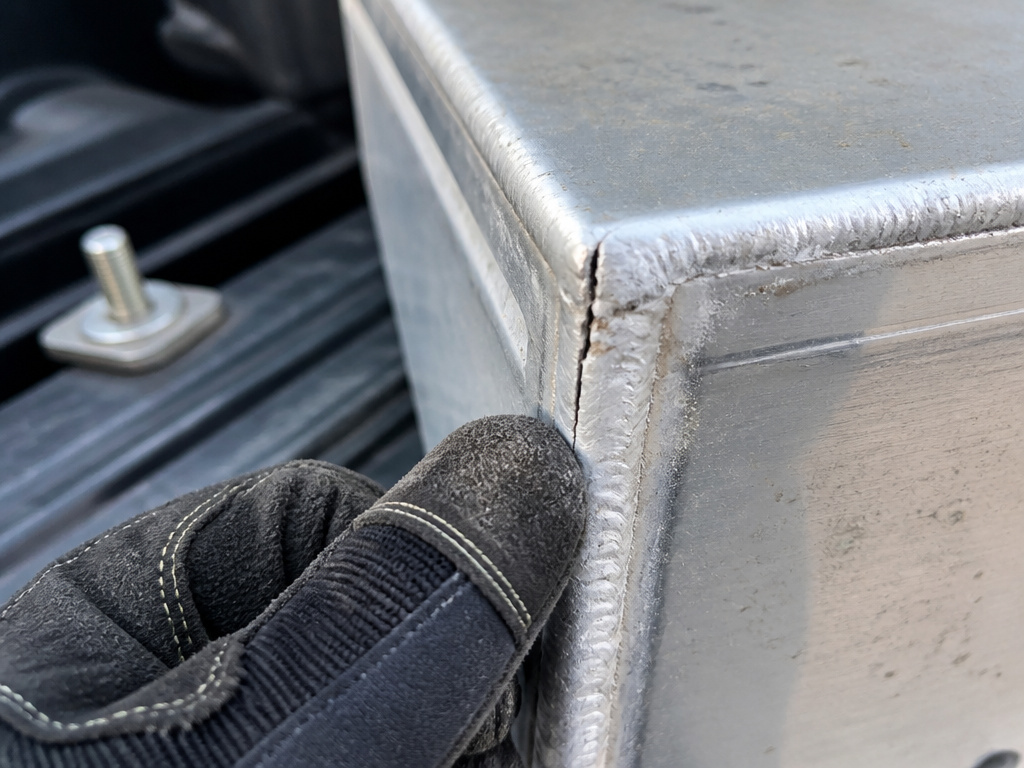
Toolboxes don’t usually die suddenly. They degrade in predictable stages, and knowing the timeline lets you intervene or choose a better box from the start. The failure points are almost always the same: welds, seals, latches, and mounts.
Corner welds take the most stress. On rough roads, the whole box flexes. A cheap box uses simple butt welds, two edges joined flush. It looks clean, but that weld line is a natural crack point under constant vibration. A box built to last uses lap-joint welds, where the material overlaps. That spreads stress across more surface area. Look at the inside corners of any box you’re considering. A smooth, rounded, overlapping weld is a good sign. A thin, straight seam is a red flag.
Door seals degrade from UV exposure and temperature cycling. They get hard, crack, and pull away from the channel. Once a seal is compromised, moisture gets in. That moisture accelerates corrosion on the box’s interior and on your tools. Inspect the seal. It should be soft, pliable, and seated evenly all the way around without gaps.
Latch and hinge hardware fail from sheer use, especially with gloved, greasy hands. The striker plate wears down, the latch gets sloppy, and eventually it won’t catch. A high-quality box uses reinforced steel or stainless steel components here, not thin stamped metal. A wobbly latch on a new box tells you everything about its intended lifespan.
| Failure Point | Early Warning Sign | Likely Outcome if Ignored |
|---|---|---|
| Corner Welds | Visible fine white powder (aluminum oxide) or hairline crack | Crack opens, box loses structural integrity, major leakage |
| Door Seal | Seal feels hard, has visible cracks, or has pulled away from its channel | Interior corrosion, wet tools, mold/mildew smell |
| Latch Mechanism | Latch feels gritty, doesn’t click firmly, or handle has side-to-side play | Lock fails to engage, lid can pop open while driving |
| Mounting Hardware | Rust on J-bolts or washers, box has slight rocking movement when latched | Holes in bed wallow out, box comes loose, accelerated wear on all components |
Mounting fatigue is the silent killer. Even a well-built box will shake itself to death if installed with undersized or mismatched hardware. The constant vibration of highway driving works on every bolt. If the J-bolts aren’t thick enough for your bed rail or the nuts aren’t lock nuts, they will loosen. A loose box rocks, which stresses the welds and destroys the seal. The UWS installation manual specifies using 5/16” or M8 bolts with lock nuts for a reason. Skipping the lock nut guarantees a comeback.
Where this goes sideways: Using the wrong hardware or forgetting to retorque bolts after the first 500 miles. The box shifts a quarter-inch, the seal no longer mates, and the next heavy rain soaks everything inside. You blame the box, but the install killed it.
Aluminum vs. Steel vs. Polymer: The Real Trade-Offs
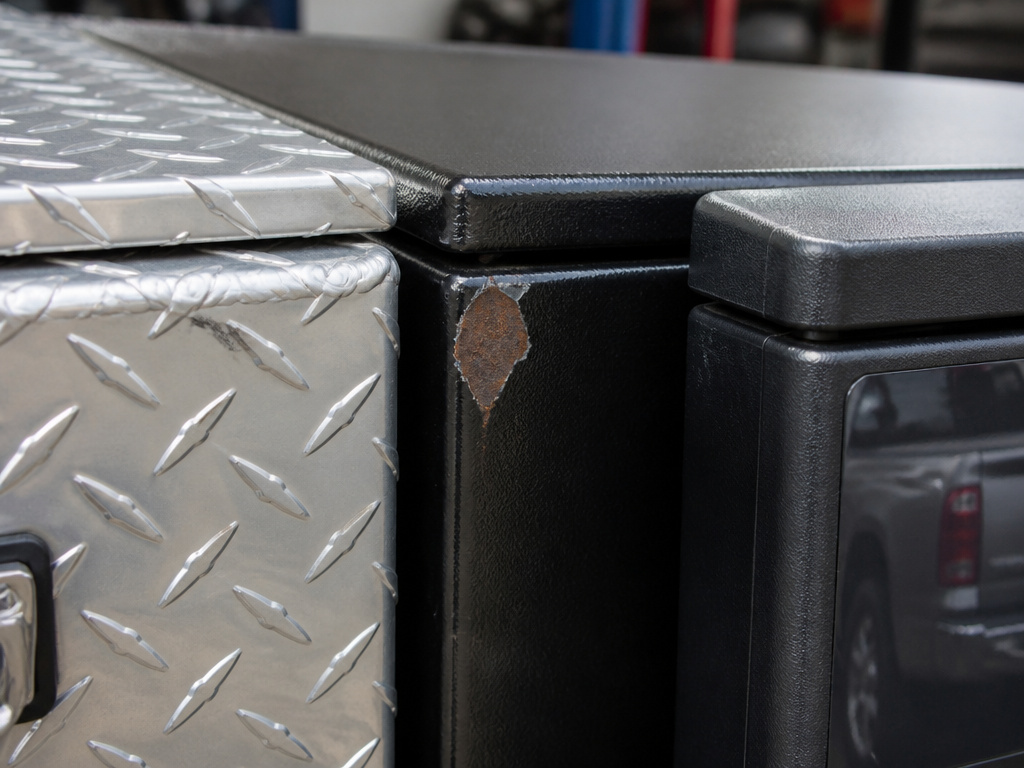
You’ll hear that aluminum is light and rust-resistant, steel is strong, and polymer is modern. That’s the marketing sheet. The real choice is about matching the material to the punishment your truck’s bed sees.
Aluminum is the default for good reason. It’s lighter than steel, which helps with fuel economy and handling. It doesn’t rust in the traditional sense, but it can corrode, especially around welds and where the finish is scratched. The critical spec is gauge thickness. A box like the Chandler Truck Accessories CTA series uses 0.125-inch (10-gauge) aluminum. Many economy boxes use 0.063-inch or thinner. That thinner metal dents if you lean on it, “oil-cans” (flexes and pops) under load, and cracks faster at stress points. The diamond-plate pattern isn’t just for looks; it adds rigidity.
Steel boxes are about maximum security and dent resistance. If you’re hauling construction debris or loading heavy equipment that might slide into the box, steel can take the impact. The trade-off is weight, a lot of it, and the need for a robust powder-coated finish to prevent rust. That finish will chip if hit with a hammer or a loose shovel. Once the steel is exposed, it will rust. A steel box is a commitment to maintenance.
Polymer/Composite boxes, like the Decked Tool Box, are a different beast. Made from compression-molded SMC (Sheet Molding Compound), they’re lightweight, rustproof, and dent-resistant. The Decked survived a test with a 200-pound oak log being rolled over it on a rough road. The weakness isn’t impact; it’s potential for sagging over a very long span if not internally reinforced. Decked solves this with integrated aluminum supports in the lid and base. The material also handles road salt and chemicals without a second thought.
| Material | Best For | Biggest Weakness | Maintenance Demand |
|---|---|---|---|
| Aluminum (Heavy-Gauge) | Daily drivers, commercial work, any environment | Corrosion at welds & fasteners | Low; occasional seal/latch check |
| Aluminum (Light-Gauge) | Budget buyers, light-duty use | Denting, cracking under load | Medium; watch for fatigue |
| Steel (Powder-Coated) | Maximum security, high-impact environments | Rust at chip sites, very heavy | High; inspect coating annually |
| Polymer (Reinforced) | Corrosive environments (salt, chemicals), off-road | Long-span sag (if unreinforced) | Very Low; clean and lubricate |
The bottom line: For most people, a heavy-gauge aluminum box strikes the best balance. If you live where roads are salted half the year or work with corrosive materials, look hard at a polymer option. Only choose steel if you need a vault and are willing to keep up with the finish.
Crossover, Saddle, Side-Mount, or Drawers?
The style of box determines how you access your gear and how much bed space you sacrifice. This isn’t just a preference; it’s a workflow decision.
A crossover box (or trunk-style) sits across the width of the bed, up against the cab. It typically has one lid that opens towards the cab. The big advantage is large, unimpeded storage in one compartment. The downside is it eats the front section of your bed. You can’t slide a 16-foot piece of lumber flat to the front wall anymore. These are the classic choice for general tool storage.
A saddle box is a type of crossover that sits on the bed rails, leaving a gap underneath. This lets you slide long, flat items (plywood, ladders) beneath it. The Decked Tool Box is a saddle design. The trade-off is the box itself is shallower, so it won’t fit very tall items.
A side-mount box runs along one or both bed rails. It leaves the entire center floor and bed length open for cargo. This is the go-to for plumbers, electricians, and landscapers who need constant, easy access to tools without climbing into the bed. The sacrifice is capacity, it’s usually a long, narrow compartment.
Drawer systems, like the famous Decked Drawer System, are in a league of their own. They replace the bed floor with a platform containing heavy-duty pull-out drawers. You retain the full length and width of the bed above the system. This is the ultimate in organization and security, but it’s also the most expensive and complex to install. It’s a permanent modification.
What most people get wrong: Choosing a crossover box because it’s common, then constantly fighting it when they need to haul drywall or a quad. Measure your most frequent cargo first, then pick the box style that accommodates it.
The Installation Mistakes That Void Your Warranty
You can buy the best-built box on the market and ruin it in an afternoon with a bad installation. The manual isn’t a suggestion; it’s a blueprint for longevity.
First, clean the contact points. Bed rails are dirty. If you’re clamping a saddle box onto a layer of grit and old paint, it won’t sit square. That uneven pressure will distort the box base over time. Wipe the rails down with a degreaser first.
Second, use the right hardware. The included J-bolts are sized for a range of bed rail thicknesses. If your rails are unusually thick or thin, the clamp may not seat correctly. Don’t force it. The UWS manual explicitly says to enlarge the bolt holes with a 1/2” drill bit if using their specific mounting kit (#003-CBOXMK). Drilling into your truck bed is serious, you must check underneath for fuel lines, wiring, or brake lines first.
Third, achieve even clamping force. Tighten the bolts gradually and alternately, like lug nuts on a wheel. You want the box to settle evenly onto the rails. An uneven install twists the frame.
Finally, retorque after 500 miles. Everything settles. The gaskets compress, the paint on the bed rails wears in, the hardware seats. Go back with a wrench and check every bolt. This single step prevents 90% of early “rattling box” complaints.
Before you start: You are drilling into your truck’s structure. Verify there are no fuel tanks, brake lines, or electrical harnesses directly beneath your chosen drill points. A puncture could be catastrophic. Use a stud finder or consult a service manual.
The short version: A rushed install causes premature failure. Take the hour to do it right with the correct tools, and your box will be a solid part of the truck, not a rattling accessory.
Are Truck Bed Toolboxes Worth It? The Final Verdict
A truck bed toolbox is worth the money when it solves a specific, expensive problem you actually have. If you regularly carry hundreds or thousands of dollars in tools that must stay secure and dry at a job site, a quality box pays for itself on the first project where it prevents theft or weather damage. It’s a business expense that makes sense.
If you’re a weekend DIYer who tosses a few ratchet straps and a tow rope in the back, a heavy-duty box is overkill. A simple, lockable storage container might be a better fit. The value of the box must align with the value of what’s inside.
For the large group in the middle, contractors, tradespeople, serious outdoorspeople, the answer hinges on choosing the right box. Don’t buy the thinnest aluminum crossover you can find because it’s cheap. That’s a three-year box. Invest in a solid heavy-gauge aluminum or reinforced polymer model from a reputable brand like UWS, Decked, or Chandler Truck Accessories. The upfront cost is higher, but the cost-per-year plummets.
So, is it worth it? Yes, if you buy for durability, not just price. No, if you treat it as a generic accessory. Your tools deserve a home that lasts as long as they do.
Frequently Asked Questions
Are truck toolboxes universal?
No, truck toolboxes are not truly universal. While many are marketed as “full-size” or “mid-size,” the fit depends on the exact width between your bed rails and the bed’s contour. Systems like the Decked Drawer System or Undercover Swing Case are model-specific. Always check the manufacturer’s fitment guide for your exact truck year, make, model, and bed length.
Do truck toolboxes hurt gas mileage?
Any addition to your truck adds weight and can affect aerodynamics, but the impact of a toolbox on fuel efficiency is minimal for most drivers. A lightweight aluminum box might reduce mileage by an imperceptible amount. The fuel cost is negligible compared to the utility gained. A heavy steel box or a drawer system that adds significant weight will have a more noticeable effect.
Can you use a toolbox with a tonneau cover?
Yes, but compatibility is key. Roll-up or tri-fold tonneau covers often work with crossover and saddle boxes, as the cover can roll up behind the box. Low-profile boxes improve compatibility. Retractable or hard folding covers may conflict. You must check with both the toolbox and tonneau cover manufacturers for confirmed compatibility before purchasing.
What maintenance does a truck toolbox need?
Minimal but critical maintenance extends a box’s life by years. Clean the exterior with automotive soap to remove road salt and grime. Wipe the rubber door seal clean and apply a silicone spray annually to keep it pliable. Lubricate the latch mechanism and lock cylinder with a dry graphite lubricant every six months, avoid wet lubricants like WD-40 that attract dirt. Inspect mounting hardware annually for rust or loosening.
How do I choose the right size toolbox?
Measure your truck bed, not once, but twice. You need the inside width between the bed rails at the front, middle, and back (they can taper). You also need the height from the bed floor to the top of the rail. Compare these to the box’s external dimensions. Remember to account for any bed liner thickness and ensure the open lid won’t hit your rear window or cab. When in doubt, manufacturers provide detailed sizing charts.
