
Are All Camaros Rear Wheel Drive? Official Platform Answer
This post contains affiliate links. As an Amazon Associate, we earn from qualifying purchases.
Every Chevrolet Camaro produced for the 2019 through 2024 model years is rear-wheel drive (RWD). This includes every trim from the base 2.0L Turbo LS to the supercharged V8 ZL1. The confirmation comes directly from manufacturer specifications, which detail a longitudinal engine layout driving the rear wheels via a standard six-speed manual or available automatic transmission.
That longitudinal layout is the mechanical signature of a true sports car chassis. It’s not a marketing bullet point. It’s the physical reason the Camaro handles the way it does, with a specific weight distribution and drivetrain geometry that front-wheel drive or all-wheel drive platforms cannot replicate without compromise.
What follows is a breakdown of the GM Alpha platform that makes this possible, the exact powertrain and axle specifications for each major engine, and how this definitive RWD layout positions the Camaro against rivals that have adopted all-wheel drive.
Key Takeaways
- Every sixth-generation (2016-2024) Chevrolet Camaro is exclusively rear-wheel drive, as documented in official NHTSA filings and model year brochures.
- The car uses the GM Alpha platform, a rear-wheel-drive architecture shared with performance sedans like the Cadillac ATS-V, designed for a longitudinal engine.
- Axle ratios change significantly depending on your engine and transmission choice, affecting acceleration and highway cruising—a 2.0L Turbo automatic has a 2.77:1 final drive, while a V8 manual has a 3.73:1.
- Chevrolet includes a Driver Mode Selector with a Snow/Ice mode to help manage RWD in low-traction conditions, as noted in the 2023 model brochure.
- The Camaro’s main competitors, the Ford Mustang and Dodge Challenger, have offered all-wheel-drive configurations on certain models, making the Camaro the purist’s choice in its segment.
The Short, Direct Answer
The 2023 Chevrolet Camaro brochure lists all available configurations—2.0L Turbo, 3.6L V6, 6.2L V8 LT1, and 6.2L supercharged LT4—without any all-wheel or front-wheel drive option. The standard chassis is a four-wheel independent suspension system driven exclusively by the rear wheels.
Are all Camaros rear wheel drive? For the current generation, the answer is an unambiguous yes. You cannot walk into a Chevrolet dealership and order a new Camaro with front-wheel drive or all-wheel drive. This is a deliberate engineering choice, not an oversight. The platform was conceived as a rear-driver from the first line on the drafting table.
The powertrain sits longitudinally, meaning the engine is mounted front-to-back, with a transmission bolted directly to it and a driveshaft running to a differential at the rear axle. This layout is non-negotiable for the handling balance Chevrolet targeted. It creates a specific front-to-rear weight distribution and allows for the precise steering feedback the car is known for.
The GM Alpha Platform: Born to Drive the Rear Wheels
The Camaro’s bones explain the rule. Since its 2016 reintroduction, the sixth-generation car has ridden on the GM Alpha platform. This architecture was developed specifically for rear-wheel-drive performance. Its other notable application was the Cadillac ATS and CTS, including the high-performance ATS-V.
A platform is more than a floorpan. It dictates the hard points for the suspension, the placement of the engine and transmission, and the path of the driveshaft tunnel. Alpha was engineered around a longitudinal powertrain. Designing an all-wheel-drive variant would have required a fundamentally different center section and front axle setup, adding weight, complexity, and cost for what GM decided was a negligible market gain.
The platform’s stiffness is another clue. A rigid chassis is critical for handling precision. The Alpha structure uses strategic bolt-on bracing, noted in the 2016 NHTSA new-model bulletin, to achieve its target stiffness without excessive weight. This bracing is optimized for the loads and harmonics of a rear-wheel-drive car. The result is a chassis that communicates road feel directly to the driver, a trait often diluted in all-wheel-drive systems that add weight over the front axle.
This shared architecture with upmarket Cadillacs is a point of pride for Chevrolet. It means the Camaro’s fundamental dynamics were benchmarked against world-class sports sedans. When you look at a modern BMW X3 or an Audi A3, their platform choices dictate different drivetrain possibilities. The Alpha platform only does one thing, but it does it exceptionally well.
Powertrain Specifics: Not All RWD Setups Are Equal
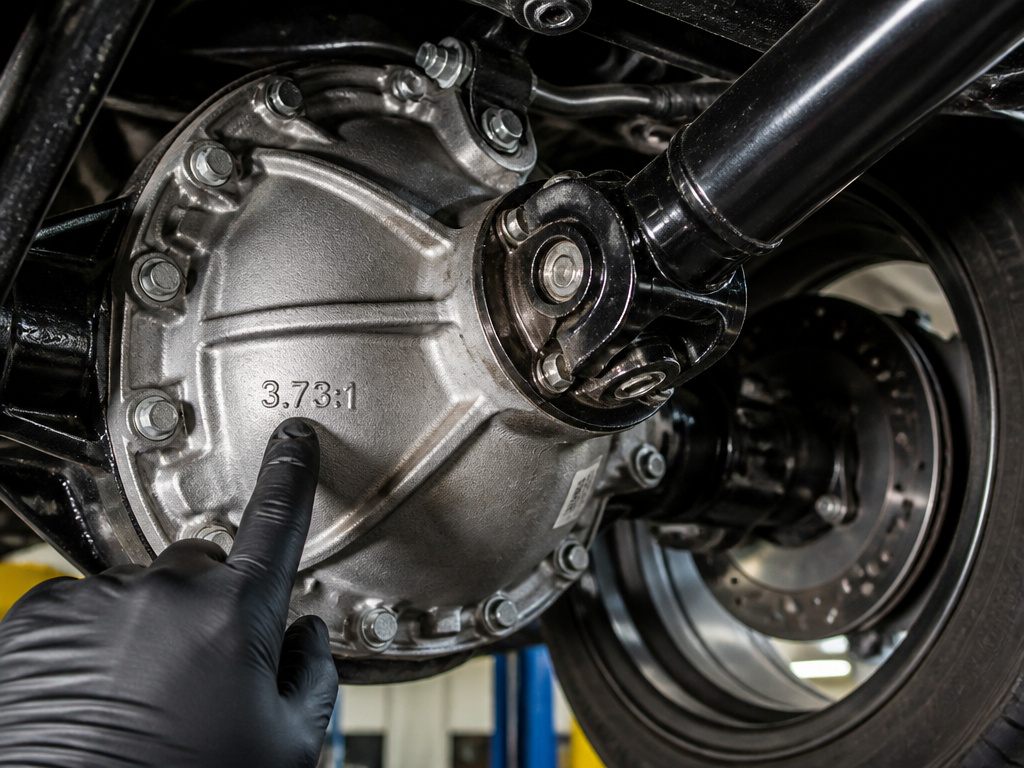
Saying a car is rear-wheel drive is just the beginning. The specific transmission and axle ratio determine its character. A base model Camaro and a ZL1 share the same driven wheels, but the experience is worlds apart.
The factory specifications are precise. The official 2023 Chevrolet Camaro brochure provides the definitive list of final drive ratios. These numbers tell you how many times the driveshaft spins to turn the rear wheels once. A lower number (like 2.77) is taller, better for fuel economy at highway speed. A higher number (like 3.73) is shorter, delivering more aggressive acceleration off the line.
| Engine & Transmission | Standard Final Drive Ratio | Primary Character |
|---|---|---|
| 2.0L Turbo (Manual/Auto) | 3.27:1 | Accessible torque, balanced |
| 3.6L V6 (Manual) | 3.27:1 | Linear power, smooth |
| 3.6L V6 (Automatic) | 2.77:1 | Highway efficiency |
| 6.2L V8 LT1 (Manual) | 3.73:1 | Aggressive launch |
| 6.2L V8 LT1 (Automatic) | 2.77:1 | Versatile performance |
| 6.2L Supercharged LT4 (Manual) | 3.73:1 | Maximum traction demand |
The V8 manuals get the aggressive 3.73 ratio to harness their torque. The automatics, whether the Hydra-Matic 8L45 on four-cylinder models or the 10L80 on V8s, use taller ratios like 2.77 or 2.85. This lets the transmission’s closely spaced gears manage acceleration while keeping revs low during cruising.
Where this goes sideways: Assuming all Camaros have a “sporty” axle ratio. The 2.77:1 in a V6 automatic is geared for relaxed highway driving, not tire-smoking launches. The character of the rear-wheel-drive experience changes completely with that number.
The transmission choice is equally specific. The revered TREMEC TR6060 six-speed manual in the SS and ZL1 is a robust, driver-focused unit with active rev-matching. The available Hydra-Matic 10L80 10-speed automatic is a technical marvel, capable of lightning-fast shifts that can actually post quicker acceleration times. Both send 100% of the engine’s power to the same rear differential. This is a key differentiator from a Jeep Grand Cherokee or a Toyota 4Runner, where a transfer case can split power to another axle.
Why No All-Wheel Drive? The Purist’s Trade-Off
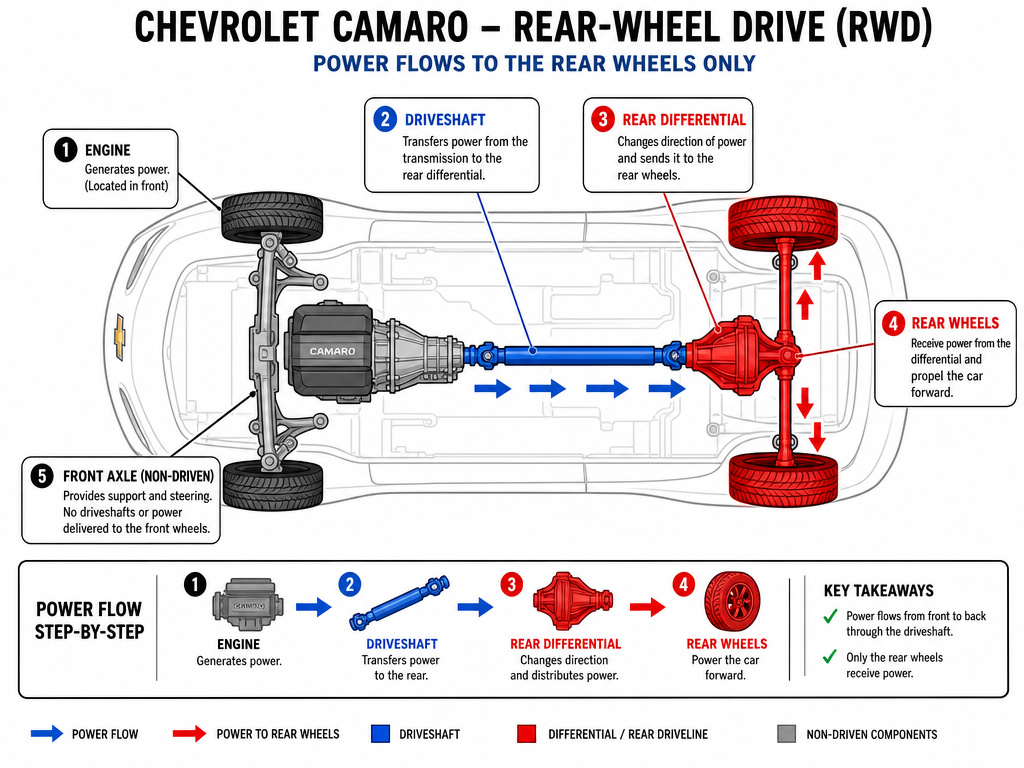
Chevrolet’s decision seems counterintuitive in an era where even the Ford Mustang offers an all-wheel-drive option on its EcoBoost models. The reason is a focused philosophy on weight, cost, and driving purity.
Adding all-wheel drive means adding weight—roughly 150 to 200 pounds for the hardware. That weight typically sits high in the front of the car, worsening the center of gravity and adding inertia that dulls steering response. For a car lauded for its handling balance, this is a significant penalty. It also adds complexity and cost, both for manufacturing and for the buyer. The Camaro’s mission has always been to deliver maximum performance for the dollar, and all-wheel drive conflicts with that value equation.
Furthermore, the market demand is questionable. The core Camaro buyer seeks the traditional rear-drive experience: the ability to steer with the throttle, the challenge of managing power delivery, the specific feedback through the steering wheel. The car’s sophisticated stability control systems and available limited-slip differential provide ample help for most drivers in most conditions. The 2023 brochure even highlights a standard Driver Mode Selector with a dedicated Snow/Ice mode, a tacit admission that rear-wheel drive can be managed in poor weather with the right electronics and tires.
This stands in contrast to the approach for trucks or family SUVs like the Chevrolet Tahoe, where all- or four-wheel drive is a functional necessity for towing or off-pavement use. The Camaro is a sports coupe first. Its main competitor, the Dodge Challenger, also remains rear-wheel drive, while the Mustang’s AWD is a niche configuration. Chevrolet bet that their audience would prefer a better, purer rear-drive car over a compromised all-wheel-drive one.
Historical Context and Model Year Consistency
The consistency across model years reinforces that this is a core identity. The sixth generation launched for the 2016 model year. The initial NHTSA bulletin (15-NA-066) from November 2015 introduced the new model, detailing the longitudinal V6 and V8 powertrains with no mention of any other drivetrain layout.
This commitment held firm through the entire production run. The 2021 Camaro owner’s manual covers operation for every model, all under the same rear-wheel-drive paradigm. The final 2024 model year, as described by Chevrolet dealers, continues to list “rear-wheel-drive configuration” as a defining feature. There has never been a factory-produced, sixth-generation Camaro with power sent to the front wheels.
This clarity is refreshing. It eliminates the confusion found in other segments where a model nameplate can hide multiple drivetrains. You don’t have to decode a VIN or an option code to know what you’re getting. A Camaro is a rear-wheel-drive car. Full stop. This is different from the strategy for a Ford Escape or an Acura Integra, where front-wheel drive is standard and all-wheel drive is an available upgrade.
Living With a Rear-Wheel-Drive Camaro
Owning this drivetrain layout requires a slight mental shift if you’re coming from a front-wheel-drive car. The physics are different. In a front-driver, you pull the car with the steering wheels. In the Camaro, you push it with the rear wheels. This changes how the car behaves under power, especially in corners or on wet pavement.
The car’s electronic aids are sophisticated. Stability control, traction control, and the optional limited-slip differential work together to keep the car composed. The Snow/Ice drive mode drastically reduces throttle response and intervenes earlier with the stability system. It’s a genuine help. However, no electronic system can override the laws of physics. The single most important factor for all-season usability is your tire choice. High-performance summer tires, like the Goodyear Eagle F1s on SS models, become dangerously hard in cold temperatures and offer almost no grip in snow. Switching to a dedicated set of winter tires or high-quality all-seasons is non-negotiable for winter driving.
The payoff for this minor seasonal hassle is a driving experience that is more engaging, more rewarding, and more connected. The steering is precise because the front wheels only have to steer. The acceleration feels more visceral as the car settles onto its rear axle under power. This is the trade-off Chevrolet engineers made, and for driving enthusiasts, it’s the correct one.
Frequently Asked Questions
Did any older Camaro models have front-wheel drive?
No. Every generation of the Chevrolet Camaro, from the first in 1967 through the final sixth-generation model in 2024, has been exclusively rear-wheel drive. The car’s identity is rooted in this layout.
Can you get a Camaro with all-wheel drive?
You cannot order a new Camaro with all-wheel drive from Chevrolet. The factory does not produce or offer this configuration for any model year of the sixth-generation (2016-2024) car.
Is the Camaro rear-wheel drive in the snow?
The Camaro is rear-wheel drive in all conditions, including snow. It can be driven in winter with proper snow tires and careful use of its electronic Snow/Ice drive mode, but it is inherently less sure-footed in deep snow than a modern all-wheel-drive vehicle.
What is the advantage of the Camaro being rear-wheel drive?
The primary advantages are superior handling balance, more precise steering feedback, and a more engaging driving dynamic. The rear-wheel-drive layout allows for a 50/50 weight distribution and enables classic sports car behaviors like controlled oversteer.
Why does the Camaro have a Snow/Ice mode if it’s RWD?
The Snow/Ice mode is an electronic aid to help manage the rear-wheel-drive powertrain in low-traction conditions. It significantly dulls throttle response and allows the stability control system to intervene much earlier to prevent wheelspin and loss of control.
The Bottom Line
The Chevrolet Camaro’s rear-wheel-drive specification is a defining pillar of its character. It is not a marketing claim or a historical artifact. It is a concrete engineering reality verified by every official specification sheet from the last decade. From the base turbo-four to the supercharged ZL1, power flows through a longitudinal engine and transmission to a differential at the rear axle.
This commitment shapes everything about the car—its sharp handling, its visceral acceleration feel, and even its seasonal limitations. While rivals like the Ford Mustang have expanded into all-wheel drive, the Camaro remained a purist’s proposition until the end of its sixth-generation run. You buy it for that specific, unadulterated rear-drive experience. For anyone asking “are all Camaros rear wheel drive,” the answer is a resounding, well-documented yes.
