
Weighing If Usage Based Insurance Programs Are Worth It
This post contains affiliate links. As an Amazon Associate, we earn from qualifying purchases.
Usage-based insurance programs are worth it only for a specific driver: one who drives low miles, avoids hard braking, and accepts constant data monitoring in exchange for a potential discount that, in 2023, only 31% of enrolled drivers actually received. The other 69% saw no change or a premium increase.
The 31% figure comes from a state regulator’s survey, not an insurer’s marketing. That’s the gap between the advertised maximum discount and the real-world outcome. Most articles talk about “potential savings.” This one starts with the documented result.
What follows is the breakdown of that number: the data points insurers track beyond mileage and speed, the privacy trade-offs most states don’t regulate, and the one driving behavior change that actually moves the needle on your score. By the end, you’ll know exactly which profile gets the discount and whether you fit it.
Key Takeaways
- In 2023, a Maryland regulator found only 31% of drivers in telematics programs got a discount; 24% saw their premium increase, and 45% saw no change.
- Programs collect far more than mileage and speed, data can include turn signal usage, car battery level, and phone use, often shared with third-party data firms.
- A 2017 study found drivers reduced hard-brake frequency by an average of 21% over six months when monitored, showing UBI can change behavior.
- California law strictly limits how driving data can be used for pricing, but most other states, like Maryland, have few restrictions on data use or sale.
- The decision hinges on your driving pattern: low annual mileage, daytime driving, and smooth habits are the only reliable path to a discount.
The Real Numbers on Discounts and Surcharges
Forget the “up to 40% off” banner ads. The real discount rate is a single-digit number for most people. The Maryland Insurance Administration surveyed 18 major insurers in 2023. Their finding was blunt: less than a third of enrolled drivers saw a premium decrease.
The breakdown is 31% down, 24% up, 45% unchanged. That “up” category is critical. A telematics program isn’t just a discount tool; it’s a re-rating tool. Your driving data can justify a surcharge just as easily as a discount. If your online quotes assumed you were an average risk and the telematics data says you’re worse, the company has the evidence to raise your rate.
Common mistake: Signing up for the advertised maximum discount. Those are ceiling rates, not averages. They require a near-perfect driving score, minimal mileage, zero hard brakes, no late-night trips. The average driver hits one of those tripwires within a month.
Why the gap between hype and reality? Insurers use the data to refine risk models, not just reward good driving. A study in the Journal of Risk and Insurance noted that customers who received higher UBI discounts were actually more likely to increase their coverage at renewal, the discount made comprehensive insurance feel more affordable, leading to an upsell. The business model isn’t just about giving away money.
What Data Do Telematics Programs Actually Collect?
Mileage, speed, and hard braking are the headline acts. The full list in the Maryland report runs deeper. It includes factors with a vague link to risk: your car’s battery level, idle time, the altitude where you drive, how often you use your turn signals, and whether your adaptive high beams are on.
Phone use data is a separate category. The app can detect if you’re interacting with the screen while the vehicle is moving. This isn’t just about calls; it’s about unlocking the phone or switching apps.
The part nobody mentions: Eleven of the sixteen insurers in the Maryland survey contracted this data collection out to third-party companies. Your driving behavior isn’t just going to your insurer’s underwriting department. It’s flowing to a data analytics firm whose other clients you’ll never know.
This matters for privacy and for your credit history. While insurers say they don’t use telematics data for credit scoring today, the data pipeline now exists. A regulator’s guide, like the Washington Insurance Commissioner’s UBI guide, explains the basics, but state laws on data use are patchy.
| Data Point Category | Specific Examples Collected | Potential Insurance Use |
|---|---|---|
| Driving Behavior | Hard braking, rapid acceleration, cornering force, speeding over limit. | Direct risk scoring. Determines your “score” and discount eligibility. |
| Trip Details | Time of day (night driving), mileage per trip, total annual mileage, route location. | Rates based on low-mileage discounts and surcharges for high-risk times. |
| Vehicle & Phone Data | Battery level, fuel level, turn signal usage, phone screen interaction, adaptive high beam use. | Secondary risk indicators. Could be used for claim verification or future rate factors. |
| Third-Party Data | Data shared with contracted telematics providers (e.g., LexisNexis, Verisk). | Analytics, model building, and potentially sold to other industries. |
The table shows the scope. When you agree to a telematics program, you’re agreeing to this granular level of surveillance. The question is whether the discount is worth that footprint.
The Privacy Trade-Off and Regulatory Gray Zone
California is the outlier. Since 1988, California Proposition 103 has mandated that auto insurance rates be based primarily on a driver’s safety record, miles driven, and experience. This law creates a high barrier for using other telematics data for pricing. In most other states, the regulatory environment is wide open.
Maryland’s report explicitly notes the state has no restrictions on what data is collected or how it can be used. That data could be used to “nickel and dime” consumers, for claim disputes, to market other products, or to sell to third parties. This is the current legal reality in most of the country.
Where this goes sideways: A claim dispute where your insurer cites telematics data you’ve never seen. They might argue your hard-braking event five minutes before a collision indicates distracted driving, potentially justifying a denied claim or a higher at-fault accident designation.
The National Association of Insurance Commissioners article frames UBI as a consumer choice, which it is. But the information asymmetry is vast. You get a simple “driving score”; the insurer gets hundreds of data points fed into a proprietary algorithm. You cannot audit that algorithm.
If you have a young driver on your policy, the calculus changes. The monitoring could encourage safer habits, but it also creates a permanent record of their early mistakes. That record could affect their insurance for young drivers costs long after the telematics device is removed.
Does UBI Actually Make You a Safer Driver?
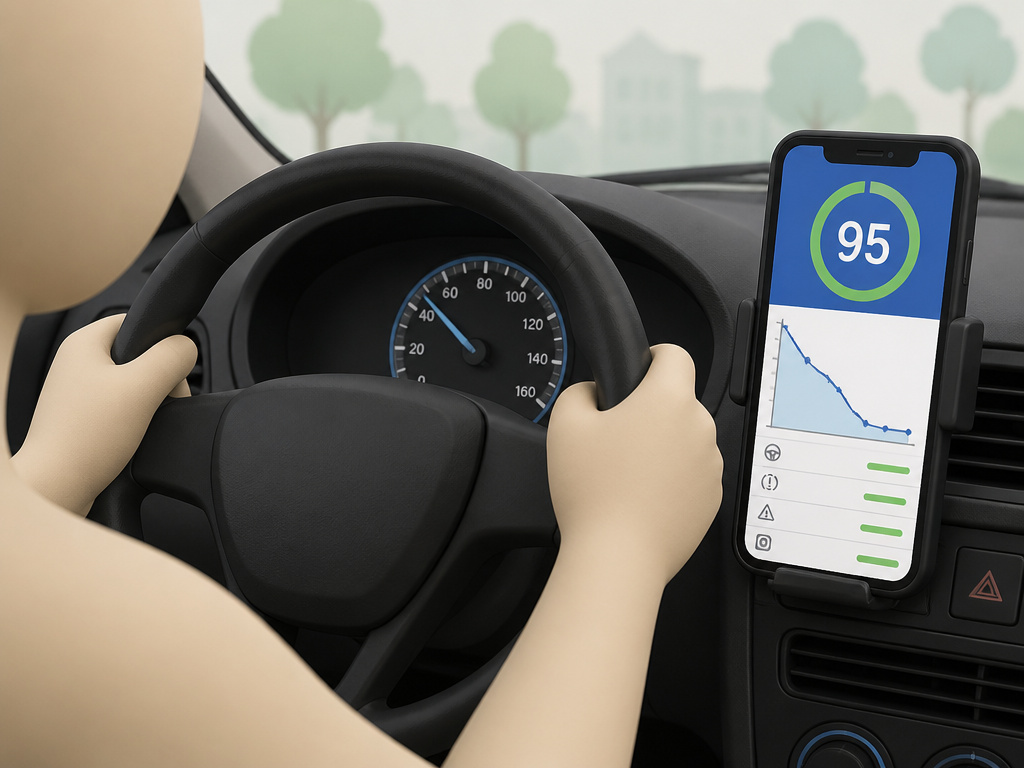
The evidence says yes, in one specific way. A 2017 University of British Columbia study analyzed data from a major insurer and found that drivers reduced their daily hard-brake frequency by an average of 21% after six months in a UBI program.
The improvement wasn’t uniform. Younger drivers and female drivers showed more significant improvement. The study found no real change in total mileage driven, people didn’t drive less, they drove more smoothly when they knew they were being scored.
Participants decreased hard braking by 21% within six months. They knew the score was watching.
This behavioral nudge is the social benefit insurers cite. Fewer hard brakes likely mean fewer rear-end collisions. But the improvement seems tied to the monitoring itself. The big, unanswered question is whether the safer driving persists after the telematics device is unplugged. The research doesn’t have that data.
For the individual, the takeaway is mechanical. If you want to game the system for a discount, focus relentlessly on eliminating hard stops. Smooth acceleration and obeying speed limits matter, but the hard brake is the metric that moves the needle fastest on most algorithms. It’s a tangible, correctable habit.
Who Should (and Shouldn’t) Enroll in a UBI Program
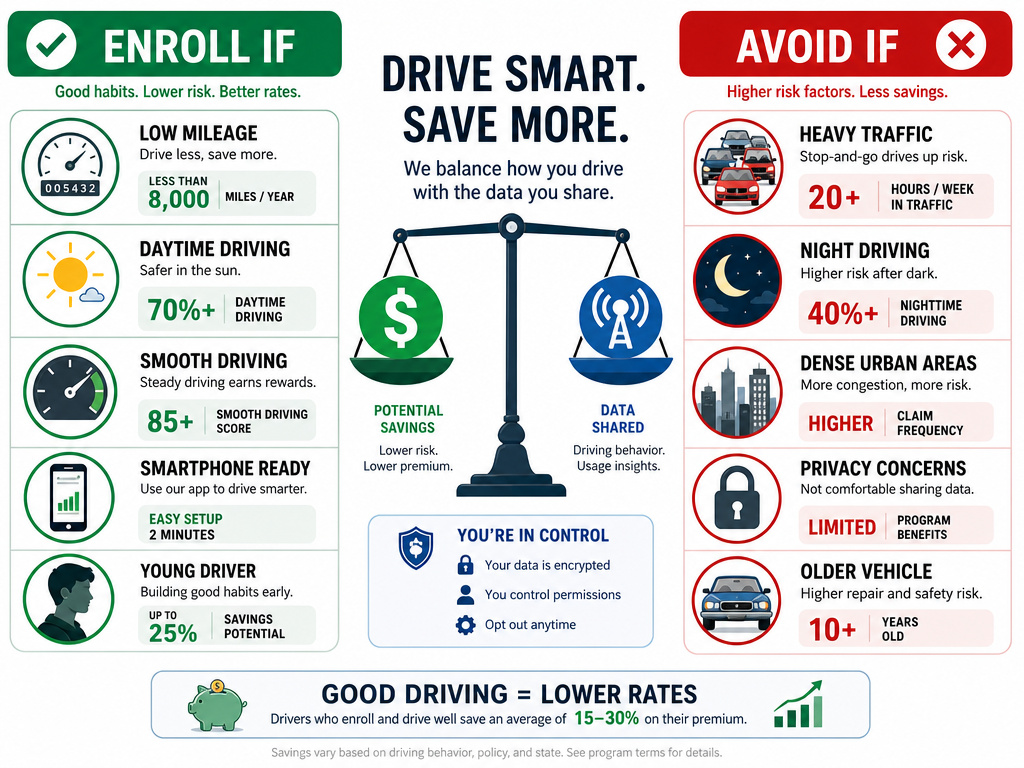
This is a calculated trade. You need to match a specific profile to have a reliable shot at the discount.
Enroll if you:
- Drive under 8,000 miles per year, mostly during daytime hours.
- Have a predictable, low-congestion commute.
- Are already a smooth driver who rarely slams the brakes.
- Are comfortable with a smartphone app or OBD-II device constantly transmitting data.
- Are a young driver looking for a way to prove your low risk and lower your high base rate.
Avoid it if you:
- Have a long highway commute with unpredictable traffic (hard braking is often unavoidable).
- Frequently drive late at night.
- Live in a dense urban area with aggressive driving patterns.
- Are privacy-sensitive and uncomfortable with the lack of data-use restrictions.
- Have an older vehicle that might not play nicely with an OBD-II dongle.
Consider your types of coverage first. If you’re carrying only minimum liability to save money, a 10% discount on a tiny premium is a small absolute win. The data trade might not be worth it. If you have a full comprehensive and collision coverage policy on a new car, the potential discount is larger in dollar terms.
Your insurance deductible choice is another lever. A higher deductible lowers your premium more reliably than a telematics gamble. Use that tool first.
The Bottom Line
Are usage-based insurance programs worth it? For the majority, the answer is no. The 2023 data shows 69% of participants saw no financial benefit or paid more. The privacy trade is significant, and the discount is not guaranteed.
For a narrow segment, the truly low-mileage, daytime, smooth driver, it can be a legitimate way to shave 10-15% off a premium. That person must go in with eyes open, knowing they are trading granular behavioral data for that chance.
Before you enroll, get a firm quote without telematics. Then, read the program’s fine print on data use and third-party sharing. Ask if the discount is applied at every renewal or just the first. This is an ongoing experiment with your wallet and your data on the line. For most, the safer bet is to shop for a better base rate or adjust your deductible, not to invite your insurer into the passenger seat for a year.
Frequently Asked Questions
Can usage-based insurance raise my rates?
Yes. In the 2023 Maryland survey, 24% of enrolled drivers saw their premiums increase after their driving data was evaluated. The program re-rates you based on actual behavior, which can be riskier than the insurer’s initial assumption.
How long do I have to use a telematics device?
Programs vary. Typical trial periods are 6 months. Some, like Progressive Snapshot, allow you to remove the device after the trial while keeping your discount. Others, like certain app-based programs, require continuous monitoring to maintain the discount.
Do all insurance companies offer UBI programs?
Most major national carriers do, including Progressive (Snapshot), Allstate (Drivewise), State Farm (Drive Safe & Save), and Liberty Mutual. However, the specifics, device vs. App, data points tracked, discount formula, differ significantly between companies.
Can I be penalized for hard braking during an emergency?
Insurers state that their algorithms can distinguish between a hard brake for a sudden obstacle and aggressive driving. However, the specifics are proprietary. A pattern of hard braking, even for legitimate reasons, will likely lower your driving score and discount.
What happens to my data if I cancel the program?
You must read your insurer’s privacy policy. Some state they will stop collecting data but may retain what they already have for a period. The peer-reviewed UBI coverage choices study highlights that data retention and usage policies are a key area of consumer concern and regulatory interest.
Is UBI a good idea for a new driver?
It can be a double-edged sword. It may help a safe new driver prove their responsibility and lower their initially high rates. However, it also creates a permanent record of any mistakes, which could be used against them if they switch insurers later. It’s crucial for a teen driver and their parents to understand the long-term data implications.
