
What is the Most Fuel Efficient Full Size Truck? Compare Top MPG
This post contains affiliate links. As an Amazon Associate, we earn from qualifying purchases.
The most fuel-efficient full-size truck for 2026 is the Chevrolet Silverado 1500 or GMC Sierra 1500 equipped with the 3.0L Duramax turbo-diesel engine, achieving an EPA-estimated 26 MPG combined. For those who prioritize hybrid power and capability, the Ford F-150 PowerBoost hybrid offers 23 MPG combined with 430 horsepower.
That 3 MPG gap between diesel and hybrid represents the central trade-off. One engine type squeezes every drop of fuel for mileage, the other blends efficiency with serious towing muscle and acceleration. Which one wins depends entirely on the math of your average drive cycle, your payload needs, and how much you care about the pump versus the pedal.
The rest is a choice between three powertrain philosophies: turbo-diesel, gas-electric hybrid, and modern turbocharged gasoline. We’ll walk through the EPA numbers, the hidden penalties each efficient engine carries, and the real-world owner math that decides whether you should chase the top spot on the mileage chart or settle for third.
Key Takeaways
- The Chevrolet/GMC 3.0L Duramax diesel is the mileage king (26 MPG combined) but adds a significant upfront cost.
- The Ford F-150 PowerBoost hybrid (23 MPG) sacrifices a few MPG for vastly more horsepower and seamless electric torque.
- The turbocharged 2.7L engine in light-duty Chevys (19 MPG) proves that smaller, forced-induction gas engines struggle to compete on pure efficiency.
- Aerodynamic add-ons like a hard truck bed covers can add 1-2 MPG at highway speeds, which matters more for diesel’s long-range touring.
- Official EPA ratings are a controlled lab benchmark; your actual mpg hinges on driving style, payload, and whether you use features like cylinder deactivation.
The Diesel Front-Runner: GM’s 3.0L Duramax
If your only question is “what number is highest on the sticker,” the answer lands on the General Motors 3.0-liter inline-six Duramax turbo-diesel. In a 2WD Chevrolet Silverado 1500 or GMC Sierra 1500, this engine posts an EPA-estimated 23 city / 33 highway / 26 combined MPG.
The 3.0L Duramax’s 26 MPG combined rating isn’t just a class leader; it’s a 13% efficiency gain over the next-best full-size gasoline truck. This gap is why diesel dominates the long-haul discussion for owners who cover 20,000+ miles a year.
The diesel’s advantage is thermodynamic. Diesel fuel contains more energy per gallon than gasoline, and the engine’s high compression ratio extracts more of that energy as forward motion, especially under load. Where it loses is in complexity, cost, and daily driving feel. The premium over a base V8 can approach $3,000, and diesel exhaust fluid (DEF) is another consumable to track. The payoff timeline is about 60,000 miles for most drivers.
You also surrender some initial grunt. The diesel makes 305 horsepower, respectable, but not class-leading. Where it shines is torque: 495 lb-ft available at a low 1,500 RPM. This is the spec that tows 13,000 pounds without breaking a sweat, a perfect match for the payload capacity of a well-equipped half-ton. It’s an efficiency play for the driver who uses their truck as a tool.
The Hybrid Contender: Ford’s F-150 PowerBoost
The Ford F-150 PowerBoost hybrid doesn’t try to beat the diesel’s highway number. It aims to be good enough everywhere while adding a 430-horsepower electric assist that feels like a cheat code in traffic. Its EPA rating is 22 city / 24 highway / 23 combined MPG.
Where this goes sideways: Expecting the PowerBoost to deliver diesel-like economy on long, steady highway drives. The hybrid system’s benefit diminishes above 50 MPH, where the electric motor assists less and the gasoline engine carries the full load. Your highway mileage will trend toward the lower end of the EPA band.
The hybrid’s magic is in stop-and-go and low-speed torque. The electric motor fills in the power band where a traditional V8 would be drinking fuel, and the truck can even drive short distances on electric power alone. This makes it a star for city driving, job sites with lots of idling, or as a mobile power source with its Pro Power Onboard generator.
You pay for this versatility. The PowerBoost is a premium powertrain, often bundled with higher trim levels. Its real-world fuel economy is also more sensitive to driving style than the diesel. Aggressive acceleration burns through the battery’s assist quickly. But for the buyer who wants one truck to do everything, commute, tow, and power a worksite, the compromise works.
The Gasoline Field: Turbos and Cylinder Deactivation
Beneath the diesel and hybrid, the traditional gasoline field fights with technology. The most efficient pure-gas full-size truck is often the one with the smallest turbocharged engine, like the Chevrolet Silverado’s 2.7L Turbo four-cylinder, rated at 19 MPG combined.
| Engine Type | Example | Best Combined MPG | Best Use Case |
|---|---|---|---|
| Turbo-Diesel | GM 3.0L Duramax | 26 MPG | Long-distance highway driving, high annual mileage |
| Gas-Electric Hybrid | Ford 3.5L PowerBoost V6 | 23 MPG | Mixed city/highway, towing, auxiliary power needs |
| Turbocharged Gasoline | Chevrolet 2.7L Turbo I4 | 19 MPG | Light-duty daily driving, lower upfront cost |
| V8 with Cylinder Deactivation | GM 5.3L V8 (AFM) | 17 MPG | Traditional truck feel, moderate towing, simplicity |
These smaller turbo engines promise V8 power with better fuel economy. The reality is more nuanced. Under light throttle, they can be efficient. Ask them to move a 5,500-pound truck with any urgency, and the turbo spools up, fuel injectors open wide, and mileage plummets. They work best for the driver who rarely tows and carries light loads.
Cylinder deactivation, like GM’s Active Fuel Management (AFM) or Chrysler’s MDS, tries a different trick. It shuts down half the cylinders on the highway. The problem is predictability. The system’s on/off cycling can create a resonant vibration some drivers find annoying, and it only activates under very specific light-load conditions. Its benefit is real but modest, maybe 1 MPG on a long trip.
Diesel vs Hybrid: The Real-World Mileage Showdown
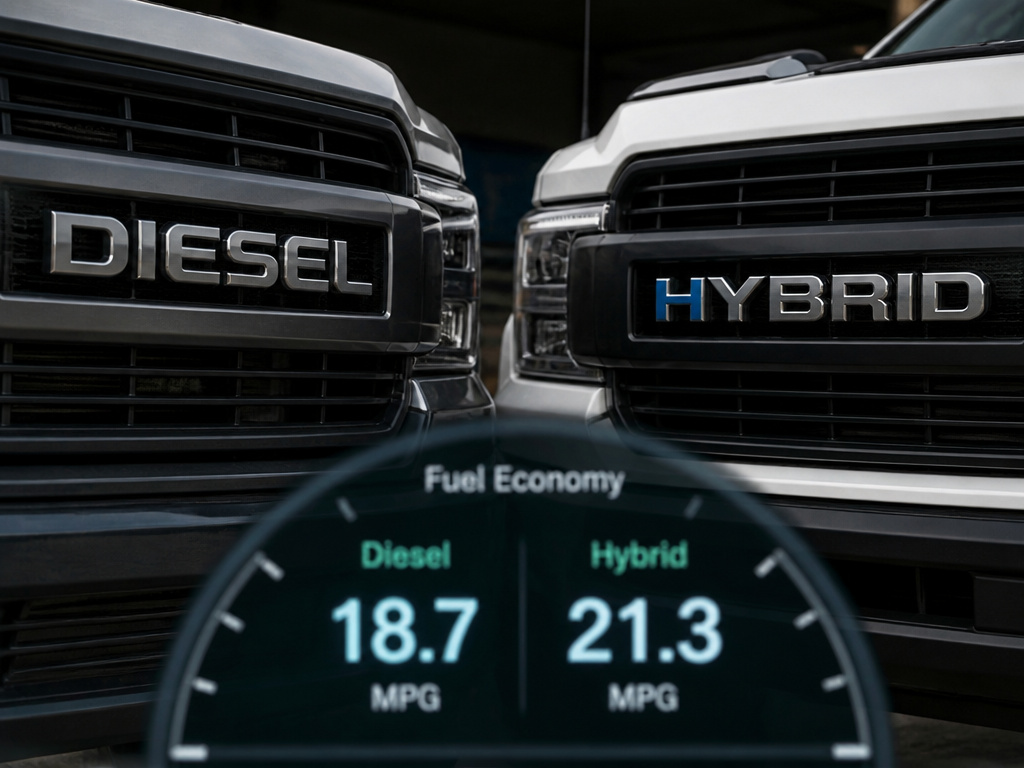 On paper, the diesel leads by 3 MPG. On the road, the comparison gets messy fast. The diesel’s advantage expands on long, flat interstate runs where its thermodynamic efficiency shines. The hybrid closes the gap dramatically in suburban loops with frequent stops, where regenerative braking recaptures energy.
Your driving signature decides the winner. If your “highway” miles are actually hilly, stoplight-dotted state routes, the hybrid might even pull ahead in real-world calculations. The diesel’s consistent performance is its strength, but it demands you drive long distances to justify its price.
The other hidden penalty is capability. To reach those peak MPG figures, you often need the most basic 2WD, single-cab, short-bed configuration. Add four-wheel drive, a crew cab, or a premium trim package, and the weight goes up, the aerodynamics change, and the mileage ticks down. This is why understanding your truck’s GVWR matters, a heavier truck from the factory leaves less margin for your cargo before efficiency suffers.
Beyond the Powertrain: How to Maximize Any Truck’s MPG
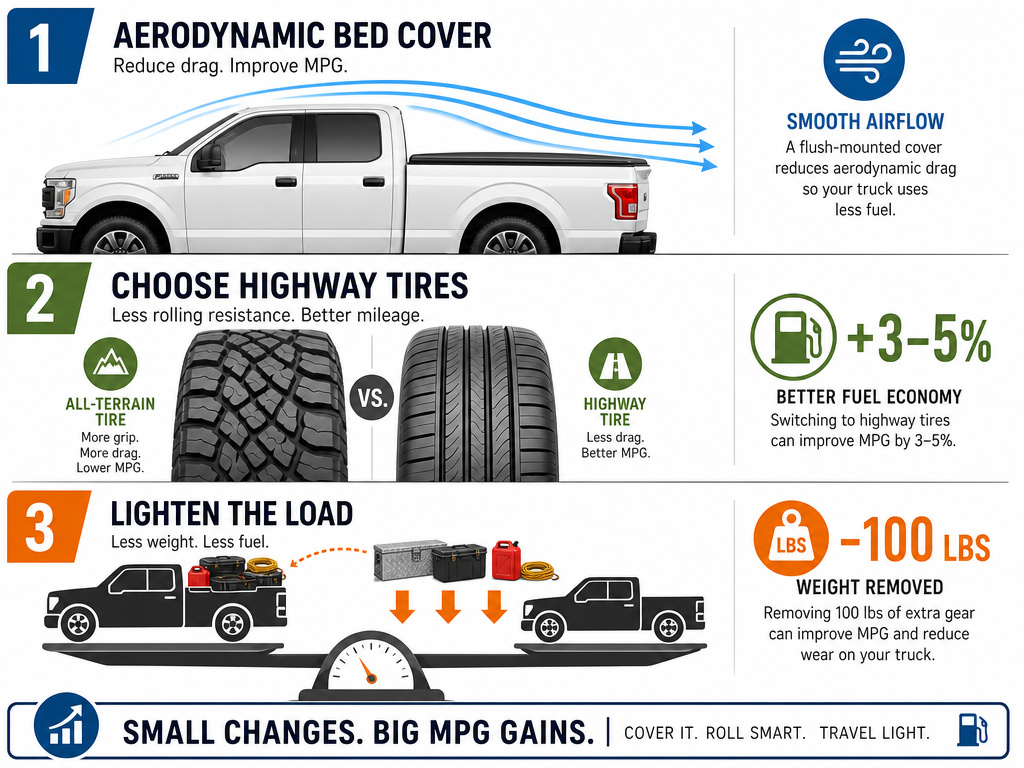 The engine is the biggest factor, but it’s not the only one. Three supporting modifications can add meaningful mileage, especially for the diesel and hybrid trucks already at the top of the chart.
First, aerodynamics. A truck’s bed is a giant air brake. Adding a tonneau covers, especially a hard, flush-fitting model, reduces turbulent drag. At 70 MPH, this can be worth an extra 1-2 MPG. For a diesel truck that might see 30,000 highway miles a year, that’s 60+ gallons of fuel saved.
Second, rolling resistance. Factory tires are a compromise. Switching to a highway-focused, low-rolling-resistance tire can improve mileage by 3-5%. The catch is you’ll sacrifice wet grip and tread life. This is a direct example of how tire size impact on fuel economy plays out; bigger, heavier all-terrain tires can tank your MPG.
Third, weight. It’s simple physics. Every extra 100 pounds requires more energy to move. Strip out unused tools, opt for a lighter truck bed cap if you need storage, and be ruthless about what you leave in the cab. A clean, light truck is a frugal truck.
The Most Efficient Truck for Your Actual Life
So, which one should you buy? The answer isn’t in the brochure. It’s in your garage logbook.
For the long-haul driver, the diesel’s math is compelling. The higher purchase price and cost of diesel fuel are offset by its unshakeable highway mileage and massive torque. It’s the choice for the owner who views their truck as a high-mileage asset. The Chevrolet Silverado 1500 3.0L Duramax is the default pick here.
For the mixed-use driver who values versatility, the hybrid is the tool. The Ford F-150 PowerBoost hybrid won’t win a hypermiling contest, but it will tow a boat on Saturday, power a tailgate on Sunday, and commute quietly on Monday. Its fuel economy is good enough, and everything else it does is exceptional.
If you just need a basic truck for occasional duties, the most fuel-efficient move might be the smallest gasoline V6 you can find, paired with a two-wheel drive chassis. Don’t pay for technology you won’t use. Sometimes the most efficient truck is the one that costs least to own, not the one with the highest EPA number.
Frequently Asked Questions
Do diesel trucks really get better fuel economy than hybrids?
Yes, in steady-state highway driving, modern turbo-diesel engines like the 3.0L Duramax are more thermally efficient than gasoline-electric hybrid systems. The hybrid’s advantage is in city and mixed driving, where regenerative braking and electric assist recover energy that a diesel simply wastes as heat.
How much does a tonneau cover improve MPG?
Smooth, hard tonneau cover can improve highway fuel economy by 1-2 MPG for a full-size pickup by reducing aerodynamic drag. The gain is most noticeable at speeds above 55 MPH. Soft covers or partial covers provide a smaller, less consistent benefit.
Is the Ford PowerBoost hybrid reliable?
The Ford PowerBoost system, introduced in the 2021 F-150, is based on a familiar 3.5L EcoBoost V6 paired with an electric motor. Early reliability has been generally good, though it’s a more complex system than a standard gasoline engine. For long-term ownership beyond 150,000 miles, a simpler reliable trucks platform like a naturally aspirated V8 may have an edge.
What is the most fuel-efficient full-size truck with four-wheel drive?
The efficiency crown for 4WD models still generally goes to the diesel. A 4WD Chevrolet Silverado 1500 with the 3.0L Duramax is EPA-rated at 23 MPG combined. The Ford F-150 PowerBoost 4WD is close behind at 22 MPG combined. The 4WD system adds weight and drivetrain friction, pulling down all ratings.
Does cylinder deactivation save a meaningful amount of gas?
Yes, but not a transformative amount. Systems like GM’s AFM can improve highway fuel economy by roughly 5-10% when activated. However, they only function under light load on flat roads. For many drivers, the real-world fuel savings might average out to half an MPG over a year of mixed driving.
Before You Go
Chasing the highest MPG in a full-size truck is an exercise in compromise. The diesel wins the number but asks for more money and patience at the pump. The hybrid wins the versatility award but gives up a few miles per gallon. The turbo-four promises efficiency but often fails to deliver under real truck workloads.
Your mission is to match the engine to your mileage pattern. If your odometer spins fast on open highway, the diesel’s premium pays for itself. If your driving is a scattered mix of tasks, the hybrid’s jack-of-all-trades nature is the smarter buy. And if you just need a simple truck, the most fuel-efficient choice might be the one that costs the least to drive off the lot.
