
Tire Size: Does It Really Matter? Load Ratings & Tolerance Rules
This post contains affiliate links. As an Amazon Associate, we earn from qualifying purchases.
Changing your vehicle’s tire size is a mechanical and legal equation governed by three fixed variables: the load rating must meet or exceed the Gross Axle Weight Rating (GAWR), the rolling circumference must stay within a +/- 3% tolerance to avoid electronic system errors, and the speed rating must match or exceed the vehicle’s capability. Swap any of these incorrectly and you risk a ticket, a system failure, or an overloaded tire blowout.**
That +/- 3% figure is the engineering tolerance from Continental Tire’s technical bulletin where vehicle stability control, anti-lock brakes, and your speedometer are calibrated. Go beyond it and the computer’s assumptions about wheel speed fall apart.The same goes for the load rating math, federal law requires a specific calculation, especially when putting passenger car tires on trucks or SUVs.
What follows is a breakdown of the federal regulations, the engineering specs, and the real-world consequences of getting this wrong. By the end, you’ll be able to read your door jamb placard, decode any tire sidewall, and know exactly what you can and cannot swap.
Key Takeaways
- Federal law (49 CFR § 571.110) mandates that the total load capacity of tires on an axle must meet or exceed the vehicle’s Gross Axle Weight Rating (GAWR). For passenger car tires used on trucks or SUVs, that load rating must first be divided by 1.10.
- A change in overall tire rolling circumference greater than +/- 3% can corrupt signals to your ABS, stability control, and speedometer, according to manufacturer engineering bulletins.
- The load index and speed rating on your tire’s sidewall are non-negotiable minimums. Installing a tire with a lower load index than your original equipment is illegal and dangerous.
- “Plus sizing”, using lower-profile tires on larger-diameter wheels, is only safe if the new tire’s load capacity at the manufacturer’s recommended pressure equals or exceeds the original, and the overall diameter stays within the 3% window.
- Your vehicle’s tire information placard, located on the driver’s door jamb or pillar, is the legal baseline. Any deviation starts there.
The Legal & Safety Equation: Load Rating and GAWR
Forget about looks for a second. The first question any tire shop should ask is whether the new tires can legally carry the weight of your vehicle. This isn’t about opinions; it’s codified in FMVSS 110 tire selection standard.
The rule is simple on the surface: the sum of the maximum load ratings of the tires on an axle must not be less than the Gross Axle Weight Rating (GAWR) listed on your vehicle’s certification label. Find your GAWR on the same door jamb placard that lists tire pressures. If your front GAWR is 2,800 lbs, the two front tires together must be rated to carry at least 2,800 lbs.
Where this goes sideways: Using a passenger car tire on a truck, SUV, or trailer. Federal law requires a derating calculation: you must divide the tire’s load rating by 1.10 before checking it against the GAWR. A tire rated for 1,500 lbs is legally considered a 1,364 lb tire in this application. Miss this step and your math is dangerously wrong.
| Vehicle Type (GVWR) | Governing Regulation | Key Load Rule | Common Pitfall |
|---|---|---|---|
| ≤ 10,000 lbs (Cars, Light Trucks) | FMVSS 110 (49 CFR § 571.110) | Tire load sum ≥ GAWR. Passenger tires on trucks derated by 1.10. | Assuming a P-metric tire’s sticker load applies directly to an SUV. |
| > 10,000 lbs (Heavy Trucks, Buses) | FMVSS 120 tire standard (49 CFR § 571.120) | Same load-sum rule, with exemptions for very low-speed vehicles. | Applying light-vehicle assumptions to commercial rigs. |
The load index on your tire’s sidewall, that two- or three-digit number before the speed rating letter, is your lookup key. A load index of 91 means 1,356 lbs per tire. You need to confirm this capacity is available at the manufacturer’s recommended inflation pressure, not the tire’s maximum pressure. This is why tire width alone is an unreliable guide; a wider tire with a lower load index is worse than a narrower, stronger one.
Speed Rating and Rolling Circumference: The Electronic Toll
Your car’s computers assume a fixed relationship between wheel rotation and road speed. Change the tire’s overall diameter, and you change its revolutions per mile. This is called rolling circumference.
Continental Tire’s plus-sizing bulletin states a change within plus or minus 3% typically does not require adjustments to speedometer calibration, ABS, or stability control systems. Exceed that, and you’re asking the computer to interpret faulty data.
A larger diameter tire rotates fewer times per mile. Your speedometer will read slower than you’re actually going. More critically, systems like traction control and anti-lock brakes compare wheel speeds across the axle to detect slip. If all four tires are equally wrong, the system might adapt. But if you only change two tires, or if the change is beyond tolerance, the system can trigger false interventions or fail to intervene when needed.
The 3% rule is your guardrail. This is why simply changing tire size without calculating the new diameter is a rookie mistake. The speed rating, the letter at the end of the service description like ‘V’ or ‘W’, is equally binding. It indicates the maximum speed the tire can sustain under its rated load. Going lower than the vehicle’s original rating is a direct safety compromise, especially for high-performance or heavy vehicles.
Plus Sizing & Practical Swaps
“Plus sizing” means increasing wheel diameter while lowering the tire’s aspect ratio (the middle number in the size code) to maintain a near-identical overall diameter. The goal is better handling and looks without breaking the rules above.
The checklist for a valid plus-size is strict: 1. Load Capacity: The new tire’s load capacity at the vehicle manufacturer’s recommended pressure must be equal to or greater than the original. 2. Inflation Pressure: You must never use a pressure lower than the OE recommendation, even if the new tire can carry the load at a lower psi. 3. Clearance: You must check full wheel articulation, steering lock-to-lock, and under load for rub. This includes accounting for “tire growth” at highway speeds.
Common mistake: Assuming a lower-profile tire is inherently “stronger” or can handle a lower pressure. The load capacity is determined by the tire’s construction and inflation, not the profile height. An XL (Extra Load) or Reinforced tire might have a higher load index at the same size, which is often the key to a successful plus-size.
Here’s how a typical plus-size calculation works, using common sizes:
| Original Tire | Plus-Size Target | Diameter Change | Load Index Check | Fits 3% Rule? |
|---|---|---|---|---|
| P215/60R16 95H | 235/55R17 99V | +0.3% | 95 → 99 (Higher) | Yes |
| P225/55R17 97V | 245/45R18 96Y | -1.1% | 97 → 96 (Slightly Lower) | No – Load index decreased. |
| 265/70R16 112S | 285/65R17 116S | +0.9% | 112 → 116 (Higher) | Yes |
The second example fails. Even though the diameter change is within 3%, the load index dropped from 97 to 96. That one-point drop could mean a difference of several pounds in load capacity, breaking the first rule. This is why eyeballing it doesn’t work. You need the spec sheets.
What You Can’t Do: Mixing, Mismatching, and Ignoring the Placard
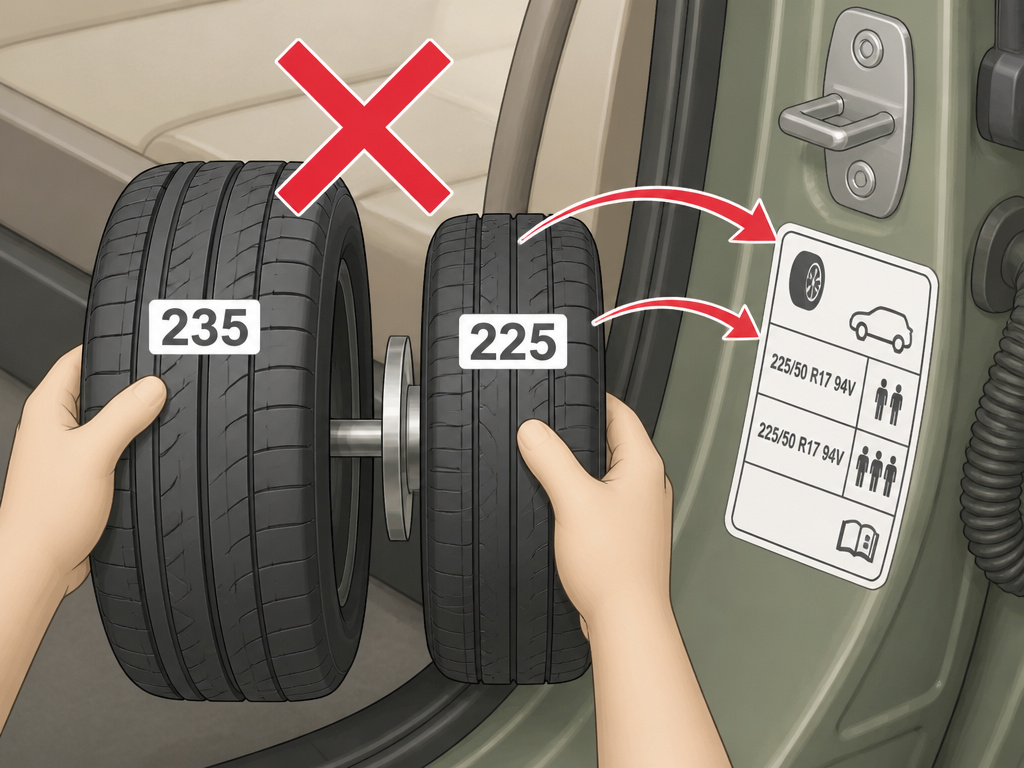
The door jamb placard isn’t a suggestion. It’s the vehicle manufacturer’s certified specification for safe operation. Deviating from it shifts liability to you and your tire shop.
- Don’t mix sizes across an axle. This should be obvious, but it’s a common cause of differential wear and electronic system faults.
- Don’t mix different size tires front to rear without confirming the vehicle supports a “staggered” fitment. Many all-wheel-drive systems are particularly sensitive to diameter differences front-to-rear and can be damaged.
- Don’t assume a “similar” size is okay. A 235-width tire is not a direct swap for a 225 just because it fits the rim. The load index and overall diameter must be checked.
- Don’t use a tire with a lower speed rating than original. If your SUV came with an ‘S’ (112 mph) rating, dropping to an ‘H’ (130 mph) is fine, but dropping to a ‘T’ (118 mph) might not be if the vehicle is rated for higher speeds.
This discipline applies to everything from a sports car to an ATV tire size selection. The principles of load, diameter, and speed are universal.
When a Professional Should Do It
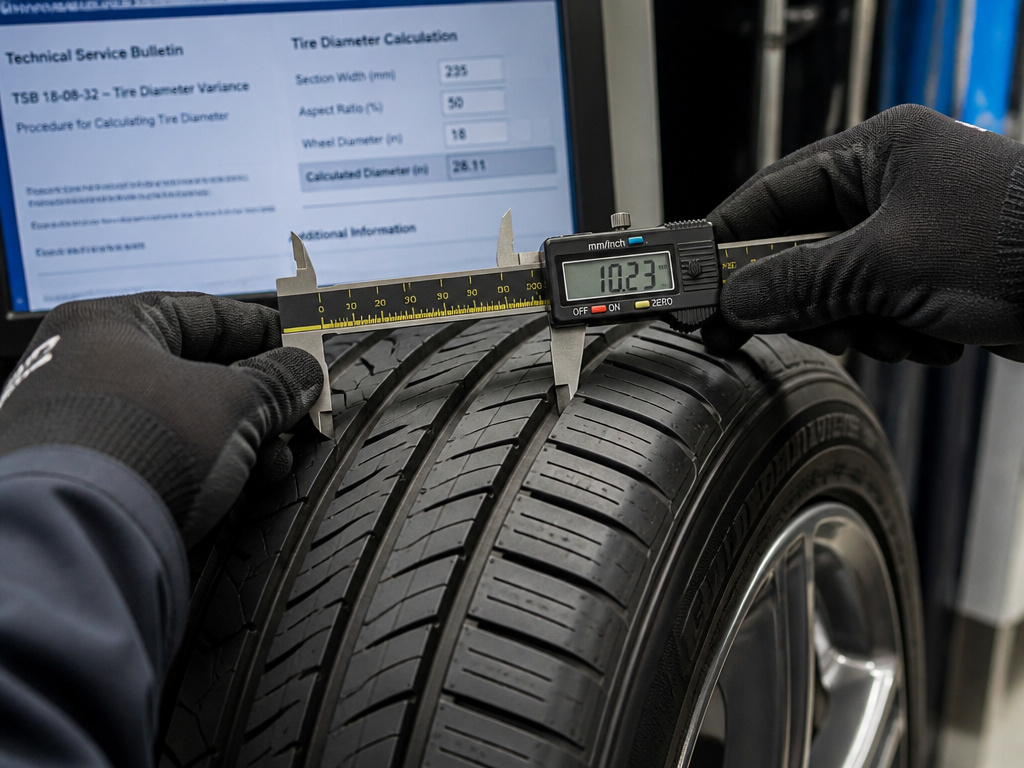
You can look up tire specs and run the diameter calculations yourself. But the final authority should be a certified tire technician or the vehicle manufacturer. Why?
They have access to the technical service bulletins for your specific model. They know if your stability control system is hypersensitive to diameter changes. They can perform a test fit and check clearances under compression and at full steering lock. They are also the ones assuming liability if they install an illegal or unsafe combination.
If you’re moving beyond a direct, like-for-like replacement, a pro is your best insurance. This is especially true for grand touring tires or performance-oriented directional tires, where tolerances are tighter and the consequences of a mistake are more pronounced.
Frequently Asked Questions
Can I put a taller tire on my truck for off-road ground clearance?
Maybe, but you’re immediately flirting with the 3% rolling circumference limit. A taller tire will slow down your speedometer and may require reprogramming. More critically, you must ensure the new tire’s load rating meets or exceeds the original at your placard’s recommended pressure. The larger contact patch doesn’t automatically mean more load capacity.
Does a higher load index tire give a stiffer ride?
Often, yes. Tires with a higher load index (like XL or Reinforced) have stiffer sidewalls to handle the extra weight. This can translate to a firmer ride on a light vehicle. It’s a trade-off between capacity and comfort.
My car allows three approved tire sizes on the door placard. Are they all equal?
They are all legal, but they may not be equivalent. One might be a standard touring tire, another a performance summer option, and a third a winter tire size. The tire speed rating and load index will differ. Always match or exceed the specifications for the axle position you’re filling.
I have a slow leak. Can I just replace the one bad tire with a different, matching size?
If the tread depth difference between the old and new tire is significant (more than 2/32″), it is inadvisable, especially on all-wheel-drive vehicles. The diameter difference can strain drivetrain components.For a safe tire repair or replacement, consult a professional.
The Bottom Line
Tire size matters because physics and the law say it does. The load rating keeps you safe from a blowout, the rolling circumference tolerance keeps your electronics honest, and the speed rating matches your vehicle’s potential. Your door jamb placard is the contract; any change must satisfy its terms through verified math, not guesswork.
The most common failure is focusing on width and appearance while ignoring the load index and diameter. That’s how people end up with a sharp-looking setup that wears out their differential in 20,000 miles or triggers constant stability control lights. Do the homework, run the numbers, and when in doubt, trust a pro with the spec sheets in hand. Your safety and your vehicle’s health depend on it.
