
Does Tire Width Matter | The 7% Tolerance That Decides
This post contains affiliate links. As an Amazon Associate, we earn from qualifying purchases.
Tire width matters because it decides your vehicle’s grip, wear pattern, and load capacity. The critical number is the section width, measured from sidewall to sidewall on a specified rim. Federal law allows actual width to exceed the marked size by only 7%, a tolerance that decides whether a wider tire fits your wheel well or rubs on full lock.
That 7% figure isn’t a suggestion. It’s the ceiling in the Federal Motor Vehicle Safety Standard 139 for light-vehicle tires. Go over it, and the tire is out of spec, the speedometer is off, and the fender liner gets chewed through on the first hard corner. Width changes everything from the contact patch to the fuel pump.
What follows: the federal test procedure that defines width, the ISO formula that matches rim to tire, and the three trade-offs that make a 10mm change the difference between planted and problematic.
Key Takeaways
- The legal section width of a tire is measured on a specific measuring rim after a 24-hour conditioning period, per 49 CFR 571.139.
- Actual width cannot exceed the marked size by more than 7% (or 10mm for metric tires), this tolerance decides fitment.
- Rim width is non-negotiable. For a 45-series tire, the ISO 4000-1 standard limits rim width to 0.8–0.95 times the measuring rim width code.
- Wider tires increase lateral grip but can cause accelerated center wear if over-inflated and hurt fuel economy through higher rolling resistance.
- Load capacity is king. Never fit a tire with a lower Load Index than the original, regardless of width.
How Tire Width is Actually Measured (It’s Not the Tread)
Forget the tread. The official width that matters for fitment and regulation is the section width. This is the linear distance between the exteriors of the tire’s sidewalls, excluding any raised lettering or protective ribs.
The government doesn’t guess. Under 49 CFR 571.139, a tire must be mounted on its designated measuring rim, inflated to a set pressure (180 kPa for standard load), and conditioned at room temperature for at least 24 hours. A technician then uses a caliper to take six measurements around the circumference, avoiding any special ribs. The average of those six points is the official section width.
Where this goes sideways: Measuring a tire off the rim or right after inflation. The rubber needs a full day to relax into its final shape on the metal. A fresh mount can read 3-4mm narrower than the true, settled section width.
The overall width includes those sidewall decorations. It’s always a larger number. For fitment checks, especially tight fender or strut clearance, you need the overall width. The manual for your car or the tire size selection guide for your vehicle will specify which dimension to use.
The Federal Tolerance That Catches Owners Off Guard
Here’s the rule that stops a simple width change from becoming a garage project. The actual section width of a production tire cannot exceed the size designation marked on its sidewall by more than 7%.
For tires with maximum pressures of 240 kPa and above, the tolerance is 7% or 10 millimeters (0.4 inches), whichever is larger. This is straight from S6.1.2 of FMVSS 139 tire standard.
| Marked Tire Size | Maximum Allowable Actual Width (7% Rule) | What Happens at 8% Over |
|---|---|---|
| 205 mm | 219.35 mm | Likely rubs on inner fender liner at full steering lock. |
| 235 mm | 251.45 mm | Speedometer error exceeds 3%, may contact suspension components. |
| 275 mm | 294.25 mm | Exceeds design clearance, risks tire disablement under hard cornering. |
This tolerance exists because rubber compounds and construction vary. But it also means two “235mm” tires from different brands can differ by over 15mm in actual width. That’s why test-fitting a single wheel is non-negotiable before buying a full set. The importance of tire size is in these real millimeters, not the marketing name.
Rim Width: The Partner You Can’t Ignore
Tire width doesn’t exist in a vacuum. It’s a function of the rim it’s mounted on. A 235mm tire on a narrow rim balloons outward, creating a rounded profile. On a wide rim, the same tire gets pulled taut, squaring the shoulder and effectively increasing its section width.
Standards bodies provide approved rim width ranges. The ISO 4000-1:2024 standard gives coefficients. For a tire with a 45-series aspect ratio, the approved rim width is between 0.8 and 0.95 times the measuring rim width code.
Example: A tire with a measuring rim width code of 8 inches has an approved rim range of 6.4 inches (0.8 x 8) to 7.6 inches (0.95 x 8). Mount it on a 9-inch rim, and you’re outside the industry-approved combination.
The Continental Plus-Sizing guide states CTNA “does not approve the use of any tire size – rim width combination outside of the applicable standards such as TRA, ETRTO or JATMA.” Go outside the range, and you affect wear, handling stability, and tire durability. The sidewall flex becomes unpredictable.
This is the core of plus-sizing, installing lower aspect ratio tires on wider, larger-diameter rims. It’s not just for looks. The goal is to maintain the original rolling circumference while increasing the width of the contact patch. But you must stay within the approved rim width for the new tire size. Every time.
The Load and Pressure Equation
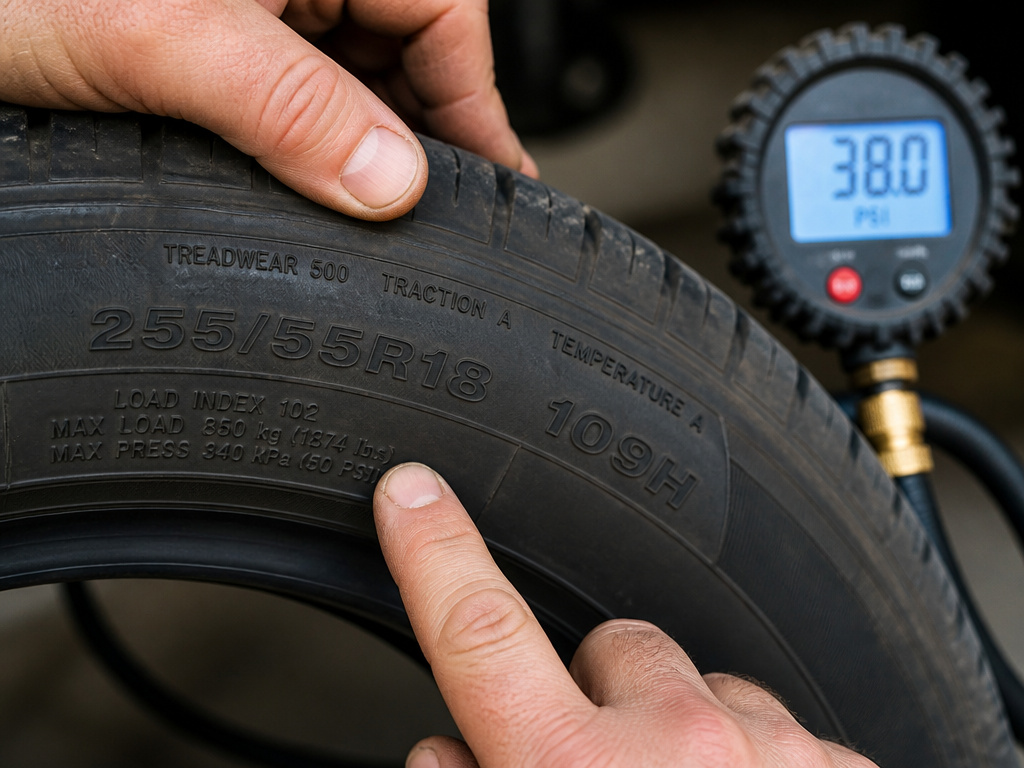
Width alone does not carry weight. The Load Index does. This is the most critical and misunderstood relationship.
A wider tire does not automatically have a higher load capacity. A 225/65R17 with a Load Index of 102 carries 1,874 lbs. A 245/55R17 might have a Load Index of 100, carrying only 1,764 lbs, it’s wider but weaker. You must check the sidewall.
Federal law is blunt. The FMVSS 110 tire selection standard requires that the “vehicle maximum load on the tire shall not be greater than the applicable maximum load rating as marked on the sidewall of the tire.” Never go lower than the original equipment specification.
Common mistake: Assuming a wider aftermarket tire automatically handles more weight. Check the Load Index first. Always.
Inflation pressure is the lever for load capacity. The pressure on your door placard is for the original tire size and type. If you change width or switch from Standard Load (SL) to Extra Load (XL), the pressure must be recalculated to maintain the original load capacity. The Bridgestone Replacement Manual warns: “Substitute tires should never be inflated below the pressure shown on the vehicle tire placard.”
For passenger car tires installed on a light truck or SUV, the rules get stricter. The load rating must be reduced by dividing by 1.10 before checking if it meets the axle’s Gross Axle Weight Rating (GAWR). This derating is in both FMVSS 110 and FMVSS 120 tire standard.
The Real-World Trade-Offs: Grip, Wear, Efficiency
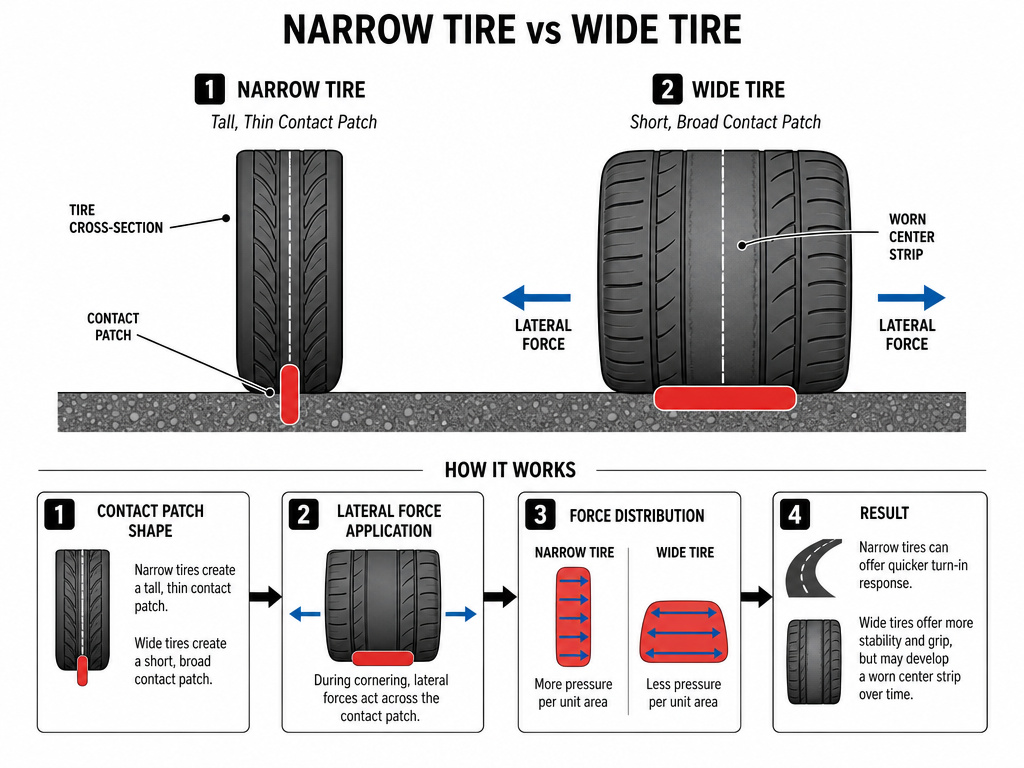
So you’ve matched the rim, respected the load, and stayed within the 7% tolerance. Now what does the width actually do?
Lateral Grip Improves. A wider tire has a broader contact patch when the car is leaning in a corner. This increases lateral stiffness and grip, reducing understeer. This is why performance and sport models always come with the widest tires that fit.
Center Wear Can Accelerate. That same broad patch, if over-inflated, crowns in the center. The middle strips wear out long before the shoulders. You need a tire pressure gauge and discipline to keep pressure exact. Over-inflate a wide tire by 5 psi, and you’ll see cord at 15,000 miles.
Rolling Resistance Rises. More rubber on the road creates more friction. The engine works harder to overcome it, dropping fuel economy by 1-3 MPG on a typical sedan. The trade-off for cornering power is more frequent stops at the pump.
Steering Feel Heavens. The steering rack fights more surface area. The wheel feels heavier at low speeds, and the tramlining effect, where the tire follows pavement grooves, becomes more pronounced. It’s not a defect. It’s physics.
When a Width Change Makes Sense (And When It Doesn’t)
Use this matrix. It commits.
| Your Goal | Recommended Width Change | Critical Check | What to Avoid |
|---|---|---|---|
| Better Dry Cornering | Increase by 10-20mm (e.g., 205 → 225) | Fender clearance at full compression and lock. | Exceeding the approved rim width range. |
| Smoother Ride / Less Noise | Decrease by 10mm (e.g., 235 → 225) | Load Index remains equal or greater. | Going so narrow you compromise braking stability. |
| Heavier Towing / Payload | No change. Increase Load Index. | Ensure new tire’s max load > old tire’s max load at placard pressure. | Assuming width adds strength. It doesn’t. |
| Winter / Snow Traction | Decrease width for higher pounds-per-square-inch to cut through snow. | Overall diameter stays within 3% of original. | Wide, low-profile winter tires. They float. |
For a daily driver, the best upgrade is often the factory optional size. The carmaker has already tested it for clearance and calibration. For a dedicated sports car, the aftermarket has wider directional tires and grand touring tires that fit the mission. For an SUV, a proper crossover tire in the correct width will always outperform an ill-fitting truck tire.
The aspect ratio, the middle number, works with width. A width increase with an aspect ratio decrease (a “plus-size”) keeps the overall diameter stable. That’s the smart path.
Frequently Asked Questions
Does a wider tire improve braking distance?
Not reliably on the street. Braking is primarily a function of tire compound, temperature, and proper inflation. A wider, harder tire can actually brake worse than a narrower, stickier one. Track testing shows brake distance improvements come from stickier rubber, not more of it.
Can I put a 235 tire on a 225 rim?
Maybe, but you shouldn’t. A 235 tire has a specific approved rim width range, usually starting around 7.5 inches. A 225 rim is likely 7.0 inches wide. Mounting the 235 on the narrower rim will over-stretch the bead area, creating a bulbous profile that hurts handling and risks bead damage. Always match the tire to the rim’s width, not the other way around.
Why do some wide tires wear out so fast?
Two reasons. First, performance wide tires use softer compounds for grip, which sacrifice longevity. Second, wide tires are more sensitive to incorrect pressure. Even 3 psi over spec focuses all the wear on a thin center strip, destroying the tread in half the expected time. Check pressure monthly with a quality gauge.
Do wider tires affect my speedometer?
Yes, if you change the overall diameter. The speedometer reads wheel revolutions. A wider tire with the same aspect ratio (like a 225/50 to a 245/50) is also taller. That larger diameter means fewer revolutions per mile, causing the speedometer to read slower than your actual speed. Always calculate the new diameter before buying.
Are fat tires always better for off-road?
For flotation in sand or mud, yes, think fat tire bikes or sand buggies. For rock crawling or technical trails, a narrower tire can sometimes provide better sidewall stability and a more precise footprint to grip edges. It’s about ground pressure, not just width.
The Bottom Line
Tire width matters, but not as an isolated number. It matters as part of a system: the rim that holds it, the load it must carry, and the 7% federal tolerance that governs its real size. Changing width changes the car’s personality, for better or worse.
The safe move is to stick to a factory-approved optional size. The enthusiast move is to calculate, using the ISO rim coefficients and load tables, then test-fit a single wheel. The wrong move is to assume wider is always better. Your fuel bill, your inner fender liner, and the treadwear indicators will tell you the truth long before the cornering limits do.
Match the rim. Respect the load. Mind the 7%. That’s the width that works.
