
Can You Put Different Size Tires on Your Car? Risks & Rules
This post contains affiliate links. As an Amazon Associate, we earn from qualifying purchases.
You can put different size tires on your car only if the manufacturer designed it that way, known as a staggered fitment. For all other vehicles, mixing sizes can damage ABS sensors, cause unpredictable handling, and void warranties. The critical specs to match are load index, speed rating, and construction, not just the physical size.
That mismatch isn’t just about looks. Modern stability and braking systems rely on a precise, calibrated relationship between the front and rear wheel speeds. A variance in tire diameter, even a fraction of an inch, creates a data conflict the computer can’t resolve.
This guide walks through the three specs that actually matter, shows you the single OEM-approved exception, and details what physically breaks when you ignore the manual. You’ll also learn how to correctly match a replacement tire when the exact OEM model is discontinued.
Key Takeaways
- Staggered fitments are the only factory-sanctioned exception. Vehicles like the Porsche Taycan have different front and rear sizes from the factory; swapping those positions voids the design.
- Mismatched diameters confuse ABS and traction control. These systems compare wheel rotation speeds. A size difference reads as a perpetual skid, triggering erratic braking or power cuts.
- Load Index is not interchangeable between tire types. A P-metric tire with a load index of 94 carries a different load at 35 psi than a Euro-metric tire with the same index.
- If you must mix constructions, radials go on the rear. The only marginally safe mix is two radials on the back axle and two non-radials (bias-ply) on the front. Never split an axle.
- A new tire’s tread depth must be within 30% of its mate. On the same axle, a brand-new tire paired with a half-worn tire creates a handling imbalance severe enough to trigger stability control.
The Staggered-Fitment Exception (OEM-Approved)
Some performance and luxury cars leave the factory with different tire sizes on the front and rear axles. Porsche does this on models like the Taycan. The front might be a 225/55R19, while the rear is a wider 275/45R19. This isn’t a suggestion, it’s a calculated part of the vehicle’s balance.
Common mistake: Swapping a staggered set front-to-rear to “even out wear.” You ruin the engineered handling balance. The car will understeer heavily on entry and oversteer unpredictably on exit, because the front tires are now too wide and the rears too narrow for the suspension geometry.
The key is that the difference is designed in. The suspension, stability control programming, and even the gear ratios are calibrated for those specific rolling diameters. Putting the same size on all four corners on a car built for a stagger can actually reduce performance and safety.
What Happens if You Mix Different Sized Tires?
The problems start with the car’s computers and work their way out to the driver’s seat.
ABS and Traction Control Malfunction
Your anti-lock brake system (ABS) and electronic stability control (ESC) rely on wheel speed sensors. They expect all four wheels to rotate at nearly identical speeds during straight-line driving. If you have a larger-diameter tire on one axle, it covers more ground per revolution than the smaller tire on the other axle.
The sensor sees this speed difference and interprets it as a wheel locking up (for ABS) or spinning (for traction control). It will then pulse the brakes or cut power unexpectedly. The Honda owner’s manual states directly that using tires of a different size “can cause the ABS to work inconsistently.” You lose the smooth, predictable intervention these systems are supposed to provide.
Unpredictable and Dangerous Handling
A tire’s contact patch, sidewall stiffness, and slip angle are all tuned to its size. Mixing sizes shifts the car’s balance. A larger rear tire can make the car feel more stable in a straight line but cause it to “plow” or understeer in corners. A larger front tire can make the steering feel heavier and induce oversteer on throttle lift-off.
The Kia owner’s manual warns that using tires of a different size “can damage the related parts or make them work irregularly.” This includes stress on the differential, wheel bearings, and suspension components not designed for the uneven loading.
Speedometer and Odometer Inaccuracy
Your speedometer is calibrated based on the revolutions per mile of the original tire size. A larger overall tire diameter means fewer revolutions per mile, causing your speedometer to read slower than you’re actually traveling. A smaller diameter has the opposite effect. The Ford manual notes that changing tire diameter will affect speedometer accuracy. This isn’t just about getting a ticket; it throws off every mileage-based service interval.
| Problem | Primary Cause | Driver Feels |
|---|---|---|
| ABS Activation | Wheel speed sensor mismatch | Brake pedal pulses during normal stops |
| Erratic Traction Control | Perceived wheel slip on one axle | Power cuts during acceleration |
| Handling Imbalance | Differing front/rear grip levels | Car “plows” in corners or snaps loose |
| Premature Wear | Drivetrain & suspension stress | Vibration, noise, uneven tire wear |
The Three Tire Specs You Must Match (Beyond Size)
If your exact original tire is discontinued, you need to match more than just the three numbers on the sidewall. These three specs are non-negotiable.
1. Load Index: The Weight Capacity
The load index is a numerical code on the sidewall (e.g., 103T). It corresponds to the maximum weight the tire can carry at its maximum inflation pressure. This is critical for SUVs, trucks, and any vehicle that tows or carries heavy loads.
Where this goes sideways: Assuming a higher load index is always safe. According to Bridgestone’s replacement manual, a P-metric tire and a Euro-metric tire with the same load index (e.g., 94) can have different load capacities at the same inflation pressure. An equal or greater load index does not always mean equal or greater load capacity. You must check the manufacturer’s load tables.
For everyday driving, replacing a tire with one of a lower load index is a direct safety violation. The tire could overheat and fail under normal load.
2. Speed Rating: The Heat Tolerance
The speed rating (T, H, V, etc.) indicates the tire’s maximum sustained speed capability and, more importantly, its ability to dissipate heat at high speeds. A “V” rated tire is constructed with different materials and belts than a “T” rated tire to manage the heat generated at 149 mph.
Michelin Canada advises that if you must mix speed ratings, the lower-rated tires must go on the front axle. This is to prevent a dangerous oversteer condition. If the rear tires have a higher grip limit than the fronts, the car can spin more easily. Putting the lower-limit tires on the front promotes safer understeer.
3. Construction: Radial vs. Bias-Ply
Nearly all modern cars use radial tires. Mixing in an older bias-ply tire (sometimes found on trailers or classic cars) is a severe compromise. The handling characteristics are vastly different. If you have no other choice, Michelin states the two radials must be installed on the rear axle and the two bias-ply tires on the front. This placement helps maintain rear-end stability during braking.
How to Correctly Select a Replacement Tire
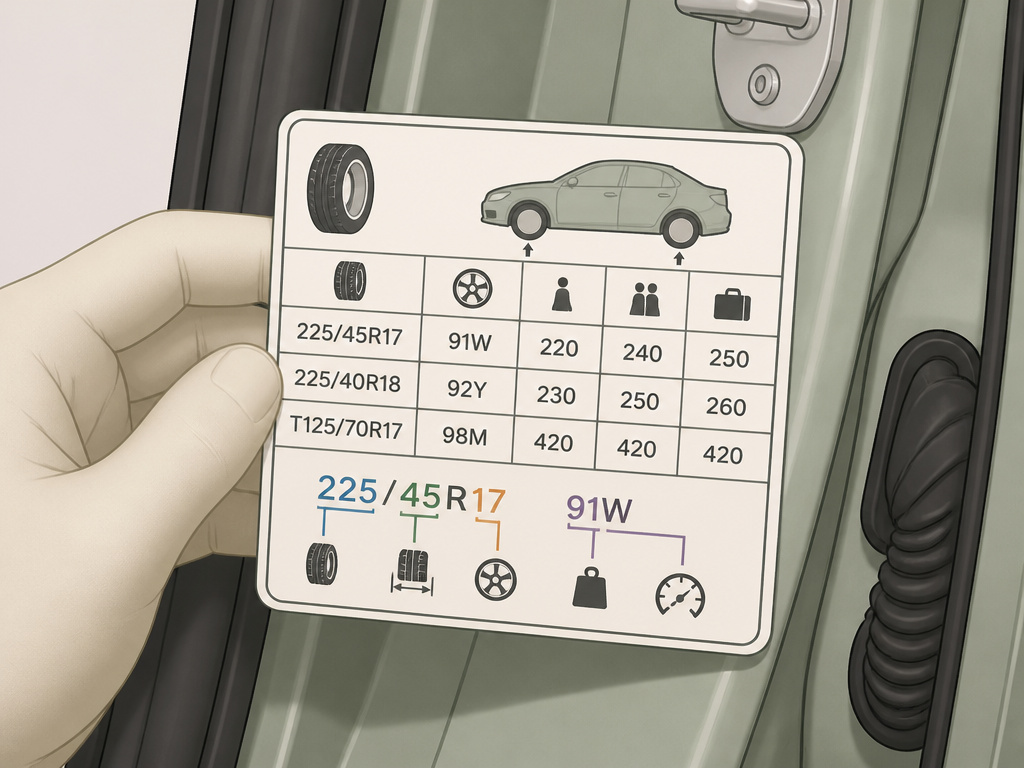
When your original tire size is gone, follow this sequence. It moves from the ideal match to the acceptable compromise.
Step 1: Find your vehicle’s placard. Look in the driver’s door jamb or glove box for the tire information sticker. It lists the exact OEM size, load index, speed rating, and recommended cold pressure. This is your bible.
Step 2: Match everything exactly. Search for a tire with the identical size designation, load index, and speed rating. This is the only way to guarantee full compatibility with your vehicle’s systems.
Step 3: If unavailable, match load and speed, then consult a tire pro. If the exact size is gone but the load index and speed rating are available in a different aspect ratio (like swapping a 275/60R20 for a 275/55R20), a professional can calculate the overall diameter difference. A change of 3% or less in overall diameter is generally considered the maximum safe variance. They can also advise on potential tire size differences and necessary speedometer corrections.
Step 4: Never compromise on load index. This is the hardest line. A lower load index is an immediate disqualifier. Understanding why tire size matters starts with this number, it’s the tire’s structural safety factor.
| Priority | Spec to Match | Why It’s Critical | Consequence of Mismatch |
|---|---|---|---|
| 1 | Load Index | Supports the vehicle’s weight | Overheating, belt separation, blowout |
| 2 | Speed Rating | Manages heat at highway speeds | Rapid tread wear, handling fade, failure |
| 3 | Construction (Radial) | Consistent handling response | Unpredictable grip, stability control errors |
| 4 | Overall Diameter (<3% diff) | Preserves drivetrain & computer calibration | ABS/traction faults, speedometer error |
The Tools and Knowledge You Need Before Buying
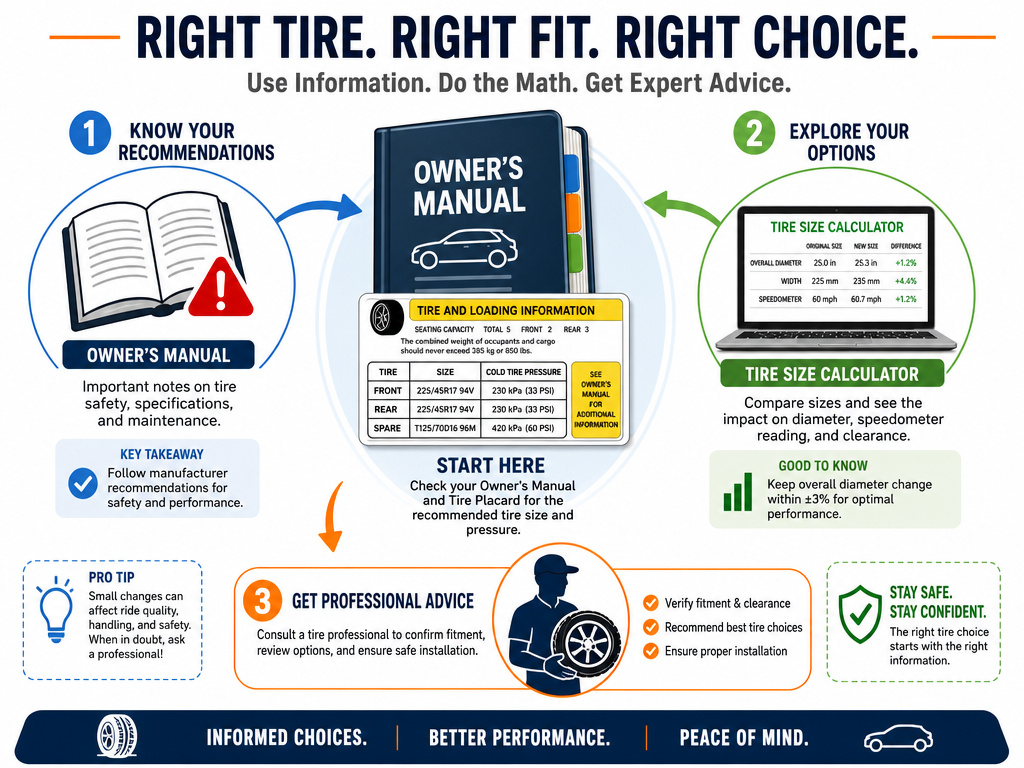
You don’t need many tools, but you do need the right information.
- Your owner’s manual. It has the final say. The Honda manual specifically warns that installing improper tires “can affect handling and stability. This can cause a crash.”
- A tire size calculator. Online tools let you input your OEM size and a potential replacement to see the percentage difference in diameter, width, and sidewall height.
- A tire professional. This is the most important tool. A good tire shop has access to industry fitment guides and technical bulletins, like the Porsche document detailing strict tire and rim width matching, that aren’t public knowledge. They can navigate the complexities of mounting 235-width tires on 225 rims or the performance trade-offs of switching from 255 to 265 width tires.
Before you shop for any passenger car tires or winter tires, have your placard information and owner’s manual in hand. It turns a confusing guess into a informed decision.
Frequently Asked Questions
Can I put a different size tire on the front only?
No. Replacing just one tire on a drive axle with a different size, even if the brand and model are the same, is dangerous. The diameter difference will cause the limited-slip differential or all-wheel-drive system to work overtime, leading to premature wear and potential failure. Always replace tires on the same axle in identical pairs.
Is a slight difference in tire width okay?
Maybe, but it depends entirely on the rim width and the manufacturer’s specifications. A slightly wider tire (e.g., going from a 225 to a 235) can sometimes fit on the same rim, but it changes the tire’s profile and contact patch. This can affect handling, speedometer accuracy, and may rub against the suspension or wheel well. Always consult a fitment guide or professional. The potential advantages of bigger tires come with these precise fitment challenges.
What if my car is old and the exact tire doesn’t exist anymore?
This is a common scenario for classic cars. The process remains the same: match the load index and speed rating first. Then, find a tire with the closest possible overall diameter (within 3%). You may need to select a different aspect ratio (the middle number in the size) to achieve this. A tire specialist who works with classic cars is invaluable here.
Do tire shops allow you to mix sizes?
Reputable shops will refuse to install mismatched sizes on a vehicle not designed for it. Their liability insurance won’t cover it, and they risk your safety. They are obligated to follow the vehicle manufacturer’s specifications. If a shop is willing to mix random sizes without a fitment guide, go somewhere else.
Can I put bigger tires on my car for looks?
You can, but it is a modification that requires research. You must consider the pros and cons of bigger tires, including potential suspension clearance, speedometer recalibration, and the impact on acceleration and fuel economy. It is not a simple bolt-on upgrade and should be done with a complete understanding of the changes to your vehicle’s dynamics.
Before You Go
Putting different size tires on your car is not a casual customization. For the vast majority of vehicles, it’s a direct path to compromised safety systems, uneven wear, and potentially expensive drivetrain damage. The rule is simple: replace with the same size, load index, and speed rating as your door placard specifies.
The single exception is the factory-staggered fitment, and even then, you don’t get to choose the sizes, the engineer does. When an exact match isn’t available, your next step isn’t a guess. It’s a consultation with a professional armed with your owner’s manual and the right fitment data. Your car’s computers are expecting a specific dance partner. Give them the right one.
