
Most Reliable Trucks | The J.D. Power Data That Upended GM
This post contains affiliate links. As an Amazon Associate, we earn from qualifying purchases.
The most reliable trucks for 2026, according to the J.D. Power U.S. Vehicle Dependability Study, are the Ram 1500 for full-size pickups and the Toyota Tacoma for midsize trucks. These rankings are based on problems reported per 100 vehicles (PP100) by original owners of three-year-old models, specifically the 2023 model year. The data shows a shift, with General Motors trucks losing their lead in both segments.
That shift from the top spot isn’t academic. It coincides with documented, specific failures in current models, failures that won’t show up in a three-year survey but absolutely shape ownership. The 2026 study highlights owner concerns about over-the-air software updates and phone integration, which are now directly linked to real-world stalling incidents in newer trucks. This guide breaks down the proven winners, the models that slipped, and the mechanical reasons behind both the ratings and the recent headlines.
Key Takeaways
- The Ram 1500 and Toyota Tacoma lead their segments in the 2026 J.D. Power study, which measures problems in three-year-old vehicles.
- General Motors full-size trucks (Chevrolet Silverado 1500, GMC Sierra 1500) now trail Ram, a change from previous years where they led.
- A March 2026 NHTSA recall for certain GM 3500-series trucks with dual fuel tanks cites an engine control module software flaw that can cause a stall, a concrete example of the “software update” issues the J.D. Power study notes.
- For diesel trucks, fuel system contamination is a primary failure point; a common repair for 2010-2016 Duramax models involves a 15.5-hour cleaning and flushing procedure per a federal technical service bulletin.
- True reliability weighs long-term survey data against current manufacturer bulletins and recalls; a truck with a great three-year score but an active safety recall is not currently reliable.
The 2026 J.D. Power Rankings Explained
The J.D. Power U.S. Vehicle Dependability Study is the industry benchmark for long-term quality. It surveys original owners of three-year-old vehicles about problems experienced in the prior 12 months. For the 2026 study, that meant owners of 2023 model-year trucks. Problems are measured as Problems Per 100 Vehicles (PP100), a lower score is better.
The 2023 Ram 1500 is the highest-ranked full-size pickup in the 2026 study. The 2023 Toyota Tacoma is the highest-ranked midsize pickup. The study specifically notes increased owner complaints regarding over-the-air software updates, phone integration, and electrified powertrains in the truck segment.
The results reveal a notable change. General Motors trucks, which previously led the large and midsize segments, have fallen back. The Ram 1500 now tops the full-size category, with the Chevrolet Silverado 1500 in second and the Ford F-150 tying the GMC Sierra 1500 for third. In the midsize arena, the previous-generation Toyota Tacoma holds its legendary position.
Why a three-year-old model matters. This lag is the study’s core value. It filters out the honeymoon period and captures how a truck’s components, from infotainment screens to transmission solenoids, hold up under real daily use. A glitchy touchscreen in a brand-new truck is an annoyance. That same screen failing to respond three years later, when you’re relying on it for navigation, is a reliability problem.
What “Problems Per 100 Vehicles” Actually Covers
The PP100 score isn’t just about breakdowns. It categorizes issues across eight areas: climate, driving assistance, exterior, features/controls/displays, interior, powertrain, seats, and driving experience. A rattling interior trim piece counts the same as a check-engine light in this metric. This is why trucks known for rugged, simple interiors often score well, there are fewer complex features to fail.
| Truck Model (2023) | Segment Rank | Key Strengths | Common Owner Gripes |
|---|---|---|---|
| Ram 1500 | 1st (Full-Size) | Ride quality, powertrain range, interior luxury | Fuel economy (non-diesel), towing capacity vs. Rivals |
| Toyota Tacoma | 1st (Midsize) | Durability, off-road capability (TRD), value | Unrefined ride, dated transmission, cramped interior |
| Chevrolet Silverado 1500 | 2nd (Full-Size) | Strong engine lineup, spacious bed, ZR2 off-road | Unrefined road manners, dated interior design |
| Ford F-150 / GMC Sierra 1500 | 3rd (Tied, Full-Size) | F-150: Configurability, hybrid option. Sierra: Luxury trims, Super Cruise. | F-150: Underwhelming interior materials. Sierra: High cost, no hybrid/electric option. |
The table shows a pattern. The top-rated trucks excel in core mechanical execution and day-to-day livability. The lower-ranked models, while often more capable on paper, draw complaints for interior refinement and complex tech, the exact categories where long-term problems often arise.
Reliability Isn’t Just About Age
Survey data is a rear-view mirror. It tells you what broke on trucks built three years ago. A complete picture requires looking through the windshield at what’s happening with current models. This is where manufacturer technical service bulletins (TSBs) and National Highway Traffic Safety Administration (NHTSA) recalls become critical. They are real-time diagnostics of emerging failure patterns.
A stark example is NHTSA Recall 26V129, filed in March 2026. It involves certain 2025-2026 Chevrolet Silverado 3500 and GMC Sierra 3500 trucks with gasoline engines and dual fuel tanks. The defect is an incorrect engine control module (ECM) software calibration.
Where this goes sideways: The faulty software can erroneously set diagnostic trouble codes during a normal fuel transfer between tanks. This disables the transfer pump. The fuel gauge still shows the combined volume from both tanks, but the engine can only access the primary tank. The driver sees a half-tank of fuel right before the truck stalls.
The chronology in the NHTSA recall campaign RCLRPT-26V129 is telling. GM’s investigation began in October 2025 after a systems engineer spotted a high occurrence of specific fault codes. By January 2026, the company had 20 complaints of stalling vehicles. This is a software and sensor integration failure, precisely the category of “over-the-air update” and “features/controls” problems that the J.D. Power study flagged as growing pain points.
This recall doesn’t affect the trucks in the 2026 study. Those are 2023 models. But it is a powerful indicator of where reliability headaches are forming for today’s buyers. It demonstrates that the industry’s push for complex, software-dependent systems is creating new failure modes that traditional durability testing might miss.
Diesel-Specific Reliability: The Fuel System Fight
If you’re considering a heavy-duty truck, the diesel engine is often the draw. Their reputation for longevity is earned, but it comes with a specific, non-negotiable maintenance requirement: immaculate fuel. Diesel reliability lives and dies by its high-pressure fuel system. Contamination is the enemy.
The Duramax 6.6L diesel in GM trucks is a workhorse. But models from the 2010-2016 period (LML, LGH engines) are known for a particular vulnerability. Debris in the fuel can cause a cascade of failures, triggering diagnostic codes like P0087 (Fuel Rail Low Pressure) and P0191 (Fuel Rail Pressure Sensor Performance).
The official fix for this is not a simple part swap. GM TSB 16-NA-102 outlines a comprehensive cleaning and flushing procedure for the entire fuel system. The NHTSA technical service bulletin details the repair, which mandates replacing specific components, cleaning all fuel lines, and flushing the tank and sender. The warranty labor time for this job on pickup trucks is 15.5 hours. That’s nearly two full days of shop time, underscoring the system’s complexity and the cost of neglect.
For any diesel truck, prevention is straightforward but critical: 1. Use high-quality fuel from reputable stations. 2. Replace the fuel filter at half the recommended interval if you frequently tow or drive in dusty conditions. 3. Never run the tank to empty, which can pull settled contaminants into the pump. 4. Consider an aftermarket fuel/water separator for severe service.
Skipping these steps doesn’t mean a breakdown next week. It means a gradual accumulation of microscopic abrasive particles in the fuel injectors and rail. The loss of power and efficiency is so slow you might not notice until a $4,000 injection pump replacement is the only fix left.
How to Use This Information When Shopping
You’re not buying a data point. You’re buying a specific truck. The ratings and bulletins are tools to narrow your search and ask the right questions. Here’s how to apply them.
First, lock in your use case. Are you towing a 10,000-pound trailer weekly, or just needing a cab for hardware store runs? A half-ton like the Ram 1500 or Ford F-150 is likely sufficient. For heavy, constant towing, a 3/4-ton or 1-ton truck with a diesel is the only responsible choice. Remember, drivetrain choice impacts complexity; a simpler 2WD vs 4WD system has fewer parts to maintain, though less capability.
Second, research the exact model year and powertrain. Don’t just search “Ram 1500 reliable.” Search “2023 Ram 1500 5.7L eTorque problems” or “2022 Ford F-150 PowerBoost hybrid recalls.” Look for patterns. Three forum posts about a weird transmission shudder might be an anomaly. Fifty posts about the same issue is a pattern.
Third, get a pre-purchase inspection from a specialist. This is non-negotiable for used diesels. Ask the mechanic to specifically check for fuel system diagnostics history and to look for signs of uneven tire wear, which can indicate worn suspension components masking themselves as alignment issues.
Finally, factor in the cost of consumables. A truck’s true cost includes tire replacement schedules and whether it requires expensive, proprietary all-terrain tires for optimal performance. The most reliable truck in the world still needs tire rotation and brake service.
The Verdict: Which Truck Should You Buy?
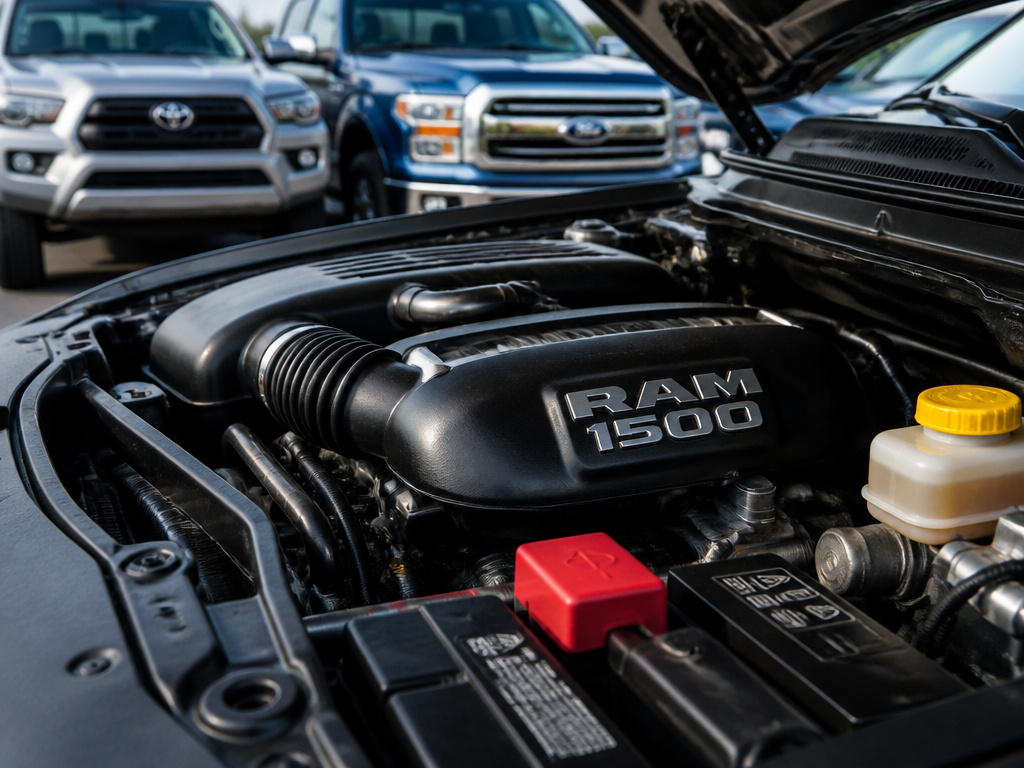 This isn’t a cop-out. Based on the 2026 data, real-world failure trends, and long-term ownership costs, here is the default pick for most people.
For the majority of users who need a full-size truck for occasional towing and daily driving, the Ram 1500 is the current benchmark. Its top-tier dependability score combined with its best-in-class interior and ride quality makes it the most balanced package. If your needs are smaller and you prioritize legendary longevity over comfort, the Toyota Tacoma (previous generation) remains the undisputed midsize king.
There are clear exceptions. If you need maximum integrated tech and a hybrid, the Ford F-150 PowerBoost is compelling, but acknowledge its slightly lower dependability score. If you require a heavy-duty truck, understand that the diesel powertrain in the Chevrolet Silverado 2500HD or Ram 2500 is a commitment to meticulous maintenance, their capability is unparalleled, but so is the repair bill if you neglect the fuel system.
The goal is to match the truck’s proven strengths to your actual life. A reliable truck isn’t the one that never has a problem. It’s the one whose problems are known, manageable, and worth the capability it provides.
Frequently Asked Questions
What is the #1 most reliable truck of all time?
While “of all time” debates are endless, the Toyota Hilux holds a near-mythical status for global durability. In the North American market, the previous-generation Toyota Tacoma (2016-2023) and the Ford F-150 with the 5.0L V8 or the 6.7L Power Stroke diesel have consistently demonstrated exceptional long-term survival rates, often clocking over 300,000 miles with proper care.
Are newer trucks less reliable than older ones?
They are more reliable in terms of major mechanical failures (e.g., engines seizing, transmissions disintegrating). However, they are more prone to complex electronic and software issues. An older truck might need a new alternator; a newer truck might need a firmware update for its braking module. The nature of problems has shifted from purely mechanical to integrated software-mechanical.
How important is the J.D. Power Dependability Study?
It’s an essential, standardized benchmark. It provides a direct comparison across brands using the same methodology. However, treat it as one data point among several. Also consult model-specific forums, NHTSA recall databases, and reliability metrics from sources like Consumer Reports for a rounded view.
Is a diesel truck more reliable than a gas truck?
For high-stress, high-mileage work like constant towing, a modern diesel is more durable and efficient. Its components are built stronger. For lighter, daily-driver use with shorter trips, a gas engine is often more reliable because it avoids the complex, emissions-sensitive, and contamination-prone high-pressure fuel system that defines modern diesels.
What is the most reliable full-size truck for towing?
The Ford F-250/F-350 Super Duty with the 6.7L Power Stroke diesel consistently ranks highest for heavy-duty towing reliability. Its combination of massive torque, a robust transmission (the TorqShift 10-speed), and a strong frame is engineered for constant stress. The Chevrolet Tahoe and Jeep Grand Cherokee are capable SUVs, but for serious, continuous towing, a dedicated heavy-duty pickup is in a different league.
The Bottom Line
Reliability is a story told in two chapters. The first chapter is written by surveys like J.D. Power’s, summarizing the past. The second chapter is being written right now in dealer service bays and NHTSA investigations, forecasting the future. The 2026 data crowns the Ram 1500 and Toyota Tacoma based on three-year-old evidence, but it simultaneously flashes a warning light about software and integration quality.
Your job is to read both chapters. Choose a truck with a strong historical record, then vet the specific model year and powertrain against the latest technical bulletins. Whether you choose the comfortable Ram, the rugged Tacoma, or a capable heavy-duty diesel, let the data inform your choice, but let your actual needs make the final decision. The most reliable truck is the one that works for you, year after year, without drama.
