
Are Tire Rotations Free? Where You Pay & Where You Don’t
This post contains affiliate links. As an Amazon Associate, we earn from qualifying purchases.
Tire rotations are free at many national tire retailers, including Discount Tire, America’s Tire, and some Firestone locations, as a standard customer service. This complimentary service is a loss-leader designed to build loyalty for future tire purchases. However, “free” often comes with conditions related to your vehicle’s specifications, and dealerships or luxury brand service centers like Tesla typically charge a fee.
The catch is your car’s build sheet. A free rotation offer assumes a standard, square tire setup, four identical tires. If your vehicle has a staggered fitment (wider tires in the rear), directional tires, or a tire pressure monitoring system that requires a reset, the simple job becomes complex. Many shops that advertise free rotations will charge for these exceptions.
What follows: a breakdown of the national chains with free policies, the three vehicle specs that void them, and the real cost-benefit math of paying a dealer versus using a complimentary service.
Key Takeaways
- Discount Tire/America’s Tire offers free tire rotations for life, regardless of where you bought the tires, as their flagship customer retention tool.
- Tesla Service Centers charge for rotations (often $60-$100), while third-party chains like Discount Tire perform them for free, creating a clear price dichotomy.
- “Free” rotations apply only to standard, non-directional, square tire setups. Staggered fitments, directional tires, or TPMS resets usually incur a fee.
- The NHTSA and most manufacturers recommend rotation every 5,000–8,000 miles, but specific intervals like Tesla’s 6,250 miles or Rivian’s 9,000 miles are critical for warranty adherence.
- Skipping rotations leads to uneven wear that can shorten tire life by thousands of miles, turning a free maintenance item into a premature replacement cost.
Where Tire Rotations Are Usually Free
Walk into a Discount Tire or America’s Tire store with any car, and they’ll rotate your tires at no charge. It doesn’t matter if you bought the tires from them last week or from a competitor five years ago. This isn’t generosity, it’s a calculated business model. The service loses them money on labor, but it gets your car on the lift every 6,000 miles. The technician checks your tread depth, notes your tire brand, and builds a relationship that makes you far more likely to buy your next set from them.
Where this goes sideways: Assuming all “tire shops” follow the same model. Local independent garages and many dealerships treat rotations as a billable service line, not a perk.
Other national chains have similar policies, but often with strings attached. Many Firestone Complete Auto Care locations offer free rotations, but typically only for tires purchased from them. Some may offer a complimentary first rotation to new customers as a hook. Always verify the policy before you drive in. The universal rule is that specialty tire retailers use free rotations as a lure; general repair shops and dealerships do not.
The Stores That Charge (And Why They Can)
If you drive a Tesla and schedule a tire rotation through the mobile app, you’ll get a quote. For a Model 3 or Model Y, it’s usually between $60 and $100. This isn’t a scam. Tesla Service Centers are not tire shops; they are branded service hubs for complex electric vehicles. Their pricing reflects proprietary diagnostics, certified technician rates, and the overhead of the brand experience. They also follow the manufacturer’s specific procedure, which for Tesla includes a TPMS sensor relearn and a check for tread depth variance exceeding 2/32 of an inch.
The same logic applies to dealerships for brands like BMW, Mercedes, or Rivian. You’re paying for OEM-certified service. For a Rivian R1T with a square tire fitment, the manual specifies rotation every 9,000 miles. A dealer will charge for that. The work is identical to what Discount Tire would do for free, but you’re buying the assurance (or the requirement, for lease terms) that the work is logged in the manufacturer’s system by their techs.
| Service Provider Type | Typical Cost for Rotation | Best For |
|---|---|---|
| National Tire Retailer (e.g., Discount Tire) | Free | Anyone seeking no-cost maintenance, especially on standard tire setups. |
| Brand Dealership / Luxury Service Center (e.g., Tesla) | $60 – $150 | Owners who require OEM service records, have complex TPMS, or need specific manufacturer checks. |
| Independent Local Garage | $20 – $50 | Convenience when a national chain isn’t nearby; often quicker turnaround. |
| Quick Lube / Oil Change Shop | $20 – $40 | Bundling with an oil change for internal combustion vehicles. |
The Hidden Costs That Turn ‘Free’ Into a Fee
The advertised free rotation is for a simple, four-tire swap on a standard passenger car. Your vehicle’s design can turn that free offer into a line item on an invoice before the tech even grabs a wrench.
First, staggered fitments. Many performance sedans, EVs, and SUVs have wider tires on the rear axle. A Tesla Model S Plaid or a Rivian with the optional 22″ sport wheels has different front and rear tire sizes. They cannot be rotated front-to-back. The only possible rotation is side-to-side, and only if the tires are not directional. Most free rotation policies exclude staggered setups because the service provides minimal wear evening. You’ll likely be charged a reduced fee, if it’s offered at all.
Second, directional tires. These have a tread pattern designed to channel water in one direction, marked by an arrow on the sidewall. They can only be rotated front-to-rear on the same side of the vehicle. If the shop has to dismount the tire from the wheel to flip it, that’s a mount-and-balance job, not a rotation. The Kia owner’s manual is explicit: “Rotate radial tires with an asymmetric tread pattern only from front to rear and not from right to left.”
Third, the TPMS reset. Modern cars have sensors that monitor air pressure in each wheel. When you rotate tires, the car’s computer still thinks the sensor reading “Front Left” is in that location. If your vehicle has different recommended pressures front and rear (common in trucks and performance cars), the dashboard warning light may come on after a rotation. Some systems auto-relearn. Others require a manual reset with a scan tool. Many shops charge an extra $10-$25 for this TPMS relearn service.
Common mistake: Not telling the shop about a full-size spare in a five-tire rotation. The Ford Bronco manual recommends including the spare for optimal wear, but this requires a TPMS sensor relearn at a dealer, a service that is never free.
How Often Should You Actually Rotate Your Tires?
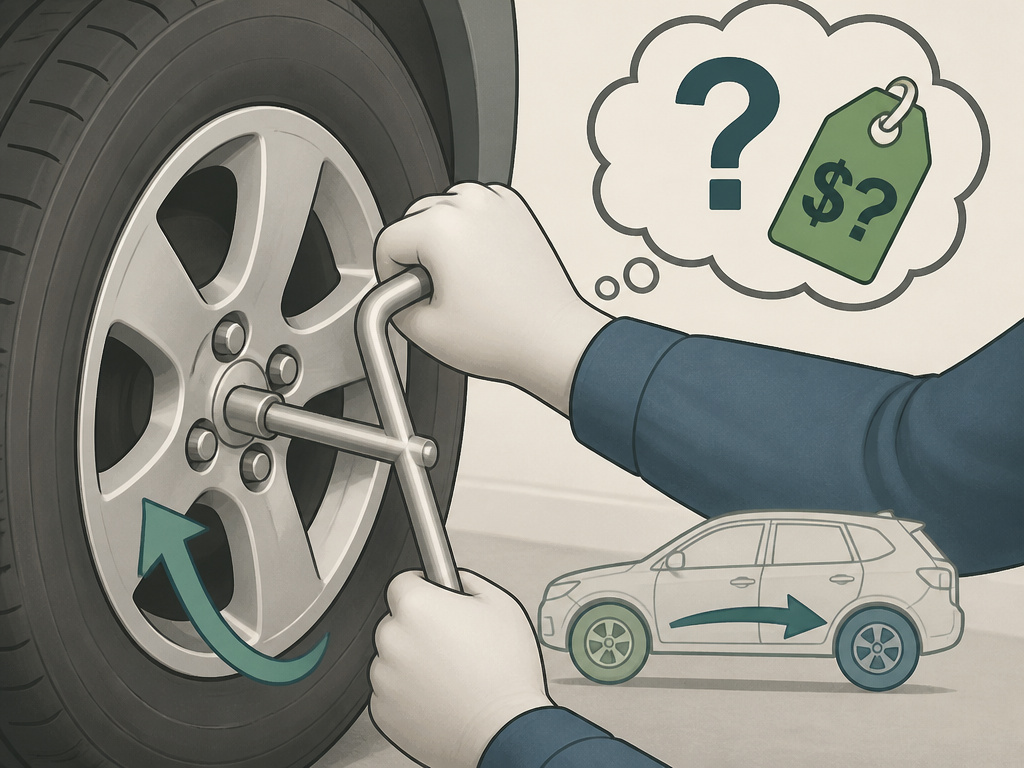
Forget the generic “every 5,000 miles” advice. Your car’s manual holds the only number that matters for warranty and wear. The NHTSA tire maintenance manual suggests 5,000 miles as a general baseline, but manufacturers specify intervals based on the vehicle’s weight, drivetrain, and suspension tuning.
Tesla’s service manuals call for rotation every 6,250 miles (10,000 km) or if the tread depth difference reaches 2/32 of an inch. Kia recommends every 8,000 miles. Rivian says 9,000 miles for square setups. These aren’t suggestions. They are the engineering thresholds where wear patterns become pronounced enough to affect handling and longevity. Missing these intervals won’t void a tire warranty, but it can lead to a claim denial for “improper maintenance” if wear is severely uneven.
The why-layer is about force distribution. On a front-wheel-drive car, the front tires handle acceleration, steering, and most of the braking. They scrub off tread faster. On a rear-wheel-drive performance car, the driven rear tires wear quicker. All-wheel-drive systems are more balanced but not perfect. Rotation moves each tire through every stress position, so they wear down as a uniform set. This maximizes the life of all four tires, delaying the expensive moment when you need to buy a full new set.
| Manufacturer / Source | Recommended Rotation Interval | Key Condition or Note |
|---|---|---|
| NHTSA General Guideline | 5,000 miles | Default if vehicle manual is unavailable. |
| Tesla (Model Y, 3, Cybertruck) | 6,250 miles (10,000 km) | Or if tread depth difference is ≥ 2/32 in. |
| Kia (Various Models) | 8,000 miles (13,000 km) | Lug nut torque: 79–94 lb-ft. |
| Rivian R1T/R1S (Square Setup) | 9,000 miles (15,000 km) | Staggered fitments: side-to-side only. |
| Ford Bronco (5-Tire Rotation) | As per normal interval | Requires dealer TPMS reset; spare tire ages out in 6 years. |
Doing It Yourself: What You’re Really Signing Up For
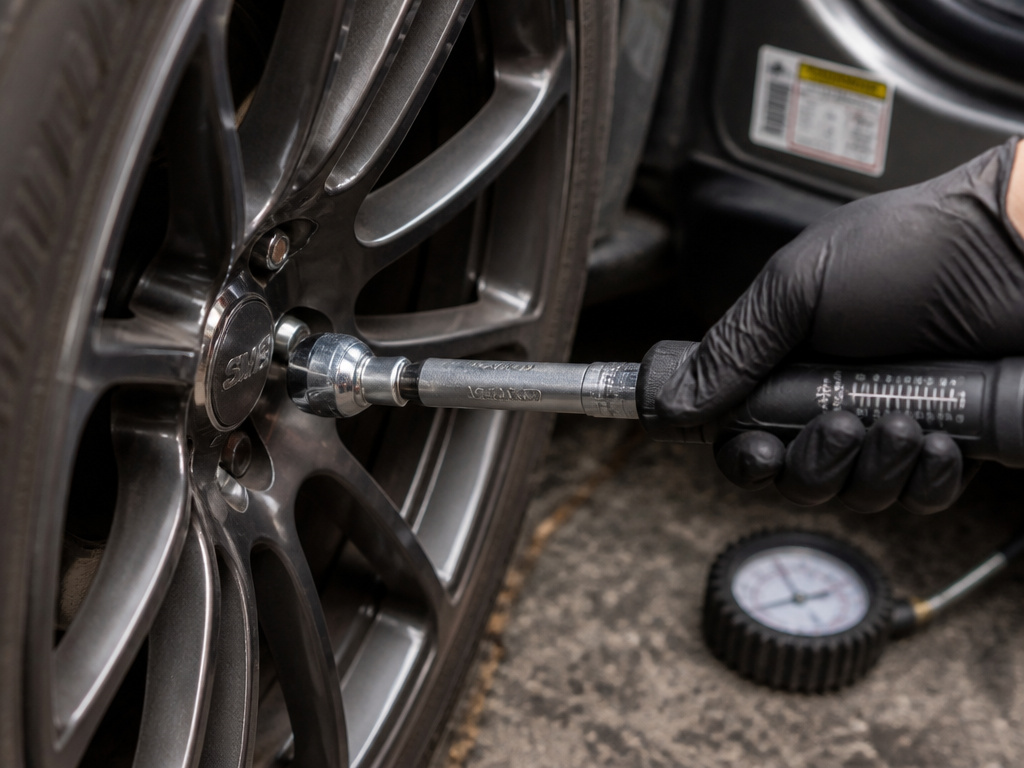
You can rotate your own tires in a driveway with a jack, a lug wrench, and an hour of time. The process is straightforward: lift, swap, lower, torque. The hidden cost isn’t money, it’s liability and precision.
You need a quality tire pressure gauge to reset pressures to the spec on the door jamb after the move. You must torque the lug nuts to the exact specification, which for a Kia is 79–94 lb-ft. An under-torqued lug nut can loosen and cause a wheel to separate; an over-torqued one can stretch the studs and lead to a catastrophic failure later. Most DIYers don’t own a calibrated torque wrench, which is a non-negotiable tool for this job.
Then there’s the TPMS. If your system doesn’t auto-relearn, you’ll drive with a warning light on until you pay a shop for the reset anyway. For the majority of drivers, the DIY path saves $30 but introduces risk and hassle. The calculus changes if you have a performance car on jack stands every weekend. For the once-a-year rotation, the free service at a professional shop is the smarter play.
Frequently Asked Questions
Are tire rotations ever free at dealerships?
Rarely. Dealerships primarily offer free rotations as part of a new vehicle purchase package or a prepaid maintenance plan. Outside of those promotions, they charge standard labor rates. The fee covers more than labor, it includes a multi-point inspection and an entry into your vehicle’s service history, which adds value at resale.
Does Discount Tire rotate tires for free if you didn’t buy them there?
Yes. This is their core customer acquisition strategy. They hope that by providing free, friendly service, you will become a customer for your next tire purchase or when you need a tire repair. No purchase is ever required for their complimentary rotation service.
Why would I pay Tesla for a rotation if it’s free elsewhere?
You pay for the certified service record, which can be important for warranty claims or if you plan to sell the car to a discerning buyer who wants a complete Tesla service history. You also pay for their specific diagnostic check, which may include scanning for vehicle faults unrelated to the tires. For most owners, the free third-party rotation is the practical choice.
Is a tire rotation necessary if my car has all-wheel drive?
Yes, absolutely. All-wheel drive (AWD) systems distribute power, but they don’t distribute wear evenly. Steering, braking, and alignment quirks still cause front-rear and side-to-side wear differences. Uneven wear on an AWD car is especially critical because it can damage the drivetrain. Significant tread depth differences force the center differential to work overtime, leading to premature wear.
Can uneven tire wear be fixed by rotation?
No. Rotation prevents uneven wear from becoming worse; it does not correct existing irregular wear. If you have cupping, feathering, or severe inner shoulder wear, those tires are already damaged. Rotation will simply spread the compromised handling and noise across all four corners. You need an alignment, balance, or suspension repair first.
The Bottom Line
Tire rotations are free at the places that sell tires for a living. Use them. For a standard car or SUV, a lifetime of free rotations at Discount Tire is one of the best deals in automotive maintenance. Just know the limits: if your car has a staggered performance setup, directional tires, or a finicky TPMS, call ahead. That free offer might not apply.
The interval is not a suggestion. Stick to your manual’s mileage or the 5,000-mile default. Letting wear go uneven for an extra few thousand miles costs you more in lost tire life than any service fee. Your tires are the only thing connecting two tons of metal to the road. Keeping them wearing evenly isn’t just about saving money, it’s the foundation of how the car is supposed to handle. That’s worth a free visit to the shop.
