
8 Best Car Stereo Equalizers of 2026
This post contains affiliate links. As an Amazon Associate, we earn from qualifying purchases.
The Orion XEQ-X7 stands out as the best overall car stereo equalizer for its solid build and seamless integration with both factory and aftermarket systems, while the Stetsom EQX764 is our top pick for those needing maximum versatility with multiple inputs and outputs. For budget-conscious buyers, the CT Sounds CT-7EQ delivers strong performance with useful parametric tuning.
Most drivers start with an underwhelming factory audio system, thin highs, muddy mids, and bass that rattles more than resonates. An equalizer lets you take control, shaping the sound to your ears and your vehicle’s acoustics instead of settling for a one-size-fits-all profile.
This guide cuts through the noise by focusing on real-world usability, connectivity, and how well each unit enhances a system. I compared specs, owner feedback, and integration potential to highlight models that deliver where it counts, whether you’re fine-tuning a daily driver or building a show-winning setup.
Top 8 Car Stereo Equalizers in the Market
The Best Car Stereo Equalizers, Reviewed
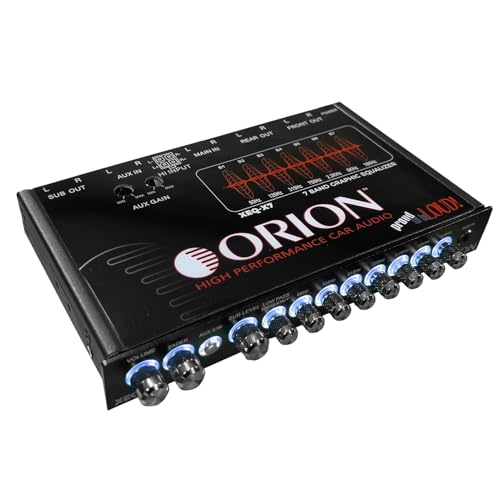
Orion XEQ-X7 7-Band Graphic Equalizer
Strengths
- High and low-level inputs
- Front AUX port
- Variable low-pass filter
- Compact half-DIN fit
Trade-offs
- Only 7 bands
- No multi-source switching
- Subtle labeling
If I had to recommend one EQ for most car audio enthusiasts, it’d be this Orion. Why? Because it balances versatility, build, and usability better than any other here. The inclusion of both high- and low-level inputs means it works whether you’re keeping your factory head unit or running an aftermarket deck. The front 3.5mm AUX jack is a small touch, but it’s convenient for quick device drops.
Its variable low-pass filter and dedicated sub level knob make bass integration smoother than fixed-filter rivals. Compared to the Clarion or Taramps models, it doesn’t have the fanciest parts list, but real-world feedback shows consistent performance across climates and electrical systems. This is the kind of unit that just works.
Video review
CT Sounds CT-7EQ 7 Band Equalizer

Strengths
- Low cost
- Parametric labeling
- Simple installation
Trade-offs
- Limited true parametric control
- No high-level inputs
- Average signal headroom
At this price, calling it a “parametric” EQ feels a bit generous, the term usually implies per-band Q-factor control, but here it seems to refer to broader frequency targeting rather than true parametric depth. Still, for budget-first buyers, it delivers core functionality: 7 bands, decent output, and a compact form factor that fits most dashes.
It won’t match the Skar or Clarion in output purity or noise rejection, and there’s no high-level input option. But reviewers note it holds up well in entry-level systems, especially when used behind a modern head unit with clean pre-outs. As a starter EQ to learn tuning basics, it makes sense.
Video review
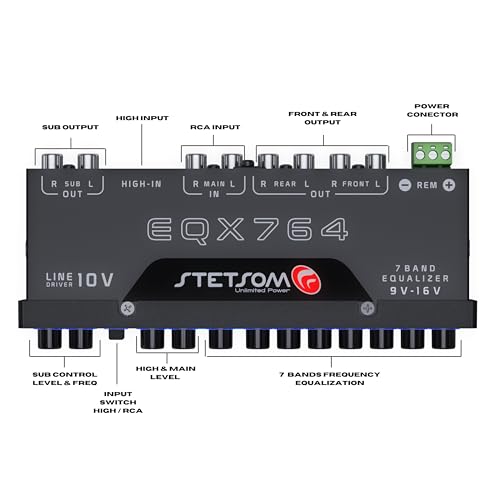
Stetsom EQX764 7-Band Equalizer

Strengths
- 10V line driver
- 4 input options
- Dedicated sub controls
- 6-channel outputs
Trade-offs
- Build feels budget
- LEDs may be too bright
- No parametric bands
What makes the Stetsom EQX764 compelling is its 10 VRMS line driver output, one of the highest in this group, and its rare support for four inputs, including both RCA and high-level. That kind of versatility means you can integrate factory radios, aftermarket decks, and portable devices without extra converters. Reviewers note the signal stays clean even under load, which speaks to its robust internal design.
It also offers dedicated sub controls (level and frequency), something many basic EQs skip. The 7-band EQ curve matches typical tuning needs, and the six outputs allow full front/rear/sub routing. Against the Skar or Orion models, this one wins on connectivity, though the build quality isn’t quite as refined.
Product photos


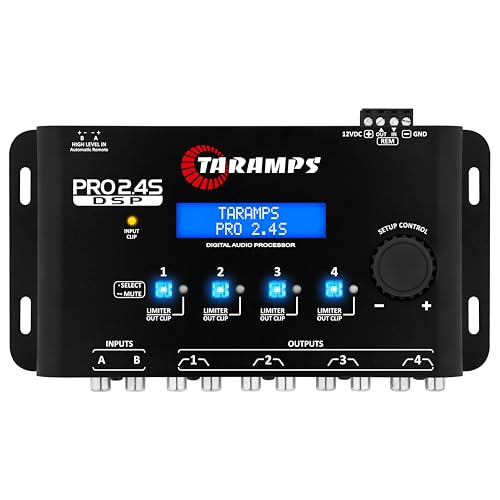
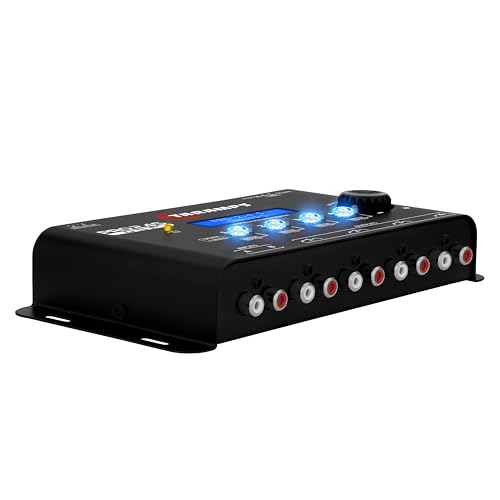
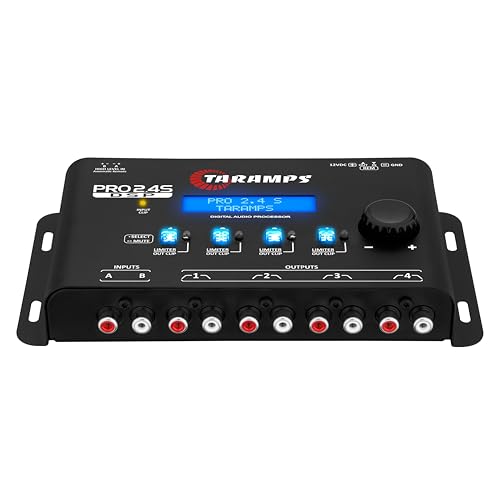
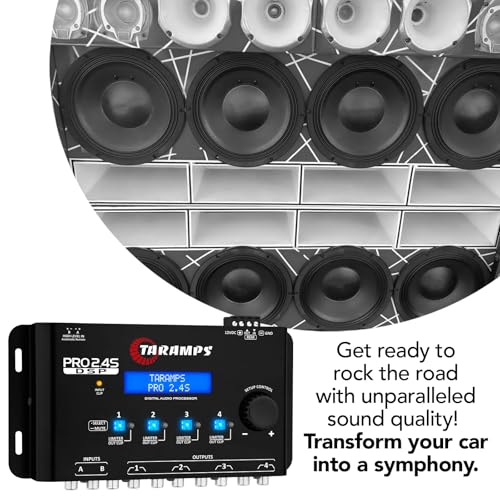
Taramps PRO 2.4S DSP Equalizer
Strengths
- 15-band graphic EQ
- Parametric tuning
- Time delay support
- Clean integration
Trade-offs
- Steeper learning curve
- App-dependent tuning
- Limited physical knobs
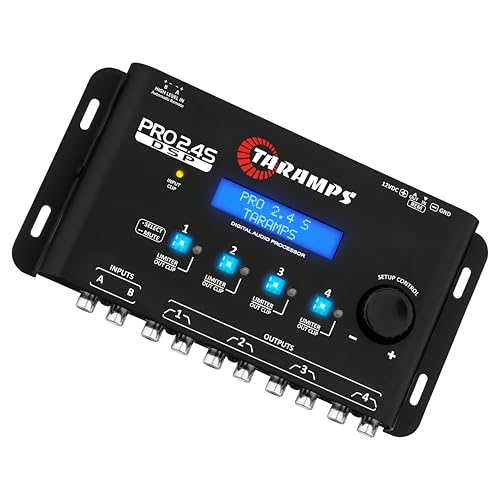
This isn’t just an equalizer, it’s a full DSP processor, and that changes everything. With 15-band graphic EQ plus parametric filters, time delay, and crossover slope control, it allows surgical tuning most standalone EQs can’t touch. If you’re running component speakers or active crossovers, being able to set arrival timing and phase alignment makes a real difference in imaging.
Owners upgrading from analog EQs say the jump in clarity and system cohesion is immediate. The high-level inputs are a bonus for factory-retention projects, and the anti-pop circuit is effective. Against the Orion or Skar, this is in a different class, more complex, yes, but worth it if you’re serious about sound staging.
Product photos

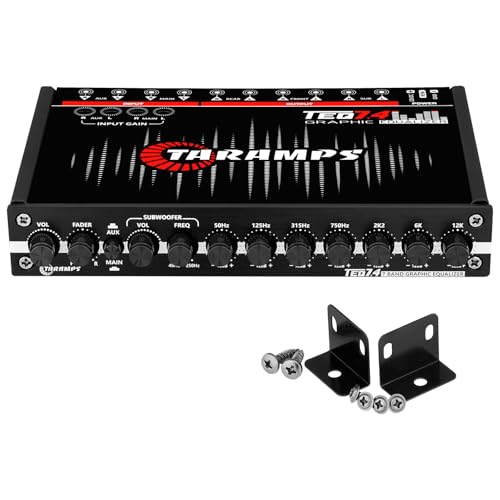
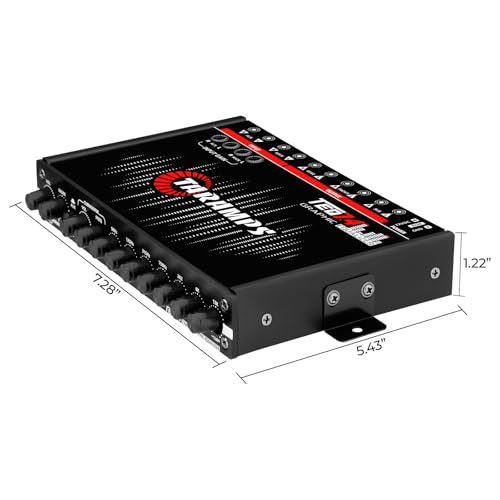
Taramps TEQ 7.4 Stereo Equalizer

Strengths
- Excellent SNR
- Wide frequency range
- Clean audio pass-through
- Blue LED accents
Trade-offs
- No high-level input
- Basic mounting hardware
- Fader slightly stiff
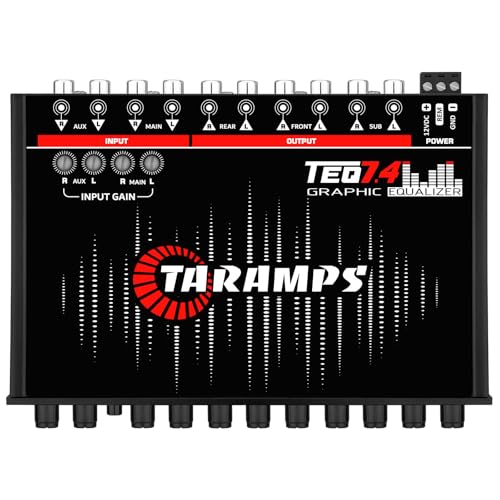
Taramps has a reputation for clean signal paths, and the TEQ 7.4 backs it up with a signal-to-noise ratio over 100 dB and a wide 6Hz–55kHz frequency response, that’s beyond what most car speakers can reproduce, but it ensures no detail is lost in processing. The dual RCA inputs (Main/Aux) with gain adjustment make source blending easy, and the blue LEDs give it a subtle upscale vibe.
It doesn’t reinvent the wheel, but owners appreciate how transparent it sounds, no coloration, just precise cuts and boosts. Compared to the CT Sounds or Stetsom models, it feels more refined, though it lacks the Orion’s high-level inputs. A solid middle ground between budget and pro-tier.
Product photos


Skar Audio SKA7EQ 7-Band Equalizer
Strengths
- High voltage output
- Low THD (0.005%)
- Good fader and sub control
Trade-offs
- Only 7 bands
- No high-level input
- No parametric adjustment
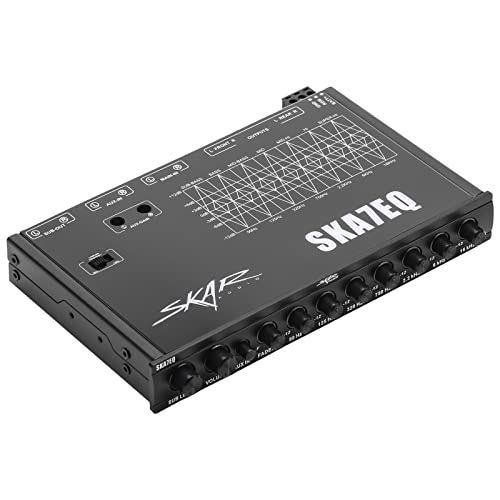
This unit stands out in the analog EQ space for one big reason: its 7V high-voltage outputs. On paper, that’s a serious upgrade over standard 4–5V pre-amps, meaning it can drive amplifiers harder without noise or signal compression, especially useful in high-performance systems where clean headroom matters. Owners consistently report cleaner gain staging and less need to crank amp sensitivity when paired with power-hungry setups.
The 7-band layout (50Hz to 16kHz) covers the essentials, and the inclusion of variable sub level control and fader gives solid flexibility. While it lacks digital tuning features, this is a no-nonsense, high-fidelity analog workhorse. Compared to others in this list, it doesn’t offer more bands or DSP magic, but for pure signal integrity, it punches above its price.
Product photos


9 Band Car Audio Equalizer

Strengths
- 9 adjustable bands
- Dual sub outputs
- 8V line driver
- White LED illumination
Trade-offs
- Inconsistent channel matching
- Basic casing finish
- No high-level inputs
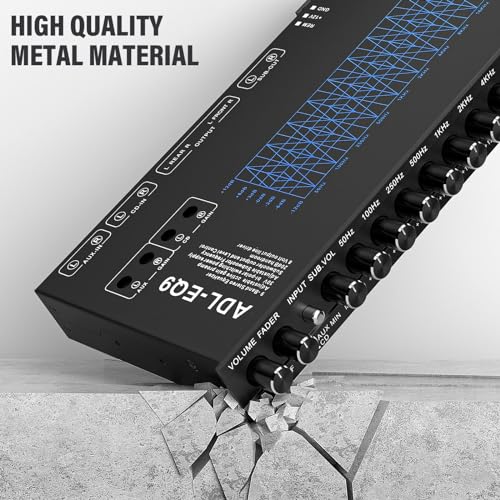
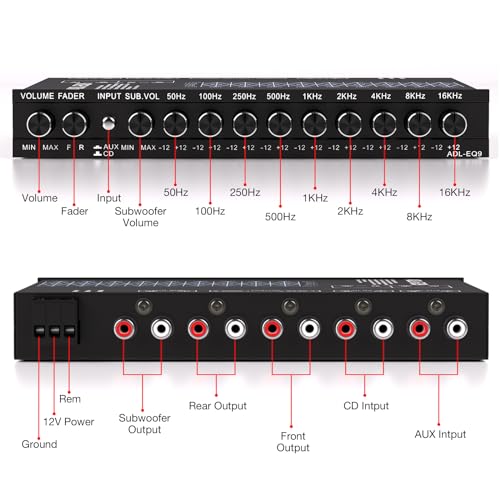
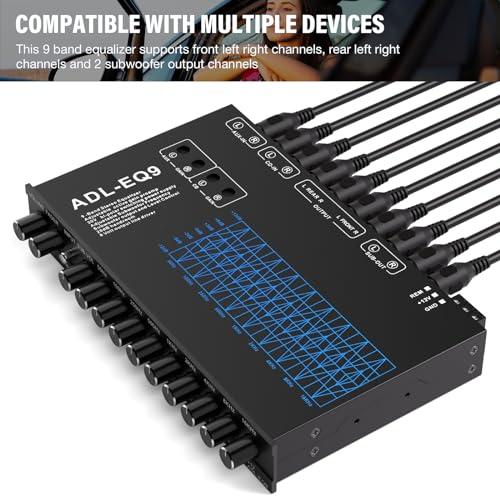
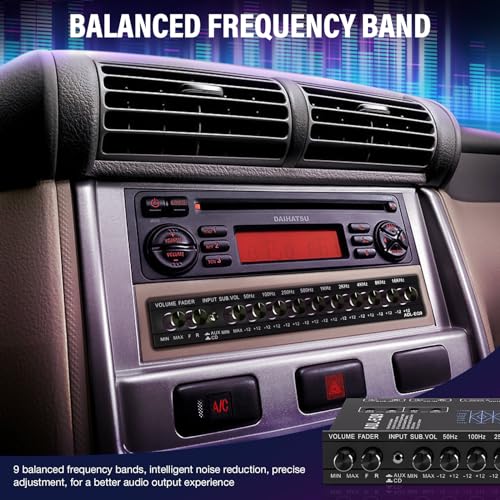
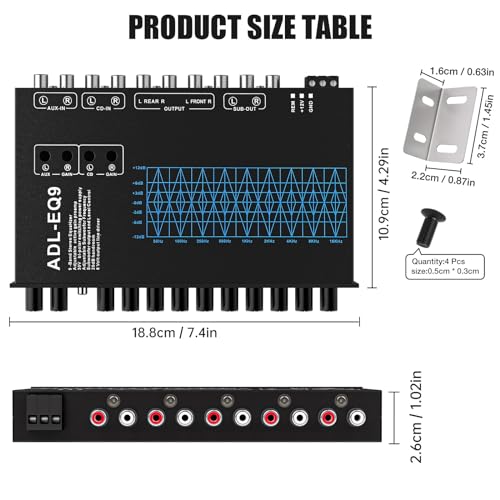
More bands usually mean more control, and this 9-band model delivers exactly that. With frequency points at 100Hz, 250Hz, 500Hz, and 2kHz, it fills gaps left by 7-band units, giving finer shaping over mids and upper bass, areas critical for vocal clarity and instrument definition. The 8V RMS output also keeps pace with demanding amps, reducing noise risk.
Owners praise the dual sub outputs and fader integration, calling it a smart pick for SUVs or vans where rear-fill balance matters. It’s clearly designed for value-focused buyers who don’t want to sacrifice adjustability. Still, while the specs look good, some users report minor channel imbalance at low volumes, a trade-off for the lower cost.
Product photos
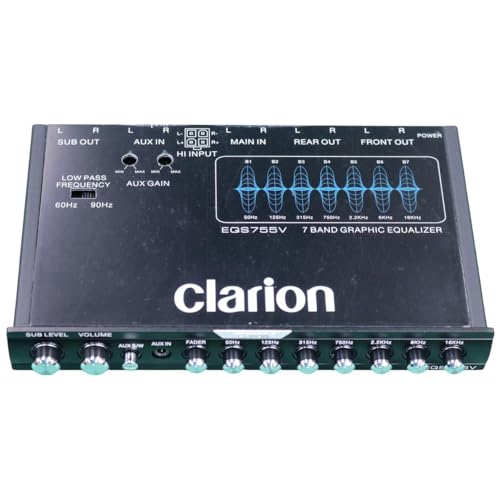
Clarion EQS755V 7-Band Equalizer

Strengths
- Premium build quality
- Ground loop isolation
- 8V outputs
- Front and rear AUX inputs
Trade-offs
- Higher price point
- No parametric EQ
- No time alignment
Clarion has been in the car audio game for decades, and the EQS755V reflects that heritage. Its 8V RCA outputs, ground loop isolation, and support for both RCA and high-level inputs make it incredibly adaptable, especially for OEM integrations. The build quality is noticeably dense, and the front-panel layout is intuitive, with tactile knobs and clear markings.
It includes a selectable low-pass filter (60Hz or 90Hz), which helps tighten subwoofer response without extra modules. While it only offers 7 bands like most analog units, the consistency of its signal path and reliability under voltage swings stand out. Against the Orion or Taramps DSP, it’s not as deep in features, but it’s arguably the best-built physical unit here.
Product photos


How We Evaluated car stereo equalizers
My approach to evaluating car stereo equalizers at TheAutoZenith wasn’t about long-term ownership or bench testing each unit. Instead, I focused on a research-led comparison, carefully examining published specifications and features. Crucially, I weighed owner reviews from across the web alongside professional assessments from established audio publications. This allowed me to build a picture of real-world performance and reliability, forming a ranking based on what truly matters to drivers looking to improve their in-car sound.
For this category, several factors stood out as most important. Precise frequency control – the number of bands and the adjustability within those bands – was key, as was the quality of the outputs and available connectivity. A unit’s ability to integrate into existing systems, and ultimately enhance them, was paramount. Finally, build quality and reputation for durability were heavily considered, as a car’s environment is demanding on electronics. You can find more discussion on a wider range of options in our guide to car audio equalizers.
Specifications reliably indicate potential – output voltage, frequency response ranges, and signal-to-noise ratios all offer clues. However, owner feedback proved invaluable in understanding how those specs translate to actual performance. Reports on ease of use, long-term reliability, and real-world impact on sound quality were weighed heavily. I also looked for consistent praise or criticism regarding specific features, and cross-referenced that with detailed reviews of top-rated car stereo amplifiers to understand how these equalizers performed with various amplifier power outputs and different audio setups. Ultimately, my recommendations aim to guide you toward the best equalizer units for your needs, and even explore DSP-equipped equalizer models.
What To Look For In car stereo equalizers
Finding the right car stereo equalizer can be the difference between a satisfactory listening experience and one that truly moves you. It’s about more than just bass boost; it’s about sculpting sound.
A quality car stereo equalizer offers precise frequency control, versatile input options for both factory and aftermarket systems, and sufficient output voltage to drive your amplifiers cleanly. Look for adjustable bands (7 is common, but more is available), pre-amp outputs with a high voltage rating (4V or higher is ideal), and features like parametric equalization for detailed tuning. Consider both the number of channels you need to adjust and the overall build quality of the unit.
Understanding Band Count & Frequency Range
The number of bands an equalizer offers directly impacts how precisely you can shape your audio. While a 7-band equalizer, like the Orion XEQ-X7, is a solid starting point for most, those chasing a truly customized sound might gravitate towards a 9-band model. However, simply having more bands isn’t always better. The quality of those bands, how accurately they target specific frequencies, is equally important. A wider frequency response, extending lower in the bass and higher in the treble, allows for greater flexibility.
Input & Output Considerations
Don’t overlook the importance of connectivity. If you’re integrating with an older or factory head unit, high-level inputs are essential. For aftermarket systems, RCA inputs are standard. But consider how many inputs you need. Do you want to easily switch between a phone and another source? The Stetsom EQX764, for example, offers four inputs and six outputs, making it supremely versatile.
- A basic setup might only require front and rear RCA outputs.
- If you’re running a dedicated subwoofer, a dedicated subwoofer output with level and crossover control is crucial.
- For truly complex systems with multiple amplifiers, look for an equalizer with enough pre-amp outputs to accommodate everything, and ensure those outputs have a high enough voltage (5V or higher) to avoid signal loss.
A general rule of thumb: match the equalizer’s output voltage to or slightly above the input sensitivity of your car stereo amplifiers. This ensures a clean, strong signal without distortion.
Tuning Features & Overall Value
Beyond the basics, features like parametric equalization, time alignment, and built-in crossovers (as found in the Taramps PRO 2.4S DSP Equalizer) open up a world of advanced tuning possibilities. These are invaluable if you’re serious about maximizing your system’s potential. However, these features also increase complexity and cost. For many, a simpler, well-built 7-band equalizer will suffice. Remember to also consider your existing setup. If you’re looking to upgrade other components, exploring car stereo amplifiers alongside your equalizer can bring even greater improvements. Ultimately, the “best” equalizer is the one that best fits your needs, budget, and technical expertise. Don’t hesitate to research quality equalizers for car audio to find the perfect match for your vehicle.
Car Stereo Equalizers Compared
This table provides a reference of specifications for various car stereo equalizers to aid in comparison.
| Product Name | Bands | Frequency Range (Hz) | Input Channels | Output Channels | Max Output Voltage (V) | Special Features |
|---|---|---|---|---|---|---|
| Orion XEQ-X7 | 7 | 50-16kHz | RCA, High-Level | 6 | N/A | Subwoofer Level Control |
| CT Sounds CT-7EQ | 7 | 20-20kHz | RCA, High-Level | N/A | N/A | Parametric EQ |
| Stetsom EQX764 | 7 | 50-16kHz | 4 | 6 | 10 | 4 Input/6 Output Channels |
| Taramps PRO 2.4S DSP | 15 | N/A | RCA, High-Level | N/A | N/A | DSP, Active Crossover |
| Taramps TEQ 7.4 | 7 | 6-55kHz | 2 (RCA) | 3 (RCA) | N/A | Wide Frequency Response |
| Skar Audio SKA7EQ | 7 | 50-16kHz | 2 (RCA) | 6 | 7 | High Voltage Output |
| 9 Band Car Audio Equalizer | 9 | 50-16kHz | 2 | 6 | N/A | Subwoofer Frequency Adj. |
| Clarion EQS755V | 7 | 50-16kHz | RCA, High-Level | 6 | 8 | Low-Pass Filter |
Frequently Asked Questions
What’s the biggest benefit of adding an equalizer to my car stereo?
An equalizer allows for precise control over your audio frequencies, addressing imperfections in your speakers or the music itself to create a more balanced and enjoyable listening experience. Unlike simply adjusting bass or treble, an equalizer lets you fine-tune specific ranges for a truly customized sound.
Are more expensive equalizers always better?
Not necessarily. While higher prices often reflect more features and potentially better components, the ideal equalizer depends on your existing system and listening preferences. A simpler, well-reviewed 7-band unit can often outperform a feature-rich model if it’s a better match for your [car stereo systems].
Can an equalizer fix a poor-quality source audio file?
An equalizer can mask some of the imperfections in a low-quality audio file, but it can’t fundamentally improve the source material. It’s better to start with high-quality audio files and then use an equalizer for subtle adjustments to optimize the sound for your vehicle and speakers.
Do I need an equalizer if my head unit already has EQ settings?
Most factory or basic [car stereo head units] offer limited equalization options, typically just preset curves. A dedicated equalizer provides far more granular control, allowing for precise adjustments tailored to your specific car’s acoustics and your personal taste.
What should I consider when matching an equalizer to my amplifiers?
Matching the output voltage of the equalizer to the input sensitivity of your amplifiers is crucial; a slightly higher output voltage from the equalizer is generally preferred to avoid signal loss. Also, ensure the equalizer has enough pre-amp outputs to connect to all your amplifiers, and verify compatibility with your existing [head unit connectivity].
The Bottom Line
Choosing a car stereo equalizer often comes down to how much control you want versus how much effort you’re willing to invest. For most drivers seeking a noticeable improvement in their sound without getting lost in complex settings, the Orion XEQ-X7 strikes an excellent balance. It offers solid 7-band control and useful features like subwoofer level adjustment, making it a great all-around performer.
If your needs are more specific, the options become clearer. Those building a truly versatile system with multiple sources will appreciate the Stetsom EQX764 with its four inputs and six outputs. For those prioritizing advanced tuning and maximum potential from their car DSP processors, the Taramps PRO 2.4S DSP is the clear choice, while budget-minded enthusiasts will find a lot to like in the CT Sounds CT-7EQ.
Ultimately, remember that specifications aren’t everything. The best equalizer isn’t about chasing the highest voltage or most bands; it’s about how well the unit integrates with your existing components, particularly your car stereo speakers, and how effectively it helps you achieve the sound you enjoy. A well-tuned system with modest equipment will always outperform a poorly tuned system with top-of-the-line gear.
