
8 Best 4 Channel Car Amps of 2026
This post contains affiliate links. As an Amazon Associate, we earn from qualifying purchases.
The Kicker 46CXA3604 stands out as the best overall 4 channel car amp for its clean power delivery and robust feature set, while the Fosi Audio CA30 is a strong budget pick that doesn’t skimp on essential performance. For those who want flexibility, the Taramps TS 1200W offers excellent versatility with high power output and solid tuning options.
If your car audio system sounds flat, distorted, or lacks punch, the problem often isn’t your speakers, it’s the power behind them. A good 4 channel amp transforms how music feels in your cabin, delivering control and clarity that factory systems can’t touch.
In this guide, I break down the top performers based on specs, real-world owner feedback, and what actually matters in daily driving. These picks balance power, signal quality, and value, with attention to impedance stability, efficiency, and features that make a real difference once installed.
Top 8 4 Channel Car Amps in the Market
The Best 4 Channel Car Amps, Reviewed
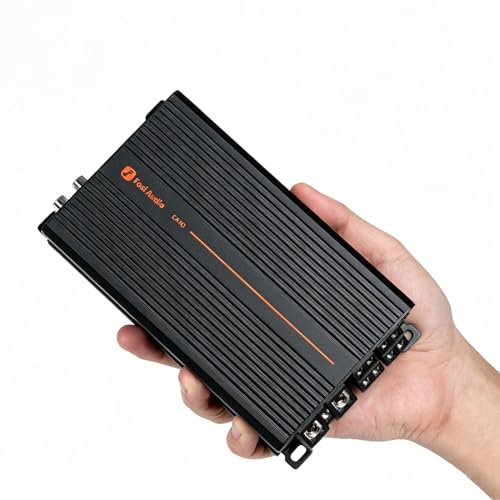
Fosi Audio CA30 4-Channel Amplifier
Strengths
- Studio-grade sound clarity
- High SNR, low distortion
- Dual input options
Trade-offs
- Lower RMS than peak suggests
- Gain range feels limited
Fosi Audio didn’t just build another mini amp, they pushed the envelope on fidelity in this price range. The CA30’s use of premium op-amps and automotive-grade components translates to a signal-to-noise ratio of 104dB and distortion under 0.006%, specs that rival far more expensive units. Reviewers consistently praise the clarity, especially when driving tweeters or component sets, and the ultra-low noise floor means you won’t hear hiss at idle.
It’s also one of the most flexible entry-level amps available. The ability to bridge cleanly into subwoofers, plus the inclusion of both RCA and high-level inputs, makes it a true plug-and-play solution for factory radio upgrades. While it doesn’t hit the raw power of some competitors, the efficiency and sonic accuracy make it my top recommendation for the buyer who values sound quality over brute force.
Video review
Recoil DI550.4 Class-D 4-Channel Amp

Strengths
- Very affordable
- Full control suite
- Good thermal design
Trade-offs
- Plastic housing
- Lower RMS than top models
- Build quality varies
At under $90, the Recoil DI550.4 is a budget powerhouse, offering 130W RMS x 4 at 2 ohms with full user controls and solid thermal management. It’s not as loud or refined as the DI800.4, but for the price, it delivers surprising versatility. The adjustable crossovers and bass EQ make it usable for both door speakers and small sub applications when bridged.
Owners report it performs reliably in basic setups, though some note the plastic casing feels a bit light. Still, for a first-time upgrade or a secondary amp in a multi-zone system, it’s hard to beat. I’d recommend it over generic no-name amps any day, this one offers real control without the premium tag.
Video review
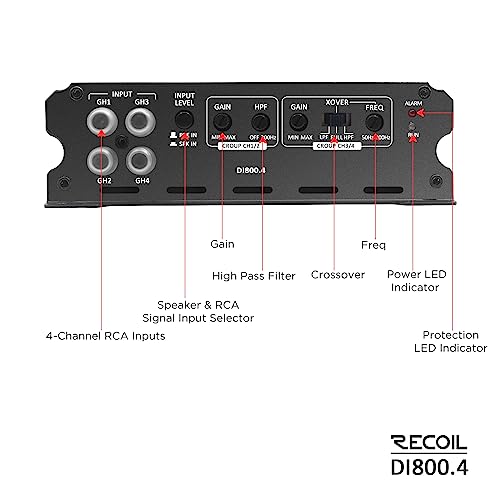
Recoil DI800.4 Class-D 4-Channel Amp

Strengths
- High RMS at 2 ohms
- Full user controls
- Strong thermal management
Trade-offs
- Noticeable distortion at high volume
- Build quality inconsistent
- Average SNR
The Recoil DI800.4 is all about raw output. With 185W RMS x 4 at 2 ohms, it’s one of the most powerful 4-channel amps under $100. The MOSFET power supply and robust protection circuitry mean it can handle extended use at high volume, and owners consistently report strong performance with both mids and subs when bridged.
It’s not the cleanest-sounding amp in the mix, distortion creeps in at high gains, but for bass-heavy genres and loud systems, that’s often acceptable. The heatsink design keeps temps manageable, and the full suite of filters gives you tuning flexibility. If you want maximum wattage without maxing your wallet, this is the one. I’d take it over pricier options when volume rules.
Product photos


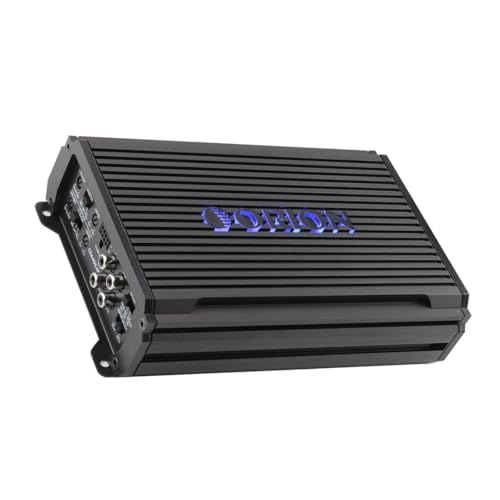
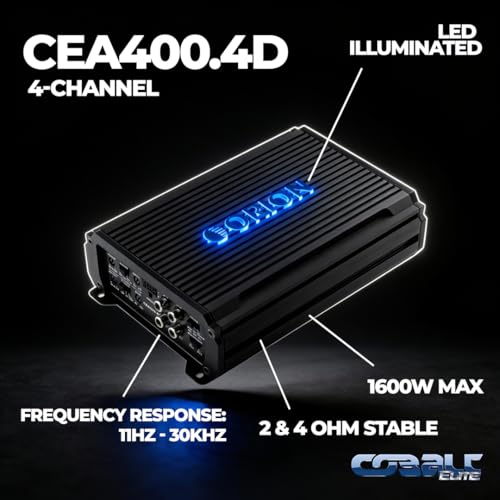
ORION CEA400.4D Cobalt Elite Amp
Strengths
- Compact design
- Clean RMS output
- Adjustable crossovers
Trade-offs
- Moderate power at 4 ohms
- No high-level input
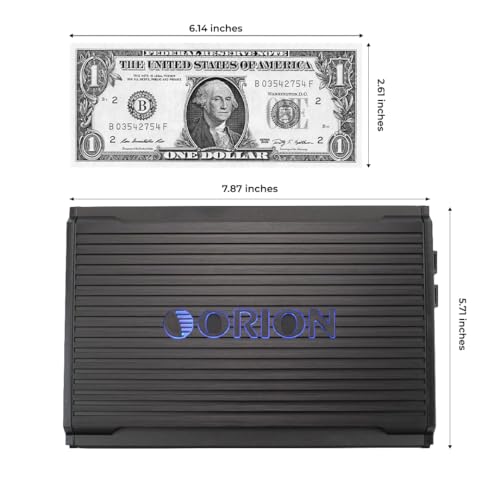
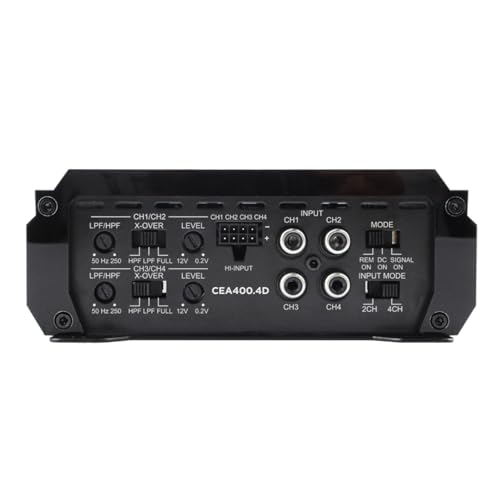
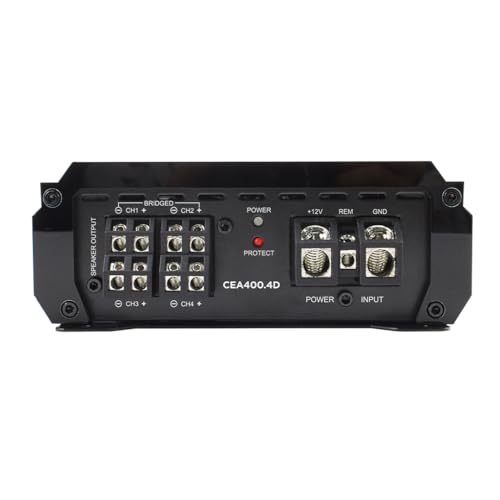
The ORION CEA400.4D packs a solid punch for its size, delivering 400W RMS across four channels with a clean Class-D design that won’t cook your trunk. On paper, the 100W x 4 at 2 ohms is competitive, and owners consistently report stable performance with component sets and door speakers, even when bridged for rear fill. The adjustable crossovers are a real win, giving you control without needing an external DSP.
Where it really stands out is in footprint. For tight installs, under seats or behind panels, this amp is a no-brainer. It’s not the most powerful option here, but for a daily driver setup where reliability and space-saving matter, it’s a strong contender. I’d pick this over bulkier Class AB units if you’re not chasing extreme volume.
Product photos
Pioneer GM-A6704 Class AB Amplifier

Strengths
- Excellent sound clarity
- Low distortion
- Smooth tone curve
Trade-offs
- Lower efficiency
- Runs hot
- Less power at 2 ohms
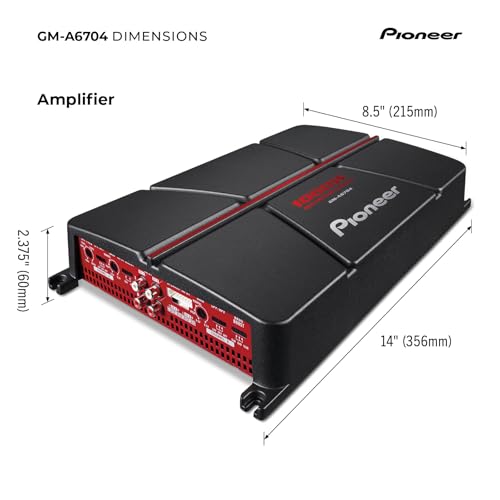
Pioneer’s GM-A6704 leans into its Class AB roots with a warm, smooth output that many prefer for vocal and acoustic clarity. The 60W RMS x 4 at 4 ohms isn’t eye-popping on paper, but the real story is in the low distortion and linear frequency response. Owners note it pairs exceptionally well with OEM head units and factory speakers, making it a favorite for subtle upgrades where you want richer tone without harshness.
It’s also one of the few in this list using a traditional Class AB topology, which trades efficiency for sonic purity. That means more heat and higher current draw, so adequate ventilation is a must. If you’re chasing crisp mids and highs, not raw power, this amp delivers a refined character that stands apart from the Class D crowd. I’d choose it over higher-wattage models for a vintage-inspired sound.
Product photos


Taramps TS 1200W 4-Channel Amplifier

Strengths
- High RMS output
- Handles 2-ohm loads
- High-level inputs
Trade-offs
- Bulky design
- Fixed crossover limits tuning
- Installation complexity
The Taramps TS is built for the no-compromise installer. With 300W RMS x 4 into 2 ohms, it’s one of the most powerful 4-channels here, clearly aimed at driving multiple drivers or even small subs in bridged mode. The full-range crossover and dual input options make it adaptable, and the high-level inputs work flawlessly with factory decks, no line output converter needed.
But this is a serious amp for serious builds. The size and power demands mean professional installation is more than a suggestion. Owners report excellent stability under load, though some note the fixed crossover settings lack the fine-tuning of higher-end models. If you’re stacking speakers in a truck or SUV and need headroom, this is the kind of brute-force solution that keeps up. I’d pick it over pricier brands when output is the priority.
Product photos


PRV Audio QS400.4 Mini Amplifier

Strengths
- Extremely compact
- Efficient Class D
- True 2-ohm stable
Trade-offs
- No high-level input
- Basic crossover controls
- Limited mounting options
At just 4 inches wide, the PRV Audio QS400.4 is the undisputed king of compactness, yet it still delivers 100W RMS x 4 at 2 ohms, which is impressive for its size. The Brazilian Class D tech is efficient, and owners report it handles daily commutes and weekend drives without breaking a sweat. It’s the kind of amp you can tuck behind a dash or under a seat without sacrificing much space.
It doesn’t have fancy filters or high-level inputs, but for a basic, no-frills power boost to coaxial speakers, it’s hard to beat. The build feels solid for the price, though the feature set is barebones. If you’re upgrading factory audio in a compact car and don’t want to eat up real estate, this is the smart buy. Just don’t expect DSP-level tuning.
Product photos


Kicker 46CXA3604 4-Channel Full-Range Amp

Strengths
- Trusted brand reliability
- KickEQ bass boost
- Flexible mounting
Trade-offs
- Higher price point
- Class AB inefficiency
- Less power than Class D peers
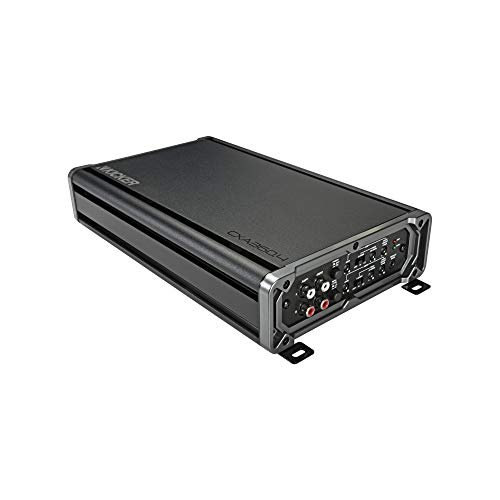
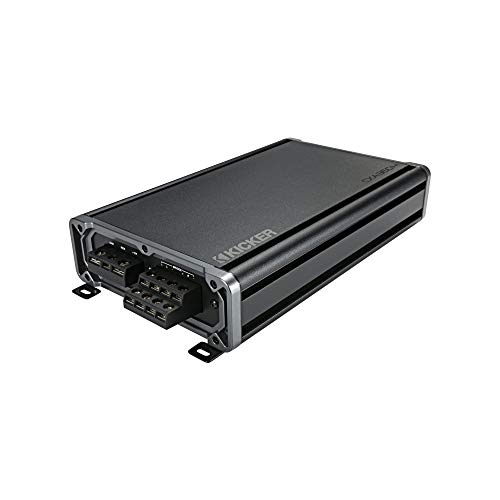
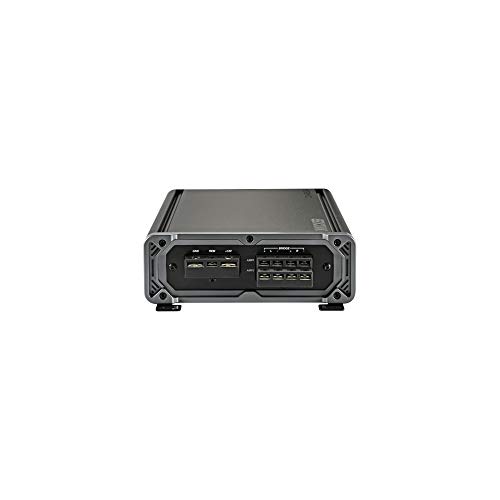
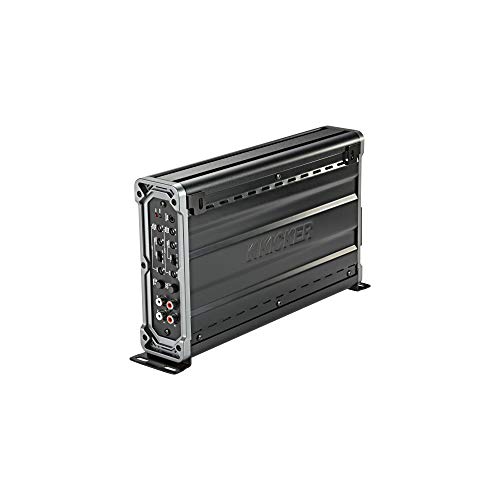
Kicker’s CXA3604 carries the brand’s reputation for durability and consistent performance. The Class AB design delivers 90W RMS x 4, which isn’t class-leading, but the real value is in the build and features. The KickEQ bass boost is a standout, giving you that extra 6dB bump without muddying the mids, and the 24dB subsonic filter adds useful control for cleaner output.
Owners praise its reliability over years of use, even in extreme climates. The ability to mount vertically or horizontally adds install flexibility, and it starts cleanly at low voltages, ideal for older vehicles. While it costs more than most here, you’re paying for longevity and brand trust. For someone who wants a ‘set it and forget it’ amp, this is the smarter long-term pick.
Product photos

How We Picked These 4 channel car amps
Rather than a hands-on lab test, my research for these recommendations involved a detailed comparison of published specifications and features across numerous models. I weighed owner reviews from multiple sources, looking for consistent praise or complaints, alongside expert reviews from respected car audio publications. Applying my experience with vehicle audio systems, I ranked these amps based on how well they met the needs of a variety of drivers and budgets.
For 4 channel car amplifiers, power output, signal-to-noise ratio, and versatility were the most important factors. Higher wattage provides headroom for louder, clearer sound, especially with demanding speakers. A low signal-to-noise ratio (SNR) minimizes unwanted hiss and distortion, and the ability to bridge channels for subwoofer use or power different speaker configurations expands usability. These elements directly impact the listening experience.
Specifications reliably indicate an amplifier’s potential power and signal quality. However, owner feedback proved crucial for assessing real-world performance and long-term reliability. I gave significant weight to reports of overheating, distortion at high volumes, and ease of installation. You’ll find further discussion of car audio amps and their core functionality in our broader guide. Ultimately, I sought to identify the models offering the best balance of performance, features, and value, as detailed in our overview of recommended four-channel amps.
How To Choose The 4 channel car amps
Choosing the right car amplifier can dramatically improve your listening experience, but there’s a lot more to consider than just wattage.
A quality car amplifier delivers clean, consistent power to your speakers, enhancing clarity and dynamic range. Key specifications include RMS power, impedance matching, signal-to-noise ratio (SNR), and total harmonic distortion (THD). Look for models with robust protection circuitry and efficient Class D designs for cooler operation and minimal drain on your vehicle’s electrical system.
Power & Impedance Matching
The most common mistake I see people make is mismatching the amplifier’s power output to their speakers. Speakers have an RMS wattage rating, and you want an amplifier that provides roughly the same amount of power. Underpowering results in clipping and distortion, while overpowering can physically damage the speakers. More importantly, pay close attention to impedance (measured in ohms). Most car speakers are 4 ohms, but some are 2 or 8. The amplifier must be stable at the impedance of your speakers, or you risk damaging both. Bridging channels is a useful trick to increase power for subwoofers, but it also changes the impedance load, so understand the math before you start wiring.
Signal Quality & Features
Don’t get fixated on peak power numbers; RMS power is what truly matters for sustained, clean sound. Beyond that, look at the amplifier’s specifications for signal-to-noise ratio (SNR) and total harmonic distortion (THD). Higher SNR and lower THD indicate a cleaner signal with less background noise and distortion. Many amplifiers, like the Fosi Audio CA30, include adjustable crossovers (HPF/LPF) which allow you to tailor the frequency response to specific speakers.
Here’s what to consider when looking at those features: * Basic Crossovers: Simple HPF/LPF controls are fine for basic system tuning. * Variable Crossover Points: More precise control over cutoff frequencies is useful for detailed sound shaping. * KickEQ & Subsonic Filters: Advanced features like these (found in the Kicker 46CXA3604) allow you to fine-tune the bass response to your liking.
A good rule of thumb is to spend at least as much on your amplifier as you do on your speakers. The amplifier is the heart of your system, and skimping on it will limit your audio quality.
Size, Efficiency, and Value
Space is often tight in a car, so consider the physical dimensions of the amplifier. Compact models like the ORION CEA400.4D are ideal for discreet installations. Class D amplifiers are generally more efficient than Class A/B designs, meaning they produce less heat and draw less power. If you’re building a complete system, you might consider expanding to a 5 channel amps to power everything from door speakers to a subwoofer. For those seeking a reliable brand with a proven track record, exploring best 4-channel car amps from Kicker or Pioneer is a smart move. Ultimately, finding the right balance between features, power, and price is key.
4 Channel Car Amps Compared
Here’s a comparison of key specifications for several 4-channel car amplifiers.
| Product | Max Power (Watts) | RMS Power @ 4Ω (Watts x 4) | RMS Power @ 2Ω (Watts x 4) | Bridged Power (Watts @ 4Ω) | Crossover (HPF/LPF) |
|---|---|---|---|---|---|
| Fosi Audio CA30 | 400 | 200 | 200 | 400 x 2 | 50Hz-250Hz |
| Recoil DI550.4 | 1040 | 80 | 130 | 260 x 2 | Adjustable |
| Recoil DI800.4 | 1500 | 125 | 185 | 360 x 2 | Adjustable |
| ORION CEA400.4D | 400 | 65 | N/A | N/A | 40Hz-500Hz |
| Pioneer GM-A6704 | 1000 | 60 | N/A | 190 x 2 | Variable |
| Taramps TS 1200W | 1200 | 300 | 300 | 600 x 2 | HPF, LPF, Full |
| PRV Audio QS400.4 | 400 | 100 | N/A | 200 x 2 | N/A |
| Kicker 46CXA3604 | N/A | N/A | N/A | N/A | 12dB Variable |
Frequently Asked Questions
What power output should I look for in a 4 channel amp?
Generally, you should aim for an amplifier with an RMS power output that closely matches your speakers’ RMS wattage. Mismatched power can lead to distortion or speaker damage, so careful consideration is key for optimal performance.
Are Class D amps better than Class A/B amps for car audio?
Class D amplifiers are usually more efficient, producing less heat and drawing less power from your vehicle’s electrical system. This makes them a good choice for most car audio setups, especially where space or power conservation is a concern.
What does impedance matching mean, and why is it important?
Impedance matching refers to ensuring the amplifier’s output impedance is compatible with your speakers’ impedance (measured in ohms). A mismatch can cause the amplifier to overheat or the speakers to perform poorly, potentially leading to damage.
What are adjustable crossovers, and do I need them?
Adjustable crossovers (HPF/LPF) let you filter specific frequencies, directing only the appropriate sounds to each speaker. While not essential, they give you greater control over your audio and can significantly improve sound quality, especially with component speaker systems.
Where can I find more information on building a complete car audio system?
For guidance on pairing your amplifier with a subwoofer, explore resources on subwoofer and amplifier pairing to create a balanced and powerful audio experience. You can also find information about car stereo amps and a wider range of options.
The Bottom Line
Ultimately, building a great car audio system comes down to balance. You can chase peak power numbers, but a well-matched amplifier and speakers working in harmony will always sound better than a mismatched, overpowered setup. For the best overall performance and flexibility, the Kicker 46CXA3604 stands out – its advanced features and reputation for quality make it a solid investment for anyone serious about their sound.
If you’re on a tighter budget, the Fosi Audio CA30 delivers impressive power and features for the price. For those needing maximum power and versatility, the Taramps TS 1200W is a strong contender, offering plenty of headroom and flexible configuration options. Don’t overlook exploring car amplifiers from established brands if you want proven reliability.
More than any specification, remember that proper installation and careful speaker selection are crucial. A well-installed, modestly powered system with quality speakers will outperform a powerful, poorly installed one every time. If you’re planning on a serious low-end upgrade, checking out dedicated subwoofer amps is also a good idea to get the most out of your bass.
