
Street Legal Sit-Down Electric Scooters: The Defining Rule
This post contains affiliate links. As an Amazon Associate, we earn from qualifying purchases.
A sit-down electric scooter is street legal only if it meets the specific legal definition of a low-speed electric vehicle or similar category in your jurisdiction. In many places, adding a seat immediately reclassifies it as a motor vehicle or motorcycle, subjecting it to registration, insurance, and equipment standards it cannot meet. The legality hinges entirely on local laws, which vary wildly from state to state and country to country.
That seat is a legal switch. Regulatory bodies like the NHTSA use its presence to draw a bright line between an unregulated personal mobility device and a regulated motor vehicle.This classification dictates everything—where you can ride, what you need to operate it, and what happens if you’re stopped.
What follows: a breakdown of the federal interpretation that changes the game, a state-by-state and international comparison of how that rule plays out, and the exact technical specifications that make or break a scooter’s legal status. By the end, you’ll know how to read your local laws and why buying a scooter with a seat is a different legal proposition than buying a standing model.
Key Takeaways
- The seat is the trigger. Under U.S. Federal interpretation (NHTSA), a motorized scooter with a seat is considered a motor vehicle, specifically a type of motorcycle. This subjects it to Federal Motor Vehicle Safety Standards (FMVSS) for lights, brakes, and mirrors that most scooters fail.
- State laws override but follow the pattern. While states set their own rules, many, like Florida, exempt standing “micromobility devices” from registration and licensing. A seat often removes those exemptions, pushing the device into a more regulated category.
- International rules are often stricter. In the UK and Ireland, any powered transporter is a “motor vehicle” by default. In Ireland, having a seat on your e-scooter is an explicit offense with a fixed penalty.
- Technical specs are non-negotiable. Legal scooters in places like British Columbia (500W max, 24 km/h max, no seat) and Ireland (400W max, 20 km/h max, 25 kg max, no seat) have hard limits. Exceed them, and the vehicle is illegal for road use.
- Enforcement is real and costly. Police can and do issue fines and seize non-compliant scooters. Assuming “no one will check” is a gamble that leads to tickets and the loss of your ride.
How Legality is Determined: The Three Layers
You cannot answer “is it legal?” with a simple yes or no. The question unfolds across three distinct layers of law: federal/ national classification, state/provincial operating rules, and local municipal ordinances. A device can be legal at one layer and prohibited at another.
Think of it like a filter. Federal law defines what the thing is. State law says what you need to do with that thing (license, register, insure). Local law says where you can actually use it (sidewalks, bike lanes, specific roads). Your scooter’s speed and weight capacity are key inputs into the first filter.
Where this goes sideways: Assuming your state’s law is the final word. A state may allow low-speed scooters on roads, but your city can ban them from downtown streets or all sidewalks. You must check the municipal code for your specific route.
The most critical filter is the first one: classification. Get that wrong, and nothing that follows matters.
The Federal View (U.S.) — The Seat is the Switch
At the federal level in the United States, the National Highway Traffic Safety Administration (NHTSA) provides interpretations that shape how states view these devices. Their stance is famously clear and consequential.
A “Power Scooter” with a maximum speed of 15 mph, when sold without a seat, is not considered a motor vehicle. However, when equipped with a seat, it is considered a motor vehicle, indistinguishable from a moped, and thus a type of motorcycle.
This NHTSA motor vehicle classification ruling is the cornerstone. Adding a seat changes the device’s fundamental legal identity. It’s no longer a “toy” or “personal mobility device”; it’s a motor vehicle.
Once classified as a motor vehicle, it must comply with Federal Motor Vehicle Safety Standards (FMVSS). These include standards for lighting, brakes, rearview mirrors, and controls. The NHTSA’s example involved a Go-Ped type scooter with a 21cc engine. Even though its engine was small (likely under 5 brake horsepower, classifying it as a “motor-driven cycle” with slightly less stringent rules), it still failed because it lacked lights, a dual braking system, and mirrors.
The practical result? A commercially available sit-down electric scooter almost certainly does not meet these FMVSS. It wasn’t built to. Therefore, according to federal interpretation, it is not a street-legal motor vehicle. This doesn’t mean states can’t make their own rules, but this interpretation heavily influences state code and gives law enforcement a clear rationale for a stop.
State Laws: A Patchwork of Permission
States use the federal framework as a starting point, then create their own exemptions and categories. This is where you get the wild variation. Some states are permissive, some are restrictive, and many are confusingly silent.
Florida is a prime example of a permissive state. Its Florida electric scooter statute 2024 states that operators of motorized scooters or micromobility devices have the same rights and duties as bicyclists. Crucially, these devices are not required to be registered, insured, or operated with a driver’s license. However, local governments can adopt ordinances, so Tampa’s rules may differ from Miami’s.
Contrast this with Pennsylvania. As of mid-2026, PennDOT’s official guidance states that electric scooters are not defined in the state vehicle code. Devices not defined may not be legally operated on “highways,” which includes roads, bike lanes, and sidewalks. The result is a de facto ban on legal road use until the legislature acts.
| State | Key Stance on Low-Speed Scooters | Implied Status of Sit-Down Models |
|---|---|---|
| Florida | Exempt from registration, insurance, licensing. | Likely tolerated if under speed/power limits, but local rules vary. |
| California | Max 15 mph, driver’s license required, no sidewalks. | A seat likely pushes it into moped classification (registration, license, helmet). |
| New York | Max 20 mph (illegal over 15 mph), no sidewalks. | Defined as under 100 lbs; a seat may exceed weight or trigger moped rules. |
| Pennsylvania | Not defined in vehicle code; use on roads likely illegal. | Almost certainly illegal for road use regardless of seat. |
| Illinois | Max 10 mph, rider must be 18+, local authorization required. | A seat likely violates the “low-speed” design intent; illegal. |
The pattern is clear. States comfortable with electric scooters with seat often still regulate them under bicycle-like rules. States with narrow definitions or silence tend to make all scooters, especially seated ones, legally dubious for street use. Always verify your state’s specific definition of “electric scooter” or “micromobility device.”
International Perspectives: Often Stricter Frameworks
Outside the U.S., the regulatory approach is typically more unified within a country but also more stringent. The common thread is the classification of powered transporters as “motor vehicles.”
United Kingdom & Ireland: Motor Vehicles by Default
The UK government’s guidance is absolute: “Given how powered transporters are motorised and designed, they fall within the legal definition of a ‘motor vehicle’. Therefore the laws that apply to motor vehicles apply to powered transporters.”
This means to be legal on public roads, an e-scooter would need type approval, registration, tax, insurance, a license, and a helmet. Private e-scooters do not meet these requirements, making them illegal on roads and pavements. Rental scooters in trial areas are the only exception. Police seizures, as seen in YouTube videos, are a standard enforcement action.
Ireland’s new laws, active from May 2024, create a legal pathway but with strict conditions. E-scooters must have a maximum continuous power of 400W, a weight under 25 kg, and a design speed under 20 km/h. They must be CE-marked under the EU Machinery Directive 2006/42/EC.
The part nobody mentions: The Irish regulations explicitly list “Using an electric scooter equipped with a seat” as a separate offense with a €50 fine. The seat itself is illegal.
Canada: Provincial Pilot Projects
Canada regulates at the provincial level. British Columbia’s BC Electric Kick Scooter Pilot Regulation is a detailed example. It legalizes “electric kick scooters” under specific terms: * Maximum continuous power: 500 W * Maximum speed: 24 km/h * Braking distance: Must stop within 9 m from 24 km/h * Must not have: a seat, pedals, or an enclosing structure.
The inclusion of “no seat” is deliberate. It ensures the device is classified as a “kick scooter” and not a motor vehicle. This allows it to be insured under a provincial pilot program and used in bike lanes. This technical specificity is what makes some scooters for commuting legal and others not.
The Technical Specifications That Define Legality
When a law creates a legal category, it draws a box with precise dimensions. Your scooter must fit inside that box. These are the most common hard limits found in legislation worldwide.
| Specification | British Columbia (B.C. Reg. 247/2023) | Ireland (S.I. 199 of 2024) | Common U.S. State Threshold |
|---|---|---|---|
| Max Continuous Power | 500 Watts | 400 Watts | Often 750W – 1000W (or unspecified) |
| Max Speed | 24 km/h (~15 mph) | 20 km/h (~12.5 mph) | 15 mph – 20 mph |
| Max Weight | 45 kg (unladen) | 25 kg (including battery) | Often 100 lbs (~45 kg) |
| Seat Allowed? | No | No | Sometimes, but often triggers moped laws |
| Required Equipment | Bell/horn, brakes | Lights, reflectors, brakes, bell, manufacturer’s plate | Brakes, bell/horn (varies) |
Why these numbers matter: If you import a top-rated sit-down electric scooter from another country that does 30 mph with a 1000W motor, it is categorically illegal for road use in Ireland or British Columbia. It falls outside the legal definition. Enforcement may check these specs, especially after an accident.
Worth knowing before you buy: The manufacturer’s “maximum” speed and power are what regulators look at, not the “eco mode” you promise to use. A scooter capable of 28 mph is a 28 mph scooter in the eyes of the law, even if you never go that fast.
Risks and Consequences of Non-Compliance
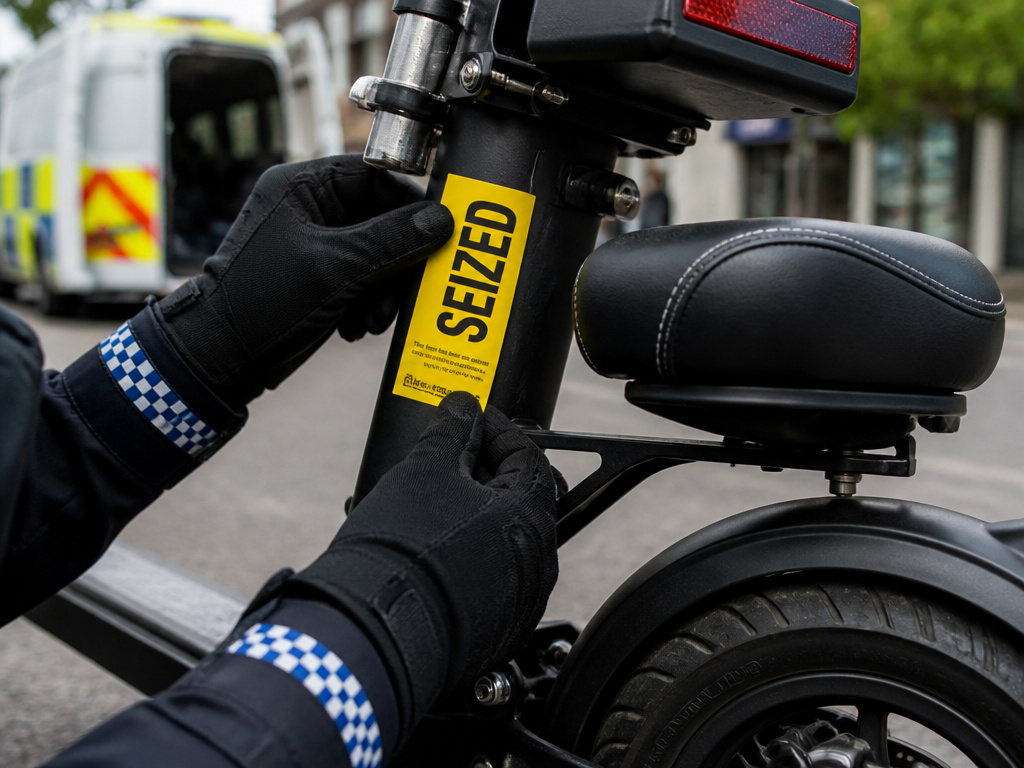
Ignoring these rules isn’t a trivial risk. The consequences are financial and practical.
- Fines and Penalties: Fixed penalty notices are common. Ireland’s €50 fines for a seat or speeding add up. In the UK, you could face fines for no insurance, no license, and illegal vehicle use.
- Scooter Impoundment: Police have the authority to seize the scooter. Recovery fees and storage costs can exceed the value of the scooter itself. You see this in UK enforcement videos—officers loading an illegal scooter into a van.
- Insurance Nullification: If you are in an accident while riding an illegal vehicle, your personal insurance (auto, homeowners) will likely deny coverage. You become personally liable for all damages and injuries.
- Liability in Accidents: Operating an illegal vehicle can be used to assign fault in a collision, regardless of the other party’s actions. It undermines your position completely.
The assumption that “it’s just a scooter, they won’t bother” is outdated. As these devices proliferate, targeted enforcement is increasing, especially in urban areas. Your daily commute safety depends as much on legal compliance as it does on wearing a helmet.
Frequently Asked Questions
Can I make my sit-down scooter street legal?
It is extremely difficult and usually impossible. “Street legal” means certifying it meets all FMVSS or equivalent standards (lighting, braking, mirrors, crashworthiness). This is a certification process for manufacturers, not a modification an owner can perform. Adding lights won’t make it a legally certified motor vehicle.
Are mobility scooters different?
Yes, completely. Mobility scooters (like those from Pride Mobility) are classified as “medical devices” or “powered wheelchairs” in most jurisdictions. They are intended for users with mobility impairments and are subject to separate, often more permissive, rules for use on sidewalks and road crossings. They are not designed for the speeds or traffic mixing of an electric scooter.
Do I need a license for a sit-down electric scooter?
It depends entirely on your local law. If the law classifies it as a “motor vehicle” or “moped,” then a valid driver’s license is almost always required. If it’s classified as a “micromobility device” or “electric kick scooter,” a license may not be required (e.g., Florida). You must check your state and city regulations.
Where can I legally ride my sit-down scooter?
You must consult a trifecta of sources: 1) State vehicle code for device classification, 2) State and local laws for bike lane rules and road access, and 3) Municipal ordinances for local sidewalk regulations. The only universal safe zone is private property with the owner’s permission.
Before You Go
The question of legality for a sit-down electric scooter is a question of bureaucratic classification, not about the machine’s quality or your skill as a rider. That seat triggers a cascade of legal requirements that the scooter was never built to satisfy.
Before you purchase a comfortable seated scooter, do the homework. Look up your state’s legal definition of an electric scooter. Search for the words “seat,” “moped,” and “motor vehicle.” Check your city’s transportation ordinances. The few minutes spent reading could save you hundreds in fines and the loss of your ride. The law, in this case, is the officer writing a ticket while your scooter gets loaded onto a truck.
