
Are Tire Plugs Safe? The Hidden Risk of Common DIY Tire Repairs
This post contains affiliate links. As an Amazon Associate, we earn from qualifying purchases.
A plug-only tire repair is not safe. Major tire manufacturers, industry standards, and a 2006 court case define it as an improper repair that can cause tread separation, blowouts, and fatal accidents. The only accepted permanent repair is a combined patch-and-plug unit installed from the inside after the tire is removed from the wheel.
That verdict from Continental, Michelin, Toyo, and the U.S. Tire Manufacturers Association (USTMA) leaves no room for the weekend warrior’s plug kit. The gap between what’s sold at every auto parts store and what’s stamped into an OEM service manual is where most owners make a $20 decision that risks a $20,000 lawsuit.
What follows is the manufacturer evidence, the physical failure mode they’re warning about, and the three hard limits that turn a simple puncture into a mandatory replacement. By the end you’ll know exactly when a repair is legal, when it’s a band-aid, and when the tire belongs in the scrap pile.
Key Takeaways
- A standalone string plug is condemned by every major tire manufacturer and voids the tire’s warranty. The only approved repair is an internal patch-and-plug combination.
- The danger isn’t a slow leak; it’s intracarcass pressurization, where air seeps into the tire’s steel belts, causing a sudden tread separation or blowout.
- Repairs are only allowed in the center of the tread. Any puncture in the shoulder or sidewall, larger than 1/4 inch (6mm), or in a tire with less than 2/32″ tread depth demands a new tire.
- A 2006 court case, Falco v. Copeland, established legal precedent where experts testified plug-only repairs are “dangerous and unreliable” and directly caused an accident.
- Emergency sealants and plug kits are temporary mobility aids only. The tire must be demounted and inspected internally by a professional before a permanent repair.
The Official Industry Stance (They All Say No)
Ask Continental Tire, Michelin, or Toyo if a plug-alone repair is safe, and you get the same sentence with the same words: never. This isn’t a matter of competing opinions. It’s a unified safety protocol published in their official repair guidelines and referenced in OEM service bulletins.
NEVER use only a plug or NEVER use only a patch to repair a puncture. The injury must be completely filled with a suitable vulcanizing material or rubber stem and a patch must be applied to the inner liner to prevent air loss. – Continental Tire Repair Guidelines
The U.S. Tire Manufacturers Association (USTMA) reinforces this in their proper puncture repair handout, which forms the basis for most manufacturer policies. The Rubber Manufacturers Association’s RMA PRP-PLTT 1005 standard, dated October 2005, codifies the patch-and-plug combo. When a 2007 GM service bulletin for the HUMMER H3 states “NEVER perform an outside-in tire repair (plug only, on the wheel),” it’s quoting this industry-wide rule.
The consensus is mechanical, not philosophical. A patch alone doesn’t fill the puncture channel, letting moisture corrode steel belts. A plug alone doesn’t seal the inner liner, letting air migrate into the carcass. Only the combination does both jobs.
Where this goes sideways: Most gas station or quick-lube repairs default to the plug-only method because it’s fast and requires no tire machine. The 2006 Falco v. Copeland case noted that “most repairs were performed in the plug-only manner,” a practice experts in the case called “dangerous and unreliable.”
How a Simple Plug Can Kill a Tire
The failure mode isn’t dramatic on day one. You insert the sticky string, trim the ends, and the tire holds air. It might hold for months. The problem is what you can’t see.
When a plug is installed from the outside, it doesn’t bond to the inner liner of the tire. Microscopic gaps remain. Over time, pressurized air seeps past the plug and into the layered fabric and steel belts of the tire carcass. This is called intracarcass pressurization.
Think of it like a slow leak into the walls of a balloon, instead of out of it. The air has nowhere to go, so it builds up between the plies. This delaminates the tire’s structure from the inside. The steel belts separate from the rubber. Heat from driving accelerates the process.
The end result isn’t a flat. It’s a sudden, catastrophic tread-belt separation or blowout, often at highway speeds. This exact sequence was detailed by expert witnesses in the Falco v. Copeland lawsuit, where a plug-repaired tire failed and caused an accident.
| Repair Type | How It Fails | Typical Timeline to Failure |
|---|---|---|
| Plug-Only (External) | Intracarcass pressurization leads to belt separation. | Weeks to months; failure is sudden and violent. |
| Patch-Only (Internal) | Water enters unfilled puncture channel, corroding steel belts. | Months; leads to gradual weakening and eventual blowout. |
| Patch-and-Plug Combo | Seals inner liner AND fills injury channel. Prevents both air and moisture ingress. | Considered a permanent, safe repair for the life of the tread. |
That’s why the rule is absolute: the tire must come off the rim. An internal inspection is non-negotiable. You must see if the penetrating object damaged cords on the inside, which an external glance always misses. This is the core argument in Michelin’s public stance: “Do not have your tire plugged. Ever. Plug repairs do not involve taking the tire off the wheel for a proper inspection.”
The Patch-and-Plug Combo That Makes a Tire Legal
So what does a proper repair look like? It’s a single unit or a two-part system that works from the inside out.
The technician demounts the tire, cleans the inner liner around the puncture, and buffs a small area to create a smooth surface. They then ream the puncture channel from the inside to clean it. The repair unit—a combination patch with a central rubber stem—is pulled through the hole from the inside. The stem fills the injury channel, while the patch vulcanizes (bonds) to the inner liner, creating an airtight seal.
This process is what retains a tire’s speed rating (though often at a reduced level, like an H-rated tire dropping to a T rating post-repair). It’s the only method referenced in the official Tire Information Service Bulletin for sealant tires and in the GM service bulletins.
Common mistake: Using a “rope type repair that is inserted and applied externally.” Toyo Tires’ guidelines explicitly call this an improper repair. The stem must be part of an internal patch system.
For the DIYer, this means most comprehensive tire repair kits designed for professional use contain these combination units. The cheap emergency string plug kit from the gas station does not. Investing in a proper kit, or more realistically, paying a shop with a tire machine, is the price of a safe, lasting fix.
The Three Hard Limits That Scrap a Tire
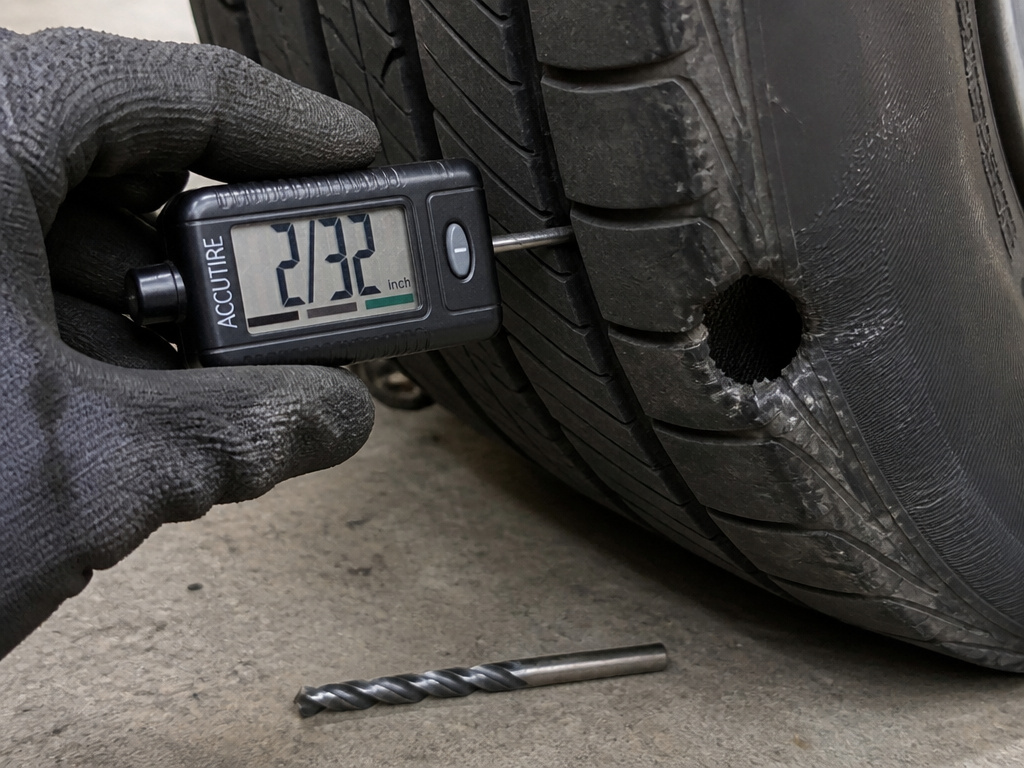
Even a perfect patch-and-plug repair isn’t always allowed. Manufacturers set strict, non-negotiable limits. Violating them turns a repairable puncture into a mandatory replacement.
- Location, Location, Location: The puncture must be in the center of the tread. If it’s in the shoulder (where the tread rounds toward the sidewall) or the sidewall itself, the tire is scrap. The flex in those areas will break any repair. This is the first check any reputable shop makes.
- Size Matters: The maximum repairable puncture diameter is 1/4 inch (6mm). A hole from a larger object, or one that’s been torn, exceeds the ability of the repair stem to fill it. The tire must be replaced.
- Tread Depth Check: You cannot repair a tire with 2/32″ of tread remaining or less. At that depth, the tire is legally worn out anyway. The repair unit needs sufficient material to bond to, and a worn-out tire lacks the structural integrity to support it.
These limits are printed verbatim in the Toyo Tires and Continental guidelines. They also list other instant disqualifiers: damage to the bead area, previous improper repairs, or exposed cords from over-buffing during a repair attempt. If you’re facing a sidewall puncture repair, the answer is straightforward: you can’t. Replace the tire.
When “Temporary” Really Means “Get to a Shop Now”
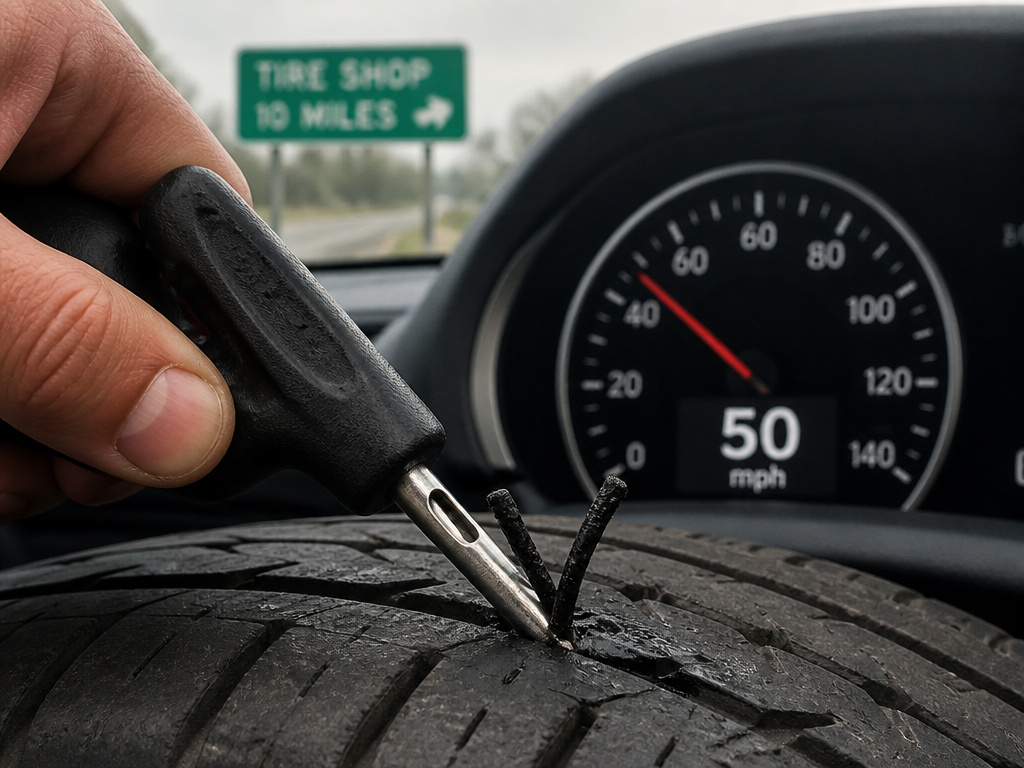
This is where the gray area lives. Every manufacturer and the USTMA acknowledge that emergency sealants or string plugs have a role: temporary mobility to get you off the road to a professional.
A can of fix-a-flat or a quality tire plug kit can save you from a roadside tire change. But that’s all it does. The official guidance from the USTMA’s sealant bulletin is clear: the tire must still be removed from the rim for a full internal inspection before a permanent repair. The sealant itself can hide damage.
The rule of thumb is speed and distance. If you use an emergency plug, drive under 50 mph and get to a tire shop within a day or two, and for no more than 50 miles. Treat it like a spare “donut” tire—because that’s essentially what it is. This temporary status is why knowing the longevity of a tire plug is critical; it’s not a permanent solution, and acting like it is courts disaster.
The Legal Precedent You’re Ignoring
The stakes moved from theoretical to courtroom-material in 2006 with Falco v. Copeland, 919 So.2d 650 (Fla. App. 2006). The case involved an automobile accident caused by a tire failure where string plugs had been used without patch seals.
The court records detail the failure mode: “using a string plug without sealing the innerliner of the tire can create problems with air diffusion or moisture seepage, and can result in intracarcass pressurization which leads to separation of the tire plies or belts with ensuing tire failure.”
The experts in the case didn’t mince words. They testified that the plug-only method was “dangerous and unreliable” and that the repair directly caused the tread separation that led to the crash. This legal precedent is the concrete consequence manufacturers warn about in their bulletins. It transforms their “never” from a recommendation into a documented, adjudicated risk factor.
This is the final argument against the quick plug. It’s not just about voiding your warranty or maybe having a slow leak. It’s about assuming a liability that a court has already recognized. When asking are plugged tires safe to drive on, the legal answer, backed by expert testimony, is no.
Frequently Asked Questions
Can I safely repair a tire with a plug kit myself?
No, not for a permanent repair. The only safe, permanent repair requires removing the tire from the wheel to install an internal patch-and-plug combination. A DIY string plug is a temporary emergency fix only to reach a professional tire shop.
How long will a tire plug last?
As a temporary repair, a plug may last weeks or even months before failing. As a permanent solution, it is unreliable and dangerous. Manufacturers do not assign a lifespan to plug-only repairs because they do not endorse them.
Will a tire plug cause a slow leak?
It might, but the greater danger is it won’t leak at all initially. Air can seep past the plug into the tire’s structure (intracarcass pressurization), causing a sudden and catastrophic tread separation or blowout later.
Are some tires more puncture-resistant than others?
Yes, tires with deeper, harder tread compounds and reinforced belts, like many all-terrain tire punctures, are more resistant. However, no tire is puncture-proof, and the same repair rules apply once they are damaged.
My sidewall is damaged. Can it be patched?
No. Damage to the sidewall or bead area is not repairable according to any major tire manufacturer. The constant flexing in those areas will cause any patch to fail. The tire must be replaced.
Does using a tire sealant ruin the tire?
Not necessarily, but it complicates repair. The sealant must be thoroughly cleaned from the inside before a proper patch-and-plug repair can be performed. Some shops may charge more for this cleanup, and if the tire was driven flat, it may be damaged beyond repair anyway.
The Bottom Line
The data from manufacturers, the physics of intracarcass pressurization, and the legal record from Falco v. Copeland all point in one direction: a standalone tire plug is an unacceptable risk.
The safe path is binary. If your tire meets the three hard limits—center tread, under 1/4 inch, enough tread—then the only repair is a professional patch-and-plug from the inside. If it fails any of those limits, or if you’re tempted by a $10 string plug, you need a new tire. The middle ground is where blowouts live.
Invest in a good tire repair for valid punctures, and invest in a new tire when the damage falls outside the rules. Your safety, and your liability, depend on knowing the difference.
