
Are Tire Plugs Permanent | The Difference That Decides
This post contains affiliate links. As an Amazon Associate, we earn from qualifying purchases.
A tire plug is not a permanent repair. Major manufacturers and industry bodies, including the USTMA, Michelin, and the Tire Industry Association, state a plug alone is unacceptable. A proper, permanent repair requires demounting the tire, inspecting it internally, and using a combined plug-and-patch unit from the inside.
That “requires” part is the whole problem. A plug’s job is to be fast, and a permanent repair’s job is to be safe. The gap between them is the 1/4-inch rule printed on every industry wall chart, which your plug kit manual probably skips.
What follows: the exact mechanics that make a plug fail, the three scenarios where even a professional patch is illegal, and the one clause that invalidates a manufacturer’s warranty before the technician even picks up the buffer.
Key Takeaways
- An external, rope-style plug is a temporary emergency fix only, designed to get you to a shop. The USTMA and TIA call it “unacceptable” as a permanent repair.
- A permanent repair must use a combination plug-and-patch unit applied from inside the tire. The plug fills the puncture channel; the patch seals the inner liner to prevent air loss and moisture intrusion.
- The maximum repairable puncture size is 1/4 inch (6mm) in diameter, located strictly in the tread’s central area. Damage in the sidewall, shoulder, or bead area is not repairable.
- If a tire has been driven on while significantly underinflated or flat, internal structural damage is likely. No ethical shop will repair it.
- A repair, even a proper one, can void the manufacturer’s tire warranty. Continental states this explicitly; others imply it by directing you to follow industry standards, which they did not perform.
The Single-Use Compromise
You buy a tire plug kit for the roadside scenario. It’s cheap, it fits in the trunk, and the promise is simple: shove the sticky rope in the hole, cut the ends, and drive away. That promise works, until it doesn’t. The plug holds because tire air pressure jams it against the puncture walls. There is no chemical bond. There is no seal on the tire’s inner liner.
Common mistake: Treating a plug as a permanent fix. Moisture seeps past the plug, corrodes the steel belts, and can cause a tread separation weeks or months later. The plug itself might hold air, but the tire around it is rotting from the inside.
The kit is a single-use compromise. It gets you off the highway shoulder. Its design intention is to fail safely on the way to a tire shop, not to last for the remaining 20,000 miles of tread life. Use it for anything longer and you’re gambling with a structural component. The industry term for this gamble is “improper repair.” Both the USTMA tire repair basics guide and Michelin are blunt: a plug-only repair is not safe or permanent.
What Makes a Tire Repair ‘Permanent’?
Permanence in tire repair is a specific, mechanical standard. It’s not about lasting a long time; it’s about addressing both failure paths of a puncture simultaneously.
First, the puncture channel must be filled completely with a vulcanizing rubber stem, that’s the plug part. Second, the tire’s inner liner must be sealed with a bonded patch. This is why every official guideline, like the USTMA puncture repair procedures PDF, mandates a combination unit. The patch alone would let air seep out the channel. The plug alone lets moisture in.
The process is non-negotiable: the tire comes off the rim. A technician buffs the inner liner around the puncture, applies vulcanizing cement, and bonds the patch-plug combo from the inside. The plug stem is pulled through the injury channel from the inside out, then trimmed flush. This creates a single, sealed system.
A repair using a plug only or a patch only is NOT ACCEPTABLE. The injury must be completely filled with a suitable vulcanizing rubber stem and a patch must be applied to the inner liner to prevent air loss. . Excerpt from the USTMA Puncture Repair Procedures wall chart
That’s the physical reality. A garage cannot perform this repair on the wheel. The equipment, a tire machine, a buffer, a stitcher roller, costs thousands of dollars and requires training. This is why a professional repair costs $25-$75 and a plug kit costs $10. You are paying for the demount, the inspection, and the permanent bond.
The 1/4-Inch Rule and Other Deal-Breakers
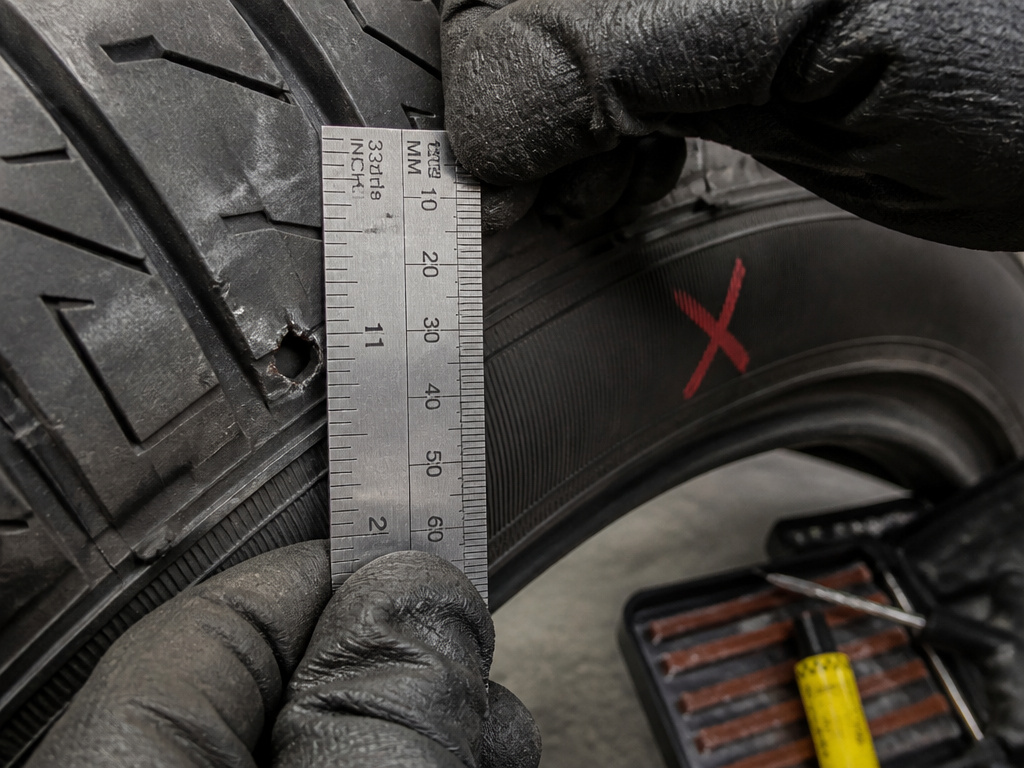
The 1/4-inch (6mm) diameter limit isn’t a suggestion. It’s the calculated threshold where the tire’s internal belts and casing can remain intact around the injury. Go larger, and the structural weave is compromised beyond a safe repair. This number comes straight from the Tire Industry Association repair guide and is echoed by Michelin, Nitto, and Toyo.
But diameter is just the start. Location is everything.
| Condition | Verdict | Why It’s Final |
|---|---|---|
| Puncture in sidewall or shoulder | Not repairable. Replace the tire. | The sidewall flexes with every rotation; a patch cannot bond reliably under that stress. The shoulder is a high-stress transition zone. |
| Tread worn to 2/32″ or less | Not repairable. Replace the tire. | The tire is legally worn out. Adding a repair to a tire at the end of its service life is pointless and unsafe. |
| Tire driven on flat | Not repairable. Replace the tire. | Driving without pressure crushes the sidewall structure against the rim. Internal cord damage is almost certain, even if it’s invisible. |
| Puncture larger than 1/4″ (6mm) | Not repairable. Replace the tire. | The injury exceeds the area a combination unit can seal and indicates likely damage to the steel belt package. |
| Multiple, overlapping punctures | Not repairable. Replace the tire. | Repairs must be at least 16 inches apart per industry rules. Close injuries weaken the casing beyond a safe margin. |
Run-flat tires add another layer. Manufacturers like Continental explicitly advise against repairing their Self Supporting Runflat (SSR) tires after a zero-pressure run, as internal damage is often undetectable.
Plug vs. Patch: The Mechanical Breakdown
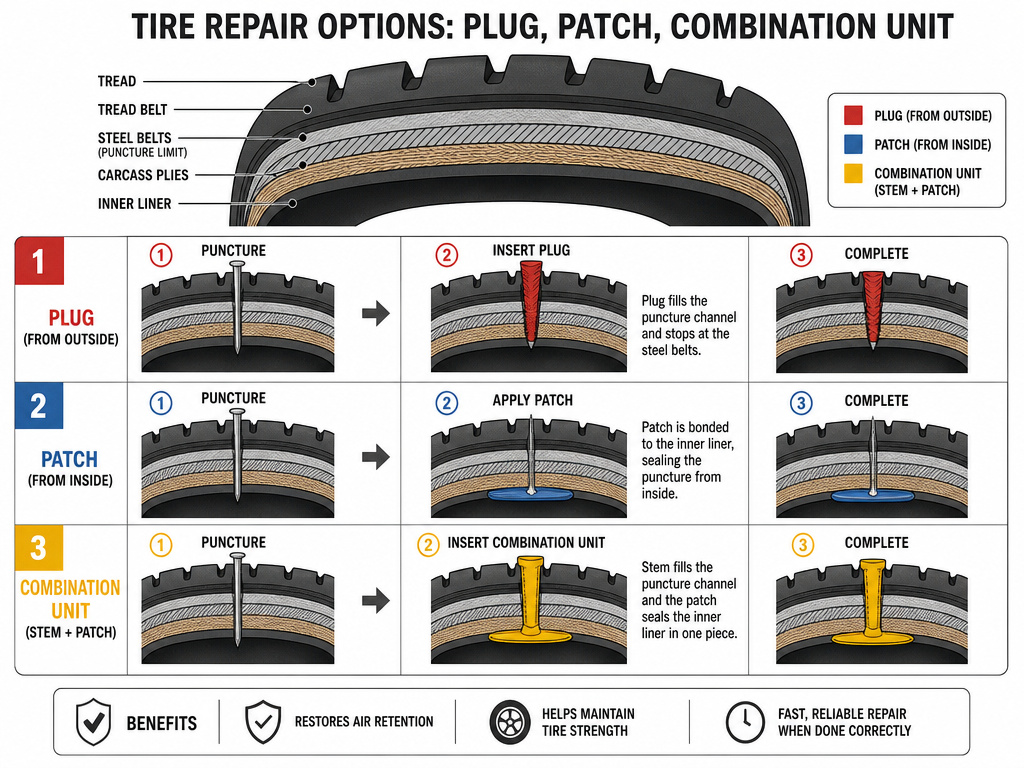
Understanding why one works and the other doesn’t requires looking at the tire’s layers. A radial tire has a steel or fabric casing, topped by steel belts, topped by the inner liner (a thin, impermeable rubber layer), then the tread.
A plug is a mechanical stopper. It sits in the tread and the top belt layer. It does not seal the inner liner. Air pressure might not escape immediately, but water and road contaminants can migrate down the channel between the plug and the tire rubber. That moisture hits the steel belts.
A patch is a chemical seal. Buffing the inner liner opens its pores; the vulcanizing cement and the patch’s own adhesive create a molecular bond with the tire rubber. It seals the inner liner, but it does nothing to fill the puncture channel above it.
A combination unit does both: the stem fills and seals the channel, the patch seals the liner. They are manufactured as one piece for a reason. This is the only repair method that meets the RMA PRP-PLTT industry standard referenced by companies like Toyo and Nitto.
The Professional Repair Process (Step-by-Step)
This is what you’re paying for when you skip the DIY kit. Every step has a consequence if skipped.
- Demount and Inspect. The tire is removed from the wheel. The technician inspects the interior for hidden damage, secondary cuts, belt separation, sidewall bruising from a flat drive. Skipping this means repairing a tire with hidden catastrophic damage.
- Clean the Injury. The puncture channel is cleaned and smoothed from the inside. This ensures the plug stem will make full contact.
- Buff the Liner. A low-speed buffer roughens the inner liner around the puncture. If buffed too deep and the casing cords are exposed, the tire must be scrapped.
- Apply Cement. Vulcanizing cement is applied to the buffed area. This is the glue that creates the permanent bond.
- Install Combination Unit. The technician peels the release film, inserts the plug stem through the injury from the inside, and presses the patch firmly onto the cemented area.
- Stitch and Seal. A stitcher roller is used to push out air bubbles and ensure full contact. The plug stem is then trimmed flush with the tread.
- Remount and Balance. The tire is put back on the wheel, inflated, and the assembly is balanced. An unbalanced, repaired tire will vibrate and wear unevenly.
The entire process takes a trained technician about 20-30 minutes. The cost covers their expertise, the equipment wear, and the liability they assume by certifying the tire as roadworthy.
When “Permanent” Isn’t Permanent: Warranty and Speed Ratings
Here’s the fine print most shops don’t volunteer. A repair can alter the fundamental specifications of your tire.
Continental’s warranty document states plainly: a repair to one of its tires invalidates the manufacturer’s warranty. Other manufacturers may not spell it out, but by directing you to “industry standards,” they transfer responsibility. If the repair fails, the tire maker is off the hook.
Speed ratings also change. Nitto’s technical bulletin outlines the derating: a properly repaired Y-, W-, or V-rated tire drops to an H-rating (130 mph max). A repaired H-rated tire drops to a T-rating (118 mph max). This is because the repair, while sound, is a deviation from the original, homogenous construction. The vehicle’s maximum safe speed is now limited by its slowest-rated tire.
Where this goes sideways: Installing a repaired, derated tire on a performance car without telling the owner. The tire might look fine, but its safe maximum speed is now 20-30 mph lower than its mates.
The Right Tools for the Right Job
Your goal dictates your tool. For a true roadside emergency where a spare isn’t an option, a quality plug kit like the Safety Seal or Slime pro-grade kit can be a lifesaver. Use it, then drive directly to a shop under 50 mph.
For a repair you intend to keep, you need a professional. Call a reputable tire service center. If you’re a DIYer managing a fleet, the investment is in the equipment: a Coats 40 tire changer, a Hunter balancer, and a supply of Tech or Rema Tip Top combination repair units.
Aerosol sealants from a mobility kit are a separate category. They are a last-resort, temporary mobility aid. Most shops hate them because the liquid gumming up the inside complicates inspection and can damage tire pressure sensors.
If you want a permanent fix for a nail in a good tire, the answer is never a plug from the outside. It’s a combination repair from the inside, performed by a technician who follows the official tire repair procedures. Anything else is a compromise with a timeline.
Frequently Asked Questions
Can a tire plug last for years?
It can, but that’s the danger. A plug may hold air for years while moisture slowly corrodes the steel belts from the inside. The failure, a sudden tread separation, won’t give warning. Longevity is not a measure of safety here.
Is a plug or patch better for a small nail hole?
Patch alone is insufficient. A plug alone is unsafe. The only correct answer for a small, repairable nail hole is a combination plug-patch unit applied from inside the tire after a full inspection.
Will a tire shop repair a tire that already has a plug?
Most reputable shops will not. Industry standards (USTMA, TIA) state that a tire with an existing improper repair must be scrapped. The shop would have to remove the old plug material, which is often impossible without enlarging the injury beyond the repairable limit.
How long does a proper tire patch repair last?
Properly installed combination repair is designed to last for the remaining tread life of the tire. The bond is permanent. However, the overall tire must still be in good condition, adequate tread depth, no other damage, and it must not have been run flat.
Are some tires unrepairable from the start?
Yes. Run-flat tires, once driven on flat, are often not repairable per manufacturer policy. Tires with specialty constructions or self-sealing liners may also have specific repair restrictions. Always check the manufacturer’s guidelines first.
The Bottom Line
A tire plug is a temporary tool for a specific crisis. A permanent tire repair is a professional procedure governed by a 1/4-inch rule, a location checklist, and a piece of equipment that bonds rubber from the inside. Confusing the two doesn’t just risk a flat. It risks a belt separation at highway speed.
The safe path is clear. Use a plug only to reach a shop. Let a technician demount, inspect, and install a combination unit. Accept that the repair may alter the tire’s warranty and speed rating. That’s the real, unglamorous price of permanence.
