
Can a Tire Be Patched on the Side | The Official Verdict
This post contains affiliate links. As an Amazon Associate, we earn from qualifying purchases.
No, you cannot patch a tire on the sidewall or shoulder. Industry and manufacturer standards uniformly state that damage outside the main tread’s center area is unrepairable. A repair attempt there leads to catastrophic failure, often a blowout or tread separation, because the sidewall flexes constantly under load and no patch can withstand that movement. The only safe, industry-approved repair zone is the central tread, and only for punctures under 1/4-inch (6.4mm) in diameter.
That 1/4-inch limit comes straight from the tire industry’s rulebook, the U.S. Tire Manufacturers Association (USTMA) puncture repair guidelines. So does the 2/32-inch tread depth floor. They are not suggestions; they are the physical thresholds where the tire structure can still handle a patch without a hidden weakness spreading into a zipper rupture. Crossing either limit, or trying to mend a sidewall, writes a failure ticket with a specific timeline.
What follows is a breakdown of the official rules, the physics behind them, and the documented consequences of ignoring them. You will learn the exact specifications for a legal repair, how speed-rated and run-flat tires change the equation, and the one time a sidewall fix might look tempting but isn’t.
Key Takeaways
- Sidewall and shoulder repairs are banned. All major manufacturers and the USTMA prohibit them due to the constant flex and high-stress in these areas.
- The repairable zone is the central 60-70% of the tread. Damage must be at least an inch from any shoulder edge.
- Puncture size and tread depth are absolute limits. Never patch a hole larger than 1/4-inch (6.4mm) or a tire with 2/32-inch (1.6mm) or less tread.
- The only proper repair is a combination plug/patch. A plug-only or patch-only fix is temporary and dangerous, invalidating any warranty.
- Special tires have special rules. Run-flat and speed-rated tires often cannot be repaired; always check the manufacturer’s policy first.
Where You Can and Cannot Patch a Tire (USTMA Rules)
Look at your tire. Draw an imaginary line down the middle of each tread shoulder, the curved area where the flat tread meets the vertical sidewall. The space between those lines is the only area where a puncture is considered for repair under the USTMA and RMA (Rubber Manufacturers Association) standards.
The repair must be of a plug (stem) and inside patch type or a patch combined with a separate plug. Do not use a rope type repair that is inserted and applied externally. Such repairs are considered improper. The injury must be completely filled with a suitable vulcanizing rubber stem and internal patch to prevent air loss.
This technical directive from Toyo Tires and Nitto Tire bulletins clarifies the method. The “where” is defined by a simple, non-negotiable map:
- Repairable Area: The central tread, staying clear of the shoulders.
- Non-Repairable Area 1: The shoulder/belt edge area.
- Non-Repairable Area 2: The entire sidewall.
- Non-Repairable Area 3: The bead area (where the tire seals to the wheel).
If a puncture is even angled into the shoulder, the tire is scrap. The industry graphic in the USTMA handouts is explicit: “DO NOT make repairs where the injury damage extends into the shoulder/belt edge area.”
| Tire Zone | Repairable? | Reason |
|---|---|---|
| Central Tread | Yes, with limits | Handles compression forces; belt package supports repair. |
| Tread Shoulder | No | High flex and twist; belt edges can separate. |
| Sidewall | No | Constant flexion; no structural belt support. |
| Bead Area | No | Critical air-seal zone; damage compromises mounting. |
The Physics of a Sidewall: Why “No” Isn’t Just a Rule
A sidewall is a carefully engineered composite of radial cords, nylon, polyester, or steel, coated in rubber and designed to flex thousands of times per mile. When a nail pierces it, it doesn’t make a clean hole.It pushes cords apart, stretches them, and often severs them.
A patch glued to the inside cannot restore the tension in those cords. Every time the tire rolls, the sidewall bends. That bending motion works against the adhesive bond of the patch and strains the already-damaged cords around the puncture. This is why a plug-only repair on the sidewall is a guaranteed failure. The plug merely fills a hole in a flexible membrane that is constantly moving; it will loosen and leak, often within a few hundred miles.
But even a proper combination repair, a stem through the hole bonded to an internal patch, fails here. The patch needs a stable, rigid foundation to adhere to. The sidewall’s inner liner is flexible. Under load, the patch and the liner move at slightly different rates, breaking the bond. Once it starts to peel, moisture gets in, the cords rust or rot, and the failure spreads. This is the “zipper rupture” you’ll see warned about in the NHTSA technical service bulletin: a catastrophic sidewall tear that happens in an instant.
The Official Limits: Size, Depth, and Condition
Knowing where to patch is half the battle. The other half is knowing when to walk away. The industry standards set clear, measurable stop signs.
Puncture Size: 1/4-Inch (6.4mm) Maximum
This is the universal diameter limit from Toyo, Nitto, Goodyear, and the USTMA. A hole larger than this, from a thick lag bolt, a large chunk of metal, or a torn injury, exceeds the ability of a repair stem to seal it effectively and compromises too much of the belt structure. The Tesla Model Y service manual repeats this exact limit. Bigger than a pencil eraser? The tire is done.
Tread Depth: 2/32-Inch (1.6mm) Minimum
Tires worn to the tread wear indicators or with 2/32-inch of tread remaining have no margin left. The structural belts are closer to the surface, and the remaining rubber is too thin to safely buff for a patch. A repair here risks exposing the belt cords during preparation, which mandates scrapping the tire. This is not a wear guideline; it’s a structural limit.
Common mistake: Repairing a tire with sealant residue inside without a full inspection. Sealants can hide internal damage from underinflation. That tire might have been run flat, cooking the sidewall from the inside out. Clean it thoroughly per the USTA puncture repair guidelines or reject it.
Other Automatic Rejections:
- Previous improper repairs: Any sign of a plug-only or external rope repair means the tire’s integrity is already questionable.
- Damage from underinflation/overload: If the tire was run low, the sidewalls may have internal cord fatigue invisible from outside.
- Multiple or overlapping repairs: Two repairs too close together stress a single area. The rule is one repair per tire, spaced widely apart.
- Visible internal damage: Any cuts, splits, or separated belts inside the tire are immediate fail criteria.
What Happens If You Patch a Sidewall
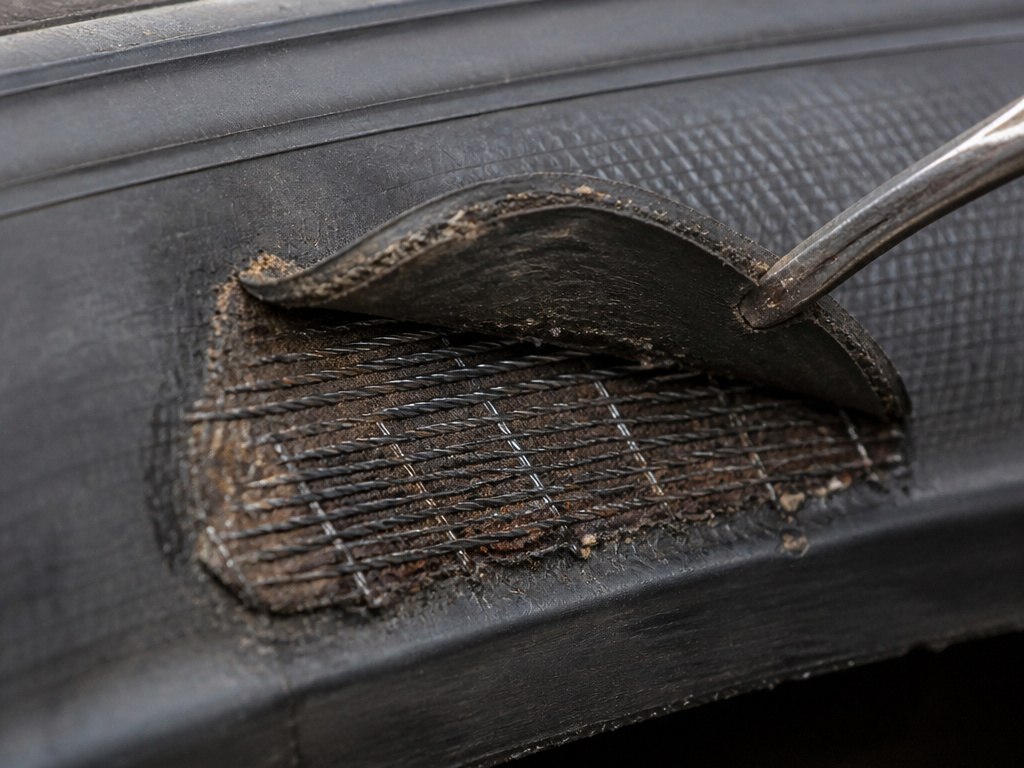
Let’s assume someone ignores every warning and applies a combination plug/patch to a sidewall puncture. The timeline is predictable.
Short-Term (First 50-200 miles): It might hold air. The driver thinks they’ve beaten the system. But during this period, the constant flexing is working the adhesive bond loose. The driver may feel a slight vibration or hear a faint, rhythmic thump-thump-thump as the unbalanced patch mass rotates.
Medium-Term (200-1,000 miles): The bond breaks. The patch starts to peel at the edges. Air and moisture seep between the patch and the inner liner. The tire may begin losing a few PSI per week, which the driver might attribute to normal seepage or cooler weather. Inside, the moisture starts corroding the steel radial cords (if present) or degrading the polyester/nylon.
Failure Point (Unpredictable, but inevitable): A hard cornering maneuver, a pothole impact, or simply accumulated fatigue causes the weakened cords to snap. This can manifest as a sudden, catastrophic blowout, a zipper rupture up the sidewall, or a rapid air loss. At highway speed, this loss of control is a severe accident risk.
This is the documented failure mode that the standards exist to prevent. This is why a proper tire repair requires dismounting the tire: to find this internal damage before it finds you on the road.
The Right Way: The Only Safe Repair Procedure
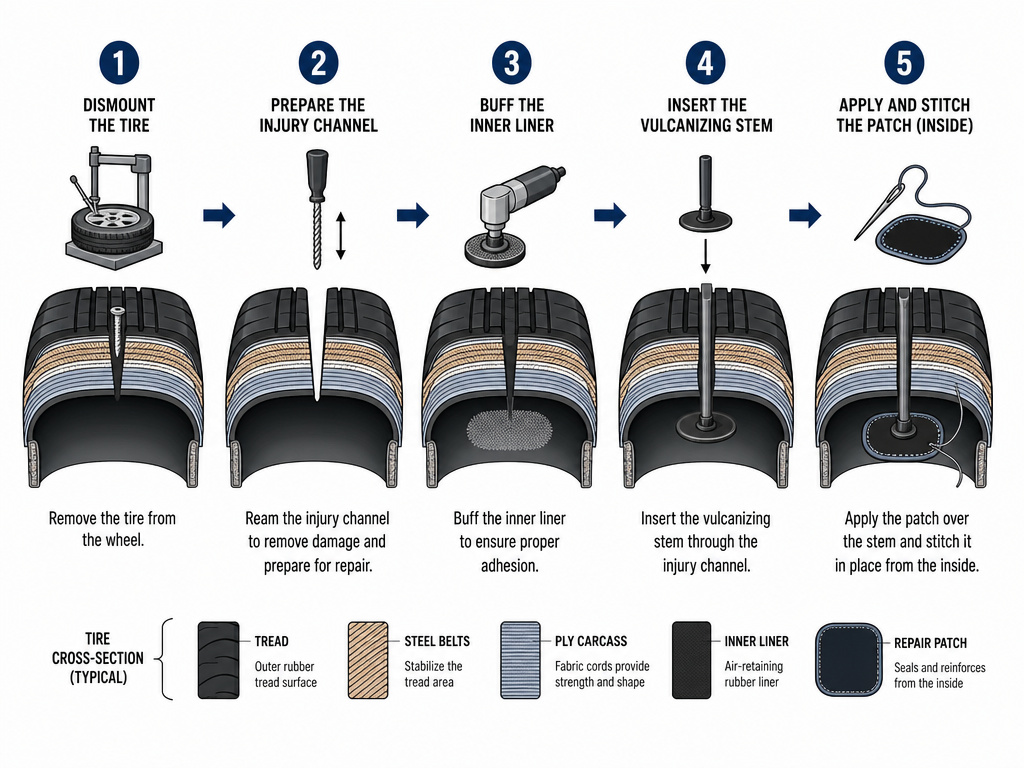
For a puncture in the legal repairable zone, the correct method is a non-negotiable sequence. Missing a step voids the safety of the repair.
- Dismount and Inspect. The tire must come completely off the wheel. An internal and external inspection under bright light is mandatory to rule out hidden damage. Any repair attempted on the wheel is illegal and unsafe.
- Prepare the Injury Channel. The puncture is cleaned and enlarged slightly with a carbide cutter from the inside out, removing damaged cord material and creating a clean channel for the repair stem.
- Buff the Inner Liner. The area around the puncture on the inside of the tire is buffed to a specific texture to allow the patch adhesive to bond properly. Buffing too deep and exposing cords means scrapping the tire.
- Fill with Vulcanizing Stem. A rubber stem coated in chemical cement is pulled through the injury channel from the inside until it fills the hole completely, preventing moisture ingress.
- Apply and Stitch the Patch. A patch is centered over the stem on the inside, stitched down thoroughly to remove air bubbles, and vulcanized. This creates a single, sealed unit.
This combination unit, often called a “plug-patch”, is the only repair that restores the tire’s air-holding integrity and structural closure. A permanent tire plug alone, inserted from the outside, is a temporary emergency fix at best. A patch alone cannot seal the injury channel.
Special Cases: Run-Flats, Speed-Rated, and Sealant Tires
Standard passenger tire rules have important exceptions. High-performance and specialty tires come with manufacturer-specific caveats.
Run-Flat Tires (e.g., Continental SSR, Goodyear EMT)
These tires have reinforced sidewalls to allow driving with no air pressure. That same reinforcement makes internal damage from a flat drive impossible to see. Continental explicitly states its Self-Supporting Runflat tires cannot be repaired or reused after a run-flat event. Other manufacturers are similar. You must consult the maker’s policy.
Speed-Rated Tires (H, V, W, Y, ZR)
A properly repaired speed-rated tire often has a reduced speed rating. Goodyear’s policy states a correctly repaired H- or higher-rated tire retains its rating, but a section repair (for a torn injury) invalidates it. The rule is clear: you must contact the tire manufacturer for its specific repair policy before proceeding. Never assume.
Tires with Built-in Sealant (e.g., Bridgestone B-Seal)
These tires have a sticky sealant layer inside. The NHTSA bulletin outlines extra steps: the sealant must be pushed aside from the repair area, the area thoroughly cleaned of residue, and the repair performed. Afterward, the sealant can be smoothed back over the patch. Failure to clean the sealant off will cause the patch to fail.
Tools and Professional Help
You cannot perform a proper tire repair with a $10 emergency kit from the auto parts store. You need a tire machine, a spreader, a buffer, and the correct repair materials. This is a professional task.
Your most important tool is a trained technician’s eye. They know to look for the subtle signs of internal damage, discoloration, cord distortion, belt separation, that the average person would miss. This is why even a simple tire plug safety discussion ends with “get it to a shop.”
For your own preparedness, a portable tire inflator and an accurate tire pressure gauge are essential for maintaining pressure and monitoring slow leaks after any repair. Underinflation is a primary cause of tire failure.
Frequently Asked Questions
Can a sidewall puncture be temporarily plugged to get to a shop?
No, not even temporarily. Driving on a sidewall with any object protruding or a plug installed dramatically increases the risk of sudden sidewall collapse or a blowout. The sidewall cannot support the weight of the car when compromised. If you have a sidewall puncture, the car should not be driven. Call for a tow.
What about a small sidewall scrape or cut, not a puncture?
Any breach of the sidewall rubber that exposes or damages the radial cords is a failure point. A deep scratch that shows white (the cord material) means the tire is structurally weakened and must be replaced. Rubber-only abrasion without cord exposure can be monitored, but any bulge indicates internal failure.
My repair shop said they could “boot” a sidewall. Is that safe?
Boot” is a flexible patch used on large truck tires, sometimes applied to sidewalls in specific, low-speed industrial applications. For a passenger car tire at highway speeds, a sidewall boot is a rejected method and is not an approved or safe repair.
Do all-terrain tires resist sidewall punctures better?
While some all-terrain tires have tougher sidewall compounds for off-road protection, they are not immune to punctures. The same repair rules apply: a sidewall puncture in an all-terrain tire is not repairable. Their improved resistance just means it might be less likely to happen.
Can I repair a bicycle or scooter tire sidewall?
The same principle applies but on a different scale. A bicycle tire repair for a sidewall cut is generally not reliable due to flex. For an electric scooter tire, which carries more weight and speed, a sidewall injury almost always requires tube or tire replacement.
Before You Go
The verdict is absolute and backed by physics, engineering, and decades of industry data. You cannot safely patch a tire on the sidewall. The attempt turns your tire into a time bomb.
The process is straightforward: locate the puncture. If it’s in the tread’s center and under 1/4-inch, a professional combination repair is an option. If it’s anywhere on the sidewall or shoulder, or if the tire is too worn or damaged, the only safe choice is replacement. Your safety, and that of everyone on the road with you, hinges on respecting these non-negotiable limits. Don’t gamble with a patch where one was never designed to hold.
