
Is An All Terrain Tire Less Likely To Get Nailed? The Data
This post contains affiliate links. As an Amazon Associate, we earn from qualifying purchases.
An all-terrain tire is not less likely to get a nail puncture than a standard tire. The risk comes from three factors: the aggressive tread pattern can trap debris, the thicker sidewalls offer no extra resistance to sharp objects penetrating the tread, and the typical use environments, construction sites, unpaved roads, rural areas, are simply nail-rich. Recent NHTSA recalls for non-compliance issues prove that a tire’s perceived toughness has zero bearing on its fundamental vulnerability to road hazards.
That puncture risk lives in the tread’s job description. An all-terrain tire is engineered to grip loose surfaces, which means its blocks are spaced apart to evacuate mud and snow. Those same gaps are perfect traps for a nail lying flat on the pavement. The tire rolls over it, the nail stands up between the lugs, and the next rotation drives it home.
What follows walks through the puncture mechanics, the two 2024 recalls that show where real safety gaps exist, and the single most effective thing you can do to protect your tires, which has nothing to do with the rubber itself.
Key Takeaways
- Aggressive tread patterns on all-terrain tires can trap nails and debris more easily than smoother highway treads, increasing puncture risk in certain conditions.
- Tire construction focuses on impact resistance and load capacity; the tread rubber’s puncture resistance is similar across passenger and light-truck tire categories.
- The environment is the biggest variable. Driving on job sites, newly paved roads, or rural areas with debris multiplies your exposure to nails, regardless of tire type.
- Recent NHTSA recalls highlight that non-compliance in date coding or safety certification (like the 3PMSF symbol) is a far more concrete and documented risk than a vague “toughness” claim.
- Maintaining correct air pressure is a more effective puncture defense than any tire design. An underinflated tire has a larger, flatter contact patch that presents more surface area to hazards.
The Nail Risk Equation: Tread Design vs. Construction
Headline toughness sells tires. The reality is more about geometry and pressure.
An all-terrain tire’s multi-pitch tread blocks and deep grooves exist to bite into dirt and eject mud. On pavement, those voids become pockets. A nail lying on the road can get flicked up into a groove, where it’s held upright long enough for the next tread block to press down onto its point. A highway tire with continuous ribs and smaller sipes presents a smoother, more unified surface that can deflect or roll over the same object.
Common mistake: Believing thicker sidewalls stop nails. The sidewall is the tire’s most flexible and impact-absorbing part, but a nail puncture happens through the tread face, the area designed to be stiff and wear-resistant. The difference between a passenger and light-truck tire’s tread rubber hardness is marginal for puncture purposes.
The construction difference is about load, not impenetrability. An LT-rated tire uses more steel belts and heavier casing materials to handle higher inflation pressures and carry more weight. That helps with impacts from rocks or curbs, but a sharp, focused point like a nail or screw concentrates force on a single steel belt filament. It still cuts through.
So a nail doesn’t care about your tire’s marketing. It cares about finding a groove to sit in and enough force to push it through the belts. Your driving environment dictates the odds.
Why Your Driving Location Matters More Than Your Tread
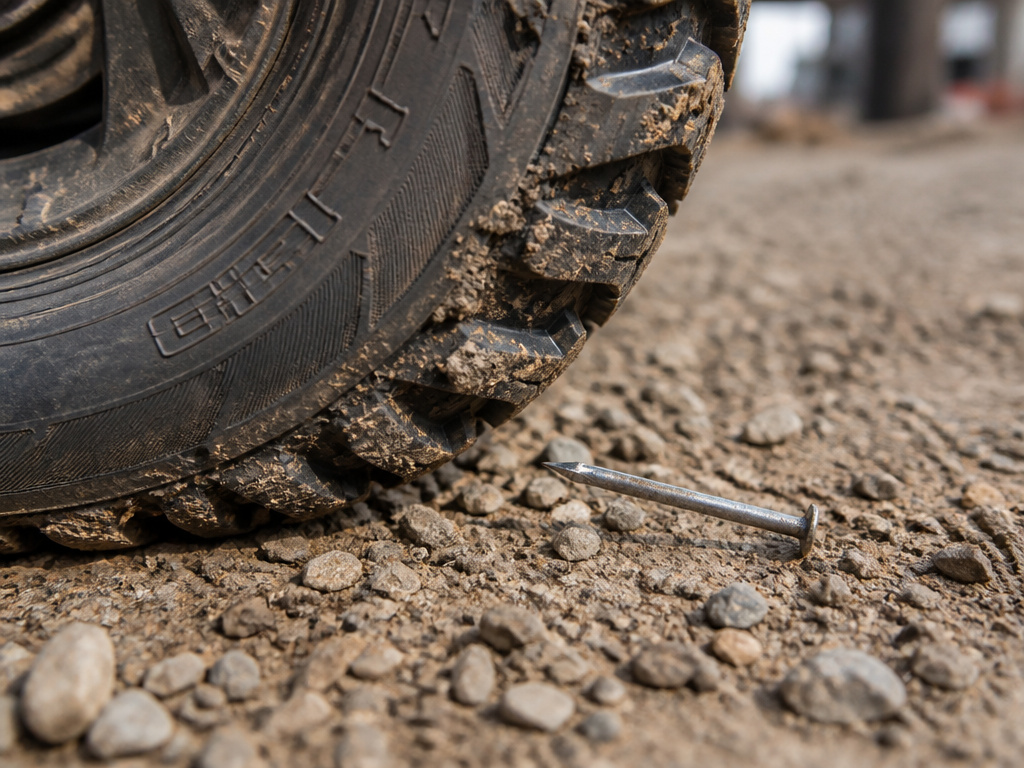
If you never leave pristine suburban asphalt, your nail risk is low. The moment your route includes detours, new developments, or unpaved access roads, the risk profile shifts completely.
Construction sites are ground zero for fastener fallout. Roofing nails, deck screws, and trim staples get dropped by the handful and swept into the street or roadside gravel. Rural and agricultural areas have fencing staples, old machinery parts, and general debris. Even recently paved roads can have stray tie-wires or clips from rebar.
An all-terrain tire’s natural habitat is these exact places. You buy it for capability on loose surfaces, but that capability brings you into the hazard zone more often. It’s an exposure problem, not an armor problem.
Consider your own driving. Do you regularly use your truck or SUV for home improvement runs, towing a trailer to a campsite, or navigating backcountry trails? Each of these activities increases your time in nail-rich environments. A set of all-terrain tires for daily driving on a commute-heavy SUV might see fewer nails simply because its miles are on maintained highways.
The math is simple: more exposure equals more opportunities for a puncture. No tire design changes that equation.
The Two Recalls That Reframe “Tough”
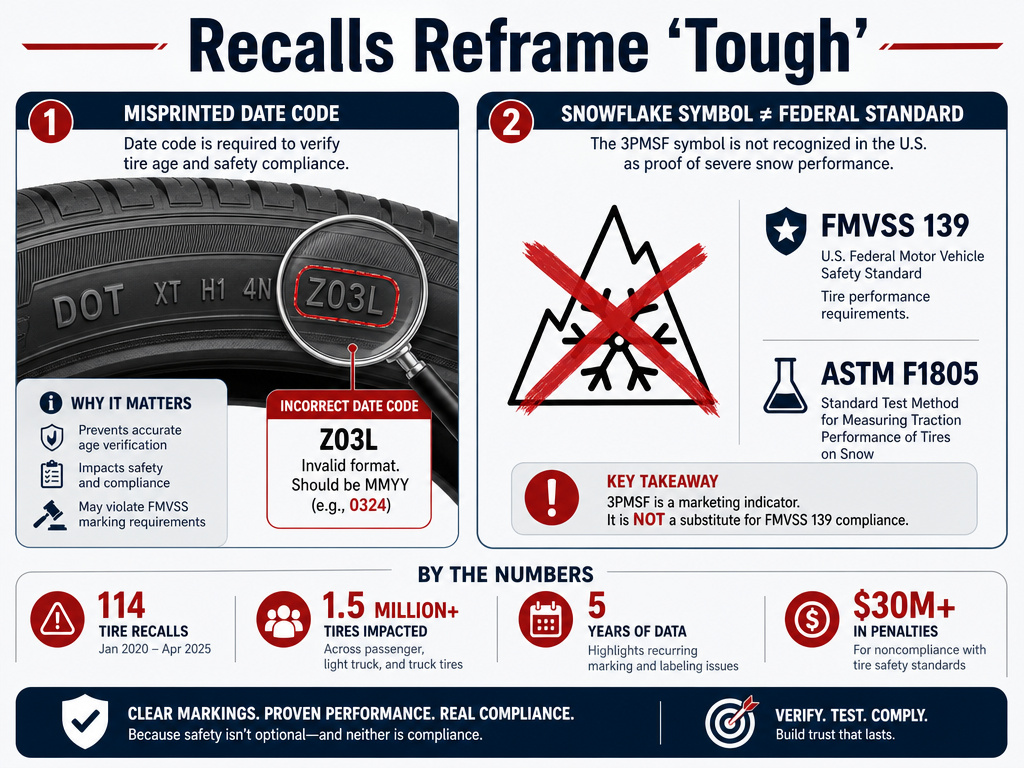
The idea of a “tough” tire masking a hidden defect is not theoretical. Two separate NHTSA actions in 2024 demonstrate that compliance and correct labeling are the real benchmarks of tire safety, not marketing about durability.
The first case involves the Hercules Terra Trac AT X-Venture, an all-terrain tire. The NHTSA important safety recall notice details a failure to conform to FMVSS 574. Tires manufactured in the 20th week of 2024, size LT265/75R16, had the curing press code “Z03L” stamped where the date code “2024” should be. This meant a buyer or technician could not accurately determine the tire’s age. Older tires degrade, and running them past their service life increases the risk of a catastrophic failure like a belt separation, a failure that happens at speed, with no warning, and is far more dangerous than a slow nail puncture.
The second case is broader. The NHTSA all-terrain tire recall report covers 520,000 AMP Terrain Attack and Terrain Pro all-terrain tires produced between 2019 and 2024. These tires were marked with the Three Peak Mountain Snowflake (3PMSF) symbol based on European testing standards but were not tested to the U.S. ASTM F1805 snow traction test required by FMVSS 139. A driver relying on that symbol for winter safety was using a tire that hadn’t met the legal performance benchmark.
| Recall | Tire Model | Non-Compliance Issue | Real-World Risk |
|---|---|---|---|
| 24T-010 | Hercules Terra Trac AT X-Venture | Incorrect date code (FMVSS 574) | Unable to assess tire age; increased risk of aged-tire failure. |
| 24T-001 | AMP Terrain Attack/Pro A/T | 3PMSF symbol without ASTM F1805 test (FMVSS 139) | Tire may not perform to expected snow traction standards. |
These recalls matter to the nail question because they prove a tire can look the part and still have a critical flaw. A “tough” all-terrain tire with a misprinted date code is a time bomb, not a shield. Your diligence should focus on verifying compliance and age, not assuming aggressive tread equals invincibility.
What Actually Improves Puncture Resistance?
If tread design isn’t a shield, what helps? The answer is less sexy but more factual: proper maintenance and a few specific technologies.
The single most effective thing you can do is maintain the correct air pressure. An underinflated tire bulges. The contact patch widens and flattens, pressing more of the tread’s surface area against the road. This maximizes the chance of encountering a nail and also puts the sidewalls under stress, making them more susceptible to damage from curbs or rocks. Check pressure monthly, when the tires are cold.
Some manufacturers offer specific technologies aimed at puncture resistance. These are not marketing fluff; they are physical layers. * Self-Sealing Liners: A layer of sticky sealant inside the tire that can close small punctures (typically up to 1/4 inch) as they happen. It adds weight and can affect balance. * Run-Flat Construction: Stiffened sidewalls allow the tire to support the vehicle’s weight for a limited distance after a total loss of pressure. It doesn’t prevent the puncture, but it can prevent a sudden blowout and let you drive to safety. * Reinforced Sidewalls: Often called “Bead-to-Bead” or “Armor” layers, these are extra belts of material (often aramid) under the tread and wrapping up the sidewall. They are designed to resist cuts and impacts from rocks, which is different from stopping a narrow nail point.
For most drivers using all-terrain tires for SUVs or trucks, the best defense is a combination of correct pressure, visual inspections before long trips, and avoiding obvious debris fields when possible.
The Verdict: Are All-Terrains a Puncture Magnet or Not?
They are not a magnet. They are not a shield. They are a tire, with a specific design that performs a specific task, operating in environments that have specific hazards.
The aggressive tread can trap debris a highway tire might deflect. That’s a minor increase in risk under certain conditions. The thicker construction resists impacts, not penetration. The biggest factor by far is where you drive. A set of LT tires on a Ram 1500 that never leaves a mine site will see more nails than a sedan on the interstate, but that’s about the mine, not the Michelins.
Where this goes sideways: Chasing “puncture-proof” tires and ignoring the documented, recall-level risks like date coding and false certification. A proper tire lifespan is determined by wear, age, and integrity, not by the number of nails it supposedly dodges.
Focus on the proven factors. Buy tires from reputable brands that meet all FMVSS standards. Check the date code on the sidewall (the last four digits of the DOT number are week and year). Maintain your pressure. And understand that nails are a random event in a life of random events. Your best preparation is a good spare tire, a working jack, and the knowledge that it can happen to any tire, anywhere.
Frequently Asked Questions
Do thicker all-terrain tire sidewalls prevent punctures?
No. Punctures occur through the tread face, where the tire is hardest and thickest to resist wear. Sidewall thickness helps with impact resistance against curbs and rocks, but a nail rarely penetrates the sidewall. A sidewall puncture is usually the result of a severe impact or a manufacturing defect, not a random road hazard.
Are nails the most common cause of tire failure?
For passenger vehicles, yes, punctures from nails, screws, and other sharp debris are among the top causes of repairable tire failure. Catastrophic failures like tread separation or blowouts are more often linked to underinflation, overloading, impact damage, or aged tires, issues highlighted in the NHTSA recalls.
Can I make my all-terrain tires more puncture-resistant?
You cannot fundamentally change the tire’s construction after purchase. You can use tire sealants as a preventative, but these can imbalance the tire and are messy for technicians to handle later. The most reliable approach is proactive: maintain correct air pressure, perform regular visual inspections for embedded objects, and consider tires that come with built-in sealant or run-flat technology if you frequently drive in high-risk areas.
How does tire pressure affect puncture risk?
Incorrect pressure directly increases risk. Underinflation causes excessive flexing and a larger contact patch, making it easier to pick up a nail and damaging the internal structure. Overinflation makes the tread crown more rigid and can reduce the tire’s ability to absorb an impact, potentially driving a sharp object deeper into the casing. Always follow the vehicle manufacturer’s recommended pressure listed on the driver’s door jamb.
Do all-terrain tires have different warranties against punctures?
Standard manufacturer warranties cover defects in materials and workmanship, not road hazard damage. Most tire retailers offer separate road hazard warranty programs you can purchase. These programs typically provide prorated credit or replacement for unrepairable punctures. The coverage and cost vary, so read the terms. The warranty length on the tire’s tread life is a separate metric, usually between 40,000 and125,000 miles for all-terrain models.
Before You Go
An all-terrain tire is a tool for capability, not a suit of armor. It trades some on-road refinement and possibly some pavement puncture odds for off-road grip. The recent recalls for the Hercules and AMP tires are the real cautionary tales, safety lies in compliance and transparency, not in tread block bravado.
Your action items are clear: know your driving environment, check your pressure, read the date code before you buy, and skip the myth that a tougher-looking tire makes you immune to bad luck. Carry a proper spare, know how to change it, and drive on.
