
Are Plugged Tires Safe | The 1/4-Inch Rule That Decides It
This post contains affiliate links. As an Amazon Associate, we earn from qualifying purchases.
Plugged tires are only conditionally safe and never permanently recommended by tire manufacturers. A plug alone, the “bacon strip” shoved in from the outside, is considered a temporary, outside-in repair that can fail catastrophically. A safe, permanent repair is a combined patch-plug installed from the inside after the tire is demounted, but only for punctures under 1/4 inch (6mm) located within the tread’s central crown, on a tire with sufficient remaining tread depth.
The official line from the Rubber Manufacturers Association is unequivocal. The industry’s own repair standards require a demounted inspection and forbid plug-only fixes. That 1/4-inch puncture limit isn’t a suggestion; it’s the threshold where the steel belts inside the tire can no longer reliably grip the repair material. Go past it, and you’re gambling on structural integrity at highway speeds.
What follows: the exact specs from service bulletins, what a failed plug looks like inside a shredded tire, and the three-step checklist that tells you if your repair is a get-me-home fix or a legitimate long-term solution.
Key Takeaways
- A standalone “bacon strip” plug is a temporary, exterior repair. Tire manufacturers and the USTMA do not endorse it as a permanent fix.
- The only industry-approved permanent repair is a combined patch-plug, applied from the inside of the tire after a full demount and inspection.
- Punctures larger than 1/4 inch (6mm) in diameter, or located on the shoulder or sidewall, are not repairable under any industry standard.
- A repair automatically invalidates the manufacturer’s warranty on most new tires, including those from Continental.
- Run-flat and sealant tires have special, stricter rules. Driving them while flat can cause invisible internal damage that makes any repair unsafe.
The Official Industry Answer: A Plug Is Not A Permanent Repair
The conversation starts with a line from the Rubber Manufacturers Association that most DIY guides skip: “NEVER use only a plug or NEVER use only a patch to repair a puncture.” This is from their RMA PRP-PLTT 1005 standard, the benchmark for the US and Canada. The injury, they state, must be filled with a stem and sealed from the inside with a patch. One without the other is a compromise.
Continental Tire’s service bulletin echoes this directly. It states a repair performed by anyone other than a trained specialist invalidates the tire’s warranty. More critically, it sets the hard physical limit: punctures must not exceed 1/4 inch (6mm) in diameter to be considered for repair. This isn’t arbitrary. A puncture larger than that begins to separate the steel belts that give the tire its shape and strength. The repair material can’t bridge that gap reliably, especially under the heat and flex of sustained driving.
Where this goes sideways: Using only an exterior plug on a puncture at or near the 1/4-inch limit. The plug may hold air initially, but the constant flexing of the tire carcass works it loose over hundreds of miles. The eventual failure isn’t always a slow leak; it can be a sudden, violent separation of the tread belts.
The takeaway is binary. The industry defines a safe, permanent repair by a specific method (patch-plug), applied to a specific type of injury (small, central puncture), after a specific inspection (tire demounted). Anything else exists outside their safety calculus.
What Makes a Repair “Official” vs. “Roadside”?
You have two repair universes. In one, a mechanic in a well-lit bay uses a tire machine to break the bead, cleans the inner liner with a buffer, applies rubber cement, and vulcanizes a patch-plug unit from the inside out. In the other, you stand on a shoulder with a $10 kit, reaming a hole and jamming a sticky string into it.
The difference isn’t about skill. It’s about physics.
A patch-plug works because it addresses the failure in three dimensions. The plug stem fills the injury channel. The patch seals the inner liner, preventing air from seeping into the steel belt package. The vulcanizing process creates a chemical bond with the tire’s own rubber. An exterior plug only addresses one dimension, it blocks the hole. It does nothing to prevent air from migrating between the tire’s layers, a process called delamination.
| Repair Type | How It’s Installed | Industry Stance | Primary Risk |
|---|---|---|---|
| Exterior “Plug” | Inserted from outside, tire on wheel | Not a permanent repair; temporary get-home only | Delamination; plug ejection under high heat/flex |
| Interior Patch-Only | Tire demounted, patch applied inside | Insufficient; RMA standard forbids “only a patch” | Air seepage through injury channel around patch |
| Interior Patch-Plug | Tire demounted, combined unit installed | The only RMA/USTMA-approved permanent repair method | Minimal when applied to an approved injury |
The vulcanizing step is what most roadside kits completely omit. That chemical bond is what allows the repair to move with the tire instead of working against it. Without it, the repair site remains a stiff, unyielding point in a flexible structure. That’s the genesis of a stress fracture.
The Three Yes/No Questions That Decide Safety
Forget vague advice. Your tire’s repair safety boils down to three questions with concrete, yes-or-no answers. If any answer is “no,” the tire is not safely repairable by any professional standard.
1. Is the puncture in the tread’s central crown?
Draw an imaginary line between the outermost main grooves of your tread. The safe repair zone is the “crown” between them. Punctures in the shoulder (the curved area near the sidewall) or the sidewall itself are automatic disqualifications. The steel belt reinforcement doesn’t extend there, so the repair has nothing structurally sound to anchor to. The flex in those areas is also exponentially higher.
2. Is the puncture smaller than 1/4 inch (6mm)?
This is the RMA PRP-PLTT 1005 limit for passenger and light truck tires. Grab a ruler. A standard pencil is about 7mm. If the object that caused the puncture is noticeably larger than a pencil lead, the hole is likely too big. This rule exists because the belts are roughly a quarter-inch apart; a larger injury can shear multiple belt wires.
3. Does the tire have more than 2/32″ of tread depth remaining?
Continental’s bulletin states you should “NEVER repair tires worn to the tire’s treadwear indicators or to 2/32” remaining tread depth.” A tire at the wear bars is already at the end of its service life. Adding a repair point to a thin, over-flexed casing is asking for a blowout. The repair process itself can stress an already weakened structure.
Common mistake: Repairing a tire because “the tread looks good everywhere else.” Tread depth is measured at the shallowest point. If the puncture is in a worn spot, even if the rest of the tread is deep, the tire fails question three.
If you can answer “yes” to all three, a professional patch-plug repair is technically permissible. If any answer is “no,” the only safe move is replacement. This checklist is what a proper shop uses before they even pick up a tool.
The Special Cases: Run-Flats, Sealants, and Temporary Kits
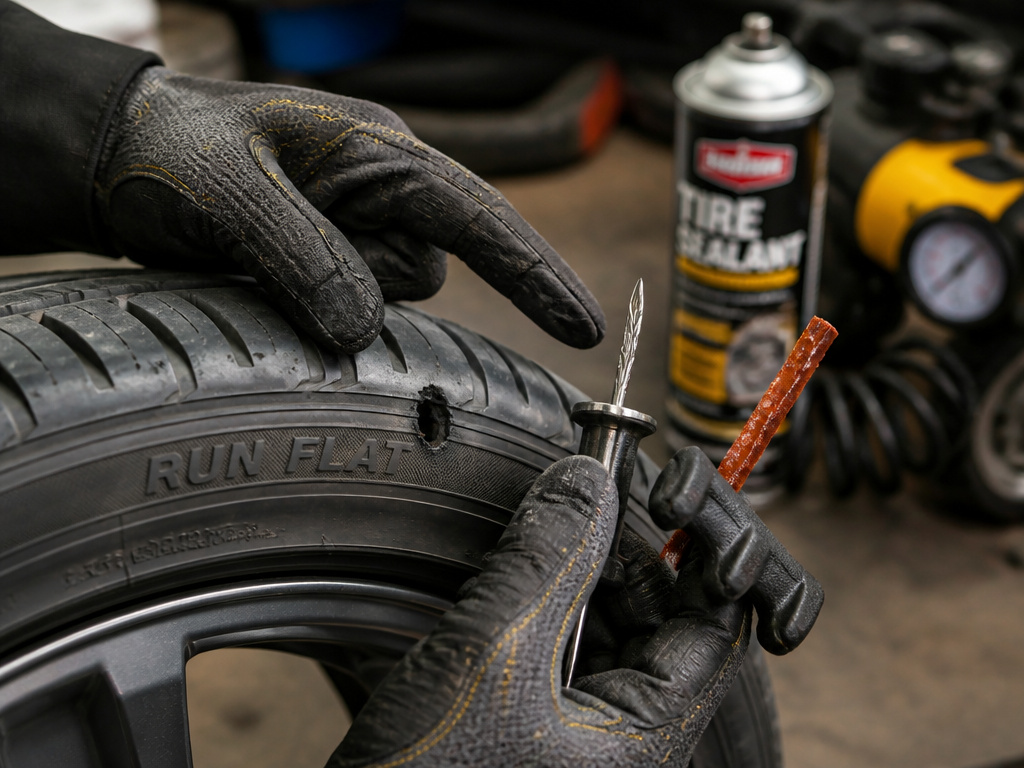
Modern tire technology adds layers of complication. Run-flat tires (often marked SSR or RF) and factory-installed sealant tires change the repair rules completely.
Run-flat tires are designed to be driven a limited distance (usually 50 miles) at a reduced speed (often 50 mph) after a total loss of pressure. The USTMA TISB 47 bulletin is blunt: operation beyond those limits “could result in sudden tire destruction.” The critical point is what happens next. The stiff sidewalls that let you drive on them can hide internal damage. Continental explicitly states that even a trained specialist may be unable to spot the damage that makes a run-flat tire unrepairable. Their official position is to not recommend any repair on a run-flat that has been driven while flat.
Sealant tires have a gooey layer inside the tread. The USTMA TISB 57 guideline for these is just as strict: “Every tire must be removed from the rim for a thorough inspection.” The sealant itself can hide the true extent of a puncture from a quick glance. A proper repair requires carefully scraping the sealant away from a small area without damaging the inner liner, a job firmly in the realm of a specialist with the right tools and the manufacturer’s specific instructions.
Your car’s temporary tire repair kit, the can of sealant and compressor, exists in a different category entirely. Honda’s and Ford’s manuals frame them identically: they are for small punctures (under 4-6mm) to enable a drive to a service station, not a permanent solution. Ford’s kit specifies a limit of 120 miles at 50 mph. These kits are a mobility aid, not a repair. The sealant can gum up the tire pressure monitoring sensor and makes the eventual professional inspection and repair messier and more costly.
What Technicians Actually See Inside a Failed Repair
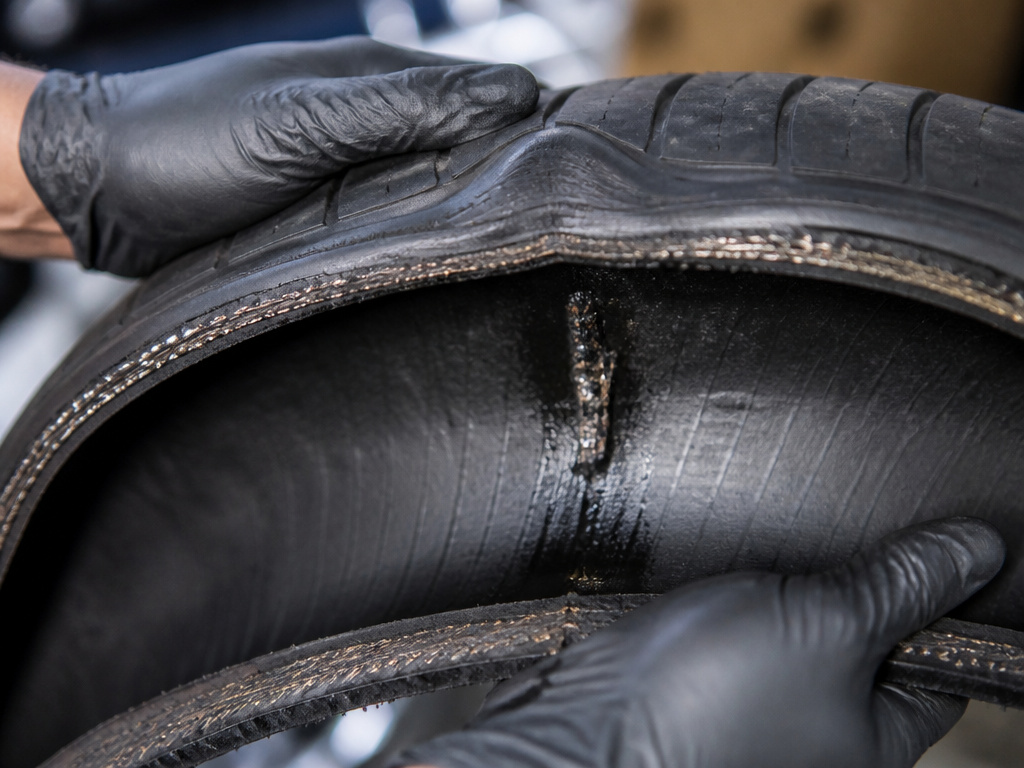
Talk to a technician who cuts open tires, and they’ll describe a specific failure pattern. A plug-only repair that’s been in place for several thousand miles often shows a clean channel worn through the plug material. On the inside, you see a “bleed” pattern around the puncture hole where air has been forcing its way between the belts. The inner liner might be stained, but the tell is a slight bulge or soft spot in the tread directly above the injury.
The failure mode isn’t dramatic until it is. The constant friction and heat concentration at the un-bonded repair site slowly degrade the surrounding rubber and the adhesive holding the steel belts together. This can lead to a section of the tread belt separating from the rest of the tire carcass. At high speed, that separation can propagate, leading to a sudden loss of tread, a blowout.
I prefer a patch-plug over a plug-only repair every time, not because it’s more profitable for a shop, but because it’s the only method that restores the tire’s layered seal. The plug stem fills, the patch seals, and the bond distributes stress. A plug just sits there, taking all the punishment itself until it gives way.
This is why many reputable shops have a flat policy against repairing a tire that already has an existing plug. The RMA standard states it clearly: “NEVER repair a tire that has an existing, improper repair; the tire must be scrapped.” They can’t guarantee the integrity of the belts around an old, unbonded repair site.
So, Are Plugged Tires Safe? The Bottom Line
A plugged tire is a conditional, temporary fix with defined limits. It is not safe as a permanent solution on a tire you expect to drive at highway speeds for the next year.
The safe path is clear. If you have a small, central puncture in a tire with good tread: use a temporary inflator kit or a careful plug to get you to a professional tire service center. Have them demount the tire, inspect it, and install a proper patch-plug if it meets the three-question checklist. Pay for that service. It is the price of the tire’s, and your, extended health.
If the puncture is large, on the shoulder, or the tread is low, the only safe choice is a new tire. The cost of a replacement is a fixed number. The cost of a high-speed failure because you gambled on a compromised structure is an open question you never want to answer.
Your car’s only contact with the road is a few square inches of rubber per tire. Trust the materials, engineering, and official standards designed to protect that contact patch. Don’t trust a sticky string that ignores all three.
Frequently Asked Questions
Can a plugged tire last for years?
It can, but that doesn’t mean it should. A plug in a perfectly centered, tiny puncture might hold air for the life of the tread. The risk isn’t primarily the plug leaking; it’s the unseen damage from flex and heat concentration around an un-bonded repair. You’re trading a known safety margin for luck. The industry doesn’t rate or certify plugs for long-term use because they can’t guarantee that margin.
Is a patch better than a plug?
Alone, neither is sufficient. A patch alone can still allow air to leak through the injury channel. A plug alone can’t seal the inner liner. The proper repair is a combined patch-plug unit, where both components work together. When people say “patch,” they often mean this combined unit. When they say “plug,” they mean the exterior string. The patch-plug is objectively the safer, sanctioned method.
Will a tire plug affect my tire’s speed rating?
Yes, immediately. Any repair, even a proper patch-plug, technically voids the tire’s original speed rating. The repair process alters the tire’s construction at that point. Most professionals will advise you to treat a repaired tire as having a “Standard” rating (up to 112 mph) regardless of its original “H” or “V” rating. The repaired area is a potential point of heat buildup and failure at extreme speeds.
Can I repair a tire with two punctures?
It depends on their proximity. The Tire Industry Association guidelines advise against multiple repairs if they are too close together (usually within a 30-degree arc of each other) or if the tire has been repaired more than once. Concentrated damage severely compromises the steel belt structure in that section. When in doubt, a professional inspection after demounting is the only way to know, but many shops will refuse a tire with multiple injuries as a matter of policy.
Are tire sealants like Fix-a-Flat a safe alternative to a plug?
No, they are a temporary mobility aid, not a repair. Sealants like those in factory mobility kits are designed to seal small holes so you can drive to a service station. They can clog tire pressure sensors, make a mess inside the wheel, and harden over time, causing imbalance. They do nothing to address the structural integrity of the puncture. They are a “get-you-there” solution, period.
