
Are Run Flat Tires Repairable? The Definitive Guide & Rules
This post contains affiliate links. As an Amazon Associate, we earn from qualifying purchases.
Run flat tires are repairable, but only if they haven’t been driven beyond strict speed and distance limits set by the manufacturer, and only if the puncture is in the tread area. The 2024 USTMA bulletin warns that exceeding these limits risks sudden tire destruction and requires a professional inspection to determine repairability.
That inspection is a mandatory legal and mechanical barrier between a safe, lasting repair and a liability. A mechanic’s visual check of the outside tells you nothing about the heat damage inside the reinforced sidewall, damage that can delaminate layers and cause a blowout weeks later.
What follows is the current framework: three non-negotiable manufacturer specs, the one inspection that matters, and the 2024 industry bulletin that reframed the entire conversation from “can you?” to “should you, and who assumes the risk?”
Key Takeaways
- Exceeding the manufacturer’s stated zero-pressure distance (e.g., Goodyear’s 80 km) or speed limit almost guarantees the tire is unrepairable due to internal heat damage.
- A professional must inspect the inner liner for heat stress, not just the outside. The 2024 USTMA TISB 47 bulletin makes this a formal requirement after any run-flat event.
- Repairs are strictly limited to the central tread area. Any sidewall puncture, or damage from curbing, means immediate replacement.
- Mixing repaired run-flats with new ones on the same axle is forbidden by most vehicle manufacturers; you often must replace tires in pairs.
- Your vehicle’s warranty and any roadside assistance coverage may be voided by an improper repair, shifting all liability to you and the shop.
The Single Deciding Factor: Distance and Speed at Zero Pressure
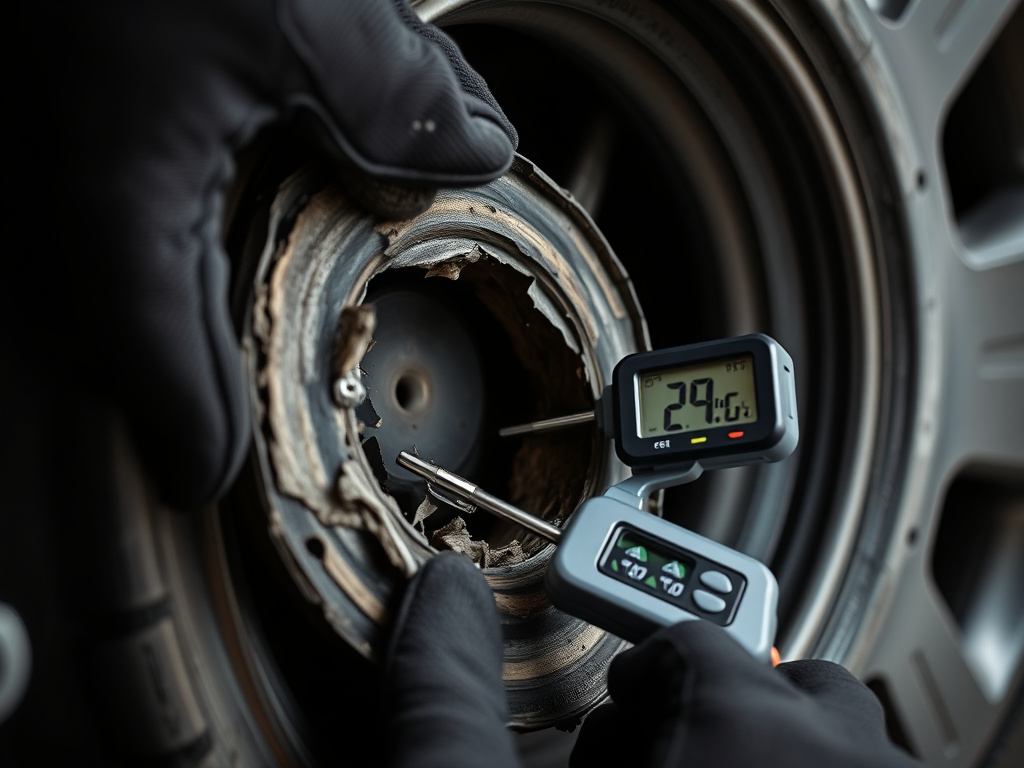
Forget the puncture for a second. The real question focuses on how far and how fast you drove after the Tire Pressure Monitoring System (TPMS) warning.com/can-you-fill-a-car-tire-with-a-bicycle-pump/) light came on.
Manufacturers publish exact tolerances. Goodyear and Dunlop’s Run On Flat standard is 80 kilometers at up to 80 km/h. Toyota states up to 100 miles at speeds below 55 mph. These aren’t generous buffers; they are engineered failure points. The reinforced sidewall flexes violently without air support, generating intense heat. Go over the limit, and that heat cooks the inner liner and begins to separate the tire’s structural layers.
Operation of a runflat tire at low or zero-inflation pressure beyond the recommended distance or speed limitations could result in sudden tire destruction, which may result in an accident, personal injury or death. . USTMA TISB 47, July 2024
This turns a simple puncture into a complex forensic problem. A shop must now determine if you stayed within the limits, a near-impossible task without a vehicle data log. This is why many reputable shops simply refuse repairs if the tire has been driven flat. The liability is too high.
Why “I Only Drove a Few Miles” Isn’t Good Enough
Heat builds exponentially with speed, not linearly. Driving 10 miles at 70 mph does more damage than 30 miles at 30 mph. The sidewall doesn’t have time to cool between impacts with the road. You might see no external scuffing, but the inner liner can be glazed and brittle.
This hidden damage is why you cannot rely on a plug kit from a gas station. Those kits seal the hole but do nothing to assess the structural integrity. You’ve fixed the leak but not the catastrophic failure waiting inside the sidewall.
The Manufacturer Split: Who Says Yes, Who Says Never
The automotive industry has no unified answer. Your tire’s repairability depends entirely on the brand stamped on its sidewall and, sometimes, the car it’s mounted on.
| Manufacturer / Brand | Repair Policy | Critical Condition |
|---|---|---|
| Michelin (ZP) | Allows repair | Must not have been driven at zero pressure; puncture in tread only. |
| Bridgestone / Firestone | Allows repair* | *Subject to inspection per their TSB; cannot be driven beyond “limited run-flat distance.” |
| Goodyear / Dunlop | Allows repair | Must be within 80 km / 80 km/h limit; no sidewall damage. |
| BMW (as vehicle OEM) | Does not recommend | Workshop manual says to accommodate customer wishes, but official stance is against it. |
| Pirelli, Continental | Never repair | Immediate replacement required after any pressure loss event. |
This table is your first stop. If your tires are Pirelli or Continental, the conversation is over. For others, the “allows repair” clause is buried in technical service bulletins (TSBs) like the USTMA tire service bulletin that most drivers never see. These TSBs transfer the burden of proof onto the technician.
Common mistake: Assuming a tire is fine because it holds air after a plug. The plug seals the leak but masks the heat-stressed sidewall right next to it. That sidewall can fail separately, without warning, at highway speed.
Step-by-Step: The Inspection That Decides Repair or Replace
A proper run-flat inspection is a full tire-off, rim-separated process. It’s not a quick look in the parking lot.
- Demount the Tire. This must be done by a technician familiar with EH2 wheels (the extended-hump rims common on run-flat-equipped vehicles). Forcing a stiff run-flat tire off a standard rim machine can damage both.
- Clean and Inspect the Inner Liner. The entire interior surface must be wiped clean and examined under bright light. You’re looking for:
- Discoloration: Brown or blueish patches indicate overheating.
- Bubbles or Delamination: Raised areas where the inner liner has separated from the casing.
- Abrasion or Rub Marks: Signs the deflated tire was folding and chafing against itself.
- Locate the Puncture. Measure its distance from the nearest sidewall shoulder. Industry standard (USTMA) requires at least 1/2 inch from the shoulder for a repair to be considered. In practice, most manufacturers want it in the central 2/3 of the tread.
- Assess the Injury. The puncture must be straight and small (typically under 1/4 inch). A gash, tear, or puncture at an angle compromises the repair.
If any of these checks fail, especially signs of heat on the inner liner, the tire is scrap. This is a definitive safety cutoff.
The One Tool You Can’t Do Without
A trained eye is the best tool, but the process is documented in official documents like the NHTSA technical instructions document for recalls. These set the precedent for methodical, evidence-based inspection. A shop following these protocols isn’t being difficult; they’re avoiding the lawsuit that comes after a failed repair.
Repair vs. Replace: The Cost Equation That Isn’t About Money
A new run-flat tire can cost $300-$500. A proper repair, including demount, inspection, and a combination patch-plug installed from the inside, might cost $80-$120. The math seems obvious.
The real cost involves the risk transfer. When a shop repairs your run-flat, they accept liability for its future performance.Given the hidden damage variables, many independent shops will not accept that risk. The dealership often will, but they default to the manufacturer’s policy, which for brands like BMW means “replace.”
Furthermore, a repaired tire often has a reduced speed rating. It may also void the remaining tread-life warranty. And if the repair fails and causes an accident, your insurance company will investigate the repair’s legitimacy. Was the shop certified? Did they follow the latest USTMA bulletin? This is where “saving” $400 becomes a million-dollar liability problem.
What About Just Switching to Regular Tires?
This is a common endgame for owners tired of the run-flat hassle and cost. It’s mechanically possible, but it’s a systems change.
Your car’s suspension was likely tuned for the stiffer sidewalls of run-flats. Switching to standard tires might improve ride comfort but can make the handling feel softer or less precise. More critically, you lose the extended mobility feature. You will need a spare tire, a jack, and a lug wrench, items your car probably doesn’t have. You’re trading convenience for cost and repairability.
If you make the switch, do it in pairs at a minimum, or replace all four. Mixing tire types (run-flat vs. Conventional) on the same axle is dangerous and violates every tire service guideline.
Frequently Asked Questions
Can a tire shop patch a run flat tire if I haven’t driven on it flat?
Yes. This is the ideal scenario. If you catch a slow leak immediately via TPMS and the tire never drops to zero pressure, it can be repaired like a standard tire, following the tread-location rules. The key is that the reinforced sidewall was never stressed.
Why can’t you repair a sidewall puncture on a run flat?
The sidewall is the tire’s structural heart, especially in a run-flat. It contains the rigid support inserts that bear the car’s weight when airless. Penetrating this area compromises the entire run-flat safety feature. No repair can restore that engineered integrity.
Do I need to replace all four run flat tires if one is damaged?
Damage often occurs in pairs. If the damaged tire is not severely worn, you can replace it with a new run-flat of the same brand, model, and size.However, significant tread depth difference (more than 2/32 inch) between axles can affect stability and all-terrain tire performance, especially in AWD systems. Most shops recommend replacing axle pairs.
How long can I safely drive on a repaired run flat tire?
Properly inspected and repaired run-flat should last the remaining tread life of the tire, assuming no further damage. However, it should be re-inspected at every rotation or balance check. The repair site is now the strongest part of the tread; the concern remains the surrounding, possibly heat-affected, structure.
Does using a sealant like Fix-a-Flat ruin a run flat tire for repair?
Usually, yes. Tire sealants are messy and can clog the TPMS sensor. They also make the internal inspection impossible because the technician cannot see the inner liner through the coating. Most shops will consider a sealant-treated tire unrepairable for this reason alone.
The Bottom Line
The question has shifted. It’s no longer “are run flat tires repairable?” The modern, liability-aware question is “under what documented, verifiable conditions would a professional assume the risk of repairing this specific tire?”
The answer lives in a three-part check: the manufacturer’s tolerance table, a pristine inner liner, and a puncture dead-center in the tread. Fail any one, and the tire is a parts-bin candidate. This perspective is informed by the direct lesson from the 2024 USTMA bulletin and the recalled Bridgestone Turanza.nhtsa.gov/odi/rcl/2019/RCRIT-19V134-2340.pdf) assemblies where improper service led to separation.
Your move is to find a technician who knows these protocols, not just one with a plug gun. The right shop will demount, inspect, and show you the evidence before they ever reach for a patch. That’s the difference between a repair and a gamble.
