
What is the Difference Between an ATV and a UTV? Explained
This post contains affiliate links. As an Amazon Associate, we earn from qualifying purchases.
An ATV (All-Terrain Vehicle) is a single-rider, straddle-seat machine you steer with handlebars. A UTV (Utility Terrain Vehicle) is a multi-passenger, side-by-side vehicle you drive with a steering wheel and pedals. The difference goes beyond seating. It dictates cargo capacity, safety features, where you can legally ride, and which machine fits a 50-inch-wide trail.
The 50-inch number is a hard limit set by the U.S.Forest Service for motorized trails, and it’s the single most important spec for deciding which vehicle you can actually take exploring. An ATV slips under it. Most UTVs do not. Your choice starts there, then branches into how many people you carry, how much you need to haul, and what kind of protection you want around you when the terrain tips over.
What follows is a breakdown of controls, specs, and federal safety standards. We’ll match each vehicle to real jobs, hunting, farming, plowing snow, and name the models that define the categories. By the end, you’ll know which one to walk toward at the dealership.
Key Takeaways
- The 50-inch trail width rule is the primary legal constraint; ATVs fit, most UTVs do not.
- ROPS (Rollover Protection Systems) and seatbelts are standard on UTVs; ATVs lack this integrated cage, making rider technique the primary safety system.
- Federal standards mandate 50 mm (2 inches) of mechanical suspension travel on all ATV wheels.
- Cargo capacity is the UTV’s domain, with some models rated for 3,000 pounds; ATVs are for lighter, more agile hauling.
- Your background matters: motorcycle riders adapt to ATV handlebars instantly; car drivers feel at home with a UTV’s steering wheel.
The Core Difference: It’s About How You Ride
The split is immediate and physical. You sit on an ATV. You sit in a UTV.
An ATV uses a motorcycle’s control scheme. You grip handlebars, shift your weight in turns, and operate thumb throttles and hand brakes. Your legs straddle the seat, and your feet work shift levers or footpegs. It’s an active, engaged riding position. The machine feels like an extension of your body, which is why experienced dirt bikers transition to ATVs seamlessly.
A UTV presents a car-like cockpit. A steering wheel turns the wheels. Your right foot presses a throttle pedal, your left foot works a brake. You sit in a bucket or bench seat, often with a passenger beside you. The experience is more detached and commanding. You drive the terrain; you don’t dance with it.
The USDA Forest Service training guide frames UTVs as “utility-terrain vehicles” distinct from highway vehicles, noting their high center of gravity and off-highway tires make them prone to roll if driven too fast or steered abruptly. This inherent risk is why integrated roll cages are non-negotiable.
This control divide dictates everything else. Handlebar steering demands a narrower, more agile chassis. A steering wheel allows for a wider, more stable platform that can enclose a passenger cabin and a cargo bed.
Specs That Matter: Width, Weight, and Wheels
Forget horsepower. The numbers that decide your purchase are printed on a tape measure and a scale.
Width is the king spec. The U.S. Forest Service mandates a maximum vehicle width of 50 inches for motorized trails. This rule exists to prevent trail damage and user conflict. It’s the line between “go anywhere” and “stay on the main path.”
- ATV Width: Ranges from 30 inches on youth models to a maximum of 50 inches for full-size adult machines. A typical sport-utility ATV like a Honda Fourtrax is about 48 inches wide. It’s designed to fit.
- UTV Width: Starts around 50 inches for rare, single-seat models and climbs to 80 inches for multi-passenger workhorses. The popular middle ground, a two-seat recreational UTV, is typically 60-64 inches wide. It is legally barred from 50-inch trails.
Load Capacity separates the pack mule from the nimble scout. * ATV Load Capacity: A good utility ATV can handle up to 1,650 pounds combined between its cargo racks and tow hitch. That’s enough for feed bags, fencing tools, or a small game cart. * UTV Load Capacity: With a dedicated steel cargo bed and a heavier frame, a UTV can manage up to 3,000 pounds. That’s for transporting lumber, multiple deer, or a full pallet of feed.
Suspension is where federal regulation steps in. The Consumer Product Safety Commission’s ATV standard requires all wheels to have mechanical suspension with a minimum wheel travel of 50 mm (2 inches). This is a safety rule to maintain tire contact and control over uneven ground. UTVs, classified differently, often have longer travel for a smoother ride but aren’t bound by this specific CPSC metric.
| Specification | ATV (Typical) | UTV (Typical) | Why It Decides Your Choice |
|---|---|---|---|
| Width | 48–50 inches | 60–80 inches | The 50-inch trail rule. An ATV is your only legal choice for designated single-track trails. |
| Seating | 1–2 riders (straddle) | 2–6 riders (side-by-side) | Solo work or riding with a group. A passenger on an ATV requires a specific two-up model. |
| Primary Controls | Handlebars, thumb throttle | Steering wheel, foot pedals | Your existing muscle memory. Motorcycle riders prefer ATVs; car drivers prefer UTVs. |
| Cargo Method | Front/Rear racks, towing | Integrated cargo bed, heavy towing | The scale of your haul. A UTV’s bed is for bulk; an ATV’s racks are for strategic loads. |
| Rollover Protection | None (rider dismounts) | Integrated ROPS cage + seatbelts | Perceived safety versus active skill. The cage protects; on an ATV, you must separate from the machine. |
The 50-Inch Trail Width Rule and Where You Can Ride
Your dream of exploring backcountry trails hits a literal wall if your machine is too wide. That 50-inch maximum is enforced by land managers and dictates where you can legally operate.
Where this goes sideways: Assuming a 64-inch-wide UTV can “squeeze by” on a 50-inch trail. The vehicle will damage trailside vegetation, widen the path illegally, and likely get you ticketed. Rangers measure.
This rule makes your vehicle choice a question of geography first. * Choose an ATV if: Your primary goal is trail riding on public land, especially in national forests or on state-designated OHV trails. Its sub-50-inch width is your pass. The machine’s agility shines on tight, technical paths where a UTV would be impossible to turn around. * Choose a UTV if: You’re riding on private property, wide-open desert or dunes, designated “open area” riding zones, or using the vehicle primarily as a farm/ranch work truck. The extra width provides stability and space for passengers and cargo.
Your local riding area’s website will list vehicle width restrictions. Check it before you buy anything.
Safety: Cage and Belts vs. Skill and Separation
This is the most serious divide. The safety philosophies are opposite.
A UTV is designed to protect you inside the vehicle during an accident. Its Rollover Protection System (ROPS), a steel or aluminum cage, is built to the SAE J2194 or ASA ES 519 standard. When combined with three-point seatbelts that keep you within that cage, the system is 99 percent effective in preventing fatalities and serious injuries in rollovers, according to USDA-cited studies. You stay put.
An ATV has no such cage. Its core safety principle is rider separation. In a tip-over, the machine is designed to allow you to jump or step clear. This is why rider training endlessly drills the technique of leaning into a turn and being ready to dismount. Your safety gear, helmet, goggles, boots, is your primary protection. The differences between ATV and motorcycle helmets matter here, as ATV helmets are often designed for slower speeds and different impact angles.
Common mistake: Adding a aftermarket “roll bar” to an ATV. This violates the manufacturer’s safety design. In a roll, the bar can trap your limb or prevent the clean separation the engineers intended. If you want a cage, buy a UTV.
The CPSC ATV safety guidelines emphasize training and age-appropriate machines for a reason. On an ATV, the rider is the most important safety feature.
ATV vs UTV Use Case Matrix: Which Machine for the Job?
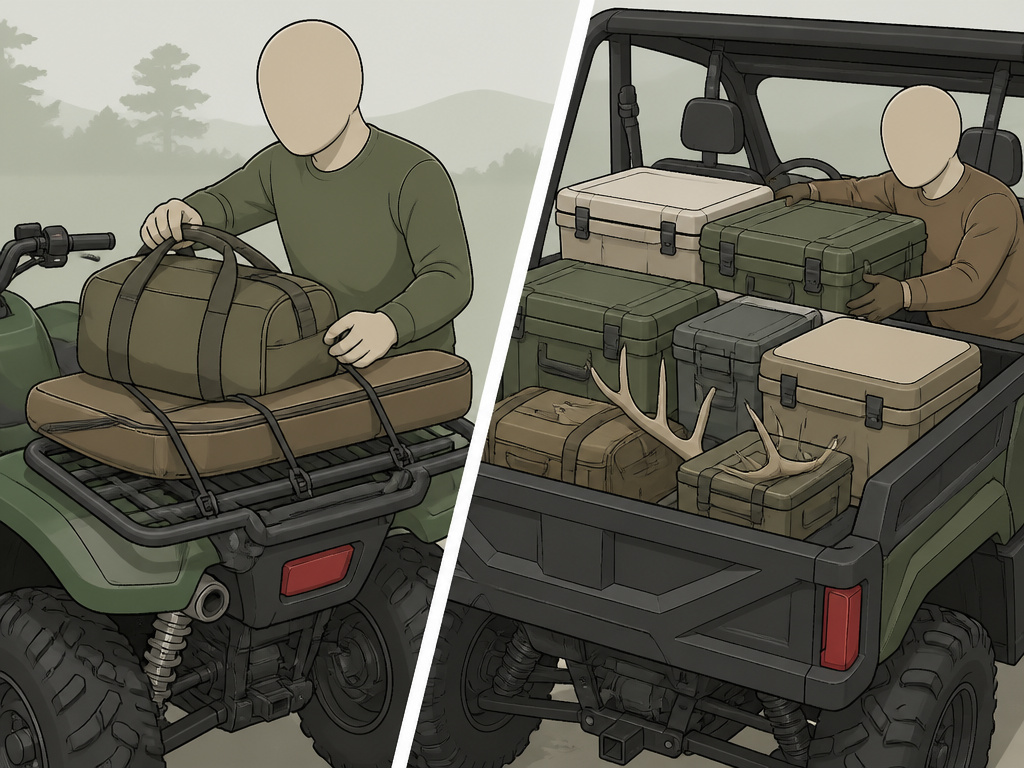 The best vehicle is the one that disappears into the job. Here’s how they stack up for common tasks.
| Use Case | ATV Advantage | UTV Advantage | Our Pick |
|---|---|---|---|
| Solo Trail Riding | Narrow width, agile handling, motorcycle feel. | More comfort, storage for day gear. | ATV. It’s what the trails are built for. |
| Hunting | Quieter, fits through dense woods, can get closer to game. | Can carry multiple hunters + gear + game in one trip. | Depends. Solo still-hunting: ATV. Camp/group hunting: UTV. |
| Farming & Ranch Work | Nimble for checking fences/herd in tight pastures. | Massive cargo bed for feed/tools, towing capacity for implements. | UTV. It’s a true off-road pickup truck. |
| Family Riding | Each person gets their own vehicle (group ride). | Whole family rides together in one machine. | UTV for young kids, ATVs for teens/adults. Togetherness vs. Independence. |
| Snow Plowing | More maneuverable in tight driveways and around obstacles. | Heavier weight pushes more snow per pass, has cab options. | ATV for residential driveways, UTV for long lanes/commercial lots. |
For hunting, the choice crystallizes. An ATV like a Honda TRX420 Fourtrax is a ghost. You can inch through timber quietly. A UTV is your base camp on wheels, capable of hauling campers, generators, and multiple harvested animals. The best ATV for mud riding often overlaps with a good hunting ATV, prioritizing aggressive tires and reliable 2WD and 4WD ATV systems for soggy terrain.
For work, ATV attachments like sprayers and seeders turn it into a versatile tool. But for serious hauling, a UTV is in another league. You’re comparing a pickup truck to a large wheelbarrow.
The Verdict: How to Choose
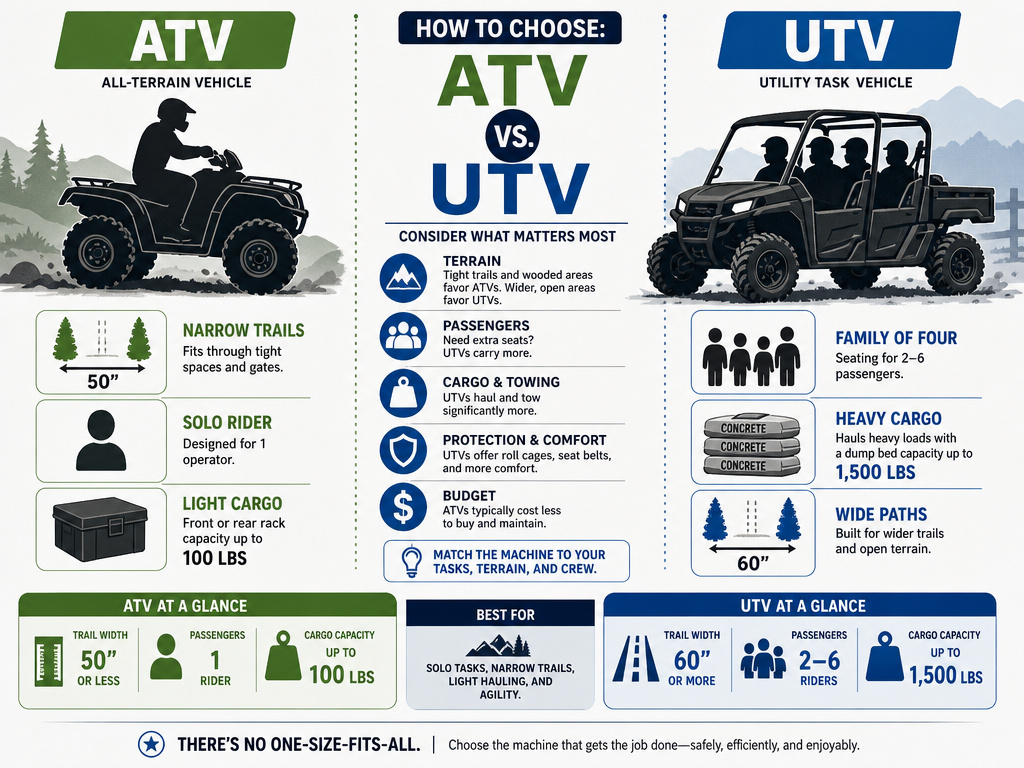 Stop thinking about “better.” Start with this checklist.
- Measure Your Trails. What is the legal width limit where you will ride most often? If the answer is 50 inches, your decision is made. Get an ATV.
- Count Your Passengers. Is this a solo or couples machine, or do you need to carry a family of four? Solo/couple = ATV or small UTV. Family = UTV.
- Weigh Your Cargo. Are you hauling a chainsaw and a lunchbox, or 20 bags of concrete? Light/medium loads = ATV. Bulk materials = UTV.
- Audit Your Comfort with Risk. Does the idea of a protective cage make you feel secure? Or does the freedom of an open machine appeal more? This is personal, but it’s real.
- Consider Your Next Five Years. Will your needs change? A growing family or a new property can shift the calculus. A UTV is generally more adaptable.
If you want one answer for the average enthusiast who rides public trails and works a small property: a full-size 4×4 utility ATV. It fits the trails, handles chores, and has the deepest ecosystem of ATV accessories and support. The Honda Fourtrax, Yamaha Grizzly, and Polaris Sportsman define this category.
If your world is private land, wide-open spaces, or heavy labor, you’re a UTV person. Look at the Polaris Ranger, Can-Am Defender, or Kawasaki Mule.
Frequently Asked Questions
Can a UTV be street legal?
It depends entirely on state law. Some states allow UTVs on certain roads with specific equipment (turn signals, mirrors, horn, windshield). Most do not. They are not designed as highway vehicles, their tires, suspension, and high center of gravity make them unsafe at sustained road speeds. Always check your local DMV regulations.
Is an ATV or UTV better for a beginner?
UTV is often easier for a first-time operator because the controls are familiar (steering wheel, pedals) and the cage provides psychological security. However, an ATV in a lower-power, automatic transmission model (like many from Honda) is also beginner-friendly with proper training. The USDA Forest Service UTV training guide emphasizes that neither vehicle is “safe”, proper instruction is mandatory.
How much more does a UTV cost than an ATV?
UTV is a significantly larger investment. A new full-size utility ATV starts in a certain range. A comparable UTV can cost nearly twice as much. The price gap reflects the larger frame, more complex suspension, ROPS cage, and additional seating.
Can you plow snow with both?
Yes. Both are excellent for residential snow removal. You’ll need a specific ATV snow plow or UTV plow attachment. An ATV is more nimble in tight spaces. A UTV can push a larger blade and often has cab options for warmth.
What about maintenance and reliability?
Complexity varies. A UTV has more systems (often a car-style radiator, more CV joints, a dump bed). An ATV’s mechanicals are simpler, akin to a large motorcycle. For pure ATV reliability, brands like Honda have legendary reputations for simple, durable engines. UTV reliability is high but depends more on model and maintenance of those additional systems.
The Bottom Line
The difference between an ATV and a UTV is the difference between a dirt bike and a Jeep. One is a rider’s machine, light and intuitive. The other is a driver’s vehicle, built for payload and people.
Let the 50-inch trail rule make the first cut. Then be honest about passenger count and cargo weight. Your answer will be obvious. Just remember: the vehicle you choose dictates the adventures you can have. Pick the one that fits the world you actually ride in.
