
Find the Best ATV for Mud Riding With These Critical Specs
This post contains affiliate links. As an Amazon Associate, we earn from qualifying purchases.
The best ATV for mud riding needs three non-negotiable specs: ground clearance over 12 inches, a lockable front differential (like Smart-Lok or Visco-4Lok), and aggressive mud tires at least 27 inches tall. Factory-built mud editions from Can-Am and Polaris, such as the Maverick X mr 1000R and Sportsman 850 Mud Edition, deliver these features stock. For deep bogs, prioritize horsepower, models under 70 hp will struggle to turn large tires once caked.
That 12-inch ground clearance number is the specific floor where most factory skid plates stop dragging on submerged logs and hidden stumps. Drop below that, and you’re not riding through mud, you’re plowing it, which burns belts and overheats engines inside twenty minutes.
What follows is a breakdown of the three mechanical pillars, a direct comparison of the top factory mud machines, and a look at when a modified utility quad might actually be the smarter pick.
Key Takeaways
- Target ground clearance above 12 inches. The Can-Am Maverick X mr 1000R offers 15 inches, the Polaris Sportsman 850 Mud Edition has 13.5 inches.
- A lockable front differential is mandatory. Systems like Can-Am’s Smart-Lok or Polaris’s Visco-4Lok prevent a spinning wheel from robbing all your torque.
- Factory mud tires matter. Stock offerings like the 30-inch XPS Swamp Force or Pro Armor MUD XT 2.0 are designed to self-clean; an all-terrain tire will pack solid.
- Winches are non-negotiable safety gear, not accessories. A synthetic-cable winch rated for 1.5 times your vehicle’s weight is the minimum.
- For deep, thick mud, horsepower under 70 is a liability. It can’t spin heavy, clogged tires fast enough to fling off the muck.
The Three Non-Negotiable Specs for Mud Riding
Mud doesn’t compromise. Your machine can’t either. Three specs decide whether you ride through a hole or get winched out of it.
Ground clearance under 12 inches turns an ATV into a dirt plow. At 10 mph, the skid plate drags a constant wave of mud that overloads the clutch, jams the spindles, and can stall the engine outright within 500 feet.
Ground clearance is your first defense. Aim for a minimum of 12.5 inches. The Can-Am Maverick X mr 1000R sets the bar at 15 inches. The Polaris Sportsman 850 Mud Edition provides 13.5 inches. Compare that to a utility workhorse like the Honda FourTrax Rancher, which offers 9.6 inches. That 3.9-inch difference is the gap between clearing a submerged branch and hanging your frame on it.
The second spec is a lockable front differential. In 2WD, an open differential sends power to the wheel with the least resistance, the one spinning freely in the air or slick mud. A locking mechanism forces both front wheels to turn at the same speed, pulling you forward even if one tire loses all traction.
| Differential Type | How It Works in Mud | Risk If Skipped |
|---|---|---|
| Open Front Diff | Sends power to the slipping wheel. You stay stuck. | Digs a single tire into a deep hole while the other sits idle. |
| Limited-Slip (Visco-4Lok) | Transfers some power to the wheel with grip. Better, but can overheat. | Can fade under continuous load in thick slop, reverting to open-diff behavior. |
| Fully Locking (Smart-Lok) | Mechanically locks both wheels together. Maximum pull. | None for traction, but can cause steering bind on hard, dry ground. |
Can-Am’s Smart-Lok and Polaris’s Visco-4Lok are the two systems to look for. Smart-Lok is a true, on-demand locker. Visco-4Lok is a sophisticated limited-slip that uses a viscous coupling. For the stickiest scenarios, the true locker has an edge.
The third pillar is tires. All-terrain or trail tires have tightly packed lugs that trap mud. True mud tires, like the XPS Swamp Force or Pro Armor MUD XT 2.0, have wide, deep, and widely spaced lugs designed to flex, grab, and, critically, self-clean by slinging mud out as they spin.
The short version: Clearance keeps you floating, the locker keeps you pulling, and the right tires give you something to pull with. Miss one, and you’re asking for a recovery.
Factory Mud Specialists vs. Modified Workhorses
You have two paths: buy a machine built for the swamp from the factory, or modify a capable all-rounder. The right choice depends on how often you see deep water and how much you enjoy wrenching.
Factory mud editions come with integrated, warranty-backed solutions. The snorkels are routed properly, the clutch cooling is upgraded, and the suspension is tuned for the extra weight and height of large tires.
The Can-Am Maverick X mr 1000R is the benchmark here. Its 15-inch ground clearance, 100-horsepower Rotax V-twin, and standard 30-inch XPS Swamp Force tires mean you’re ready from the dealership. The relocated 4,500 lb winch with a synthetic cable is a thoughtful touch, the factory knows you’ll need it.
The Polaris Sportsman 850 Mud Edition is a strong contender with its 78-horsepower ProStar engine, 30-inch Pro Armor MUD XT 2.0 tires, and a full suite of protective skid plating. Its 13.5 inches of clearance is less than the Can-Am, but it’s a more manageable size for riders who also tackle tight trails.
Where this goes sideways: Bolting a 30-inch mud tire onto a stock suspension designed for 25-inch tires. You’ll shred CV joints within 50 hours. The geometry is wrong, the stress is immense, and no aftermarket lift kit fully corrects the factory’s scrub radius.
Modifying a utility ATV like a Honda FourTrax Rancher or a Suzuki KingQuad 750AXi is a project. You must add a snorkel kit, a clutch kit for larger tires, a winch, a lift, and the tires themselves. The cost often approaches a factory mud model, and you’re left with a machine whose weak points, like lower horsepower or a lighter-duty driveline, are now stressed further.
However, if your riding is 80% trail work and 20% mud pits, a modified Suzuki KingQuad 750AXi makes sense. Its legendary reliability, smooth power steering, and lower initial cost leave budget for quality upgrades. Just know its 10.2 inches of stock clearance is a major limiting factor.
Can-Am vs. Polaris: A Head-to-Head in the Slop
These two brands dominate the factory mud conversation. Picking one isn’t about which is “better,” but which excels at your specific type of messy.
For extreme depth and horsepower: The Can-Am Maverick X mr 1000R is the answer. Its 100 hp engine provides reserve power to keep massive tires spinning when they’re fully clogged. The 15-inch clearance and aggressive approach/departure angles let you tackle near-vertical mud bank exits. It’s a specialist machine.
For mixed terrain and precision: The Polaris Sportsman 850 Mud Edition shines. Its 78 hp is ample, and the overall package is slightly narrower and more nimble in wooded trails leading to the mud hole. The Visco-4Lok front differential is less aggressive than a full locker, making it slightly easier to steer under power on tacky ground.
The Honda FourTrax Rancher and Suzuki KingQuad are utility platforms that can be fortified for occasional mud, but they lack the integrated, high-clearance architecture and dedicated mud-tuning from the factory.
| Model | Best For | Key Limitation |
|---|---|---|
| Can-Am Maverick X mr 1000R | Deep water, high horsepower demands, open mud flats. | Size and cost; can be cumbersome on tight, technical trails. |
| Polaris Sportsman 850 Mud Edition | Riders who mix trail riding with mud holes, prefer nimble handling. | Lower ground clearance than Can-Am; limited-slip diff can fade. |
| Honda FourTrax Rancher / Suzuki KingQuad | The rider who values reliability and low maintenance over pure mud performance. | Requires significant aftermarket investment to approach factory mud specs. |
The bottom line: If mud is the primary destination, buy the tool built for the job. Can-Am and Polaris have those tools on the shelf.
The Essential Supporting Gear (Beyond the ATV)
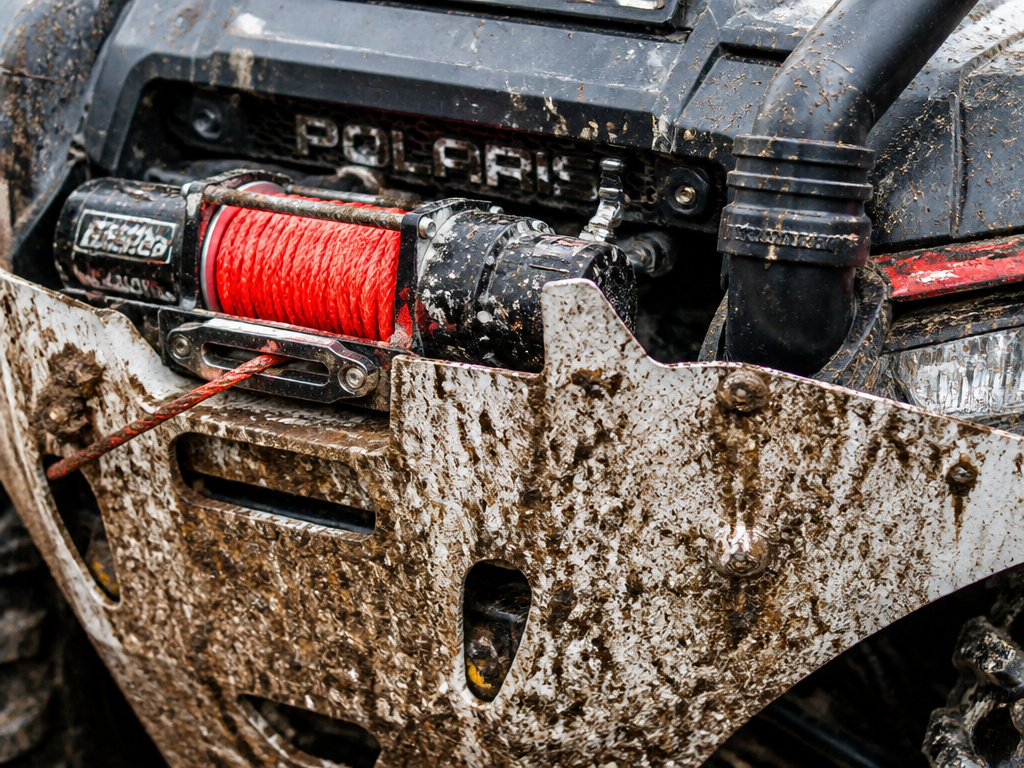
The machine is only part of the system. These four additions are what separate a successful day from a long walk home.
- A Winch. This is your “undo” button. A synthetic-cable winch with a rated pull capacity of at least 1.5 times your ATV’s weight is mandatory. The synthetic line is safer and floats. Mount it high and protected.
- Snorkels. Factory mud machines have them. If you’re modifying, you need a kit that raises the intake and the exhaust. Water in the airbox hydrolocks an engine instantly. Water on a hot exhaust can crack it.
- Skid Plates. Not just the stock plastic belly pan. Full, thick HMW polyethylene or aluminum skid plates protect the A-arms, chassis, and critical engine components from unseen stumps and rocks.
- Communications. Mud holes are often in low-lying areas with no cell service. A simple handheld GMRS radio for your group is a safety essential.
Investing in robust ATV axles is also wise, as the constant shock load from breaking traction in deep ruts is a leading cause of failure. Pair them with the right ATV tires for the conditions, whether you need dedicated mudding tires or a more versatile all-around tire.
Frequently Asked Questions
Is 4WD necessary for mud riding?
Yes, four-wheel drive is essential. The question isn’t 2WD vs 4WD, but what kind of 4WD system you have. An open-differential 4WD system can still leave you stranded with one front and one rear wheel spinning uselessly. A system with a locking or limited-slip front differential, like those found on true mud editions, is what actually provides traction.
How much horsepower do I need for mud?
For moderate mud and smaller tires (27-28 inches), 70-80 horsepower is sufficient. For deep, thick bogs and large (30+ inch) tires, aim for 90 horsepower or more. The extra power is needed to overcome the immense drag and rotational weight of tires packed with heavy mud. A machine with less power will bog down and stall.
Can I use my utility ATV for mud riding?
You can, but you must modify it. A stock utility ATV lacks the ground clearance, tire size, protected drivetrain, and often the horsepower. You’ll need to add a lift kit, larger mud tires, a snorkel kit, and enhanced skid plating. Even then, its performance will likely trail a factory-built mud specialist, and you risk accelerated wear on components not designed for the stress.
What’s more important: tire size or tread pattern?
Tread pattern is more important for traction and self-cleaning, but tire size dictates ground clearance. You need both. A tall tire with a weak all-terrain tread will pack solid and become a slick. A perfect mud tread on a short tire will leave your chassis dragging. The best factory mud machines, like the Can-Am Maverick X mr, solve this by pairing a tall 30-inch tire with an aggressive, self-cleaning Swamp Force tread.
Are winches really that important?
Yes. A winch is the single most important piece of recovery gear. Getting stuck is a guarantee, not a possibility. A winch allows self-recovery without relying on another vehicle, which is crucial in remote areas. When selecting a ATV winch, prioritize synthetic rope for safety and a waterproof solenoid.
Before You Go
The best ATV for mud riding is a machine that meets three clear mechanical thresholds: ample ground clearance, a locking front differential, and purpose-built tires. Factory options from Can-Am and Polaris are engineered to hit those marks out of the crate, saving you time, money, and frustration.
For the rider whose weekends are defined by the deepest, thickest bogs they can find, the high-horsepower, high-clearance specialist is the only answer. For everyone else, the trail rider who occasionally dips into the pit, a capable mud edition or a well-modified utility quad, paired with the right lights for muddy conditions and recovery gear, will deliver more than enough fun without the constant threat of a breakdown. Just remember to clean it thoroughly afterward. Mud is corrosive, and letting it bake onto your machine is how you end up with a garage ornament instead of a riding partner.
