
ATV Helmets vs Motorcycle Helmets: What You Need to Know
This post contains affiliate links. As an Amazon Associate, we earn from qualifying purchases.
ATV helmets and motorcycle helmets are not different under U.S. Department of Transportation law, the DOT FMVSS No. 218 standard defines both as helmets for “motorcyclists and other motor vehicle users.” The real split is in the additional certifications an off-road helmet might carry, like ASTM F3103, and the design features tailored for dirt, mud, and low-speed tip-overs versus highway pavement.
That “other motor vehicle users” clause is the legal hinge. It means any helmet bearing a legitimate DOT sticker is certified for use on an ATV, a UTV, or a motorcycle. The certification tests, impact attenuation, penetration resistance, and retention system strength, are identical regardless of the vehicle you strap it to. This isn’t a recommendation. It’s the code.
So the question shifts from “are they different” to “what happens when you use a street helmet in the dirt, or a dirt helmet on the street?” The answer lives in the supplemental standards, the recall notices for failed chin bars, and the one environment where a DOT-certified liner can melt off your head.
What follows: the three tests every certified helmet must pass, the one extra standard that matters for off-road, and the two design choices that make a helmet fit the ride instead of just the law.
Key Takeaways
- The DOT FMVSS No. 218 certification is the legal minimum for both ATV and motorcycle use in the U.S. A helmet without it is not a safety device.
- The ASTM F3103 standard is the primary differentiator for off-road helmets, requiring documented DOT compliance plus specific tests for positional stability and chin bar rigidity on full-face models.
- Full-face helmets reduce facial injury risk by nearly 35% compared to open-face designs, according to a peer-reviewed study in the International Journal of Epidemiology.
- Recent NHTSA enforcement actions led to recalls of the Bilt Vertex (2023) and Scorpion EXO Covert X (2024) for retention system failures, proof that certification alone doesn’t guarantee lifelong integrity.
- For specialized high-heat environments like firefighting, standard EPS liners fail. Agencies specify alternatives like the Simpson FR Cruiser with a Nomex liner, which meets DOT standards but is designed for thermal resistance.
The Short, Direct Answer
Legally, no. Practically, often.
The U.S. Code of Federal Regulations, Title 49, Section 571.218, the DOT motorcycle helmet standard, explicitly applies to “helmets designed for use by motorcyclists and other motor vehicle users.” An ATV is a motor vehicle. Therefore, a helmet complying with Standard No. 218 is approved for both activities. The law sees them as the same category.
A helmet meeting FMVSS No. 218 must limit peak acceleration during a guided free-fall impact to below 400g, prevent a striker from penetrating the shell to the headform, and have a retention system that withstands a 250-pound static load for 120 seconds without stretching more than one inch.
The testing is brutal and standardized. Helmets are conditioned in hot, cold, and wet environments, then dropped onto steel anvils. The retention system, the chin strap and buckle, is pulled by a machine simulating the force of a head hitting pavement at speed. Pass, and the manufacturer can affix the DOT sticker. Fail, and it cannot be sold for road use.
This creates a marketplace where a single helmet model, like the Shoei Hornet X2 or the Bell Moto-9, is marketed for both dual-sport motorcycles and ATVs. It carries the same DOT certification for both. The difference is in the marketing photos, not the test lab report.
So why does the distinction exist in riders’ minds? Because the application creates different demands. An ATV ride means mud, branches, and slow-speed rolls. A street ride means highway-speed pavement and the risk of a high-energy slide. The helmet that optimizes for one environment might be mediocre in the other, even if it’s legal for both.
Where the Standards Actually Diverge
The DOT standard is the floor. The ceiling is set by voluntary certifications from private foundations and specialized standards for specific riding disciplines.
The Snell Memorial Foundation’s M2025R standard includes oblique impact tests that measure a helmet’s ability to manage rotational forces, the kind generated in a glancing blow during a slide. Many high-end motorcycle helmets from brands like Arai and Shoei pursue Snell certification alongside DOT, arguing it represents a higher performance benchmark.
For off-road, the key voluntary standard is ASTM F3103. Its full title is “Standard Specification for Testing Off-Road Motorcycle and ATV Helmets.” Critically, section 1.1 of the specification states it “covers performance requirements for helmets used by off-road motorcycle and All-Terrain Vehicle (ATV) riders.” It does not replace DOT. Instead, it requires documented compliance with FMVSS No. 218 and then adds its own layer.
| Standard | Mandatory For | Key Additional Requirement | Why It Matters for ATV vs. Motorcycle |
|---|---|---|---|
| DOT FMVSS No. 218 | All street-legal motorcycle & ATV helmets in the U.S. | Impact attenuation (400g peak), penetration, retention strength. | The legal baseline. Defines both vehicle types as “motor vehicle users.” |
| ASTM F3103 | Off-road & ATV helmets (voluntary) | Documented DOT compliance + positional stability & chin bar tests. | Specifically addresses off-road use. A helmet claiming ASTM F3103 is built for dirt. |
| Snell M2025R | High-performance helmets (voluntary) | Oblique impact tests, multiple anvil types, stricter acceleration limits. | Often found on premium motorcycle helmets for street/track; less common on pure ATV models. |
| ECE 22.05 | Helmets sold in Europe & many other countries | Different impact speed and test methodology, includes chin bar shear test. | The global standard. Many “import” helmets sold in the U.S. Are ECE-certified, not DOT. |
The ASTM standard’s positional stability test is telling. It ensures the helmet doesn’t roll off your head during a crash, a vital concern when an ATV rider might tumble down a hill. The chin bar test on full-face models applies a direct impact to the front, simulating a face-first plant into dirt or a handlebar.
Where this goes sideways: Assuming an ECE 22.05 certified helmet is automatically DOT-compliant. It is not. The testing protocols differ. A helmet must pass DOT-specific tests to get the DOT sticker. Some models are certified to both, but you must see both labels.
This is where your selection of top-rated ATV helmets should start. Look for the DOT sticker first, it’s non-negotiable. Then, see if it also carries the ASTM F3103 designation. That combination signals a helmet engineered for off-road punishment, not just street legality.
Design Differences That Matter on the Trail
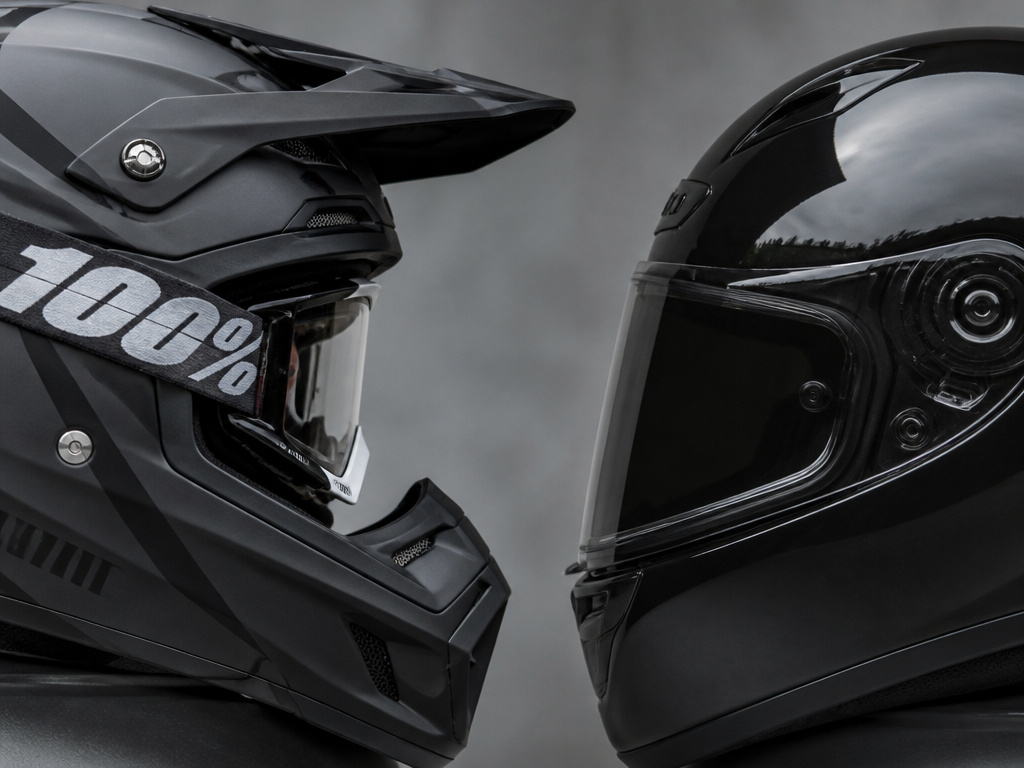
Certification tells you what the helmet can survive. Design tells you how it functions while you’re wearing it. The environmental needs of ATV riding and street motorcycling pull designers in opposite directions.
Ventilation and Visors: An ATV helmet prioritizes massive airflow. You’re working hard, riding in dust, and moving at lower speeds. Vents are larger and more numerous. A removable peak visor (or “brim”) is standard to shield the sun and deflect branches. This peak is a liability on the street at high speed, creating buffeting and lift. Street full-face motorcycle helmets are smooth, aerodynamic, and often feature integrated sunshades instead.
Field of View and Goggles: Off-road riders almost always wear goggles. Therefore, many ATV helmets for adults are designed as “goggle-compatible” with a larger eye port and a channel to secure the goggle strap. Street helmets are designed for a sealed face shield, offering a narrower but more wind-protective view.
Weight and Materials: A premium street helmet, like a Schuberth C5, uses advanced composite shells and multi-density EPS to minimize weight for long-haul comfort. A dedicated motocross helmet, like an O’Neal Sierra II, may use a heavier but more abrasion-resistant polycarbonate shell, accepting the extra weight for the sake of crash durability in a dirt slide.
The Communication Gap: A documented edge case from U.S. Forest Service testing highlights a non-safety design flaw. They trialed Simpson FR Cruiser helmets for fireline ATV crews and found operators “could not hear radio communications” inside the helmet. The safety certification was valid, but the helmet failed its real-world mission. This is why checking reviews for top-rated motorcycle helmets or ATV models should include notes on communication system compatibility if you ride with a group.
The Critical Choice: Helmet Type & Coverage
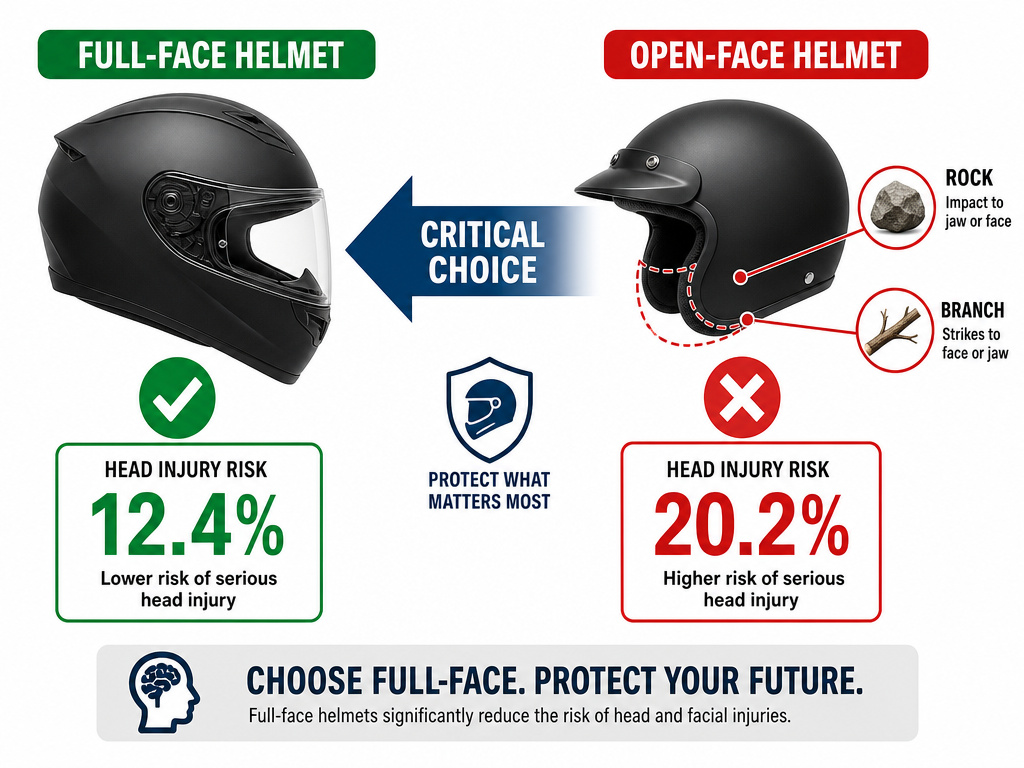
The most significant safety decision isn’t ATV vs. Motorcycle brand. It’s how much of your face the helmet covers. The data here is unambiguous.
The NIH motorcycle helmet study published in BMC Public Health analyzed over 800 motorcyclist injuries. It found riders wearing non-standard or open-face helmets had a 20.2% incidence of head injury, compared to 12.4% for those wearing standard full-face helmets. The risk of severe injury was nearly 10 percentage points higher.
Common mistake: Choosing a half helmet or 3/4 helmet for ATV riding because it’s cooler and feels less restrictive. The terrain throws rocks, mud, and branches directly at your face. A full-face shell is your primary bumper.
Full-face helmets provide a wraparound chin bar that is structurally integrated. In a forward pitch, it takes the impact, not your jaw. Modular helmets offer a hinged chin bar that flips up. They must pass the same chin bar tests as fixed full-face models when closed, per Snell standards. However, the mechanism is another potential point of failure.
Open-face helmets leave your jaw exposed. For a casual street cruiser, that’s a risk calculation some riders make. For ATV riding, where rollovers are a common accident type, it’s a gamble with very poor odds. Your selection of top-rated ATV helmets should heavily favor full-face designs. For youth riders, this is even more critical, always choose a full-face helmet from a reputable brand like O’Neal or Fox for your child’s ATV.
When a Certified Helmet Isn’t Enough: Edge Cases & Recalls
Certification is a snapshot from a test lab, usually on new equipment. Real-world conditions and manufacturing variances can reveal failures. Two recent recalls prove this.
The Bilt Vertex helmet was recalled in January 2023 after NHTSA testing found its retention system could separate under load. The Scorpion EXO Covert X, a popular modular model, was recalled in June 2024 for the same reason. Both helmets had passed initial certification. The DOT helmet test evaluation program exists precisely to catch this drift in production quality.
Then there are environmental extremes. The U.S. Forest Service’s own health code mandates DOT helmets for ATV operators. But for fireline duty, they noted a critical flaw: “the foam liners in standard motorcycle helmets could melt if exposed to high temperatures.” Their solution was to adopt the Simpson FR Cruiser, a helmet with a flame-resistant Nomex liner that still meets DOT FMVSS No. 218.
For the average rider, the lesson is to respect the helmet’s limits. The ASTM off-road helmet standard doesn’t test for thermal degradation. If you’re riding in extreme heat, store your helmet out of direct sunlight. The EPS liner can degrade.
Never buy a used helmet. You have no idea what hidden impacts it has sustained. The foam compresses once. A helmet that looks fine might have zero protective capacity left.
How to Choose for Your Ride
Stop asking “ATV or motorcycle?” Start with this sequence.
- Confirm DOT FMVSS No. 218. Look for the sticker on the back. Not the packaging, the helmet itself. It is a legal requirement, not a feature.
- Prioritize full-face coverage. The data on facial injury reduction is overwhelming. For ATV use, it is the only sensible choice. Explore our guide on full-face motorcycle helmets to understand the key features.
- Match the standard to the terrain. For dedicated trail riding, seek the ASTM F3103 helmet testing standard mark. For street or dual-sport use, a Snell or ECE motorcycle helmet standard certification indicates a higher performance tier.
- Check for MIPS. While not a government standard, MIPS (Multi-directional Impact Protection System) is a proven slip-plane technology that can reduce rotational forces. Many leading helmets with MIPS are now available for both street and dirt.
- Fit is non-negotiable. The helmet must be snug, with no hot spots. It should not shift on your head when you shake it. A well-fitted cheap helmet protects better than a poorly fitted premium one.
Your final pick might be a model like the Bell Moto-9 Flex, which is DOT and ASTM F3103 certified, designed for motocross, but perfectly legal for the street. Or it might be a modular motorcycle helmet like the Shoei Neotec 3, which is DOT and ECE certified, optimized for touring, but can handle a gravel road. The vehicle doesn’t define the helmet. The certification and the design do.
Frequently Asked Questions
Is it illegal to wear a motorcycle helmet on an ATV?
No. It is fully legal and often recommended. The DOT standard that certifies motorcycle helmets explicitly includes ATVs as “other motor vehicle users.” The legal requirement is the DOT certification itself, not a separate “ATV helmet” category.
What does the ASTM F3103 standard mean?
The ASTM F3103 helmet testing standard is a voluntary specification for off-road motorcycle and ATV helmets. It requires the helmet to first be DOT-compliant and then adds specific tests for positional stability (to prevent roll-off) and chin bar integrity. A helmet with this certification is designed and tested for off-road conditions.
Why do some ATV helmets have a sun peak?
The peak visor on an ATV helmet serves two main functions: it blocks sun and glare, and it deflects low-hanging branches and brush. It is not designed for high-speed aerodynamic stability. On a street motorcycle at highway speeds, a peak can create significant wind lift and buffeting, which is why street helmets have smooth, rounded shells.
Can I use my dirt bike helmet on the street?
Yes, provided it has a valid DOT (or ECE) certification sticker. Many dual-sport helmets are designed for this exact purpose, blending off-road features like a peak and ample ventilation with DOT certification for street legality. However, a pure motocross helmet might be very loud and less comfortable for prolonged street riding.
How do I know if a helmet is truly DOT approved?
Look for the permanent, non-removable DOT sticker on the back of the helmet. It should have the letters “DOT” at least 1 cm high, with “FMVSS No. 218” and “CERTIFIED” beneath it. Be wary of helmets with stickers that look flimsy or promotional. The NHTSA helmet assessment document details the exact labeling requirements, and they prosecute counterfeit labels.
Before You Go
The law doesn’t separate ATV and motorcycle helmets. Physics and terrain do.
Your checklist is short but non-negotiable. DOT certification is the absolute baseline, without it, you’re wearing a plastic hat. For dirt, add the ASTM F3103 standard as your filter. Always choose full-face coverage; your jaw has no second chance. And finally, trust the labels from Snell, ECE, and F3103 more than the marketing copy on the box. They represent test results, not aspirations.
A helmet is the one piece of gear you buy hoping to never use it for its primary purpose. Spend the time to get the right one. Your head is the only one you get.
