
What Is the Difference Between 4H and 4L? Speed vs Torque
This post contains affiliate links. As an Amazon Associate, we earn from qualifying purchases.
The difference between 4H and 4L is gearing: 4H sends power to all four wheels at the same ratio as 2WD for traction on slippery surfaces at speed (25-55 mph), while 4L uses a much lower gear ratio inside the transfer case to multiply engine torque for extreme, slow-speed crawling (1-15 mph) over obstacles like rocks and steep grades.
The distinction is locked in a metal box behind your transmission. Your transfer case isn’t just an on-off switch for four-wheel drive; it’s a gearbox with two very different jobs. Picking the wrong one doesn’t just mean getting stuck, it means hearing expensive noises from underneath the truck.
What follows is the breakdown you won’t get from the dealer: the specific speeds where each setting works, the model-by-model torque numbers that actually matter, the dashboard warning that means your gears are jammed, and the repair bill waiting if you use 4H where you needed 4L.
Key Takeaways
- Use 4H above 25 mph on surfaces with consistent, low traction like wet roads, gravel, or packed snow.
- Use 4L below 15 mph when you need maximum wheel-turning force to overcome high resistance from deep mud, soft sand, rock ledges, or steep inclines.
- Shifting into 4L requires rolling at 3 mph or less (on most Fords); forcing it at speed grinds the transfer case gears.
- Driving a part-time 4WD system in 4H on dry, grippy pavement causes drivetrain binding, which feels like the truck is hopping during turns and can shear differential pins.
- Fuel consumption jumps 30-50% in 4L; it’s a short-duration tool, not a cruising gear.
The Speed vs. Torque Rule of Thumb
Think of 4H as your traction gear and 4L as your torque gear. The decision starts with your speedometer, but it’s really about the mechanical work your wheels need to do.
4H keeps the drivetrain in a “high,” or 1:1, gear ratio. Power splits evenly to the front and rear axles, but your engine RPMs and road speed feel normal. The benefit is simple: four powered tires find more grip than two on a loose surface. The Ford owner’s manual specifies a maximum shift speed, but the functional range is 25 to 55 mph.
4H maintains highway speeds with added stability. It’s for when you’re moving across a surface, not fighting through it.
4L drops the transfer case into a “low” gear set, multiplying the torque sent to the axles. This is about raw, twisting force. Where 4H helps you go, 4L helps you overcome.It turns a light throttle tap into a steady, powerful pull at the wheels. The functional speed ceiling is around 15 mph; any faster and you’ll over-rev the engine.
| Mode | Best Speed Range | Primary Use | Terrain Examples |
|---|---|---|---|
| 4 High (4H) | 25–55 mph | Maintaining traction & control | Wet pavement, gravel roads, packed snow, light mud |
| 4 Low (4L) | 1–15 mph | Maximum torque for crawling | Rock gardens, steep hill climbs, deep mud, soft sand, towing heavy loads up an incline |
The table exposes the core trade-off. If you’re doing more than 15 mph, you don’t need, and shouldn’t use, the torque multiplication of 4L. Conversely, if you’re below 5 mph and the truck is struggling, 4H doesn’t provide enough mechanical advantage. Your engine revs climb but the wheels don’t turn any faster.
How Your Transfer Case Actually Works
The magic, and the potential for catastrophic failure, happens inside the transfer case. This is a cast-iron or aluminum box bolted to the back of your transmission. In a part-time 4WD system, which most trucks and SUVs use, it has three main jobs.
First, it takes the rotational power from the transmission output shaft. Second, it splits that power to send it down two driveshafts: one to the rear axle, one to the front. Third, and most critically for the 4H vs. 4L question, it changes the gear ratio between the input and output shafts.
In 2H and 4H, the transfer case uses a direct, 1:1 gearset. The input shaft spins at the same speed as the output shafts. In 4L, a planetary gearset or a separate gear train engages, dropping the output speed dramatically while increasing torque. This is the torque multiplication ratio you see on spec sheets.
A Jeep Wrangler Rubicon’s Rock-Trac transfer case has a 4:1 low-range ratio. For every single rotation the engine’s crankshaft makes (through the transmission’s chosen gear), the transfer case outputs only a quarter of a rotation to the driveshafts, but with four times the twisting force.
Different models have different “deep” ratios. A Toyota 4Runner offers a 2.566:1 low range. The Ford Bronco Sasquatch package uses a 3.06:1 ratio. A higher number means more torque multiplication and slower crawling speeds, which is why the Rubicon is a rock-crawling benchmark. Understanding your vehicle’s specific ratio tells you exactly how much mechanical help you’re getting in 4L.
This mechanical reality also explains why you can’t just slam the shifter between modes at any speed. The gears inside need to be moving at nearly the same speed to mesh. Most manufacturers, including Ford, mandate shifting to 4L at 3 mph or less. Exceed that, and the gear teeth clash instead of engage.
When to Use 4H (And When to Get Out of It)
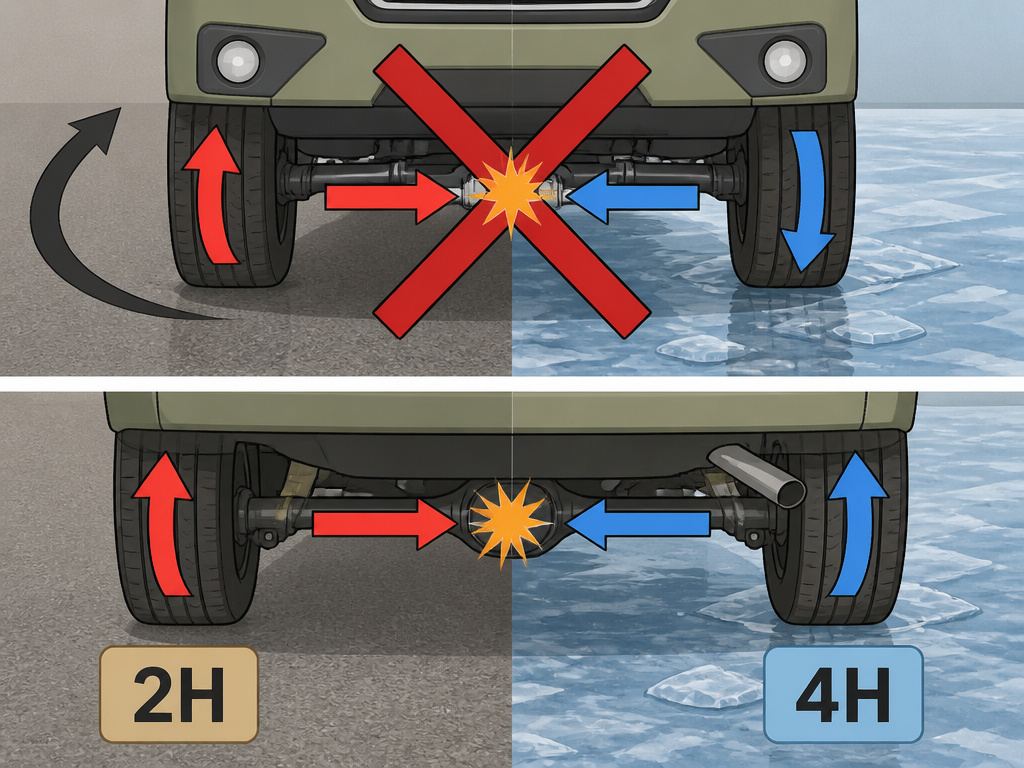 Use 4H any time you need more traction than two wheels can provide, but you still need to maintain a driving pace. The key is that the surface offers consistent, predictable slippage.
- Wet or Icy Roads: This is 4H’s home turf. It prevents rear-wheel spin during acceleration and provides more stability in corners. The moment you hit dry pavement, shift back to 2H.
- Gravel or Dirt Roads: Loose surfaces on forest roads or job sites. 4H keeps you from digging in and provides better directional control if a tire loses grip.
- Packed Snow: On snow-covered roads where you’re maintaining 30-45 mph, 4H is ideal. For deep, unplowed snow where you’re plowing at walking pace, switch to 4L.
Common mistake: Leaving a part-time system in 4H after the road dries out. The front and rear axles are locked together, but on pavement, the outside wheels in a turn must travel farther than the inside wheels. With no center differential to absorb this difference, the drivetrain binds. You’ll feel the truck shudder or “hop” during sharp, low-speed turns. Do this often enough, and you’ll stress u-joints, wind up the driveshafts, and potentially damage the differentials.
The rule is simple: if all four tires can grip the surface equally during a turn, you shouldn’t be in 4H. Full-time 4WD systems, like those in a Toyota Land Cruiser or Lexus GX, have a center differential that allows this and are meant for continuous use. Your truck’s system likely is not.
When to Use 4L (It’s a Short-Duration Tool)
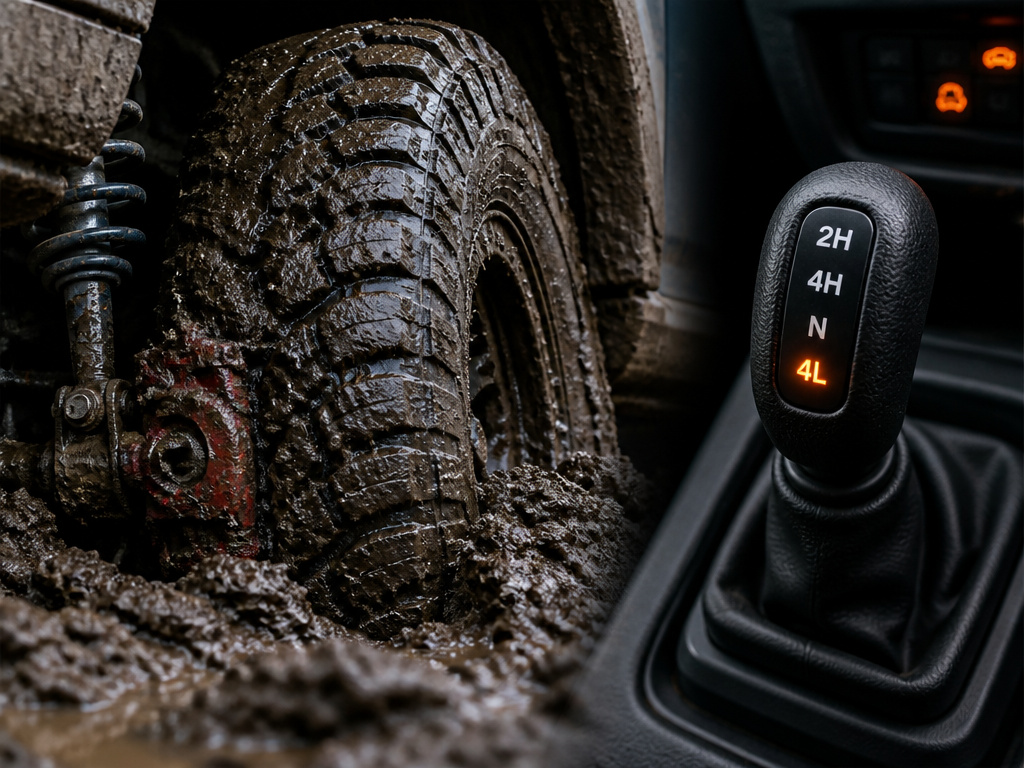 Engage 4L when forward progress requires more twisting force than your engine can provide in its normal gearing. You’ll feel the truck bog down; the throttle does less and less. That’s your cue.
- Steep Inclines: Whether it’s a muddy hill or a rocky trail, 4L provides the controlled, low-speed power to walk up without spinning tires and digging holes.
- Deep Mud or Sand: These mediums suck power. 4L lets you keep wheel speed (and momentum) low while torque remains high, preventing you from burying the axles.
- Rock Crawling: This is what 4L was invented for. Precise throttle control at 1-5 mph is impossible in 4H. The deep gearing of 4L lets the tires “walk” over obstacles without sudden lurches.
- Heavy Towing: Pulling a trailer up a steep, slippery boat launch or out of a field. 4L prevents the transmission from hunting for gears and overheating.
Fuel economy tanks in 4L, expect a 30-50% increase in consumption. The engine is working much harder per revolution to turn those massively leveraged wheels. You also put significant heat load on the transmission and transfer case. It’s not a mode for distance; it’s a mode for getting through a specific, tough section. Get through it, and shift back to 4H or 2H.
The Shift That Can Break Your Transfer Case
Shifting into 4L isn’t just a lever pull. The transfer case gears need to be perfectly aligned. Modern trucks with electronic shifters have safeguards, but they can still get stuck. The most telling failure mode is a dashboard message that reads “SHIFT DELAYED PULL FORWARD.”
This isn’t a suggestion; it’s a diagnosis. The gear teeth inside the transfer case are blocked, sitting tip-to-tip instead of meshing. The fix is a specific, mechanical procedure: 1. Come to a complete stop. 2. Place the transmission in a forward gear (Drive or a low gear). 3. Move the vehicle forward approximately five feet. 4. Shift the transmission back to Neutral. 5. Now attempt the shift into 4L again.
This small rolling motion rotates the internal gears just enough to let the teeth drop into place. Forcing the shifter or trying to drive with this message displayed can grind the gear teeth. A replacement transfer case for a vehicle like a Toyota 4Runner can run between $2,500 and $4,000 installed. That single message is a $4,000 warning.
4H vs. 4L vs. AWD
People often confuse 4H with All-Wheel Drive (AWD). They are fundamentally different systems. AWD, found on most crossovers and cars, uses a center differential or a clutch pack to vary power front-to-rear automatically. It’s seamless and designed for on-road use in all conditions.
4H, in a part-time system, is a manual lock. It sends a fixed 50/50 power split to the axles. It’s stronger for severe conditions but intolerant of dry pavement. 4L is a capability AWD simply doesn’t have, no AWD system includes a low-range transfer case for rock crawling.
If your vehicle has a 4H/4L selector, you have a truck or serious SUV meant for off-road work or severe weather. If it has an AWD button, you have a system optimized for safety and handling on paved roads. Knowing which one you have is the first step in using it correctly. This is a key distinction within the broader world of truck drivetrains, where capability varies wildly.
Frequently Asked Questions
Can I drive in 4H all the time?
On a part-time 4WD system, absolutely not. Driving in 4H on dry pavement causes drivetrain binding and damage. On a full-time 4WD system with a center differential, yes, that’s its intended design.
What happens if I shift into 4L while driving?
Most modern systems won’t allow it. If you force an older mechanical system, you’ll hear a loud grinding from the transfer case as the gear teeth clash. At best, you’ll wear the gears prematurely. At worst, you’ll chip or break teeth, requiring a full rebuild.
How fast can I go in 4L?
You can reach higher speeds, but you shouldn’t. The engine will be screaming at a very high RPM at relatively low road speeds. The functional and safe limit is 15 mph. Exceed that, and you risk overheating the transfer case and engine.
Does using 4WD hurt gas mileage?
Yes. Using 4H increases fuel consumption by about 10-15% due to added drivetrain friction and weight. Using 4L increases it by 30-50% because the engine works much harder per mile traveled.
My truck has 4Auto, is that the same as 4H?
No. “4Auto” is an automatic AWD mode that typically uses a clutch-based system to engage the front wheels only when slip is detected. It’s for on-road use. 4H is a manual, locked 4WD mode for consistent off-road or severe weather traction. Understanding these systems helps clarify other vehicle differences, like those between ATV and UTV drive systems.
The Bottom Line
Choosing between 4H and 4L is about listening to your truck and the terrain. 4H is for miles; 4L is for moments.If you’re cruising a snowy highway at 40 mph, you need 4H. If you’re inching up a rock face at 2 mph, you need 4L. Picking wrong doesn’t just leave you stuck, it leaves you with a repair bill for a component that was designed to handle the exact opposite force.
Remember the five-foot rule for a stuck 4L shift. Remember the 3 mph shift speed. And remember that the transfer case is the heart of your four-wheel drive system. Treat it with the mechanical respect it demands, and it will pull you through places a two-wheel drive ATV could never dream of going.
