
What is Boondocking and How It Works for Self-Sufficient Camping
This post contains affiliate links. As an Amazon Associate, we earn from qualifying purchases.
Boondocking is self-sufficient camping without utility hookups, water, sewer, or electricity, on undeveloped public lands like Bureau of Land Management (BLM) or National Forest areas. It works by relying entirely on your vehicle’s onboard freshwater tank, battery bank or generator, and waste holding tanks, with typical stay limits around 14 days before you must move or resupply.
That self-sufficiency is the entire game. You aren’t just picking a pretty spot. You’re managing three finite resources against a hard calendar. A stock RV with two 12-volt batteries and a 40-gallon fresh tank gives a couple about four days of cautious comfort before the systems demand attention.
What follows is the mechanical reality: the water math, the power drain rates, the public land designations that matter, and the scouting method that prevents driving down a dead-end road at dusk. This isn’t about philosophy. It’s about gallons, amp-hours, and land agency acronyms.
Key Takeaways
- Boondocking is legally distinct from dry camping and dispersed camping. Know the difference to avoid fines. National Parks forbid it, while surrounding National Forests often allow it.
- Your trip length is dictated by your smallest tank. For a typical rig, that’s the battery bank. Two 12-volt house batteries provide 2-4 days of power without recharge.
- Always scout with satellite maps and have 2-3 backup coordinates. Road conditions are the most common trip-ender.
- Temperature is a silent budget-killer. Ideal boondocking weather is 40–70°F. Running air conditioning or electric heat drains batteries in hours, not days.
- The right vehicle matters less than the right preparation. A well-equipped van can outlast a poorly prepared Class A motorhome.
Boondocking vs. Dry Camping vs. Dispersed Camping: The Legal Lines
Forums erupt over these definitions. The confusion costs people fines. The distinction isn’t academic. It’s a jurisdictional one that determines where you can park and for how long.
Dry camping means camping without hookups, but within a developed campground. You might pay a fee and have a picnic table, a trash bin, and neighbors 20 feet away. Your dry camping preparation is similar, but the stakes are lower, if your water runs out, the campground likely has a refill station.
Boondocking is the broader, colloquial term used by RVers. It means camping without hookups and outside a developed campground. This could be on public land, in a Walmart parking lot where permitted (often called “Wallydocking”), or on private property with permission. The core is the lack of amenities and the reliance on self-containment.
Dispersed camping is the official term used by land agencies like the BLM and U.S. Forest Service (USFS). It specifically means camping outside of designated campgrounds on the public land they manage. All dispersed camping is boondocking, but not all boondocking (like a parking lot overnight) is dispersed camping. If you walk into a ranger station and ask about “boondocking,” you might get a blank stare. Ask about “dispersed camping” rules.
| Term | Hookups? | Location | Key Differentiator |
|---|---|---|---|
| Boondocking | No | Undeveloped areas, parking lots, private land | The RVers’ catch-all for off-grid camping. |
| Dry Camping | No | Developed campground | You have a site number and often basic amenities. |
| Dispersed Camping | No | Designated public lands (BLM, USFS) | The legal, official term for primitive camping on specific federal lands. |
The most critical mistake is confusing a National Park with a National Forest. Olympic National Park prohibits dispersed RV camping. The surrounding Olympic National Forest allows it. The difference is a ranger’s knock on your door.
Where Can You Legally Boondock? (And Where You Absolutely Cannot)
Public lands are your primary destination. Not all public land is the same. Each agency has its own culture, rulebook, and terrain.
Bureau of Land Management (BLM) Land is the classic boondocking image: vast, open desert and mountain landscapes in the western U.S. Stay limits are typically 14 days within a 28-day period. Roads can be rough, signage is minimal, and you are truly on your own. This is for the confident, self-sufficient camper.
National Forests (U.S. Forest Service) are often more forgiving for beginners. They offer more tree cover, often have more accessible roads, and the presence of other campers (spaced far apart) provides psychological comfort. Stay limits can vary but are often 16 days. They are an ideal training ground.
What’s Off-Limits:
- National Parks: With extremely rare exception, dispersed RV camping is prohibited. Use designated campgrounds.
- Private Land: Without explicit, preferably written, permission, this is trespassing.
- State Parks & Wildlife Areas: These almost always require staying in a paid, designated site.
Before you start: Always check the specific managing agency’s website for the area you’re targeting. Rules change by district, season, and fire danger. Assume nothing.
Your planning starts with knowing which color on the map you’re looking at. BLM land, National Forest, and National Park boundaries can weave around each other. A good public lands map overlay is your first piece of essential gear.
The Core Systems: Water, Power, and Waste
This is the engineering problem you signed up for. You have three tanks: fresh water, battery power, and waste storage. The smallest one sets the length of your stay. For most stock RVs, the battery bank is the limiting factor.
The Water Budget
A typical RV freshwater tank holds 40 to 100 gallons. Consumption is the variable you control most directly.
The part nobody mentions: That 40-gallon tank isn’t 40 gallons of shower water. It’s for drinking, cooking, washing, and flushing. A navy shower (wet down, turn off, soap up, rinse) uses about 2 gallons. A standard showerhead uses 2 gallons per minute.
Stretch Your Water:
- Use a spray bottle with diluted soap for quick hand and dish washing.
- Invest in a portable RV water filtration system to safely refill from natural sources where allowed.
- Use paper plates to minimize washing.
- If your rig has a water pump, listen for its cycle. A pump that kicks on when no faucet is open signals a leak.
The math is simple but brutal. Two people living cautiously can stretch 40 gallons over four days. One long, hot shower each can cut that by a day.
The Power Equation
Electricity is your most fragile resource. A factory RV usually has two 12-volt deep-cycle batteries. That’s it.
A standard 12-volt, 100-amp-hour deep-cycle battery provides about 1200 watt-hours of usable power (50% depth of discharge). Two batteries give you 2400 watt-hours. A standard RV LED light might use 10 watts. A laptop charger uses 60 watts. The rooftop air conditioner? 1500+ watts. You see the problem.
| Appliance | Approximate Power Draw (Watts) | Runtime on 2400Wh Bank |
|---|---|---|
| LED Interior Light | 10 W | 240 hours |
| Laptop Charger | 60 W | 40 hours |
| RV Refrigerator (12V mode) | 50 W | 48 hours |
| RV Furnace Fan | 80 W | 30 hours |
| Roof Air Conditioner | 1500 W | 1.6 hours |
This table explains why temperature is a hard limit. Air conditioning and electric heat are generally off the table. This makes shoulder seasons (40–70°F) ideal. If your comfort depends on a constant 72 degrees, you need a massive power upgrade like RV solar panels or a loud generator run schedule.
Waste Management: The Less Glorious Side
You have two waste tanks: gray (sink/shower water) and black (toilet waste). The black tank fills slowly with careful use. The gray tank fills surprisingly fast.
The gray water is usually your limiting waste tank. Every dishwashing and shower adds up. Some boondockers use biodegradable soap and drain gray water onto gravel (where local regulations permit), but this is a contentious practice and often illegal. Always pack it out if you’re unsure.
An advanced alternative is a composting toilet. It separates liquid and solid waste, virtually eliminating the black tank and its associated odors and dumping needs. It’s a game-changer for extended stays but requires active management.
Finding Your Spot: Apps and On-the-Ground Scouting
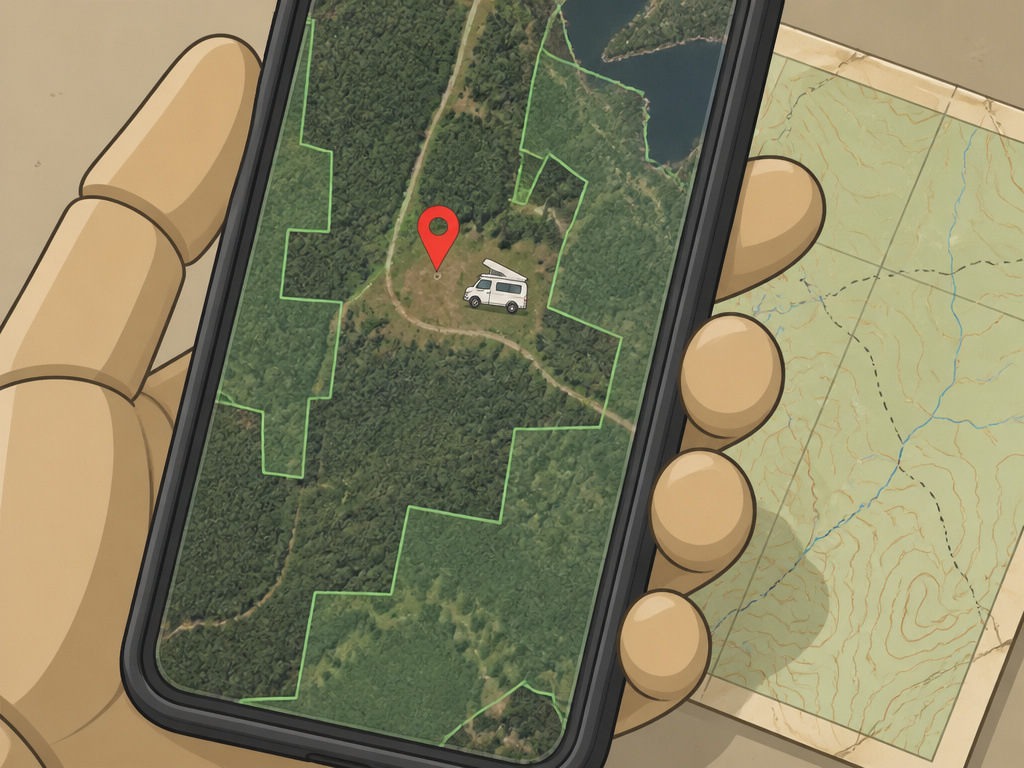
You won’t find a “Site 45” sign. Finding a legal, accessible, level spot is a skill. It combines digital scouting and old-fashioned ground truthing.
Digital Scouting (Do This at Home):
- Use a mapping app with public land overlays (like Gaia GPS or FreeRoam).
- Switch to satellite view. Look for clearings off established roads, existing fire rings, or subtle tracks from previous vehicles.
- Look for potential hazards: dead trees (widowmakers), low-hanging branches, drainage ditches, or soft sand.
- Save 2-3 backup coordinates. Your first choice may be occupied, inaccessible, or just feel wrong.
The Apps That Actually Work:
- Campendium: Excellent for RV-specific reviews. Users report road conditions, cell signal, and site size.
- iOverlander: Crowd-sourced and global. Great for remote, international, or less-conventional spots.
- The Dyrt Pro: Good mix of campgrounds and free sites, with useful offline maps.
Where this goes sideways: Relying solely on an app pin without looking at the satellite timeline. That “perfect clearing” could be a seasonal marsh. Check the satellite history for different seasons if possible.
When scouting for the best small trailers for boondocking, remember that a shorter, more maneuverable rig opens up spots a big motorhome can’t even consider. Ground clearance is often more important than overall height.
The Vehicle and Gear: What Actually Matters
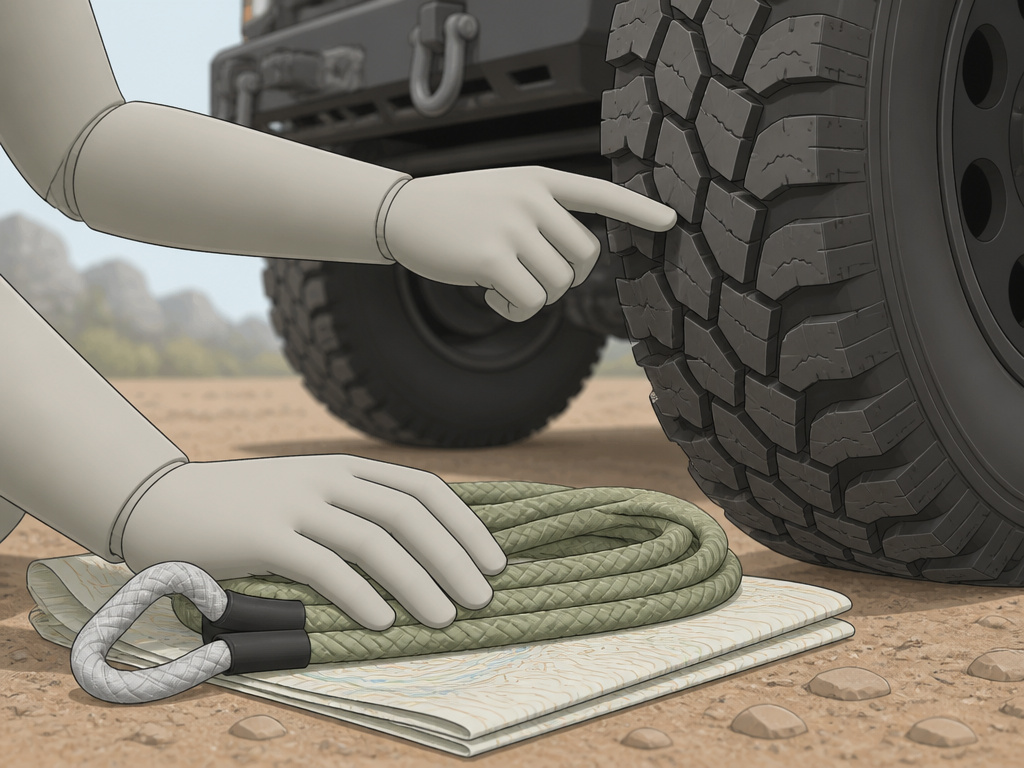
You don’t need a $300,000 EarthRoamer. You need a vehicle that is reliable and equipped for your chosen terrain. A compact travel trailer pulled by a capable truck can go farther off-grid than a massive, low-clearance diesel pusher.
Critical Vehicle Checks:
- Tires: All-terrain tires are a must for unpaved roads. Carry a full-size spare and the tools to change it.
- Ground Clearance: Know your measurement. A deep dip can high-center you.
- Alternator: It charges your starting battery, not your house batteries, while driving. Don’t count on drive time to fully recharge.
Gear You Will Use:
- A reliable mobile hotspot for camping: For weather updates, communication, and emergency research.
- A battery monitor: So you know exactly how many amp-hours you have left, not just a vague “green” light.
- Recovery gear: Traction boards, a shovel, and a kinetic rope. Your best tool is another vehicle, so never go too far alone without a plan.
- Paper maps: Cell service is a luxury, not a guarantee.
If you’re considering an RV for full-time living on the road, your boondocking capability directly translates to freedom and reduced camping costs. The systems need to be robust, not just adequate.
Safety and Etiquette: The Unwritten Rules
Boondocking only remains viable if we follow a code. It’s about leaving the place as good as, or better than, you found it.
Leave No Trace Principles are your bible. Pack out all trash, including micro-trash like bottle caps and cigarette butts. Dump waste only at authorized dump stations. Respect wildlife by storing food securely and observing from a distance.
Safety is about communication and caution.
- Always tell someone your planned location and return date.
- Arrive with enough daylight to scout and leave if the site is unsuitable.
- Have a plan for emergency communication (satellite messenger like a Garmin inReach).
- Move slowly around camp. A twisted ankle or deep cut is a major problem miles from help.
The community polices itself. Litter, loud generators after quiet hours, or damaging resources get spots closed down for everyone. The respect you show dictates the experience the next person will have.
Frequently Asked Questions
Is boondocking really free?
Often, but not always. Camping on BLM or National Forest land is typically free. Some areas, like certain Army Corps of Engineers lands or Long-Term Visitor Areas (LTVA) in the Southwest, require a nominal permit fee (e.g., $10-$20). The primary savings is avoiding $50-$100 nightly RV park fees.
Can you boondock in a regular car or tent?
The purest definition of boondocking involves a self-contained RV. However, tent campers and car campers absolutely practice dispersed camping on the same lands. The challenges are different, you lack onboard water and waste tanks, so you must carry and pack out everything.
How do I find dump stations and water refills?
Apps like Campendium and AllStays list dump stations (often at truck stops, gas stations, or some campgrounds for a fee) and potable water fill locations. Planning your route to loop past these resources is a key part of trip logistics.
What if my RV has a residential refrigerator?
This is a major complication. Residential fridges require constant 120V AC power. They will drain your batteries in a matter of hours unless you have a massive inverter and battery bank, or run a generator nearly constantly. Most boondocking rigs use efficient 12V DC or propane absorption refrigerators.
Is boondocking safe for solo travelers?
It can be, with heightened precautions. Choose more popular dispersed camping areas (like those in National Forests) where other campers are within sight. Always share your location and check in regularly. Trust your instincts, if a spot feels isolated in a bad way, leave. Many solo travelers thrive, but they plan for self-reliance.
The Bottom Line
Boondocking is problem-solving with a view. The reward is solitude, stunning locations, and the satisfaction of self-reliance. The cost is constant system management and the acceptance of variables you can’t control.
Start small. Pick a nearby National Forest for a two-night shakedown. Track your water and power use religiously. You’ll learn more about your real needs in those 48 hours than in months of reading.
Your perfect rig might be a maneuverable RV for national park camping that also excels off-grid. The goal isn’t to endure hardship, but to engineer your comfort independently. That’s the shift. You stop looking for a plug and start understanding the sun, your tanks, and the lay of the land. That knowledge is the real freedom.
