
Your Guide to the Best RV for Full Time Living on the Road
This post contains affiliate links. As an Amazon Associate, we earn from qualifying purchases.
The best RV for full time living is a motorhome or fifth wheel built on a heavy-duty chassis, with residential-grade appliances, robust climate systems, and manufacturer specs that don’t void the warranty for continuous use. Most factory warranties, like Entegra’s, explicitly exclude coverage if the unit is used as a “permanent residence.” Your first filter is the owner’s manual.**
That clause is printed on page one. Continuous living accelerates wear on everything from slide-out motors to water seals.The rigs that handle it are overbuilt, often with commercial truck foundations.
What follows is the breakdown of three non-negotiable specs, the head-to-head between a fortress-like diesel pusher and a nimble adventure van, and the onboard systems that separate a weekend camper from a true home.
Key Takeaways
- Check the warranty first. The Entegra Coach manual states use as a “permanent residence” may void the structural limited warranty. This is a standard exclusion.
- Condensation is your enemy. The Grand Design manual warns that normal living activities cause “rapid moisture saturation,” leading to mold in cold weather without constant ventilation.
- Weight capacity is everything. A 50-gallon freshwater tank adds about 400 pounds of cargo weight (per the Tiffin manual). Exceeding your rig’s GVWR by loading it like a house breaks suspensions.
- Diesel pushers win for space. A Entegra Cornerstone on a Spartan K3 chassis offers basement storage and an Aqua-Hot hydronic heating system that also heats your floors.
- Off-grid capability is a system. The Winnebago Revel pairs a Lithionics GTO battery with an EcoFlow Power Hub Pro for up to a week of boondocking, but it’s compact.
The Full-Time vs. Recreational Build Difference
A weekend camper and a full-time home share a shape, not a soul. Recreational vehicles are engineered for intermittent use, a few days here, a week there. Systems are sized for bursts, not constant demand. Living in one full-time exposes every shortcut.
Common mistake: Assuming all RVs are created equal. A unit marketed for “extended travel” often lacks the moisture management and structural reinforcement needed for 24/7/365 occupancy.
The gap starts with the warranty. Pull the owner’s manual for any major brand. The Entegra Coach 2022 Owner’s Manual is blunt: the RV is “not intended for use as full-time quarters or a permanent residence.” It warns that continuous living “could cause accelerated wear and damage” and “may affect your warranty coverage.” This is a legal foundation, not a suggestion.
Why it matters: Making a warranty claim on a delaminated wall or a failing slide-out? The first question from the service center will be, “Is this your primary residence?” If yes, that five-year structural warranty might be null. You’re now arguing over “good will” repairs, not covered claims.
The second gap is climate. You’re not just sleeping in it; you’re cooking, showering, and breathing in a sealed box. The Grand Design RV Owner’s Manual explains the physics: “The normal living activities of even a few occupants in the RV, can lead to rapid moisture saturation of the air inside and the appearance of visible moisture, especially in cold weather.”
| Recreational-Use Build | Full-Time Capable Build | Consequence of Mismatch |
|---|---|---|
| Single-pane windows | Double-pane, argon-filled windows | Condensation drips onto sills daily, wood rot within a season. |
| Basic roof vent fan | Powered, thermostat-controlled roof vent with rain sensor | Stale, humid air lingers, promoting mold in mattress corners and closets. |
| 30-amp electrical service | 50-amp service with a multi-stage inverter | Running one A/C unit plus a microwave trips the breaker. You cannot live on 30 amps. |
| Lightweight, hollow-core cabinetry | Solid wood or marine-grade plywood cabinetry | Drawers sag and tracks fail after six months of daily use. |
The fix is to buy a rig designed for the load. Look for the terms “four-season,” “all-weather,” or “arctic package.” These should include heated underbellies, tank heaters, and upgraded insulation. Brands like Grand Design (in their Lineage series) and Northwood Manufacturing build this in.
Motorized Fortresses: Class A Diesels
When your address is wherever you park it, space and stability become currency. The Class A diesel pusher is the flagship, a rolling apartment complex. It’s not for the faint of wallet or the novice driver, but for true full-time living with no plans to settle, it’s the benchmark.
The heart isn’t the leather sofa; it’s the chassis. Models like the Entegra Cornerstone ride on a Spartan K3 raised-rail chassis with a Cummins X15 605 HP engine. This is a commercial truck frame, rated for 20,000 pounds on the front axle. The Jayco Seneca XT uses a Ford F600 4X4 chassis. These are built for miles, not weekends.
A 175-gallon fuel tank and a 15-gallon DEF tank, like on the Entegra, aren’t for show. They’re for crossing Texas without stopping. That’s a full-time mindset.
The systems inside are what make life livable. Look for: 1. Hydronic Heating: An Aqua-Hot 600D system (found in high-end Entegra, Newmar, and Tiffin models) uses a diesel boiler to heat fluid that runs through radiators and in-floor tubes. It provides silent, even heat and endless hot water. It’s expensive to fix but unparalleled for comfort. 2. Residential Appliances: A full-size, 12-cubic-foot refrigerator, a domestic dishwasher, and an induction cooktop. The Jayco Seneca XT 35L offers an 18 cu. Ft. Residential fridge. These run on 120V power, demanding a robust electrical system. 3. Total Coach Control: The Firefly multiplex system (in Entegra, some Jaycos) lets you manage lights, slides, and climate from a touchscreen or phone app. It’s not a gadget; it’s a diagnostic tool that can tell you which slide-out motor is drawing too much current.
The trade-off is immense. You’re driving a 45-foot, 40,000-pound building. Fuel economy is measured in single digits. You’ll need a GPS for vehicle security and dedicated routing to avoid low bridges. Every campsite booking requires a check for length and slope. This is a lifestyle that demands planning.
Towable Foundations: Fifth Wheels
If the idea of your engine and your bedroom being inseparable makes you nervous, a fifth wheel is the dominant answer. You drop the house at the campground and use the truck for errands. This separation of powers is the biggest advantage.
The design is inherently stronger. The front section of the trailer locks into the bed of a pickup, creating a rigid, stable connection. The living area is perched over the truck bed, allowing for multiple levels and that coveted basement storage. You get more square footage per dollar than any motorhome.
| Fifth Wheel Advantage | Motorhome Advantage | Full-Time Verdict |
|---|---|---|
| Cost: More living space for less money than a comparable Class A. | Convenience: Walk from driver’s seat to bathroom without going outside. | Fifth wheel wins on value. You invest in a separate, durable fuel-efficient truck like a Ford F-350 with the 6.7L Power Stroke. |
| Maintenance: Truck and home are serviced separately. Engine failure doesn’t render you homeless. | Accessibility: Everything is onboard while driving. No need to pack up the kitchen for a grocery run. | Motorhome wins on simplicity. One engine, one insurance policy (RV insurance), one thing to maintain. |
| Upgradability: Can upgrade truck or trailer independently over time. | Community: Often more dedicated full-timer communities in Class A resorts. | It’s a lifestyle choice. Fifth wheels favor those who see the truck as a tool. Motorhomes favor those who want a unified command center. |
For full-time use, target a fifth wheel with a “full-time living” or “destination trailer” label. Brands like Grand Design (Lineage Series), DRV Suites, and Luxe build these. They feature: * Heavier framing (2×3 or 2×4 wood, or even steel). * Higher R-value insulation (R-15 in walls, R-30+ in roof). * Larger tanks (100+ gallon fresh, 80+ gallon gray/black). * Residential furniture and king-size beds.
You’ll need the truck to match. The Jayco Seneca XT 35L has a GVWR of 22,000 lbs. Towing that requires a one-ton dually (Ford F-350/F-450, Ram 3500/4500, Chevy 3500/4500) with a high-output diesel engine. Your full-time RV costs must include this $90,000+ tow vehicle.
The Compact Contender: Class B+ and Small Trailers
 Not every full-timer wants a palace. The “van life” movement is built on minimalism and mobility. For a single person or a couple without a need for a dedicated office, a well-built Class B (camper van) or a small trailer can be a full-time home.
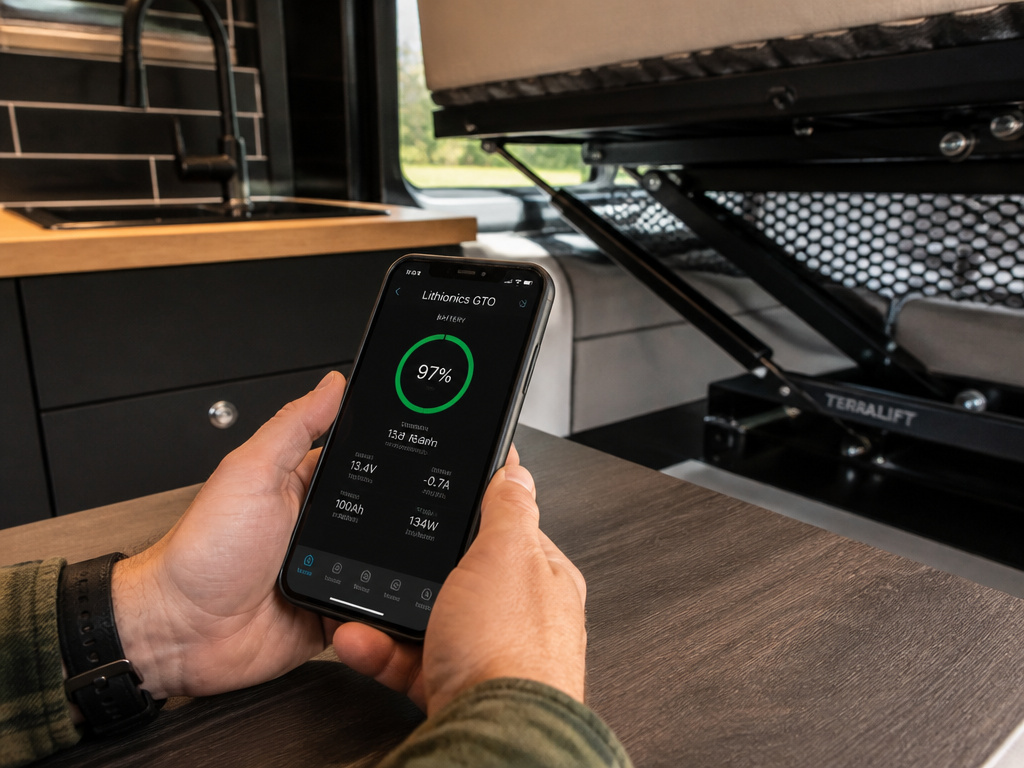
The champion here is the Winnebago Revel. It’s a Mercedes-Benz Sprinter AWD van converted into a four-season, off-grid capable micro-home. Its genius is the power-lift bed with a gear garage underneath. You can haul motorcycles or kayaks inside. The Lithionics GTO battery and EcoFlow Power Hub Pro claim up to a week of boondocking.
Where this goes sideways: Choosing minimalism without auditing your actual needs. The Revel has a 5-gallon cassette toilet. That’s 2-3 days of use for two people before you need to find a dump station. That’s the full-time math.
These compact options force efficiency. You’ll become an expert in RV living costs because you have no space for clutter. You’ll know the capacity of your 35-gallon freshwater tank by heart. A small trailer like an Airstream Classic or a Escape Trailer offers more space than a van but still tows behind a half-ton truck.
They are not for everyone. Winter in a van in Minnesota is a battle against condensation, even with the Revel’s “enhanced insulation.” Working remotely requires a disciplined setup, the dinette is your desk, your kitchen, and your dining room. It’s a trade of space for freedom of movement.
Critical Systems You Can’t Compromise On
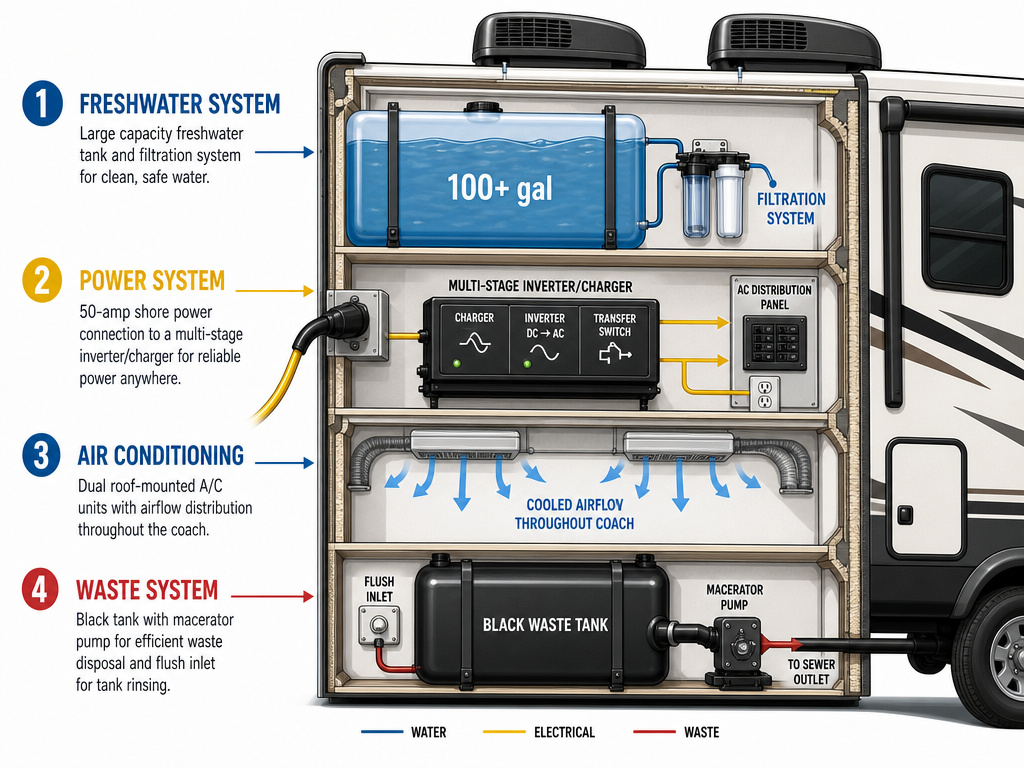 The floorplan sells the RV. The systems determine if you can live in it. These are the mechanical specs that move from “nice to have” to “essential” when you cross over to full-time living.
Fresh Water & Plumbing:
A 35-gallon tank (like in the Winnebago Revel) is fine for weekend trips. For full-time living, especially off-grid, 100 gallons is a practical minimum. Look for a water filtration system at the inlet and a water softener prep. Hard water scales up your water heater and showerhead in months. The Aqua-Hot or a Suburban tankless water heater provides endless hot water on demand, a legitimate luxury.
Electrical & Power:
30-amp service is a relic. You need 50-amps. This gives you two legs of 120V power, allowing you to run two air conditioners simultaneously while using the microwave. The power center must include a multi-stage inverter/charger (like a Victron MultiPlus or the Revel’s EcoFlow). This smoothly converts battery power to run appliances and charges your batteries efficiently when plugged in.
Tiffin’s manual notes a 50-gallon freshwater tank weighs about 400 pounds. That’s cargo weight. Your electrical system has a weight limit too, exceed the amperage, and you trip breakers or start a fire.
Climate Control:
A single 13,500 BTU air conditioner won’t cool a 40-foot fifth wheel in Arizona July. You need two, preferably 15,000 BTU units. Heat shouldn’t rely solely on the furnace, which burns propane and dries the air. The hydronic heating in a diesel pusher or an electric heat pump option on your A/C is far superior for dry, even heat.
Waste Management:
A 41-gallon black tank (standard on many) fills fast with full-time use. Look for a black tank flush system, a dedicated inlet that lets you spray down the tank. Consider a macerator pump (like the Sani-Con system in the Entegra) which grinds waste and allows you to pump it out through a skinny hose into a standard sewer cleanout. This is a game-changer for remote sites.
What’s the Single Biggest Mistake New Full-Timers Make?
They buy with their eyes, not with the spec sheet. They fall for the granite countertops and theater seats and forget to ask about the thickness of the floor insulation or the gauge of the wiring behind the walls. The glamour is upstairs. The living is in the basement.
The documented failure mode is moisture. It’s not about leaks. It’s about condensation, the water vapor from your shower, your pot of pasta, your own breath. Without constant air exchange, it settles on the coldest surface: the inside of your exterior walls in winter. That’s how you get hidden mold behind the sofa.
The Grand Design manual directly addresses this and points owners to the EPA’s indoor air quality website. This is the predictable outcome of living in a tightly sealed, thermally inefficient box. The fix is mechanical: a high-quality RV ventilation system like a Maxxair or Fantastic fan, run on low 24/7, and double-pane windows.
The second mistake is overloading. Every item you bring aboard has a weight. That portable grill, the extra set of tools, the library of books. The Tiffin manual explicitly states water weight counts against your cargo capacity. Exceeding the Gross Vehicle Weight Rating (GVWR) strains the suspension, wears tires prematurely, and makes handling dangerous. Weigh your loaded rig at a truck stop cat scale. It’s the only way to know.
Frequently Asked Questions
Can you legally live in an RV full time?
Yes, but location is everything. You cannot permanently park and live in an RV on most private properties without violating local zoning codes (often called “camping” ordinances). Legitimate full-time living happens in RV parks with monthly leases, on private land where it’s permitted, or through constant travel (boondocking on public lands for the allowed 14-day limit). Your RV insurance policy must also be informed it’s your primary residence.
Do RV warranties cover full time living?
Most do not. As cited from the Entegra Coach Owner’s Manual, using the RV as a “permanent residence” can void the warranty. Some higher-end “full-time” rated brands may have more accommodating policies, but you must get this confirmation in writing from the manufacturer before purchasing. Never assume.
What is the most reliable RV brand for full timing?
Reliability in full-time use is less about brand and more about construction quality and service network. Brands with a reputation for robust, full-time oriented builds include Newmar, Tiffin (especially their Zephyr and Phaeton lines), DRV Suites, and Grand Design’s high-end lines. The Winnebago Revel is renowned in the van life segment. Always research the specific model year for known issues.
How much does it cost to live in an RV full time?
RV living costs vary wildly. It can be cheaper than a mortgage if you boondock extensively and perform your own maintenance, or more expensive if you stay in luxury RV resorts and dine out constantly. Major budget items are: campsite fees ($500-$2,000+/month), fuel, RV insurance, vehicle maintenance (using full synthetic oil), and repairs. A detailed monthly budget is essential.
Is a motorhome or fifth wheel better for full time living?
It’s the core debate. A fifth wheel generally offers more space and value, requires a separate truck, and is more stable in wind. A motorhome (Class A) offers driving convenience, easier access while traveling, and often has more premium finishes. The “better” choice depends on your desire to drive your home, your need for a separate vehicle, and your budget for both the rig and the fuel-efficient truck required to tow a fifth wheel.
The Bottom Line
Stop looking for the best RV. Start looking for the right foundation. The winner for full-time living is the unit whose warranty doesn’t flinch at your address, whose walls can trap heat without trapping damp, and whose axles won’t sag under the weight of your life.
For most couples who want space and plan to stay put for weeks at a time, a full-time rated fifth wheel from Grand Design or DRV, towed by a one-ton dually, is the pragmatic champion. For the solo traveler or minimalist pair who values mobility above all, the Winnebago Revel is the engineered solution. And if your home must also be your chariot, a Class A diesel pusher like the Entegra Cornerstone is the rolling fortress.
Check the manual first. Then walk the aisle. The right rig is the one built to be your only address.
