
How Much Does Full-Time RV Living Cost? The Real Numbers
This post contains affiliate links. As an Amazon Associate, we earn from qualifying purchases.
Full-time RV living costs between $1,600 and $6,000 per month in 2026, with a realistic, comfortable average for most couples landing around $2,500 to $3,500. Your exact number hinges on one decision: how often you move. Stationary living with monthly site rentals is the budget lever; constant travel is the budget bomb. Forget the fantasy of cheap freedom, this lifestyle replaces a mortgage with a complex web of campground fees, accelerated maintenance, fuel, and mandatory systems like Starlink.
That spread, $1,600 to $6,000, relates to velocity. The rigs parked for months at a time in Arizona or Texas are playing a different financial game than the ones chasing national parks every week.The costs aren’t just different in degree; they’re different in kind. Moving burns fuel and demands nightly or weekly campsites at premium rates. Staying put unlocks monthly rates that can halve your lodging cost overnight.
What follows is a breakdown of where that money actually goes, drawn from real 2026 spending reports. We’ll look at the two distinct financial models for this life, the non-negotiable expenses most blogs gloss over, and the single biggest mistake that pushes people back into a sticks-and-bricks home within a year.
Key Takeaways
- Your travel pace is your primary cost driver. Moving weekly can double your monthly budget compared to staying put monthly.
- Budget $300-$500 per month for maintenance and repairs from day one. Full-time use wears out components 40-60% faster than recreational use.
- Health insurance is the most common budgetary blindside. Leaving an employer plan means budgeting $400-$800+ per person monthly.
- The RV Industry Association states RVs are built for temporary recreational use, not permanent homes. This voids warranties on failures caused by 365-day use.
- A legal domicile address (via services like Escapees RV Club) is required for licensing, insurance, and voting, costing $15-$40 monthly.
The Two Full-Time RV Lifestyles (Pick One or You’ll Bleed Money)
Most people fail at budgeting because they mix two incompatible financial models. You are either a stationary full-timer or a traveling full-timer. The budget for one will bankrupt the other.
The stationary model treats the RV as a low-cost apartment. You secure a monthly site at an RV park, often for $500 to $1,200 depending on location and amenities. Your fuel costs drop to near zero. Your campground cost is fixed and predictable. This is how you hit the $1,600 to $2,500 monthly range. It’s a lifestyle of deep local exploration, not cross-country road trips.
The traveling model is what you see on Instagram. It’s a new vista every week. It’s also a financial furnace. Fuel becomes a dominant line item. Campgrounds are paid at nightly or weekly rates, which are 30-100% more expensive per night than a monthly rate. A couple moving every week can easily spend $800 to $1,200 on sites alone, plus $400 to $700 in fuel. This is the path to $4,000+ months.
Where this goes sideways: Trying to be a traveler on a stationary budget. You’ll drain your emergency fund by the third month, forcing you to stop and work camp, which isn’t the freedom you pictured.
The data from actual full-timers like the Journey With The Gs in May 2026 shows the hybrid approach. They drove 910 miles, a moderate amount, and their camping costs were only $274.57 because they used memberships like Thousand Trails and RPI to access discounted stays. Their major cost was a $2,185 repair for a new bedroom AC unit, a reminder that maintenance is the wild card.
| Lifestyle Model | Primary Cost Driver | Monthly Camping Range | Monthly Fuel Range | Best For |
|---|---|---|---|---|
| Stationary/Slow-Mover | Monthly site rental | $500 – $1,200 | $50 – $200 | Remote workers, retirees, seasonal workers |
| Constant Traveler | Nightly/weekly site fees + fuel | $800 – $1,800+ | $400 – $1,000+ | Seasonal chasers, project-based travelers |
| Hybrid (Recommended) | Mix of memberships & monthly stays | $300 – $900 | $200 – $500 | Most full-timers seeking balance |
Your first task is picking a speed. Your budget flows from that.
Deconstructing the Monthly Budget: Where the Money Actually Goes
A generic percentage breakdown is useless. Costs are categorical and sequential. You pay for the roof over your wheels first, then the wheels turning, then everything else.
Shelter: Campground Fees & Memberships
This is your new rent. A basic full-hookup site at a private park runs $50-$100 per night. At weekly rates, that’s $350-$700. Monthly rates are the savior, often $600-$1,200, effectively cutting your per-night cost in half or more. Boondocking on Bureau of Land Management (BLM) land is free for up to 14 days, but requires robust solar and water systems. Memberships like Thousand Trails ($600-800/year + nightly fees) or Harvest Hosts ($99/year) can drastically reduce costs but come with restrictions and availability battles.
Propulsion: Fuel & Travel Costs
Your home’s mileage is terrible. A Class A motorhome gets 6-10 MPG. A tow vehicle with a fifth wheel might get 8-12 MPG. At $3.50-$5.00 per gallon, a 1,000-mile month costs $350-$700. This cost approaches zero if you stay put. This is why your half-ton truck towing capacity matters when selecting a trailer, an underpowered truck burns more fuel.
The Home Itself: RV Payment, Insurance, & Depreciation
If you financed a $80,000 rig, your payment is $800-$1,200 monthly. If you paid cash, you must account for depreciation, about 20% in the first year. Insurance is not optional. You need a full-timer policy, which costs $100-$300 monthly. Standard recreational policies can deny claims if they discover you live in the rig. This is as fundamental as knowing how much car insurance you need for a daily driver.
Utilities of Motion: Internet, Phone, & Power
Reliable internet is a utility, not a luxury. Most working full-timers use a dual-carrier mobile hotspot (Verizon + T-Mobile, ~$150/month) as a primary, with Starlink Roam ($150/month + $599 hardware) as a satellite backup for remote areas. Your phone plan is separate. Power comes from the campground grid, your generator, or a solar/lithium battery (LiFePO4) system, which is a $3,000-$10,000 upfront investment.
Life Maintenance: Food, Health, & Domicile
Food costs are similar to a house, though pantry space may limit bulk buying. Health insurance is the shocker: an ACA marketplace plan for a 50-year-old couple can exceed $1,200 monthly. You also need a legal domicile state for your driver’s license, vehicle registration, and voting. Services like Escapees RV Club handle mail forwarding and provide that legal address for about $15-$40 monthly.
The Maintenance Fund That’s Not Optional
This is the section that separates dreamers from survivors. Recreational Vehicles are not designed for full-time living. The RV Industry Association (RVIA) explicitly states they are built for “temporary recreational use.”
Common mistake: Budgeting $100 a month for maintenance. That covers an oil change. It doesn’t cover a slide-out motor, a roof leak, or a failing refrigerator.
Full-time use accelerates wear by 40-60%. A residential fridge meant to last 10 years might fail in 4-6 under constant vibration and temperature swings. Documented cases from owner forums include a $17,000 engine failure on a motorhome with 78,000 miles and a $4,000+ first-year maintenance bill on a 2017 Forest River Georgetown.
You need two funds: 1. A monthly savings fund of $300-$500. This builds up for expected repairs like new tire cost (a set of six RV tires can be $1,500-$3,000), brake jobs, and appliance replacements. 2. An emergency reserve of $5,000-$10,000. This is for the catastrophic failure, the blown engine, the major roof leak, the slide-out mechanism repair that costs $2,500-$9,000.
An extended warranty can offset this, but read the fine print. One owner’s warranty covered $5,721 in repairs that would have totaled $17,981, but many warranties exclude items due to “full-time wear and tear.”
The Hidden Sinks: Costs You Won’t Find on a Spreadsheet

The financial spreadsheet misses the psychological and logistical costs. These are the line items that drain your energy and budget in subtle ways.
The Storage Unit Anchor
You sold the house, but not everything. A 10×10 storage unit costs $100-$200 monthly. Over two years, that’s $2,400-$4,800 paid to store things you likely don’t need. It’s a mental tether to a past life and a recurring drain.
The Hotel Night Fund
After a week of battling a leak in the rain, or during a brutal heatwave when your RV AC struggles, you will need a hotel. Budget $200-$400 monthly for this sanity-preserving escape. A real shower, a stable temperature, and a bed that doesn’t vibrate when the refrigerator kicks on are priceless.
The Learning Tax
Your first year will cost more. You’ll buy the wrong hoses, replace inadequate equipment, and pay for repairs on problems you caused by not knowing how a system works. This isn’t wasteful; it’s tuition. Factor in an extra $1,000-$2,000 for your first 12 months on the road.
Administrative Drag
Establishing domicile isn’t just a mail service. It requires trips to your chosen state to get a driver’s license, register vehicles, and inspect the RV. These trips cost fuel, time, and often campground fees. It’s a multi-day process that every full-timer must complete.
Choosing Your Rig: How the RV Itself Dictates Cost
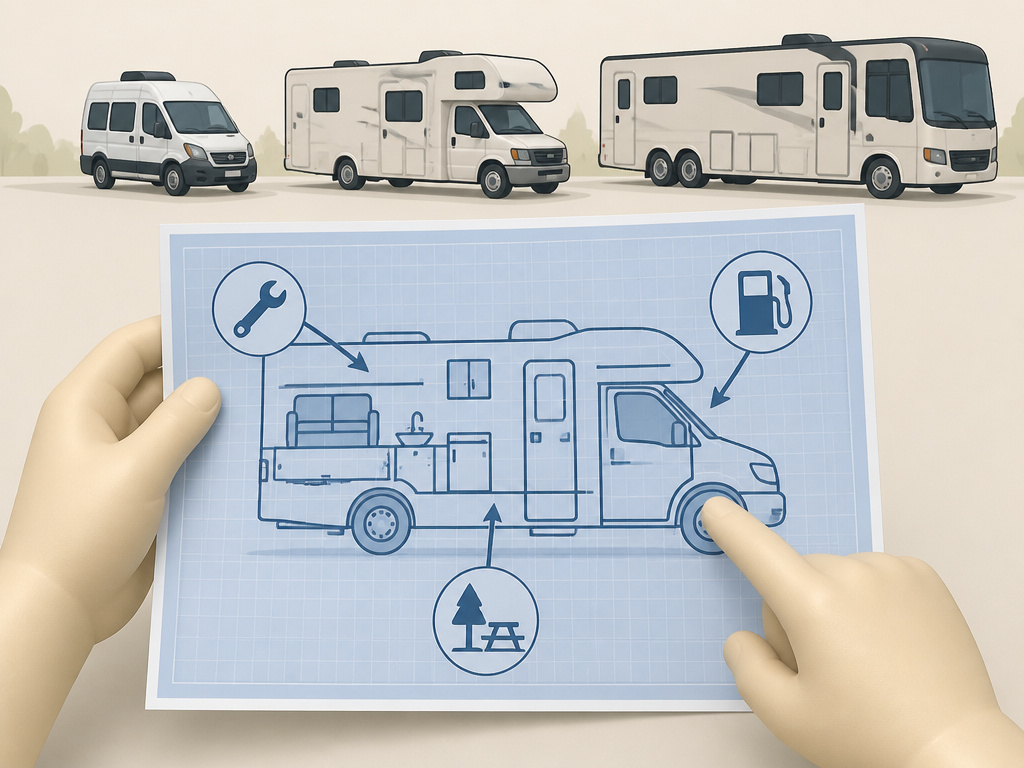
The RV is a mechanical asset that depreciates and a collection of systems that will fail. Your choice here sets your baseline for repair costs, fuel efficiency, and campground accessibility.
The part nobody mentions: A used rig might have a lower payment, but its repair history is unknown. A new rig has a warranty, but it will still suffer from “shake-down” issues in its first 10,000 miles.
The debate between Class A, B, and C motorhomes is really about trade-offs. Class A’s offer space but poor fuel economy and high repair costs. Class B’s (camper vans) are fuel-efficient and nimble but cramped. Class C’s are a middle ground. Your choice should align with your chosen lifestyle model from Section 1. A constant traveler might prioritize a smaller, more efficient Class B or C. A stationary full-timer might opt for the space of a fifth wheel, which requires a capable tow vehicle.
Features matter for cost control. Dual-pane windows and heated underbellies reduce heating costs in winter. A residential refrigerator is more reliable than an RV absorption fridge but draws more power. More slide-outs mean more living space and more potential mechanical failures. This is why researching the best RV for full-time living is about durability specs, not just floorplans.
Is It Cheaper Than a House? The Equity Trap
This is the core question. The answer is: it can be, but often isn’t when you account for everything.
You eliminate a mortgage, property taxes, and high utility bills. You gain campground fees, fuel, accelerated depreciation, and maintenance. In a high-cost housing market (California, New York), RV living can provide dramatic monthly savings. In a low-cost area where you own a home outright, RV living will almost certainly cost more.
The critical trap is equity. A mortgage payment builds ownership in an asset that historically appreciates. An RV payment covers a depreciating asset. That $1,200 monthly RV payment is gone. After five years, your $80,000 rig might be worth $40,000. You’ve spent $72,000 on payments and lost $40,000 in value.
A 2026 RV living trends report from RV Journal noted a paradox: while total RV ownership dipped post-pandemic, the number of full-time dwellers appears to have grown. This suggests people are choosing this life for necessity or lifestyle, not purely for savings.
For working-age people, this is the hidden long-term cost. You may match your old rent payment, but you’re not building any asset. You’re trading potential future wealth for present mobility. That trade can be worth it, but you must go in with eyes wide open.
Frequently Asked Questions
What is the single most underestimated cost?
Health insurance. People budget for fuel and campsites but forget that leaving an employer plan means paying the full premium. For a couple under 65, this can be a $1,000-$2,000 monthly line item that never existed before.
Can I really work remotely from an RV?
Yes, but it requires investment and planning. A dual-carrier mobile internet setup (Verizon + T-Mobile) with a quality router and external antenna covers about 90% of locations. Starlink covers most of the rest. You must also plan your travel around signal availability and have a backup power source for your electronics.
How do I handle mail and a legal address?
You establish domicile in a state like Texas, South Dakota, or Florida. Services like Escapees RV Club or Americas Mailbox provide a street address, forward your mail, and help you navigate the residency requirements (driver’s license, vehicle registration). This costs $15-$40 per month.
Is a used or new RV better for full-timing?
It depends on your tolerance for repairs and upfront cost. A new RV comes with a warranty but will have initial “teething” problems. A used RV is cheaper upfront but its repair history is a mystery. For full-time use, many recommend a lightly used, well-built rig from a quality brand, as the initial depreciation hit is already taken.
Do I need a special driver’s license?
For most RVs under 26,000 pounds gross vehicle weight rating (GVWR), a standard driver’s license is sufficient. However, you should check your state’s requirements, especially for larger Class A motorhomes or combinations over certain weight limits. The requirements are similar to understanding vehicle towing laws, it’s based on weight.
The Bottom Line
Full-time RV living is a different life with a different cost structure. The freedom has a price tag measured in monthly site fees, diesel gallons, and $300 repair bills for things you didn’t know could break.
Your budget will live or die by your travel pace. The winning strategy is almost always the hybrid: slow down. Secure monthly rates. Use memberships strategically. Build that $500 monthly maintenance fund before you leave the driveway. Understand that your home on wheels is a mechanical device that will fail, and that the industry that built it never intended for you to live in it 365 days a year.
If you can build a financial system that accounts for reality, not Instagram fantasy, the trade can be worth it. The trade is a traditional asset-building life for a life of motion and experience. Just know the cost of the ticket before you board.
