
Difference Between Class A, B, and C Motorhomes Explained
This post contains affiliate links. As an Amazon Associate, we earn from qualifying purchases.
Class A, B, and C motorhomes are defined by their chassis architecture, the frame they’re built on, which dictates their size, fuel economy, and real-world usability. A Class A uses a heavy-duty bus or commercial truck chassis (Freightliner, Spartan). A Class B is built on a van chassis (Mercedes Sprinter, Ford Transit). A Class C sits on a truck or cutaway chassis (Ford E-450) with a cabover bunk. This foundation determines everything from turning radius to which national park campgrounds you can fit into.
The chassis is the non-negotiable starting point. It’s not an accessory list or a length measurement you can fudge. That steel frame decides your vehicle’s weight, its center of gravity, and the mechanical limits you’ll live with for the entire trip. Get the chassis wrong, and you’ve bought the wrong experience before you even pack a bag.
What follows is a breakdown of the three chassis types, the fuel and parking math they force, and the two marketing claims you must verify before you book anything.
Key Takeaways
- The RV Industry Association (RVIA) classification is based solely on chassis, not length or luxury. A 32-foot rig on a van chassis is still a Class B.
- Real comfortable sleeping capacity is about 60-70% of the advertised “sleeps X” number. A Class C cabover bunk typically has a 500-600 lb combined occupant rating.
- Fuel cost dominates trip expenses if you drive over 200 miles a day. A Class B Sprinter diesel can be three times cheaper to fuel than a Class A gas motorhome on a 1,500-mile loop.
- The median improved campsite length in the U.S. Is roughly 32 feet. A 38-foot Class A eliminates most National Park Service campgrounds.
- For first-time renters, a Class B (camper van) is the easiest to drive, feeling like a large van within 30 minutes. A Class C feels top-heavy for 1-2 days.
The Chassis Reality Check
Forget length. Ignore the glossy brochure photos of granite countertops. The first line on any motorhome’s spec sheet is the chassis, and it’s the line that matters most.
The RV Industry Association (RVIA) framework sorts motorhomes by their underlying frame. This isn’t a suggestion. It’s the industry’s own rulebook, and it exists because the chassis dictates the vehicle’s fundamental capabilities and limits.
Class A: Heavy-duty commercial truck or bus chassis (Freightliner, Spartan, Ford F-53). Class B: Van chassis (Mercedes Sprinter, Ram ProMaster, Ford Transit). Class C: Truck or cutaway chassis (Ford E-450, Chevy 4500) with an integrated cabover bunk.
This classification explains why a luxurious 28-foot Leisure Travel Van Wonder is technically a “Class B+”, it’s built on a Mercedes Sprinter van chassis, not a truck frame. Calling it a small Class C misses the point. The van chassis gives it better fuel economy and a lower center of gravity than any truck-based rig.
The chassis determines your payload capacity, the weight of people, water, and gear you can safely carry. Exceed it, and you stress the suspension, brakes, and frame. It’s the number that turns a theoretical “sleeps six” into a practical “fits four with luggage.” Always check the manufacturer’s Gross Vehicle Weight Rating (GVWR) against your planned load.
Size, Drive Feel, and Parkability
Chassis dimensions create three distinct driving profiles. You don’t just choose a size; you choose a driving experience and a list of places you can physically enter.
A 30-foot Class A drives like a city bus. Its turning radius stretches 35 to 40 feet. Changing lanes on the highway requires five seconds of planning and a deliberate steering input. Crosswinds over 25 mph make the steering wheel a constant fight. You feel every gust.
A 22-foot Class B drives like a large van. It fits into a standard parking space, albeit snugly. Crosswind sensitivity is low. Most first-time renters feel comfortable behind the wheel within half an hour. The van’s original body panels and lower roof mean less surface area for the wind to push against.
A 28-foot Class C drives like a large box truck. The cabover bunk shifts the center of mass upward, creating a distinct top-heavy sensation on sharp turns or off-camber roads. That sensation is real. New drivers typically need one to two days to stop white-knuckling the wheel. It’s the rental-fleet workhorse because it offers space at a manageable driving difficulty, but “manageable” isn’t “easy.”
| Driving Metric | Class A (30 ft) | Class B (22 ft) | Class C (28 ft) |
|---|---|---|---|
| Feels Like | Large Bus | Large Van | Large Truck |
| Turning Radius | 35–40 ft | Fits Standard Parking Space | Similar to Truck |
| Crosswind Sensitivity | High | Low | Moderate |
| Comfort Timeline | Days of practice | 30 minutes | 1–2 days |
Parking is the silent constraint. The median improved campsite length in the U.S., according to Recreation.gov data, is about 32 feet. That means a 32-foot Class A fits, but you must filter reservations by length. A 38-foot Class A fits fewer than 30% of sites. A 45-footer fits under 10%.
Where this goes sideways: Assuming any RV can park at a Walmart or Cracker Barrel overnight. Store manager discretion is the real policy. A 38-foot Class A often blocks too many spots and gets asked to move. A Class B or most Class C rigs slide in without notice. Your rig’s length determines your spontaneous overnight options.
Fuel Economy and Trip Cost Math
Mileage numbers are abstractions. Fuel cost is real money. The chassis and engine type create a fuel economy range that can change the total cost of your trip more than the daily rental rate.
Let’s use a 1,500-mile trip with 2026 national average fuel prices. The math reveals a counterintuitive truth.
A Class A gas motorhome averages 7 miles per gallon. That’s 214 gallons of fuel. A Class B Sprinter diesel averages 20 MPG, needing only 75 gallons. At $3.40 per gallon for gas and $3.80 for diesel, the Class A costs over $700 in fuel. The Class B costs about $285.
The 1,500-mile fuel cost for a Class B Sprinter diesel is roughly one-third the cost of a Class A gas motorhome. That savings can offset two or three nights of a higher rental rate.
But the advantage hinges on how you travel. If you drive 200 miles a day, fuel cost dominates and the Class B wins. If you park at a base camp for five days and only drive 50 miles for day trips, the fuel savings shrink. The larger rig’s livability then outweighs the pump expense.
The diesel vs gas debate matters here. A Class A “diesel pusher” (engine in the rear) gets slightly better mileage (8-9 MPG) and is quieter at highway speed. But diesel-specific fluid costs and maintenance run 30-50% higher over time. For a one-week rental, the diesel experience premium might not be worth the extra $75-$150 per night.
Sleeping Math vs. Marketing
 Manufacturer “sleeps X” counts are a theoretical maximum. They include every horizontal surface: the permanent bed, the dinette that converts, the cabover bunk, sometimes even a fold-out sofa. Real comfortable capacity is what you’ll actually use without a nightly puzzle workout.
Comfortable capacity is typically 60-70% of the advertised number.
A Class A labeled “sleeps 8” comfortably fits four adults, two in the rear bedroom and two on a converted dinette. Using the dinette means breaking it down every night and rebuilding it every morning. Most groups skip it after the first two days of a trip.
A Class B labeled “sleeps 3” is a one- or two-adult vehicle. The “plus one” is a child or someone willing to sleep in a cramped loft or on a narrow bench seat. It’s a cozy fit, not a spacious one.
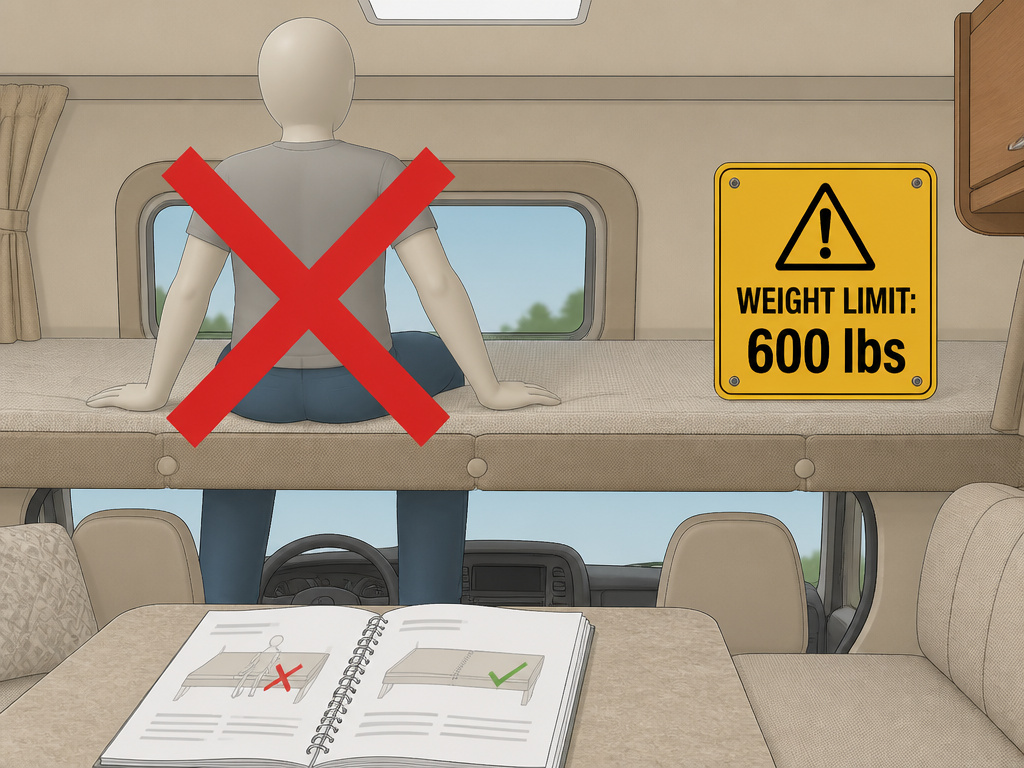
A Class C is the family favorite, but its signature feature has a hard limit. The cabover bunk above the driver has a manufacturer-rated combined occupant weight limit, usually 500 to 600 pounds. Two adults each over 200 pounds exceed that limit. It’s designed for kids or teens.
Common mistake: Booking a Class C “sleeps 6” for four adults. The cabover bunk’s weight rating often forces two adults into the dinette bed, turning your vacation into a nightly furniture rearrangement project.
Verify the cabover’s load rating in the owner’s manual or rental listing before you book. That number is a safety spec, not a suggestion.
The Rental vs. Ownership Lens
 Your time horizon changes the calculus. Renting is a one-week snapshot. Owning is a long-term relationship with maintenance, storage, and depreciation.
Renting lets you match the rig to the trip. Heading to Yellowstone’s tight, historic campgrounds? A maneuverable RV like a Class B or small Class C is the best RV for national parks. Taking a coastal highway trip with a family of four? A larger Class C provides needed space. The rental cost difference between classes ($175-$450/night) is a fixed, known variable.
Owning introduces hidden variables. A Class B Sprinter might save on fuel, but its specialized Mercedes-Benz components can lead to expensive repair bills at the dealer. A large Class A needs a place to live, storage fees for a 40-foot rig are significant. It also may require a special drivetrain system for towing a car.
The part nobody mentions: Insurance and registration costs scale with vehicle value and size. A $300,000 Class A costs more to insure than a $100,000 Class C, full stop. Financing a motorhome also differs from financing a car, with often shorter loan terms and higher rates.
Class A vs. B vs. C: The Direct Comparison
You need a winner per scenario. “It depends” is a non-answer. Here’s where each class takes the checkered flag.
For solo travelers or couples prioritizing mobility and cost: The Class B van wins. It’s the easiest to drive, cheapest to fuel, and fits anywhere. The best RV for couples who want to explore off-the-grid forest roads is almost always a well-equipped Class B. You sacrifice space for freedom.
For families of four (with younger kids) needing a balance of space and driveability: The Class C wins. The cabover bunk gives the kids their own zone, and the truck chassis provides more interior room than a van. Models like the Coachmen Leprechaun 260DS offer predictable floorplans. It’s the default family rental.
For full-time travelers or large groups wanting maximum home-like comfort and are willing to plan around size: The Class A wins. Its bus chassis allows for residential appliances, washer/dryer hookups, and multiple slide-outs. You trade campground accessibility for apartment-on-wheels livability. This is not a rig for spontaneous national park tours.
| Use Case | Winner | Why |
|---|---|---|
| First-Time Renter | Class B | Van-like driving, easy parking, low stress. |
| Family Road Trip (2+2) | Class C | Dedicated bunk for kids, more interior space than a van. |
| Long-Term, Full-Time Living | Class A | Maximum interior space, residential amenities, storage. |
| Boondocking & Remote Parks | Class B | Best fuel range, fits on narrow roads, low-profile for dispersed camping. |
| Towing a Car or Boat | Class A | Highest factory towing capacities and chassis strength for heavy loads. |
Your choice in pickup truck configurations for towing, be it a crew cab or extended cab, matters when selecting a motorhome, as you may need a tow vehicle for side trips. Each class has a different aptitude for this.
Frequently Asked Questions
What is the easiest motorhome class to drive for a beginner?
Class B motorhome (camper van) is the easiest. Built on a van chassis like a Mercedes Sprinter or Ford Transit, it drives like a large van. Most first-time renters feel comfortable within 30 minutes. Its size allows it to fit into standard parking spaces and navigate narrow roads with far less stress than larger classes.
Do I need a special license to drive a Class A motorhome?
In most states, no. If the motorhome’s Gross Vehicle Weight Rating (GVWR) is under 26,001 pounds, a standard driver’s license (Class D) is sufficient. Most rental Class A rigs are built under this threshold. Some states, like California, require a non-commercial Class B license for vehicles over 40 feet long. Always verify with your local DMV and the rental company’s stated GVWR.
Is a Class C just a smaller Class A?
No. This is the most common misconception. A Class C is built on a truck chassis (Ford E-450) with an attached cabover bunk. A Class A is built on a wider, heavier bus or commercial truck chassis (Freightliner) with no separate cab structure. The driving feel, cost, and interior construction are fundamentally different. A Class C is not a “baby Class A.”
Can a Class B motorhome really fit a family of four?
It can, but comfortably? Rarely. A Class B marketed as “sleeps four” typically uses a convertible dinette and a pop-top roof or a cramped loft. It works for two adults and two very small children on a short trip. For a family of four, the space, storage, and lack of privacy quickly become burdensome. A Class C is a better fit for most families.
Why are used Class A motorhomes sometimes cheaper than large Class Cs?
Depreciation and maintenance costs. Class A motorhomes, especially diesel models, have higher initial costs and steeper depreciation curves. Their complex systems (multiple slide-outs, residential HVAC, larger engines) also lead to higher long-term maintenance costs, which can dampen resale value. A well-maintained, popular Class C model can sometimes hold its value better in the mid-market.
What’s the single biggest hidden cost of a larger motorhome?
Campsite accessibility and fees. A 38-foot Class A won’t fit in most U.S. National Park campgrounds, whose median site length is under 30 feet. This forces you into more expensive, privately-owned RV parks that can accommodate big rigs. The nightly rate difference, compounded over a long trip, often exceeds the higher fuel cost.
Before You Go
The chassis is the DNA. It dictates the driving experience, the fuel bill, and the list of campgrounds that will return your reservation inquiry.
Match the chassis to your trip’s reality, not its brochure fantasy. For tight parks and long drives, a van chassis (Class B) wins. For family trips with kids, a truck chassis with a bunk (Class C) is the default. For a movable condo where the destination is the rig itself, the bus chassis (Class A) makes sense.
Verify two numbers before you commit: the cabover bunk’s weight rating and the rig’s GVWR. The first keeps your family safe. The second keeps your investment from being crushed by your own luggage. Everything else, the granite, the theater seats, the outdoor kitchen, is decoration bolted to a frame. Choose the frame first.
