
The Best RV for National Parks: The 30-Foot Rule Explained
This post contains affiliate links. As an Amazon Associate, we earn from qualifying purchases.
The best RV for national parks is one under 30 feet in total length, built on a capable chassis, and equipped for extended dry camping. Most in-park campsites have no hookups, and site length limits, often based on turning radius, not just parking space, make anything longer a logistical headache. A rig like the Winnebago Revel, built on a Mercedes-Benz Sprinter 4×4 chassis, hits the sweet spot for size and off-grid endurance.
That length limit is the physical outcome of roads cut decades ago and campsites wedged between trees. The number on the Recreation.gov listing is for parking.The number you need to worry about is for maneuvering.
What follows breaks down the three non-negotiable specs: length, chassis, and self-containment. We’ll match RV types to park realities, name the models that get it right, and show you how to read a campsite listing so you don’t show up to a dead end.
Key Takeaways
- Total length is the first filter. Aim for under 30 feet including any tow vehicle; this opens up 80% of in-park sites that longer rigs physically cannot use.
- Dry camping is the default. Most national park campgrounds have zero hookups. Your RV must carry its own power (solar/lithium) and water (35+ gallon tank).
- Manufacturer length stickers lie. They often list interior living space. Measure your rig from bumper to bumper, including bikes or cargo boxes on the rear.
- Turning radius changes the math. A site listed for a 35-foot motorhome might only fit a 30-foot fifth wheel because the tow vehicle needs swing room.
- October is not the off-season. Popular parks like Yellowstone book solid for RV sites months in advance, even in fall.
The 30-Foot Rule and Why It’s Real
Forget the brochure photos of 45-foot coaches under desert skies. The average national park campsite apron is short, narrow, and often perched on a curve. The 30-foot total length guideline exists because that’s what fits.
The constraint is history. Many campground loops were laid out in the 1960s, when a 22-foot trailer was considered large.Roads snake through old-growth groves where widening isn’t an option. That gorgeous, shaded site you want has a granite boulder six feet off the pavement on one side and a Douglas fir on the other.
Where this goes sideways: Relying on the manufacturer’s sticker for length. That number usually only factors in the interior living space, not the exterior measurement from bumper to bumper. You must grab a tape measure and include any tow vehicle, rear-mounted bike rack, or cargo carrier.
The consequence is immediate. You arrive after a long drive, find the site won’t fit, and the campground is full. Now you’re the afternoon entertainment as you attempt a 27-point turn to escape, or you’re driving back out to find overflow parking in the dark.
The fix is simple. Before you book anything, know your rig’s true length. Then, use the Recreation.gov filters not as a guarantee, but as a first pass. Look for phrases like “back-in,” “narrow,” or “not suitable for long trailers” in the site description.
Motorhome vs. Towable: The Turning Radius Problem
This is where the 30-foot rule gets a critical sub-clause. A towable RV, fifth wheel or travel trailer, needs more maneuvering room than a motorhome of the same length.
| Rig Type | Site Listed For 35-Foot Vehicle | Why The Difference |
|---|---|---|
| Motorhome | Likely fits. | Single unit. Pivot point is between the axles. Can often “crab” into a tight spot. |
| Fifth Wheel | May only fit if 30 feet or less. | Two pivot points (truck and trailer). The truck needs room to swing wide before the trailer begins to turn. |
| Travel Trailer | May only fit if 28-30 feet. | Similar to fifth wheel, but with a different pivot geometry. More prone to jackknifing. |
The National Parks Traveler RV guide states it plainly: a towable is typically allowed five fewer feet of parking space than a motorhome to account for that turning radius. A site with a 35-foot maximum for a motorhome might only handle a 30-foot fifth wheel.
So your first decision is about geometry. If you dream of remote park loops, a nimble motorhome or a very short trailer wins.
Power and Water: The Dry Camping Math
Hookups are the exception. According to a survey of major parks, over 90% of in-park campsites are dry. You will not plug into shore power. You will not connect to a water spigot at your site. Your RV is an island.
This makes two specs non-negotiable: freshwater capacity and electrical generation. Let’s run the numbers.
Fresh Water: A couple using water conservatively (short navy showers, minimal dishwashing) will use about 10 gallons per day. A 20-gallon tank gives you two days. A 35-gallon tank, like the one in the Winnebago Revel, buys you 3-4 days before you need to break camp and find a fill station. That’s the difference between a relaxing stay and a chore.
Power: The biggest drains are the refrigerator (12V compressor models are best), lights, water pump, and fan. A single 100Ah lead-acid battery might last a day. Modern lithium systems change the game.
The Winnebago Revel’s Power Max system uses a Lithionics GTO battery with up to 16,800Wh capacity, paired with 210W of roof-mounted solar. Winnebago claims this can support up to a week of boondocking. The real takeaway is redundancy: dual alternators charge while you drive, and solar tops you up when parked.
If your RV has a 12,000 BTU air conditioner, forget about running it on batteries alone without a massive and expensive system. In summer, you’ll rely on shade or a generator during permitted hours. This is why many seasoned park visitors aim for spring or fall trips.
| System | Minimum For 3-4 Day Stay | Real-World Example |
|---|---|---|
| Battery | 300Ah Lithium (approx. 3,800Wh) | Lithionics GTO in Winnebago Revel |
| Solar | 200W | Revel’s 210W roof panel |
| Alternator Charging | High-output DC-DC charger | Revel’s dual-alternator setup |
| Fresh Water | 35 gallons | Winnebago Revel custom tank |
| Fuel Capacity | 25+ gallons | Critical for generator use and remote driving. |
The rig that gets this right is built for independence from the start, not retrofitted. It’s why dedicated off-grid adventure vans are dominating the conversation for park travel.
Chassis and Drivetrain: Getting There Matters
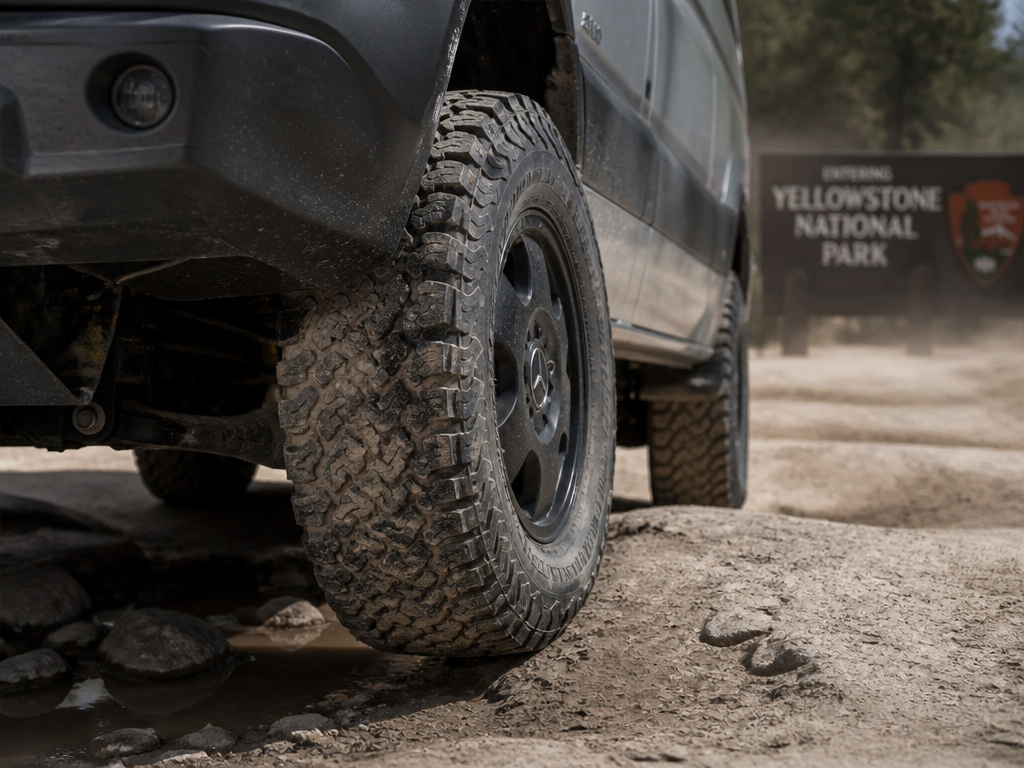
The park road is often the final exam. Pavement ends, grades steepen, and potholes deepen. Your RV’s foundation, its chassis and drivetrain, determines whether you arrive calmly or white-knuckled.
For smaller rigs (under 25 feet), the Mercedes-Benz Sprinter 4×4 chassis is the benchmark. It’s used in the Winnebago Revel, the Storyteller Overland MODE, and others. The 2.0L turbo-diesel provides enough torque, and the all-wheel-drive system offers genuine confidence on forest service roads or in muddy campgrounds. It’s not a rock crawler, but it will handle the washboard gravel to that perfect dispersed camping spot outside the park.
Larger Class C motorhouses, like the Jayco Seneca XT, often use a Ford F550 4×4 chassis. This is a serious step up in capability. The Seneca XT’s 6.7L Power Stroke diesel delivers 950 lb-ft of torque, and the 4×4 system is built for rougher terrain. The trade-off is size: even the shortest Seneca XT model is over 29 feet long, putting it at the upper limit for many park sites.
For the biggest Class A coaches that do venture into parks (like certain Entegra Cornerstone models), the chassis is everything. These use custom Spartan K3 or Ford F53 chassis with heavy-duty components. The key spec here is Gross Vehicle Weight Rating (GVWR) and Gross Combined Weight Rating (GCWR). They must be high enough to handle the coach’s weight plus all your gear and water without stressing the drivetrain on long mountain passes.
Common mistake: Choosing a drivetrain for the 1% of off-road dreams while ignoring the 99% of highway driving to the park. A competent 4×4 system is a safety net for bad weather and rough access roads. You don’t need a lifted monster truck; you need reliable traction and enough ground clearance to avoid scraping on drainage dips.
Your tire choice is part of this equation. While true mud-terrain tires are overkill, a quality set of all-terrain tires offers a better balance of highway manners and loose-surface grip than standard highway rib tires. Just know that their winter capability is not the same as a dedicated snow tire.
RV Types Ranked for Park Suitability

Not all RVs are created equal for this mission. Here’s a breakdown, from most to least suitable, with the specific trade-offs for national park travel.
- Class B/Adventure Vans (Winnebago Revel, Storyteller MODE): The top pick for maximum access. Their sub-21-foot length fits almost anywhere. The 4×4 Sprinter chassis handles rough access roads. Their modern lithium and solar systems are designed for dry camping. The compromise is space, you live compactly.
- Small Travel Trailers (Under 25 feet): Incredibly flexible. You drop the trailer at the campsite and use your tow vehicle, ideally one with good 4WD in snow and ground clearance, to explore. This separates your living space from your exploration vehicle, a huge advantage. The setup and leveling process is an extra step every time you move.
- Class C Motorhomes (Short-floorplan models): Offer more living space than a van. Models built on a Ford Transit AWD or Mercedes Sprinter chassis retain some agility. Once you’re parked, you can’t easily run to the trailhead without packing up the entire house. Length quickly becomes the enemy.
- Large Fifth Wheels (Over 30 feet): Offer residential comfort. Their tall ceilings and multiple slide-outs feel like a cabin. Their size severely restricts which campgrounds you can enter, and maneuvering them into tight, tree-lined sites is a specialized skill. They are best for long-term stays at park-adjacent private resorts with full hookups.
- Large Class A Motorhomes (Over 35 feet): The luxury liners. They are fantastic for cruising between private campgrounds with concrete pads and 50-amp service. They are the worst choice for authentic in-park camping. Many iconic park roads, like Glacier’s Going-to-the-Sun Road, have hard vehicle length limits (21 feet) that prohibit them entirely.
The pattern is clear. As comfort and space increase, access decreases. Your choice is ultimately a vote: for the front-row site deep in the woods, or for the spacious lounge where you watch the woods from a distance.
The Booking Trap and How to Avoid It
The best RV is useless if you can’t park it. The booking system is where trips are won or lost, and the mistakes are predictable.
First, October is not a secret. An RVer showed up at Yellowstone in October a few years back without a reservation, assuming the off-season would have openings. Every site for their RV size was full. The shoulder seasons are now as competitive as summer at flagship parks.
Second, Recreation.gov length filters are approximate. The listed “Max Vehicle Length” is a best guess, sometimes made by a ranger who doesn’t own an RV. As one park volunteer noted, sites are often ‘guesstimated’ and not formally measured. Always look at the site photos. Look for long, straight pull-throughs versus short, curved back-ins.
Third, you need a Plan B. Your first-choice park or campground might be full. Before you commit to a cross-country journey, identify the National Forest or BLM land surrounding the park. These areas often allow dispersed camping for self-contained rigs, sometimes for free. It’s a different experience, no facilities, no neighbors, but it guarantees you a spot close to the park gates.
Before you start: Research is not optional. Book campsites the minute reservations open (often 6 months ahead). Have a printed map of alternative camping areas. Know the dump station and freshwater fill locations outside the park. A single overlooked detail can turn a dream trip into a stressful ordeal.
This logistical diligence is as important as any spec on your RV. The machine gets you there. The plan lets you stay.
Frequently Asked Questions
Can I bring a 40-foot RV to a national park?
You can, but your options will be extremely limited. You will be restricted to the largest campgrounds, often those near the park entrance. You will not fit on many interior park roads or in most scenic, wooded campgrounds. It is possible, but it requires meticulous research and booking the longest sites the moment reservations open.
Do any national parks have full hookups for RVs?
Very few. Yellowstone is a notable exception with the Fishing Bridge RV Park, which offers full hookups. Most parks have zero hookups. Some may have a single campground with electric-only sites. For reliable water, sewer, and 50-amp power, you will almost always need to stay in a private commercial campground in a gateway town outside the park.
How do I measure my RV’s true length for booking?
Do not use the model name or manufacturer’s brochure. Get a tape measure. Measure from the very front point (often the trailer hitch or bumper) to the very rear point (including any ladder, spare tire, or bike rack that is permanently attached). Add the length of your tow vehicle if it’s a trailer. This is the number you use when filtering campsites.
Are there any national parks that are particularly bad for large RVs?
Yes. Parks with narrow, winding scenic roads are the most restrictive. Glacier National Park’s Going-to-the-Sun Road has a 21-foot length limit. Great Smoky Mountains and Acadia National Park have many tight, historic campgrounds with low branches and short sites. Great Basin National Park, as one RVer discovered, has steep, narrow access roads to some campgrounds that are unsuitable for long or tall rigs.
Is a 4×4 or AWD chassis necessary for national park RVing?
It is not strictly necessary for the paved roads to the campgrounds, but it is a significant safety and access enhancer. A 4WD for winter driving can get you through unexpected spring snow. An AWD in snow system provides better traction on wet, muddy, or gravel roads common in park settings. For accessing dispersed camping on public land around parks, 4×4 or AWD is often recommended.
The Bottom Line
Stop looking for the perfect RV. Start looking for the RV that fits the park.
That means a shorter rig, a tank you don’t have to fill every other day, and a power system that doesn’t rely on a plug. It means the Winnebago Revel over the palace on wheels, because the Revel goes where the palace cannot.
Measure your rig. Book your site early. Plan to be self-sufficient. The parks reward the prepared and punish the assumption. Your reward is a site under the stars, not a parking lot at the gate.
