
Are RV Solar Panels Worth It? Evaluating Recalls & Returns
This post contains affiliate links. As an Amazon Associate, we earn from qualifying purchases.
RV solar panels are worth the investment if you regularly camp without hookups, prioritize energy independence, and accept the long payback period. The value isn’t just in free power, it’s in the freedom to camp anywhere. However, recent NHTSA recalls on Grand Design and Brinkley RVs prove that poor installation, not panel quality, is the most common point of failure, turning a $2,000 upgrade into a safety hazard.
That adhesive and wiring recall data from 2023 to 2026 reframes the entire question. The debate isn’t solar versus generator. It’s a properly engineered system that lasts a decade versus a cheap kit slapped on a roof that detaches at highway speed or melts its own wiring. The upfront cost is one number. The cost of a rework, a road hazard citation, or a totaled controller is a different calculation entirely.
What follows is the real math: three trade-offs every buyer faces, the installation specs that actually matter, and the two owner-documented case studies that show what “worth it” looks like in the snow and in the shop.
Key Takeaways
- Solar pays off fastest for full-timers and frequent boondockers who avoid campground fees and generator fuel, with a typical ROI of 3-7 years depending on use.
- Installation quality is non-negotiable. Adhesive-only mounts (like those in the Grand Design recall) and undersized wiring (like in the Brinkley recall) are the leading causes of system failure, not panel degradation.
- Size for your worst month, not your best. A system that keeps you powered in December will be overbuilt for July, but the alternative is dead batteries when you need heat.
- Lithium batteries change the equation. Their higher usable capacity and efficiency pair with solar better than lead-acid, effectively increasing the value of every watt your panels harvest.
- The freedom has a tangible value. Beyond dollar savings, the ability to secure a remote campsite without worrying about power is the feature you can’t price.
The Three Real-World Trade-Offs
Forget the simple yes/no. The worth of RV solar is decided in three specific tensions: autonomy versus cost, summer abundance versus winter scarcity, and the quiet sun versus a roaring generator.
A 2026 NHTSA recall (26V276) of 1,269 Grand Design Lineage RVs was issued because solar panels were attached with an epoxy adhesive incompatible with the roof substrate. The remedy wasn’t a better glue, it was adding mechanical fasteners. This single recall proves that the mounting method is a safety specification, not an installation detail.
Autonomy vs. Initial Cost
The math is straightforward but often misapplied. You don’t compare the cost of solar to the cost of nothing. You compare it to your actual alternatives: nightly campground fees with hookups, gallons of generator fuel, or the accelerated wear on your RV batteries from constant deep cycling.
For a weekend warrior who stays at full-hookup state parks, solar is a luxury. The system may never pay for itself. For someone who dry camping 30 nights a year, the savings on campground fees alone can justify a basic 200-watt system in two seasons. The full-timer living off-grid eliminates a monthly utility bill, that’s where the investment shines.
Where this goes sideways: Buying too small a system to save money. A 100-watt panel might only trickle-charge a battery bank drained by a 12V fridge. You end up running the generator anyway, defeating the purpose. Size for your actual load, then add 20% headroom.
Summer Harvest vs. Winter Reality
This is the most common planning failure. In July, at a low latitude, you might get 6 peak sun hours. That same RV solar panel in Washington state in December might see 1.5. Your 600-watt array suddenly performs like a 150-watt array.
| Season & Scenario | Peak Sun Hours (Est.) | Harvest from a 400W Array | Realistic Load Coverage |
|---|---|---|---|
| Southwest, Summer | 6.5 hours | ~2,600 Wh | Full-timer loads + margin |
| Midwest, Fall | 4.0 hours | ~1,600 Wh | Weekend boondocking |
| Pacific NW, Winter | 1.8 hours | ~720 Wh | Basic lights & phone charge |
The table isn’t meant to discourage winter travel. It mandates a choice: oversize your array for the worst month, supplement with a generator, or migrate with the sun. Solar alone is rarely sufficient for four-season off-grid RVing in northern climates without a massive panel footprint.
Silent Sun vs. Generator Runtime
The value of silence is subjective until you’ve experienced it. A solar system has no moving parts, no exhaust, and no schedule. It works while you hike. A generator demands fuel, maintenance, and imposes a noisy, smelly operational window that may violate campground quiet hours or annoy your neighbors.
The generator isn’t obsolete. It’s the backup for cloudy stretches and high-demand appliances like air conditioning. The winning hybrid strategy uses solar for the 90% baseline load and the generator for the 10% peak. This dramatically reduces fuel costs and runtime, extending the life of both systems.
The Installation Quality Trap
The panels themselves are durable. The brackets, adhesive, wire gauges, and connectors are where systems fail. The NHTSA recall for Model G fifth wheels is a masterclass in this. Four 200-watt panels were wired in parallel, creating a current that could exceed the capacity of downstream components. The fix took a certified technician 2.0 hours to rewire into a series-parallel configuration.
Before you start: Working on an RV roof involves fall risk. DC electrical systems can deliver constant current, causing severe burns or fire if shorted. Always disconnect both house and chassis battery banks before touching any solar wiring.
The Lippert WAY panel recall (23V262) is another case. The mounting brackets could pull through slots. The 0.7-hour rework kit added L-brackets and spacers, a hardware fix for a design flaw. These aren’t edge cases. They are blueprints for what to inspect on any pre-installed system or to mandate for your own install.
- Mounting: Never rely solely on adhesive. Mechanical fastening into roof rafters or a dedicated track system is mandatory. The Grand Design recall switched to fasteners for a reason.
- Wiring: Use the correct wire gauge for the run length and current. Undersized wire heats up, loses efficiency, and can ignite insulation. The NHTSA safety recall report 26V276 shows that even OEMs get this wrong.
- Waterproofing: Every roof penetration is a future leak. Use proper sealant like Dicor self-leveling lap sealant, not silicone. Inspect and reseal annually.
Skipping any of these steps doesn’t mean your system won’t work tomorrow. It means you’re accepting a known, documented risk of failure within the first five years.
Sizing Your System: Loads, Sun, and Storage
You need three numbers: your daily energy consumption in watt-hours (Wh), the peak sun hours for your travel region in its worst month, and the usable capacity of your battery bank.
Step 1: Tally Your Actual Loads
Guesswork fails here. You must measure or calculate.
- 12V Fridge: The biggest consumer. A compressor fridge like a Dometic CFX3 75DZ uses about 600-800 Wh per day.
- LED Lights: Minimal. 10W for 4 hours = 40 Wh.
- Vent Fan: Around 30W. Three hours = 90 Wh.
- Phone/Laptop Charging: ~60 Wh total.
- Inverter Losses: Add 10% if you run AC appliances.
A realistic daily total for a couple is 900-1,200 Wh. A family running a residential fridge via an inverter can hit 2,500+ Wh.
Step 2: Find Your Peak Sun Hours
Use the National Renewable Energy Laboratory (NREL) PVWatts Calculator. Input your actual camping locations and months. If you winter in Minnesota, you might see 2.5 PSH. If you summer in Arizona, you’ll see 7.5. Use the lowest number from your travel calendar.
Step 3: Match Panels to Harvest
The formula: Daily Wh Needed ÷ Peak Sun Hours = Minimum Solar Wattage. Example: 1,200 Wh ÷ 3 PSH = 400 watts minimum.
Now apply the loss factors: wiring (5%), heat (10%), shading (15%), dirt (5%). A conservative total loss is 30%. So: 400W ÷ 0.70 = ~570 watts of panels needed. This is why a “400-watt kit” often disappoints.
Step 4: Right-Size the Rest of the System
Your camper batteries must store the energy. For 1,200 Wh in a 12V system, that’s 100Ah (1,200 ÷ 12). But you can’t use 100% of a battery.
- Lithium (LiFePO4): 90% usable. Need 100Ah ÷ 0.9 = ~112Ah battery.
- Lead-Acid (AGM): 50% usable. Need 100Ah ÷ 0.5 = 200Ah battery.
Lithium’s higher efficiency makes your solar array more effective. The charge controller is your gatekeeper. A Victron Energy SmartSolar MPPT 100/30 can handle up to 100V and 30A, perfect for a 570W 12V system. A cheap PWM controller might waste 30% of your panel’s output.
Case Studies: When Solar Is (And Isn’t) Worth It

Data beats theory. These two documented scenarios show the extremes.
The Four-Season Success: A traveler documented 182 days of boondocking using only 500W of solar and 200Ah of lithium. Key to his success was modest loads (560 Wh/day average), an MPPT controller, and disciplined energy management. His system reached full battery charge 80% of the time, even in February. For his style of travel, solar was unequivocally worth it, it enabled the trip.
The Retrofit Regret: An owner installed a 200-watt panel on a Class C with old AGM batteries. He expected to run his rooftop AC. The system couldn’t even start the compressor, and the batteries were depleted by noon running the fridge. He spent $1,500 to still need his generator daily. His mistake was sizing for a wish, not a watt-meter reading.
Your scenario likely lies between them. The question isn’t “is solar good?” It’s “will my solar system, sized for my loads, in my campsites, replace my generator runtime and campground fees enough to justify my cost?”
Financial Payback: Running the Numbers
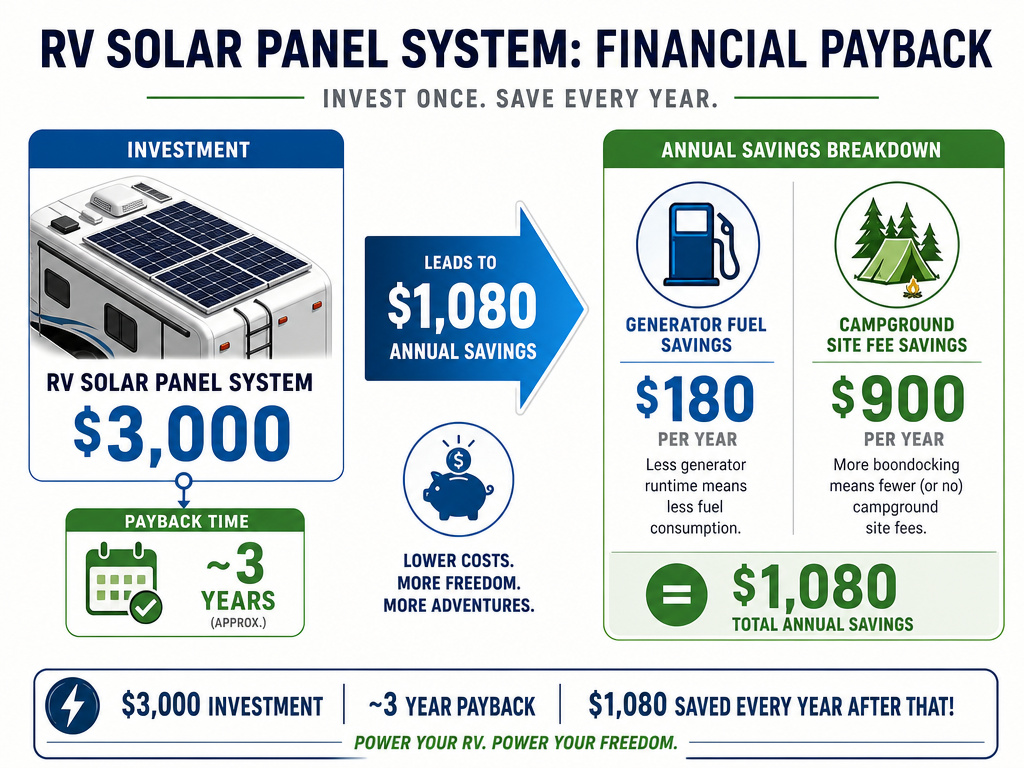
Let’s assume a robust, well-installed 600W system with an MPPT controller and lithium upgrades: total investment ~$3,000.
- Alternative Cost 1 (Generator): Running a Honda 2200i for 4 hours daily to charge batteries consumes ~0.5 gallons. At $4/gallon, that’s $2/day. Over a 90-day season, that’s $180 in fuel.
- Alternative Cost 2 (Campground Hookups): Skipping a $50/night full-hookup site for a $20/night dry site saves $30/night.
If you boondock 30 nights a year, you save $900 on site fees. Add $180 in generator fuel savings. That’s $1,080 in annual savings. Payback period: just under 3 years.
If you’re a weekend camper who prefers state parks with hookups anyway, your savings might be $100 a year. Payback: 30 years, not worth it.
The calculus changes if you factor in extended battery lifespan. Solar provides a steady, gentle charge that can triple the life of lead-acid batteries. Replacing a $400 battery bank every two years versus every six years is a hidden saving that accelerates ROI.
Frequently Asked Questions
Can RV solar panels power air conditioning?
Rarely, and not practically. A 13,500 BTU AC needs 1,500-2,000 watts to run. You’d need over 2,000 watts of panels, perfect sun, a massive battery bank, and a large inverter. Most owners who run AC on solar use it to supplement a generator or shore power, or they install a soft-start device and only run it during peak sun.
How long do RV solar panels last?
Quality monocrystalline panels have a performance warranty of 25 years, typically guaranteeing 80-90% of original output at that point. The panels will likely outlast your RV. The other components, charge controllers, wiring, connectors, are more likely points of failure first.
Do I need a special battery for solar?
You need a deep-cycle battery. Flooded lead-acid is cheapest but requires maintenance. AGM is sealed and performs better. Lithium (LiFePO4) is the best partner for solar due to its depth of discharge, efficiency, and lifespan, though it costs more upfront. Your choice here impacts what battery models you should consider.
What’s the difference between PWM and MPPT charge controllers?
PWM (Pulse Width Modulation) controller is a simple switch connecting panels to the battery. It’s inefficient, especially when battery voltage is low. An MPPT (Maximum Power Point Tracking) controller is a smart DC-DC converter that extracts up to 30% more energy from the same panels. For any system over 200 watts, MPPT is worth the extra cost.
Are portable solar panels a good alternative?
Yes, for testing the waters or supplementing a fixed system. A portable 200-watt kit from Renogy or Jackery can be angled at the sun and stored away. They are less efficient due to longer wiring runs and are one more thing to set up and secure. They are a fantastic low-commitment entry point.
Before You Go
Are RV solar panels worth it? For the right user, absolutely. The value is a compound of fuel savings, campsite freedom, and mechanical simplicity. But the recent recall timeline, 2023, 2024, 2026, screams a warning the brochures don’t: the engineering matters as much as the economics.
Your system is only as reliable as its weakest mechanical joint or its most undersized wire. Budget for quality mounting hardware, correct gauge wiring, and a reputable MPPT controller like those from Victron or Renogy. Pair it with modern lithium batteries to get the most from your harvest.
If you camp with hookups most of the time, solar is an expensive luxury. If you crave remote sites and quiet mornings, it’s the key that unlocks the map. Just make sure the key is well-made.
