
What Is a Bike Crossbar? The Enduring Design & Its Purpose
This post contains affiliate links. As an Amazon Associate, we earn from qualifying purchases.
A bike crossbar, or top tube, is the horizontal or angled tube that connects the bike’s seat to its head tube, creating the main structural triangle of the frame. Its primary job is to provide torsional rigidity, resisting the twisting forces between your pedaling and steering inputs, which directly dictates handling stability, power transfer efficiency, and the bike’s overall strength.
That torsional rigidity is the whole game. It’s why a bike with a compromised main triangle, like an old step-through, feels slow to turn and wastes energy through frame flex. This rigidity is non-negotiable for performance bikes, but designers have spent 200 years trying to work around it for accessibility’s sake.
What follows is a breakdown of how the crossbar actually works, the engineering trade-offs in every alternative design, and the blunt truth about “men’s” and “women’s” labels. We’ll cut through the cultural baggage and land on the frame geometry that genuinely fits your body.
Key Takeaways
- The crossbar’s main function is torsional rigidity, not just carrying weight.
- The classic “men’s safety frame” geometry, with its straight top tube, hasn’t changed structurally since the late 1880s because the triangle is the most efficient load-bearing shape.
- Traditional step-through frames are inherently weaker and heavier; the Mixte frame is the strongest low-top-tube alternative.
- Bike fit is about body geometry, not gender. A “men’s” frame with a horizontal top tube often fits tall riders better, regardless of their gender.
- The crossbar debate is about stiffness versus accessibility. Modern materials like carbon fiber blur the lines, but the fundamental trade-off remains.
The Crossbar’s Real Job: It’s Not What You Think
Most people call it the crossbar, but the industry term is top tube. It’s the main leg of the triangle formed with the seat tube and the down tube. That triangle is the chassis. Its job isn’t just to hold things together; it’s to stop the bike from twisting like a wet noodle when you mash the pedals or hit a corner.
Common mistake: Thinking the crossbar is just for looks or to hang a frame bag. Its structural role defines how the bike handles under load. A frame that flexes wastes pedal power and makes steering feel vague and unpredictable.
The torsional load path is simple. Your legs drive the bottom bracket, which tries to rotate the seat tube and down tube assembly. The handlebars, anchored at the head tube, resist that twist. The top tube is the bridge that ties these two opposing forces together into a single rigid unit. Without it, you have a parallelogram, and parallelograms collapse.
This is why the classic diamond frame design, perfected between 1885 and 1890, is still the default for performance bikes. It’s not tradition. It’s physics. A triangle is the simplest stable structure, and in a world of carbon fiber and hydroforming, that fundamental truth hasn’t been engineered away. As one engineer on Bike Forums put it, “considerable portions of bike manufacturers’ R&D budgets go into finding new ways of making this part of the bike even more effective.”
Gender, Skirts, and the Safety Bicycle: A Brief History
The crossbar’s story is tangled with fashion and social norms. The safety bicycle, which looked recognizably modern, emerged in the 1880s. It replaced the dangerous penny-farthing and had two equal-sized wheels. For men, the frame was a full triangle with a horizontal top tube, the “men’s safety frame.” For women, who were expected to ride in long skirts, designers sloped the top tube dramatically downward or eliminated it entirely, creating the step-through frame. This wasn’t an engineering choice; it was a social accommodation.
The historical roots of this design distinction are well documented in a Smithsonian Institution article on bicycle crossbars, which notes that as materials evolved, crossbars became less structurally necessary, but old gender conventions persisted over comfort.
The “skirt clearance” rationale is a historical artifact. Modern cycling clothing, shorts, trousers, leggings, doesn’t require a step-through design. Yet, the association between frame shape and gender stuck, becoming a self-perpetuating market category. The truth is, the best road bikes and mountain bikes use a horizontal top tube because it’s the stiffest, lightest way to build a frame. The choice between a traditional diamond frame and a step-through should be about your body, your mobility, and your riding style, not an outdated dress code.
Frame Types: Where Strength Meets Accessibility
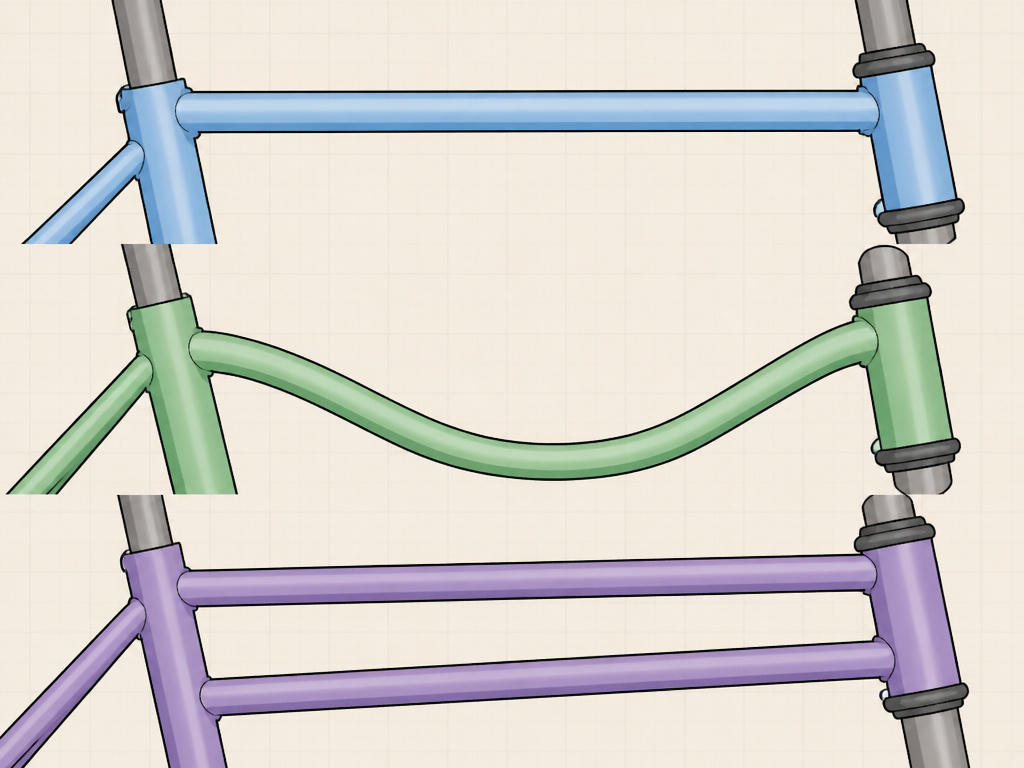
Not all top tubes are created equal. The shape and placement create three distinct frame archetypes, each with a clear set of trade-offs.
| Frame Type | Top Tube Design | Best For | Structural Compromise |
|---|---|---|---|
| Traditional Diamond | Horizontal, straight | Performance riding, rough terrain, efficiency | Higher standover height, requires leg swing to mount |
| Step-Through | Very low or completely absent | Easy mounting, riders with mobility limits, casual use | Significant loss of torsional rigidity, heavier frame |
| Mixte | Twin lateral tubes from head tube to rear dropouts | Accessibility with near-diamond-frame strength | More complex construction, slightly heavier than diamond |
The step-through frame pays a real performance penalty. Older models, in particular, are prone to flex and can show damage like bent tubes near the bottom bracket under heavy use. They’ve historically handled poorly because of that flex. This is why they’re common on commuter bikes for short, casual trips but are rare in the peloton or on a downhill course.
The Mixte frame is the clever solution. It uses two smaller-diameter tubes that run from the head tube all the way back to the rear dropouts, creating multiple triangles and preserving most of the diamond frame’s rigidity. It offers a low standover height for easy mounting without sacrificing the handling that makes cycling fun. It’s the engineer’s answer to the step-through’s weakness.
Choosing Your Frame: Fit Over Gender
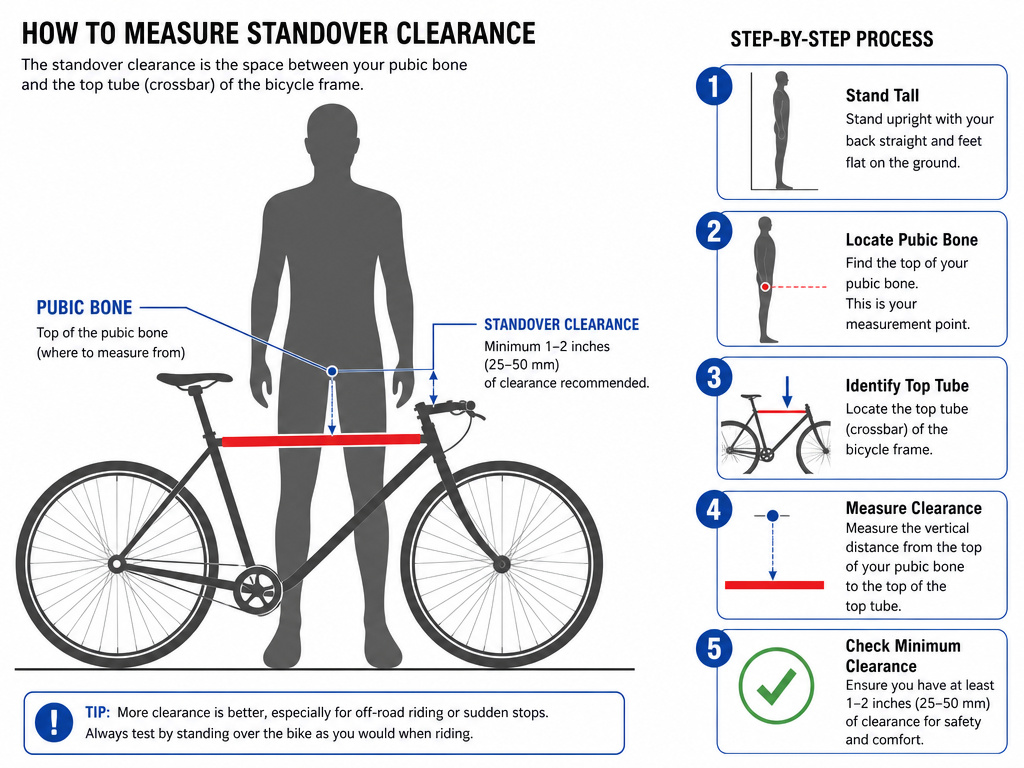
Forget the “men’s” and “women’s” labels on the tag. Your skeleton doesn’t care. What matters is your pubic bone height (which dictates standover clearance), your torso length, and your arm reach. A horizontal top tube frame is not a “man’s” frame, it’s a performance geometry.
Where this goes sideways: Picking a bike based on the gender label rather than your body’s dimensions. A tall woman will often fit a so-called “men’s” or unisex bike frame better, while a shorter man might find the standover clearance on a traditional frame dangerous and prefer a sloping-top-tube model.
Your first stop should be a basic bike fit. Stand over the bike in your shoes. You should have at least an inch of clearance between your body and the top tube. If you don’t, that frame is too big, regardless of its intended gender. The rise of unisex bike design is a market correction to this old binary thinking, focusing on stack and reach measurements that actually matter.
The right bike seat is also critical to this equation. A poorly chosen saddle can make any frame uncomfortable. Your sit bones need proper support, which is why exploring the types of bike seats available is as important as selecting the frame itself.
Modern Materials and the Future of the Triangle
Could advanced materials make the crossbar obsolete? The short answer is no, but they can change the rules. Carbon fiber can be molded into shapes that provide stiffness in one direction and compliance in another. This allows designers to use sloping top tubes on performance bikes, lowering the standover height for better aerodynamics and crash safety without the traditional step-through penalty.
However, even in carbon, the fundamental load paths remain. The forces still travel from the bottom bracket to the head tube. The triangle is still the most efficient way to manage them. The UCI, cycling’s governing body, even mandates that race frames must be built around a main triangle, a rule that squashed some wild time trial bike experiments in the 1990s.
So the crossbar isn’t going anywhere. Its form might evolve, sloping more, integrating with the down tube, becoming aerodynamically shaped, but its core function as the backbone of the bike’s chassis is permanent. The next time you look at a bike, see that top tube for what it is: the keystone of a machine designed to turn your effort into motion.
Frequently Asked Questions
What’s the difference between a crossbar and a top tube?
They are the same thing. “Crossbar” is the common, layperson’s term. “Top tube” is the correct technical term used by bike designers and mechanics. It refers specifically to the tube that completes the main triangle of the frame by connecting the top of the seat tube to the head tube.
Can a bike be strong without a crossbar?
It can be strong enough for its intended use, but it will never be as torsionally rigid as a diamond frame with a proper top tube. Designs like the Mixte frame get close by using twin lateral tubes. Traditional step-through frames sacrifice a significant amount of stiffness for convenience, which is why they feel less responsive and are heavier.
Why do men’s bikes still have the high crossbar?
The high, horizontal crossbar persists because it creates the most efficient structural triangle. It provides the best stiffness-to-weight ratio, which is critical for performance. The association with “men’s” bikes is a historical hangover from the skirt-clearance era. The design is about physics, not gender.
Are step-through bikes less safe?
They are not inherently less safe for casual, upright riding on smooth paths. However, their reduced rigidity can make them feel less stable and controllable at higher speeds or on rough terrain. For aggressive riding, a stiffer frame is objectively safer because it provides more predictable handling.
What should I look for in a comfortable bike?
Look for a frame that fits your body dimensions first, specifically, standover clearance and reach. Then, invest in a proper bike fit and a quality saddle that matches your sit bone width. Don’t get distracted by gender labels; a comfortable bike is one that fits your anatomy. Useful bike accessories like ergonomic grips and proper bike lights for visibility also contribute significantly to comfort and safety.
The Bottom Line
The bike crossbar is the chassis’s backbone. Its primary job is torsional rigidity, a non-negotiable for good handling. The 1880s-era diamond frame is still king because the triangle is physics, not tradition.
Choose a bike based on your body’s geometry and your riding goals, not the gender tag. If you need easy mounting, a Mixte frame is the smart compromise. If you want performance, the horizontal top tube is the tool for the job.
Ultimately, the crossbar is a perfect example of form following function. It’s a piece of engineering that has survived 140 years of fashion because, at its core, it just works.
