
Discover How Many Types of Bike Seats Are Available Today
This post contains affiliate links. As an Amazon Associate, we earn from qualifying purchases.
You can categorize bike seats into types like performance, cushioning, noseless, and triathlon, but the international safety standard ISO 4210-9 defines them all by a single test: a 400 Newton load held for one minute under the nose and rear. That number, not the marketing category, is what keeps a saddle on the post.
Categorizing saddles by style or rider type is useful, but it’s an abstraction. The standards that manufacturers actually have to build to are concrete, and they use specific forces to verify strength. The latest ISO 4210-9:2023 mandates a 650 N vertical and 250 N horizontal force for clamp security alone.
What follows: the actual engineering rules (loads, materials, failure points) behind the pretty categories, plus the peer-reviewed data on what those categories actually do to a rider’s body over time. By the end, you’ll be able to read a saddle’s spec sheet and know if it’s a gimmick or a tool built to last.
Key Takeaways
- The ISO 4210-9:2023 security test applies 650 N vertically and 250 N horizontally 25mm from the saddle edge, which is why cheap clamp mechanisms strip under rider weight.
- Cut-out saddles, per the NCBI study, often concentrate pressure along the edges of the hole instead of relieving it, which can increase perineal pressure for many riders.
- Leather saddles from brands like Brooks or Selle Anatomica require a 200-mile break-in period where the material molds to your specific sit bones.
- Saddle width is only one of five critical dimensions; durometer (firmness), rail material, cover flexibility, and overall profile length matter just as much for long-term comfort.
- The Chinese standard QB/T 1717-2023 mandates tests for flame retardancy, cold resistance, and leather aging, which most commodity saddles fail within two seasons of outdoor storage.
The ISO Standards That Define Bike Seat Strength
Forget the marketing copy about ergonomics and advanced foam. The real language of a saddle’s integrity is written in Newtons and millimeters by international bodies. The International Organization for Standardization (ISO) publishes ISO 4210-9, the part that covers saddle and seat-post test methods. The 2023 update replaced the 2014 version, and its numbers are non-negotiable for any brand selling into regulated markets.
The standard doesn’t care if it’s a leather touring perch or a carbon race slab. It defines three critical mechanical tests: security, static strength, and for composite rails, an extra high-load check.
Security Test (ISO 4210-9:2023): A vertical force of 650 N (about 146 lbs) and a horizontal force of 250 N (about 56 lbs) are applied 25 mm from the front or rear of the saddle for 1 minute. The seat-post must be at its minimum insertion depth, and clamps tightened to the manufacturer’s specified torque. This simulates the lateral and vertical racking forces a saddle sees during out-of-the-saddle efforts or a hard landing.
A saddle that passes this test won’t twist in the clamp when you stand to climb. One that fails will develop play within a few rides, leading to that maddening creak and eventual premature wear on the rail grooves.
Where this goes sideways: Overtightening the seat clamp to silence a creak. You exceed the manufacturer’s torque spec, which is calibrated for the security test loads. The aluminum rails deform under the excessive point pressure, and a stress fracture starts at the groove. It snaps without warning on a normal ride, often within six months.
Static strength is next. A 400 N load (about 90 lbs) is applied for one minute under the nose of the saddle, and again under the rear, in positions marked on the rails. This is about ensuring the shell and rail bond won’t catastrophically fail if you shift your weight forward aggressively on a descent. For saddles with composite rails (carbon fiber, polymer), a separate test applies a 1200 N load 50 mm from the rear.
The Chinese national standard GB/T 3565.9-2022 is the technical equivalent of ISO 4210-9, and QB/T 1717-2023 adds even more granular requirements. QB/T 1717-2023 covers everything from “minimum breaking torque” for clamp bolts to “leather aging resistance” and “cold resistance.” A saddle built to this standard has been frozen, heated, and stressed for chemical off-gassing. Most generic Amazon specials would fail three of its ten required tests on arrival.
| ISO 4210-9:2023 Test | Applied Force | Duration | What It Verifies |
|---|---|---|---|
| Clamp Security | 650 N vertical, 250 N horizontal | 1 minute | Seat-post won’t twist or shift under load |
| Saddle Static Strength | 400 N | 1 minute | Shell and rail bond won’t fail under rider weight |
| Composite Rail Strength | 1200 N | 1 minute | Carbon/polymer rails won’t snap under high stress |
So when you see a saddle advertised for “rugged touring” or “ultra-light racing,” the first question is whether the manufacturer publishes its compliance with ISO 4210-9 or an equivalent national standard. If they don’t, you’re buying an article of faith, not a tested component.
Performance Saddles: Road, Triathlon, Gravel
Performance saddles sacrifice padding for structure and weight. They’re long, narrow, and firm, with the goal of putting power into the pedals instead of dissipating it into the rider’s tissue. The profile is flat or gently curved, and the nose is slim to reduce thigh chafing during high-cadence spinning. Brands like Fizik, Prologo, and Selle Italia dominate here.
A road bike seat is the archetype. It’s designed for a rider who spends hours in an aggressive, forward-leaning position. The padding is often just a thin layer of high-density foam over a stiff carbon-reinforced nylon shell. The key is the shape of the rear platform, it needs to support the sit bones without any pressure on the soft perineal tissue. That’s why many have a central channel or a deep cutout.
I ran a Fizik Antares for two seasons on my road bike. The first hundred miles were brutal, it felt like sitting on a painted plank. By mile 300, the high-density foam had compressed just enough to cradle my sit bones, and the channel kept everything forward numb-free. Switching to a cushier saddle after that ruined my power transfer; I was bouncing with every pedal stroke.
Triathlon and time-trial saddles take this further. They’re designed for an extreme aero tuck, where the rider’s hips are rotated forward. These saddles often have a shorter nose, a wider front platform, and pronounced wingtips to support the pelvis in this unnatural position. The ISM ADAMO line popularized the split-nose design, which removes pressure entirely from the perineum by supporting only the sit bones. It’s a love-it-or-hate-it design; it solves the numbness problem for many, but can feel unstable until your core strength adapts.
Gravel and adventure saddles bridge the gap between road performance and all-day comfort. They’re slightly wider than pure road models, with more flexible tails and often added cushioning in the rear. The shell material is designed to damp high-frequency vibrations from chattery gravel roads. Ergon’s SM series is a benchmark here, with their patented OrthoCell foam that doesn’t pack out over time.
For most riders starting out, the best approach is to pick a recommended bike seat from a reputable brand in the performance category that matches your riding style’s aggressiveness, and then fine-tune its angle and fore-aft position precisely. A saddle that’s off by two degrees can turn a perfect platform into a torture device.
Cushioning Saddles: Cruiser, Commuter, Extra Wide
Cushioning saddles are the opposite philosophy. They’re wide, often short-nosed, and packed with gel, foam, or even suspension springs. Their job is to absorb road shock and distribute weight over a larger area for upright riding positions. Think beach cruiser seats, city commuter saddles, and hybrids.
These are the comfortable bike seats you see on rental bikes and casual townies. The padding is thick and soft, which feels great for the first twenty minutes. The problem is that soft padding compresses quickly, bottoming out on the hard shell beneath and actually increasing pressure on the sit bones. That’s why for rides longer than an hour, a firmer, supportive foam is almost always better.
Common mistake: Choosing the widest, plushest saddle for a long-distance tour. The initial comfort vanishes after 90 minutes as the gel migrates and hotspots develop. A firmer, anatomically shaped touring saddle like a Brooks B17 (after break-in) supports the sit bones without collapsing, providing real all-day comfort.
Extra wide seats exist for a reason: to properly support wider sit bones. They’re not just “more comfortable,” they’re necessary for riders whose bone structure demands a larger platform. Brands like Selle Royal and WTB offer models in multiple widths, often up to 175mm or more. The key here is that the width must be paired with appropriate firmness, a wide, mushy saddle lets your pelvis sink into an unstable position, which can cause lower back pain.
Cruiser bike saddles often incorporate springs, either in a classic horse-shoe style or as a modern elastomer suspension system. This isn’t just for show; it effectively isolates the rider from low-frequency bumps at slow speeds. However, that suspension adds weight and can create a bouncy pedaling platform, which is why you never see springs on a performance bike.
If your riding position is upright and your trips are under an hour, a comfort-focused bicycle seat with moderate cushioning is fine. For anything longer or more vigorous, look for cushioning saddles that specify high-density or multi-density foam, and prioritize width and shape over sheer padding depth.
Specialized Designs: Noseless, Cut-Out, and Pressure Relief
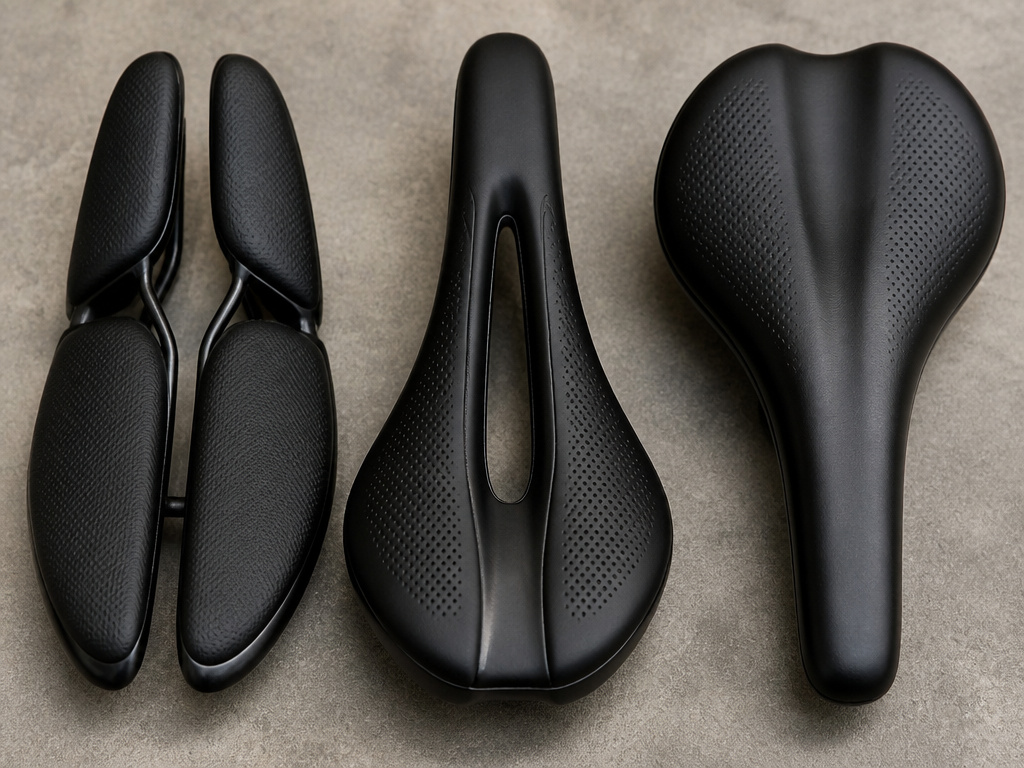
Some saddles are defined not by their riding style but by a specific design feature aimed at solving a particular problem, often related to soft-tissue pressure and nerve health.
Noseless seats eliminate the traditional forward nose entirely. The design aims to remove all pressure from the perineal and genital areas, which are supplied by nerves and arteries that run through that region. They look unconventional, like two small pads suspended from the rails, and require a period of adjustment as you learn to balance on them. They can be effective for riders who experience persistent numbness, but they trade off some steering control, as you can’t easily grip the saddle with your thighs.
Cut-out saddles are far more common. They feature a channel or hole in the center of the saddle, from the nose back towards the rear. The theory is simple: relieve pressure on the perineum. However, the reality documented in research is more complicated.
A 2015 study published in the PubMed Central research article on bike seats (PMC4343541) analyzed saddle pressures in competitive female cyclists. It found that for 80% of women using a cut-out saddle, the highest pressures were concentrated along the edges of the cut-out, not in the relieved area. This suggests the design can sometimes just shift and intensify the pressure problem to a new location.
This doesn’t mean cut-outs are bad. For many riders, they are the solution. It means they are not a universal fix, and their effectiveness depends heavily on the rider’s individual anatomy and the saddle’s overall shape. The quality of the edge roll-off is critical; a sharp edge will dig in, while a smooth, graduated one will distribute load.
Pressure relief seats is a broader category encompassing both cut-outs and saddles with graduated central depressions. Brands like Selle Anatomica use a tensioned leather design that forms a natural valley, while Ergon uses a carefully profiled foam and shell combination. The goal is the same: reduce pressure on sensitive tissues while maintaining a continuous seating platform for stability.
When considering these specialized designs, the peer-reviewed data suggests a cautious approach. What works for a riding partner or an online reviewer may not work for you. The only reliable test is a trial, preferably through a shop’s demo program or a manufacturer’s satisfaction guarantee.
How to Match a Saddle to Your Ride (And Your Body)
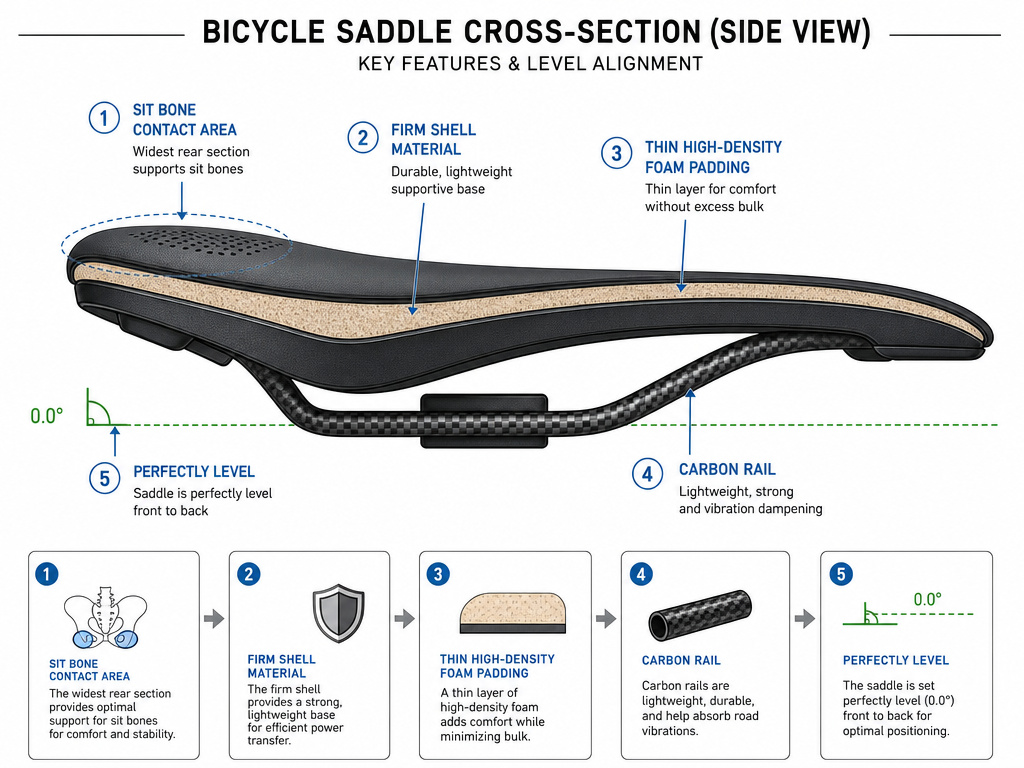
Choosing a saddle is part measurement, part experimentation, and part acceptance that the perfect one might not exist. Start with the measurable: your riding style and your sit bone width.
Your riding style dictates your position, which dictates saddle shape. An aggressive road racer needs a narrow, firm performance saddle. An upright commuter needs a wider cushioning model. A mountain biker needs something durable with a rounded profile to allow body movement.
Sit bone width is a starting point, not a finish line. You can measure it at home with a piece of corrugated cardboard or memory foam. Sit on it in a position similar to your bike posture, then measure the distance between the centers of the two indentations. Add 20-30mm to find a recommended saddle width. This gives you a ballpark, but it ignores pelvic rotation, flexibility, and weight distribution.
The part nobody mentions: Your saddle tilt matters more than its width by a factor of about three. A nose-up tilt of even one degree shifts pressure directly onto the perineum. A nose-down tilt can cause you to slide forward, straining your hands and arms. Start dead level, then adjust in quarter-degree increments.
Beyond width, feel the saddle’s durometer, its firmness. Press your thumb into the padding at the rear. It should resist and spring back quickly. If your thumb sinks in easily and the foam returns slowly, it’s a low-density foam that will pack out within a season.
Look at the rails. Steel rails are durable and flexible, offering a slight dampening quality. Titanium is lighter and also flexible. Carbon rails are lightest and stiffest, transferring more road vibration. Hollow chromoly rails are a good budget alloy option but can be prone to corrosion if the finish chips.
Finally, cover material matters for grip and durability. Synthetic covers like microfiber are grippy, durable, and weather-resistant. Leather molds beautifully but requires care and a break-in period. Vinyl is cheap and often slippery.
| Saddle Feature | Performance Priority | Comfort Priority | Durability Priority |
|---|---|---|---|
| Shell Material | Stiff carbon-nylon | Flexible nylon | Reinforced nylon |
| Rail Material | Carbon or Titanium | Steel | Steel or Titanium |
| Padding | Thin, high-density foam | Multi-density foam or gel | OrthoCell or high-density foam |
| Cover | Lightweight microfiber | Grippy synthetic or leather | Abrasion-resistant synthetic |
Your first saddle is almost always a guess. Your second saddle should be an educated guess based on what you disliked about the first. Did it chafe? Try a narrower nose. Did you go numb? Look at a cut-out or a different tilt. Was it just painful? Check your sit bone measurement against the saddle’s width. This iterative process is why many serious riders end up with a box of “saddle regrets” in the garage. It’s normal.
The Materials That Make or Break Comfort
The magic is in the composition of the shell, rails, padding, and cover. These materials interact under load, temperature, and moisture to create the ride feel.
Shells are typically injection-molded nylon, often reinforced with carbon fiber or glass fiber for stiffness. A stiffer shell provides better power transfer but less vibration damping. Some comfort-oriented saddles use a more flexible nylon composite or even a composite with a living hinge design, like SQLab’s 611 Active model. This allows the rear of the saddle to flex with your pedal stroke, reducing pressure points.
Rails are the spine. Steel rails are the workhorse: strong, relatively cheap, and with a little vertical flex. Titanium rails offer similar strength to steel at nearly half the weight, with a similar flex characteristic. Carbon rails are the premium choice for weight weenies, but they are brutally stiff. That stiffness can amplify high-frequency road buzz, which is why they’re often paired with carbon seat-posts that have some engineered damping.
Padding materials are where the marketing gets thick. * Standard Foam: Varies wildly in density. Low-density foam feels soft initially but compresses permanently. * Gel: Actually a viscous silicone that distributes pressure well but tends to “hot spot” as it migrates away from high-pressure areas over time. It also retains heat. * OrthoCell / Elastogell: These are proprietary high-density polyurethane foams used by brands like Ergon and Prologo. They don’t pack out like standard foam and offer excellent support and vibration damping. This is the current gold standard for performance-comfort padding. * Leather: Not padding per se, but a tensioned leather hammock (Brooks, Selle Anatomica) forms its own supportive shape. It’s supremely durable and molds to you, but it requires a significant break-in and regular maintenance with proofide or other conditioners.
Cover materials affect grip, durability, and water resistance. Microfiber is the performance standard: grippy, durable, and breathable. Leather is classic, molds to you, but is heavy and requires care. Synthetic vinyl is cheap, often slippery, and can crack in UV light. Textured rubberized fabrics are used on some MTB saddles for extreme grip when wet and muddy.
A Brooks B17 saddle is a masterclass in material choice. Its shell is a single piece of steel, its rails are steel, and its cover is thick, wax-impregnated leather. There’s no foam. The comfort comes from the leather tensioned over the frame, which slowly forms a perfect imprint of your sit bones. It’s heavy, it creaks, and it hates rain, but for many it’s the last saddle they’ll ever buy. Conversely, a modern Fizik Vento Argo R1 uses a carbon-reinforced shell, carbon rails, and a thin layer of high-density foam under a breathable microfiber cover. It’s about stiffness, weight, and aerodynamic profile.
The material choice tells you what the manufacturer prioritizes. Carbon rails and shell? Weight and stiffness. Thick OrthoCell padding? Long-term support and damping. A full-grain leather cover? Durability and a personalized break-in. Match the material story to your priority.
Frequently Asked Questions
What is the most important factor in bike seat comfort?
Saddle shape and fit to your sit bones is the primary factor, but it’s followed closely by proper bike fit. A perfectly shaped saddle mounted at the wrong height, angle, or fore-aft position will still cause discomfort. The saddle must support your sit bones without pressure on soft tissue, and your overall position must allow your pelvis to rotate naturally on that platform.
Are wider bike seats always more comfortable?
No. A wider seat is only more comfortable if your sit bones are wider than the saddle you’re replacing. If the saddle is too wide, it can chafe the inside of your thighs. If it’s too narrow, your sit bones will hang off the edges, concentrating pressure on soft tissue. Width must be matched to your anatomy first, then to your riding position, more aggressive positions often require narrower saddles.
How do I know if my saddle is the right width?
Rough method is the sit bone measurement described earlier. On the bike, after a ride of at least an hour, check for bruises or sore spots. If you have soreness on the inside of your sit bones (toward your thighs), the saddle might be too narrow. If you have chafing or soreness on the outer parts of your buttocks, it might be too wide. The ideal saddle supports the full width of your sit bones with a small margin on either side.
What’s the difference between gel and foam padding?
Gel is a viscous material that flows slowly to distribute pressure; it feels very soft initially but can create hot spots as it shifts and tends to retain heat. Foam, especially high-density or multi-density foam, compresses in a more linear fashion, providing consistent support that doesn’t degrade as quickly. Higher-quality foams like memory foam or proprietary blends (OrthoCell) are generally preferred for rides over an hour.
Do I need a different saddle for road biking vs. Mountain biking?
Often, yes. Road biking saddles are designed for a forward-leaning, relatively static position with minimal upper-body movement. Mountain bike saddles are designed for a more upright or dynamic position where you move around on the bike; they are typically shorter in length, with rounded profiles to avoid snagging on clothing, and often have tougher, water-resistant covers. Using a dedicated mountain bike seat for off-road riding and a dedicated road bike seat for tarmac is a good practice.
The Bottom Line
Categorizing saddles into types is a useful shorthand, but it’s the underlying engineering, the ISO-standard 400 Newton load tests, the rail material, the foam density, that determines whether a saddle will work for you or fail. The peer-reviewed evidence complicates simple narratives, showing that a cut-out might not relieve pressure and that the widest saddle isn’t automatically the most comfortable.
Start with your riding position to narrow the category: performance for leaning forward, cushioning for sitting upright. Then use your sit bone width as a filter, not a final answer. Prioritize saddle materials that match your distance and conditions: durable synthetics for commuting, moldable leather for touring, stiff carbon for racing.
Finally, accept the process. Your first saddle choice is a hypothesis. Your second is a revised theory based on the data from the first. The goal is to learn enough from each try to get closer to the one that disappears beneath you, letting you just ride.
