
What is a Unisex Bike? Focus on Fit, Not Gender Categories
This post contains affiliate links. As an Amazon Associate, we earn from qualifying purchases.
A unisex bike is a bicycle designed with a geometry and component sizing intended to fit a wide range of body proportions, moving away from marketing labels like “men’s” or “women’s” and focusing on rider-specific fit.
That definition sounds clean, but the reality is far messier. The cycling industry is in the middle of a fit revolution, and “unisex” is its newest, most confused battle flag. Forget what you’ve seen on the showroom floor. Forget pink saddles and blue handlebars.
What follows: the three dimensions that decide fit, the spec sheets that prove geometry trumps marketing, and the single test that tells you whether a frame is right for your body.
Key Takeaways
- The term “unisex” is a marketing shift, not an engineering one. It often describes bikes that were previously labeled “men’s,” now with expanded size ranges.
- Real fit is determined by three numbers: stack (vertical height), reach (horizontal length), and crank length. Gender labels often obscure these specifics.
- Women’s-specific geometry, like Liv’s, often uses a taller stack and shorter reach to accommodate a shorter torso-to-leg ratio. Some “unisex” brands are now adopting similar geometry in smaller sizes.
- The saddle and handlebars are the most critical, body-specific components. A 44cm bar on a “unisex” bike can be too wide for many women; swapping to a 38cm bar changes everything.
- Your body proportions, torso length vs. Inseam, matter more than your gender. A professional bike fit is the only way to know for sure.
The One-Sentence Definition
A unisex bike is a bicycle designed with a geometry and component sizing intended to fit a wide range of body proportions, moving away from marketing labels like “men’s” or “women’s” and focusing on rider-specific fit. In practice, the term often replaces “men’s bike” on spec sheets while expanding the size range downward to include smaller riders. The frame’s top tube, whether slanted for a step-through or horizontal for a traditional diamond frame, is no longer the defining feature it once was.
The historical “women’s bike” with a dropped crossbar was a practical solution for riders wearing skirts, not a biomechanical one. Modern materials like carbon fiber make that reinforcement unnecessary. Today, the distinction lives in the numbers on a geometry chart, not the paint job.
The part nobody mentions: For decades, the default “unisex” bike was just a men’s bike. The industry is now playing catch-up, trying to retrofit the concept of universal fit onto a sizing system built around male anthropometric data from the 1970s.
Stack, Reach, and the Geometry That Actually Matters
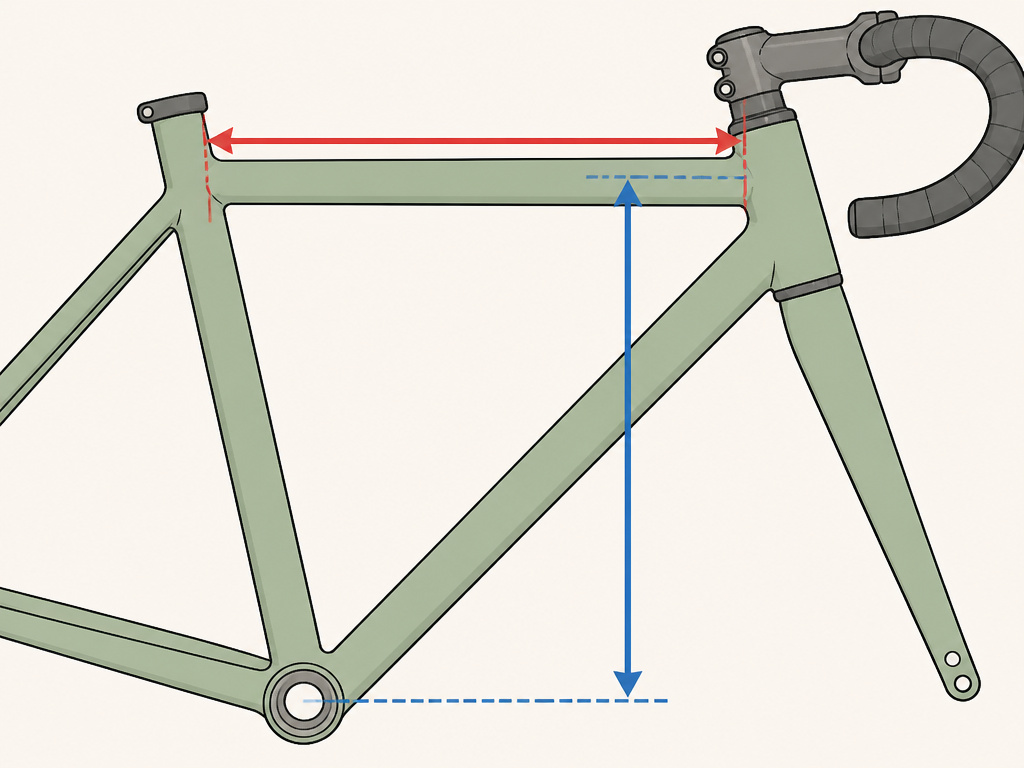
Forget “men’s” and “women’s.” Your body speaks two languages: stack and reach. Stack is the vertical distance from the center of the bottom bracket to the top of the head tube. It tells you how upright you’ll sit. Reach is the horizontal distance from that same bottom bracket to the center of the head tube. It tells you how stretched out you’ll be.
Women, on average, have a shorter torso and longer legs relative to their height compared to men of the same height. A frame designed with that in mind will have a taller stack and a shorter reach. That’s the entire premise of brands like Liv. A unisex frame for the same height rider will typically have a longer reach and a shorter stack, which can force a rider with a shorter torso to run a very short stem.
A 60mm stem changes the bike’s handling. It makes steering quicker, more nervous. That’s the compromise you make when the frame doesn’t match your proportions.
| Body Proportion | Ideal Frame Geometry Trait | Common Compromise on Mismatched Frame |
|---|---|---|
| Shorter torso / Longer legs | Shorter reach, taller stack | Very short stem (<60mm), twitchy handling |
| Longer torso / Shorter legs | Longer reach, lower stack | Excessive spacers under stem, upright position |
| Narrow shoulders | Narrower handlebar width (38-40cm) | Arms splayed, reduced control & shoulder fatigue |
| Shorter femur (upper leg) | Shorter cranks (165-170mm) | Over-extension at bottom of pedal stroke, knee pain |
The spec sheets don’t lie. Compare the Liv Embolden 1 to its unisex counterpart, the Giant Stance 1. They share components and intended use. Their geometry charts are different. The Liv has steeper seat and head tube angles, a shorter chainstay, and a longer wheelbase across its size range. It’s a different riding machine built for a different set of physical inputs.
I won’t recommend a “women’s” bike to every female rider. I will tell every rider, male, female, or otherwise, to pull the geometry chart for any bike they’re considering and look at the stack and reach numbers for their size. That’s the data that predicts comfort, not the label on the down tube.
Touch Points Tell the Real Story
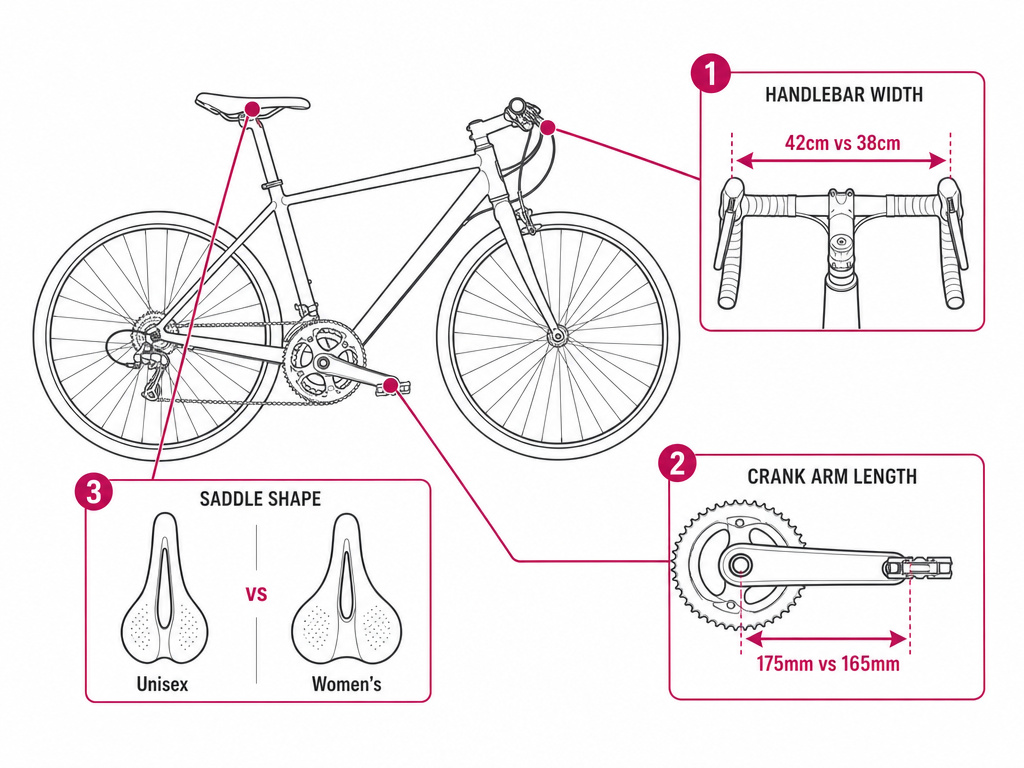
The frame is the foundation. The contact points are where you live. These are the components where “unisex” often fails, because they’re typically specced for an average male build.
Handlebars are the most common misfit. A unisex bike often comes with 42cm or 44cm bars. Many women, and plenty of men, have shoulders narrower than that. Riding with bars too wide forces your arms out, straining your shoulders and deltoids. It feels like you’re doing a permanent chest fly. The fix is simple: swap to a 38cm or 40cm bar. The control gain is immediate.
Cranks are the next offender. Unisex builds default to 172.5mm or 175mm lengths. For a rider with a shorter inseam, a 165mm or 170mm crank provides a more natural knee bend at the top and bottom of the pedal stroke. It’s not about power; it’s about joint health and efficient circles. Some women’s-specific bikes come with shorter cranks stock. On a unisex bike, you often have to request the swap.
The saddle is the most personal item on any bike. Women, on average, have wider sit bones. A “unisex” or men’s saddle is typically longer and narrower. Sitting on the wrong shape creates pressure on soft tissue, not on the bones meant to bear the load. This isn’t a minor comfort issue. It’s the difference between a one-hour ride and a lifelong hobby.
You wouldn’t buy shoes without checking the size. Don’t buy a bike without checking these three specs against your body. Any good bike shop can measure your sit bones for saddle width and your shoulder width for bar fit. They should.
The Manufacturer Reality: Liv vs. Giant, Specialized’s Shift
Look at the big brands to see the market split. Giant makes bikes. Its sister brand, Liv, makes women’s-specific bikes. The Liv Devote gravel bike runs from XS to L. The unisex Giant Revolt runs from S to XL. The Revolt in Small has a 550mm top tube, that’s the same length as the Large Devote. The Liv line is built around a different set of average proportions.
Yet, the Juliana Furtado and the Santa Cruz 5010 tell another story. Juliana is Santa Cruz’s women’s brand. The Furtado and the 5010 share identical frame geometry in similar sizes. The differences are in the touch points: the Furtado gets a 760mm handlebar and often shorter cranks, while the 5010 gets an 800mm bar. The frame is the same. The build kit is tuned.
Where this goes sideways: Buying a bike based on its “unisex” or “women’s” label alone. You could be on a Liv that’s too long in the reach for your short torso, or on a unisex Giant that fits your proportions perfectly. The label guarantees nothing.
Specialized started its women’s-specific program in 2003. Now, even they are blurring the lines, offering more unisex or gender-neutral models with size ranges that start much smaller. The smallest Specialized bikes now fit riders from 4’11”. The industry is converging on fit, not gender.
The 4-Step Checklist Before You Buy Any Bike
Forget the aisle label. Use this list.
- Get Your Numbers. You need three: inseam, torso length (collar bone to hip bone), and shoulder width. A bike shop can do this in two minutes. If a shop won’t measure you, walk out.
- Match Stack and Reach. With your torso length and inseam, look at the geometry chart. For a shorter torso, prioritize a shorter reach. For a longer torso, a longer reach with a lower stack might work. This step alone eliminates 80% of ill-fitting bikes.
- Audit the Touch Points. Check the spec sheet for stock handlebar width, crank length, and saddle model. If the bars are 42cm and your shoulders are 38cm, budget for a swap. If the cranks are 175mm and your inseam is under 30”, ask if a 170mm option exists.
- Test Ride the Right Size. Not a size up, not a size down. The right size. Feel the reach to the hoods. Do you need to slide the saddle all the way forward? That’s a reach problem. Are you stacking spacers under the stem? That’s a stack problem.
This checklist applies to any bike, from a sleek road bike to a rugged mountain bike. The principles of fit are universal, even if the riding position changes.
The Verdict: Should You Buy a Unisex Bike?
Yes, if the geometry matches your body. The “unisex” tag means you’re looking at a frame designed around a broader, often male-leaning, set of averages. If your proportions are near those averages, it will fit well. The strength of the modern unisex movement is the expanded size range. You’re more likely to find an XXS or a 44cm frame in a unisex model today than you were ten years ago.
No, if your body proportions diverge from the average. If you have a very short torso and long legs, a women’s-specific geometry like Liv’s will almost certainly provide a better starting point. It’s designed for that exact disparity.
The bottom line is agnosticism. Let your body, represented by stack, reach, and a few key measurements, choose the bike. The label is just marketing.
Frequently Asked Questions
What’s the main difference between a unisex and a women’s bike?
The main difference is the starting point for the geometry. A women’s-specific bike typically has a taller stack and shorter reach to accommodate a shorter torso-to-leg ratio. A unisex bike uses a broader set of averages, often resulting in a longer reach and lower stack. The components, like saddle width, handlebar width, and crank length, are also often tuned differently on women’s-specific models.
Can a man ride a women’s bike comfortably?
Absolutely, if it fits his body. A shorter man with a shorter torso and longer legs might find a women’s-specific geometry fits him better than a unisex frame in his height range. The inverse is also true. It’s all about the numbers on the geometry chart matching the rider’s proportions.
Are unisex bikes just men’s bikes with a new name?
Historically, yes. The “unisex” bike was the default men’s bike. Today, it’s more nuanced. Many brands are designing unisex frames with truly expanded geometry, offering smaller sizes with proportional stack and reach that work for a wider variety of bodies. The label is evolving, but you still must check the actual specs.
How do I know if a unisex bike will fit me?
You must compare your body measurements to the bike’s geometry chart. Focus on stack and reach for your size. Then, look at the stock component sizes: handlebar width, crank length, and saddle model. If your shoulder width is narrower than the bar, or your inseam suggests shorter cranks, you’ll need to factor in the cost and hassle of swapping those parts.
Is the bike saddle different on a unisex bike?
Usually, yes. A unisex bike typically comes with a saddle designed around male sit-bone averages, narrower and longer. Many women, and some men, will find this uncomfortable. The good news is the saddle is the easiest part to change. Any rider should view the stock saddle as a placeholder until they find the model that fits their unique anatomy.
The Bottom Line
A unisex bike is a frame built for a wide net. Your body is a specific set of points and angles. The magic happens when they align.
Spend an hour with a tape measure and a geometry chart. Know your stack, your reach, your shoulder width. Walk into a shop and ask for the bike that matches those numbers, regardless of what section it came from. The right bike doesn’t have a gender. It has a geometry. Find it.
