
Discover the Best Bike for Commuting for Your Specific Needs
This post contains affiliate links. As an Amazon Associate, we earn from qualifying purchases.
The best bike for commuting is the one that fits the specific distance, terrain, and traffic of your route, not a generic category. Match the frame geometry, gearing range, and accessory mounts to the ride you actually do. A bike built for a two-mile flat campus ride fails on a ten-mile hilly highway slog, regardless of price.
That route-first logic flips most buying advice on its head. We start with the road, not the bike. The wrong bike grinds you down within a month, the right one disappears under you and just works.
What follows is a breakdown of the five commuter archetypes, grounded in OEM maintenance manuals and component lifespans. By the end you’ll know which of the three frame materials matters least, which one spec sheet number predicts your total maintenance cost, and why belt-drive bikes are winning the daily-grind war.
Key Takeaways
- Your commute distance and hill profile decide the bike category. Hybrids work under 5 miles, road bikes over 10, e-bikes for hills or distances over 7 miles.
- The ISO/ETRTO tire size stamped on the sidewall is the single most important spec. It tells you which puncture-resistant tires you can swap to, not the marketing “700c x 38mm” label.
- Chain-driven bikes need a new chain every 750 km (460 miles) per the Canyon Hybrid manual. Belt drives last over 15,000 km with zero lube.
- Internal gear hubs (Shimano Nexus, Alfine) beat derailleurs for urban reliability. They shift at a stop and don’t collect road grit.
- UL 2849 is the safety standard for e-bike electrical systems. Any e-bike without it is a hard pass.
Hybrids vs. Road Bikes vs. E-Bikes. The Match-Your-Route Matrix
Most commuter bike advice is backwards. It lists bike types and asks you to pick one. Start with your route instead. The table below matches three common commute profiles to the bike that survives them.
| Your Commute Profile | Winning Bike Type | Why It Wins | What Breaks First if You Choose Wrong |
|---|---|---|---|
| Under 5 miles, flat, mixed pavement | Flat-bar hybrid (Jamis Commuter 2 style) | Upright posture for traffic visibility, wide tires absorb potholes, mounts for rack/fenders standard. | A road bike’s narrow tires pinch-flat on bad pavement, and the drop-bar posture strains your neck in stop-and-go traffic. |
| 5–15 miles, paved, some hills | Endurance road bike or gravel bike | Lightweight frame and efficient geometry save energy over distance. Drop bars offer multiple hand positions. | A hybrid’s heavier frame and upright drag make you work 20% harder per mile. You’ll arrive sweaty and late. |
| 7+ miles, significant hills, or multi-modal (train/bus) | Electric commuter bike (Bosch or Shimano Steps motor) | Motor assistance neutralizes hills and headwinds, preserving your work clothes. Removable battery charges at your desk. | A regular bike on a hilly route builds fatigue that compounds by Thursday. You start driving again by week two. |
| Short distance but must carry cargo (laptop, groceries, kid) | Cargo bike or hybrid with panniers | Extended rear rack or longtail design carries weight low and stable. Frame is reinforced at stress points. | A standard bike rack overloaded with groceries twists the seat stays after a few months of heavy loads. |
| Multi-modal (bike + train/bus) | Folding bike (Brompton, Tern) | Folds to carry-on size in under 20 seconds. Small wheels accelerate fast for short urban hops. | A full-size bike denied on a crowded train leaves you stranded. Bus bike racks are often full at peak times. |
The Jamis Commuter 2 is the classic hybrid template. Its forged alloy crank, 8-speed Shimano drivetrain, and full-coverage fenders are built for the five-mile grind. The Shimano HG41 11-34T cassette gives a wide enough gear range for moderate hills. Where it fails is on longer hauls, the upright position creates wind drag, and the 32-pound weight adds effort over ten miles.
For the longer, faster route, the endurance road bike is the answer. Look for models that include fender and rack eyelets, a concession to practicality most race bikes omit. The key is tire clearance: many endurance frames now accept 700x35c tires, letting you run a tougher, puncture-resistant casing.
Where this goes sideways: Buying a mountain bike for a paved commute. The knobby tires roll slow, the suspension saps pedaling energy, and the frame rarely has proper fender mounts. You’ll arrive tired with a stripe of road grime up your back.
The One Spec Sheet Number That Decides Everything
Manufacturers list a dozen specs. Ignore all but one: the ISO/ETRTO tire size. It’s a three-digit number like “35-622” stamped on the tire sidewall, not the vague “700x35c” marketing name. This number tells you the exact bead seat diameter and width in millimeters. It’s the only way to know which puncture-resistant or winter-specific tires will physically fit your rims.
A tire labeled 700x35c could be 35-622 or 37-622 depending on the brand’s rounding. If your frame has tight clearance, a 37mm tire might rub the chain stays. The ISO number removes the guesswork. For urban riding, you want the widest tire your frame and brakes allow, more air volume means a smoother ride over broken pavement and a lower risk of pinch flats.
Puncture protection belts matter more than tire brand. Look for phrases like “Vectran breaker,” “Kevlar belt,” or “puncture-resistant layer” in the spec. The Schwalbe Marathon series set the standard here, but Continental’s Contact Urban and Panasonic’s T-Serv are strong contenders.
Your tire choice directly impacts your need for a good bike lock. A flat tire leaves you vulnerable while you repair it.
Belt vs. Chain: The 15,000-Km Maintenance Gap
Chain drives dominate. They’re cheap and efficient. They’re also high-maintenance. The Canyon Hybrid Bike manual states a chain needs checking or replacement after 750 km (460 miles). That’s about two months for a ten-mile daily round-trip commute. A worn chain accelerates cassette and chainring wear, turning a $25 chain job into a $150 drivetrain replacement.
Belt drives, using Gates Carbon Drive belts and cogs, are the low-maintenance answer. There’s no lubrication, no cleaning, and no stretch. The belt lasts 15,000 to 30,000 km. The Marin Presidio 3 and Cannondale FlyingV 2 both use Gates belts paired with internally geared hubs.
Common mistake: Assuming a belt-drive bike is maintenance-free. The belt itself is, but the internal hub it connects to needs bearing service every two years. You trade chain lube for periodic hub regreasing.
The trade-off is cost and compatibility. Belt drives require a frame with a split seat stay or chain stay to thread the continuous belt through. They also only work with single-speed or internal gear hubs, not traditional derailleurs. For a commuter who rides year-round in all weather, the belt’s cleanliness and silence are worth the premium. No more grease stains on your work pants.
Internal Gears vs. Derailleurs: Grit and Shift Timing
 Derailleurs work. They’re also exposed to road salt, grit, and the risk of impact. An internal gear hub seals all moving parts inside the rear hub shell. The Shimano Nexus 8-speed, as used on the Brooklyn Bicycle Co. Driggs 8i Disc, is the commuter benchmark. You can shift gears while stopped at a traffic light, a genuine advantage in city traffic. There’s no derailleur to bend, and the shifting stays precise for years.
The downsides are weight and efficiency. An internal hub is heavier than a derailleur and cassette, and it has slightly more drivetrain friction. You lose about 5% of your pedaling energy compared to a well-maintained derailleur. For a sub-ten-mile commute, that’s irrelevant. For a competitive cyclist, it’s a dealbreaker.
Derailleurs still have a place on longer, faster commutes where gear range and weight matter more than absolute reliability. Modern Shimano Tiagra or 105 groupsets are robust enough for daily use if you clean and lube the chain weekly.
I’ve ridden both for years. The Nexus hub on my winter bike hasn’t needed adjustment since I built it. The Ultegra derailleur on my summer bike needs a cable tension tweak every month as temperatures change. That’s the real difference: set-and-forget versus constant minor fiddling.
Electric Commuters: UL 2849 is Non-Negotiable
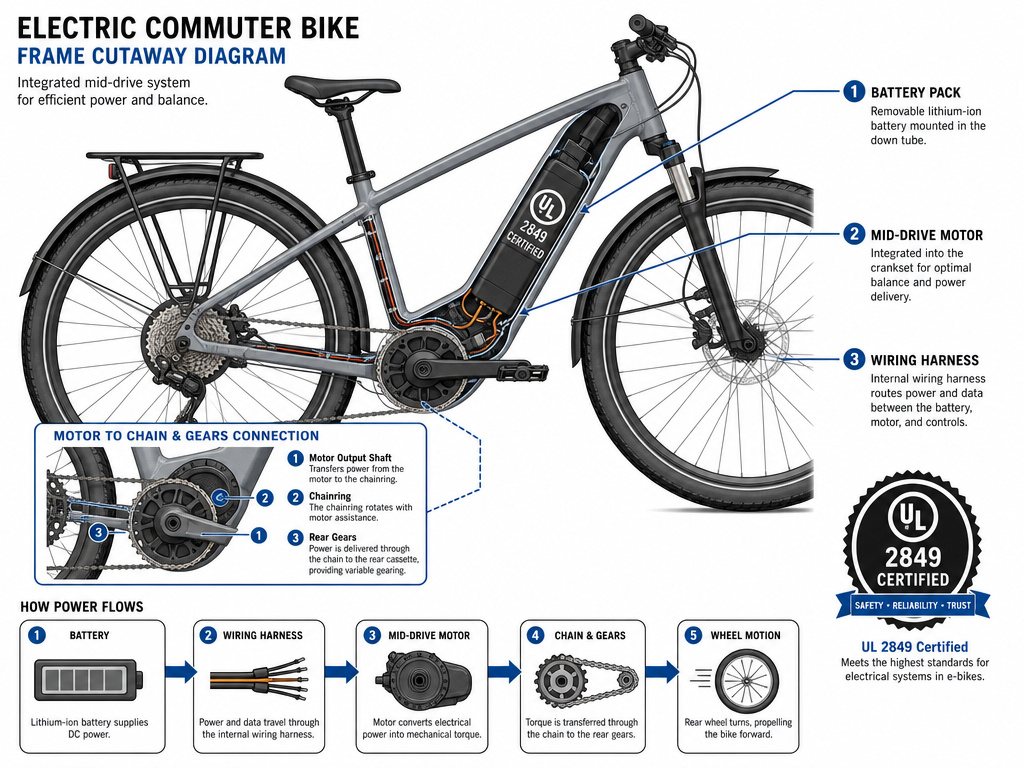 Electric bikes flatten hills and extend range. They also add complexity and potential fire risk. The UL 2849 standard certifies the complete e-bike electrical system, motor, battery, charger, and wiring, for safety. The Radster Road electric commuter bike is tested to comply with UL 2849. Any e-bike without this certification is gambling with its battery management system.
Motor placement matters. Mid-drive motors (Bosch Performance Line, Shimano Steps) power the cranks, leveraging the bike’s gears for efficient hill climbing. Hub-drive motors (like many Rad Power Bikes models) power the wheel directly, which is simpler but can struggle on steep gradients. The Cannondale FlyingV 2 uses a Bosch Performance Line SX motor, a mid-drive unit tuned for urban agility rather than raw power.
Battery capacity is measured in watt-hours (Wh). A 400Wh battery, like the one on the FlyingV 2, will typically deliver 40-60 miles of range with moderate assist on mixed terrain. Remember, you’re legally limited to 28 mph motor assistance in most US states. Beyond that, you’re pedaling a heavy bike.
Consider the security of your investment. An e-bike’s high value makes a high-security bike lock mandatory, not optional.
Accessories Are Not Optional
The bike is half the system. The other half is what you bolt onto it.
Lighting: You need a front light bright enough to see potholes, not just be seen. Look for 500+ lumens. A rear light with a daylight-flashing mode is critical for being spotted in traffic. These front and rear lights are a legal requirement in many cities after dark.
Carrying: A backpack works but makes your back sweat. Panniers mounted on a rear rack carry the weight on the bike, not you. They also double as grocery bags. For smaller loads, a handlebar basket keeps items in quick reach.
Protection: Fenders keep road spray off you and your drivetrain. A chain guard or full chainguard (like on the Jamis Commuter 2) keeps grease off your pants. In wet climates, these are as important as the brakes.
Security: Use a high-security bike lock, ideally a hardened steel U-lock, through the rear wheel and frame. Cable locks are cut in seconds.
Comfort: If the saddle hurts after a week, don’t suffer. A quality bike seat cushion designed for your sit-bone width is cheaper than a new bike. Also, the right commuter pedals provide a stable, grippy platform for street shoes.
Frequently Asked Questions
What’s the main difference between a road bike and a hybrid for commuting?
Road bike is built for speed and distance with a lightweight frame, drop handlebars, and a forward-leaning posture. A hybrid prioritizes comfort and practicality with an upright posture, flat bars, and mounts for racks and fenders. For a commute over 10 miles on good roads, the road bike is faster. For a shorter, stop-start urban ride with cargo, the hybrid is more comfortable and versatile.
Are belt-drive bikes worth the extra money?
Yes, if you commute daily in all weather and hate maintenance. A Gates Carbon Drive belt lasts years without cleaning or lubrication, protecting your clothes and the bike’s drivetrain from grit. The upfront cost is higher, and you’re locked into frames designed for belts and internal gear hubs. For the fair-weather commuter, a well-maintained chain is more cost-effective.
How do I know what size commuter bike to get?
You need two measurements: your inseam and the bike’s stack and reach geometry. Use the book-spine method against a wall to measure your inseam accurately. Compare that to the bike’s standover height (the top tube clearance). More importantly, look at the stack (vertical height) and reach (horizontal length) numbers. A higher stack gives a more upright ride. Most manufacturers provide size charts based on height and inseam, trust those over generic “small, medium, large” labels.
Can I use a mountain bike for commuting?
You can, but you shouldn’t unless your commute is on actual dirt trails. Mountain bikes have slow-rolling knobby tires, heavy frames, and suspension designed for off-road bumps. On pavement, this wastes energy. If you already own one, swap the tires for smooth, puncture-resistant ones and lock out the suspension to make it more efficient.
What’s the most important accessory for a new commuter?
Lights. Not just “be seen” blinkies, but a proper front light that illuminates the road ahead. Riding in the dark without adequate lighting is dangerous and often illegal. A good front and rear light set is the first purchase after the bike itself, before a lock, before a rack.
Before You Go
The best commuter bike fits the road you actually ride. Ignore the categories and start with your route distance, hill profile, and cargo needs. Then match the tire size, drivetrain type, and accessory mounts.
For most people with a sub-10-mile urban route, a flat-bar hybrid with an internal gear hub is the default answer. It’s the appliance of cycling, reliable, practical, and unexciting in the best way. For longer or hillier routes, an e-bike isn’t cheating; it’s the tool that makes daily riding sustainable.
Finally, read the manual. The Canyon and other OEM guides contain the real maintenance intervals, like the 750-km chain rule, that your local shop might not mention. Your bike’s longevity depends on those numbers, not on how shiny it looks in the showroom.
