
Volkswagen Jetta Automobiles | The Specs That Changed in
This post contains affiliate links. As an Amazon Associate, we earn from qualifying purchases.
The Volkswagen Jetta is a front-wheel-drive compact sedan built on the Modular Transverse Matrix (MQB) platform, offering gasoline, diesel, and hybrid powertrains across its generations. Its defining specs shifted in 2022 with the introduction of a new 1.5-liter turbocharged four-cylinder engine, replacing the older 1.4T.
That engine swap is the single biggest change in a decade. The 1.5L TSI isn’t just a larger displacement. It carries a higher compression ratio, a different turbo strategy, and a switch to 0W-20 oil. Get the oil spec wrong on a post-2019 model and the variable valve lift system gums up within 15,000 miles.
What follows: the exact bore, stroke, and torque numbers for each major engine, the part numbers your mechanic needs, the recall that affected 218,000 cars, and where this sedan actually fits against rivals like the Honda Civic.
Key Takeaways
- The 2022+ Jetta’s 1.5L TSI engine requires VW 508 00 / 0W-20 oil; using the older VW 502 00 / 5W-40 spec can damage its variable valve lift system.
- A 2020 NHTSA recall covered 218,192 Jettas (2016-2018 with the CZTA engine) for fuel rail bolts that could loosen and leak; the fix changed the torque spec from 9 Nm to 8 Nm + 90°.
- Always match the oil filter to your engine code: the common 04E 115 561 H fits the 1.4L CZTA, but the 1.5L TSI and later 1.4L models (DGXA/DJXA) have different service requirements.
- The Jetta has never been offered with all-wheel drive in the North American market, sticking strictly to front-wheel drive across all trims and generations.
- Resetting the service reminder differs by model year and instrument cluster type; pressing the wrong button sequence can lock you out of the menu until the next ignition cycle.
What are the main Volkswagen Jetta engine specs?
Engine specifications define the car. For the Jetta, they split cleanly at the 2022 model year.
The current engine is a 1.5-liter inline-four turbocharged TSI. Volkswagen’s technical document lists a bore of 74.5 mm, a stroke of 85.9 mm, and a displacement of 1498 cc. It runs an 11.5:1 compression ratio and produces 158 horsepower at 5500 rpm. Maximum torque is 184 lb-ft, arriving at 1750 rpm.
The 1.5L TSI engine in the 2022 Jetta uses a higher 11.5:1 compression ratio compared to the 1.4L’s 10.5:1. This, combined with a variable geometry turbocharger and a cylinder deactivation system, targets a specific combined fuel economy of 35 MPG with the automatic transmission.
The previous generation, roughly 2019-2021, used a 1.4-liter turbo four. This CZTA/DGXA/DJXA engine family made 147 horsepower and 184 lb-ft of torque. Its bore and stroke were smaller: 74.5 mm bore, 80.0 mm stroke, 1395 cc. The switch to the 1.5L was about efficiency, not peak power.
Older generations are a mix. The 2014-2018 period saw the 1.4T, a 2.0L naturally aspirated engine, and a 2.0L turbo in the GLI. The 2013 and earlier models used the 2.0L, 2.5L, and the venerable 1.8T. You identify your engine by the code on the vehicle data sticker in the spare tire well or driver’s door jamb.
The 2022 1.5L TSI vs. The Older 1.4L: What Actually Changed?
The numbers look similar on paper. The real differences are in the engineering details and the required maintenance.
Fuel and Oil: The 1.5L TSI recommends regular unleaded fuel. The 1.4L ran fine on regular but could take premium. The critical change is the engine oil. The 1.5L mandates VW 508 00 approval and SAE 0W-20 weight. The older 1.4L (CZTA) used VW 502 00 and SAE 5W-30 or 5W-40. They are not interchangeable.
Putting 5W-40 in a 1.5L engine is a mistake. The 0W-20 oil is thinner for reduced internal friction, which the variable valve lift system relies on. Thicker oil won’t flow through the narrow passages quickly enough. The result is sluggish valve operation, a check engine light for camshaft timing, and potentially worn lifters by 30,000 miles.
Turbo and Efficiency Tech: The 1.5L uses a variable geometry turbocharger. It adjusts the turbine vanes to spool faster at low rpm and avoid boost drop-off at high rpm. The 1.4L used a fixed geometry wastegate turbo. The 1.5L also has Active Cylinder Management (ACT), which shuts off two cylinders under light cruising loads. The 1.4L did not.
| Feature | 1.5L TSI (2022+) | 1.4L TSI (2019-2021 CZTA/DGXA) |
|---|---|---|
| Displacement | 1498 cc | 1395 cc |
| Compression Ratio | 11.5:1 | 10.5:1 |
| Oil Specification | VW 508 00 / 0W-20 | VW 502 00 / 5W-30/40 |
| Turbocharger Type | Variable Geometry (VGT) | Fixed Geometry Wastegate |
| Cylinder Deactivation | Yes (ACT) | No |
| Fuel Economy (Auto, Combined) | 35 MPG | 34 MPG |
The horsepower gain is modest. The driving feel is smoother, with less turbo lag off the line. The fuel economy bump is small on paper but more consistent in real-world mixed driving because of the cylinder deactivation.
Maintenance Schedules and Critical Part Numbers
 Volkswagen maintenance is precise. Using the wrong filter or the incorrect oil volume voids powertrain warranties. The information comes straight from NHTSA technical service bulletins.
For a 2019 Jetta with the 1.4L DGXA/DJXA engine, the official bulletin specifies an oil filter part number 04E 115 561 H. It holds 4.0 liters (4.2 quarts) of VW 508 00 / 0W-20 oil. The drain plug gasket is N 908 132 02. The air filter is 5QM 129 620 B.
For the 2017-2018 Jetta with the older 1.4L CZTA engine, the filter is the same 04E 115 561 H, but the oil spec is different: VW 502 00 / 5W-30 or 5W-40. Capacity is still 4.0L. The drain plug gasket part number is either N 902 889 01 or N 013 815 7.
Where this goes sideways: Assuming all 1.4L engines use the same oil. The CZTA (VW 502) and DGXA (VW 508) specs are chemically different. Using the wrong one won’t cause immediate failure, but it accelerates carbon buildup on the intake valves and can lead to premature timing chain wear.
The oil drain plug torque is 30 Nm (22 lb-ft) for these engines. Overtightening strips the aluminum oil pan threads. A replacement pan is a significant investment because the transmission often needs to be lowered for access.
Service Reset Procedure:
- For models with analog cluster (2017-2019): Turn ignition off. Press and hold the 0.0/SET button on the cluster. Turn ignition on. Release the button when “SERVICE RESET” appears.
- For Digital Cockpit (2020+): Turn ignition on. Press and hold the OK button on the steering wheel until the service menu appears. Use the arrow buttons to select “Reset Oil Change” or “Reset Inspection.”
Skipping the reset doesn’t harm the car, but the warning light is a persistent distraction. The system calculates the next service interval based on mileage and engine run time, not the actual oil condition.
Known Issues and the 2020 Fuel Rail Bolt Recall
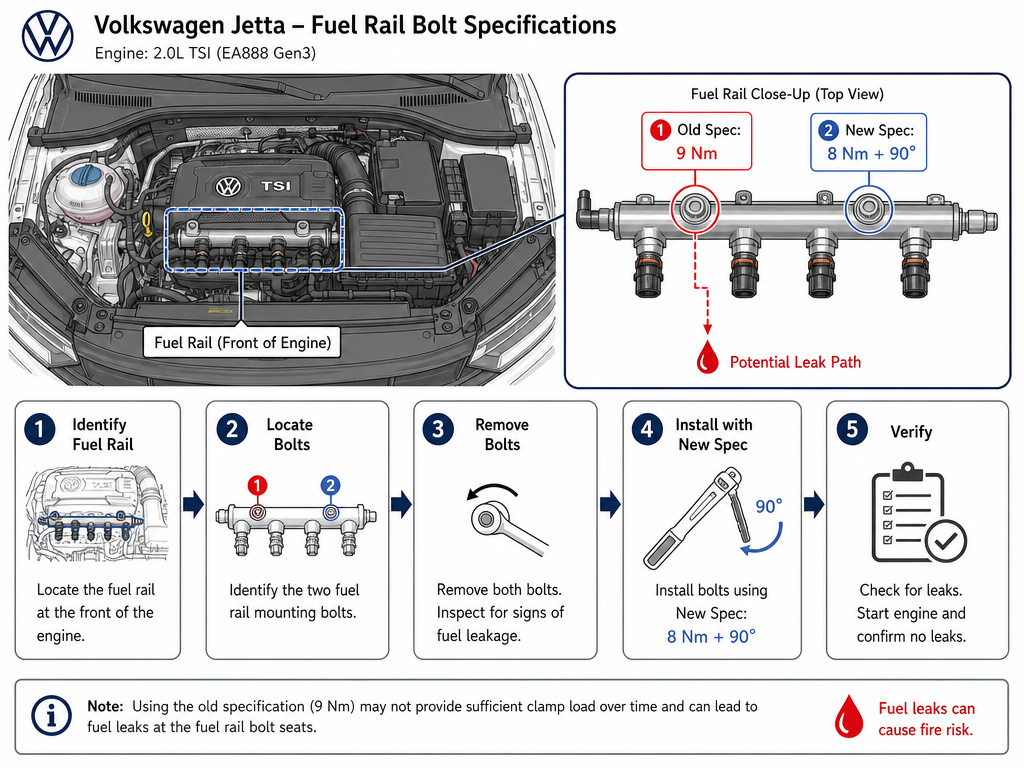 The most significant documented problem is NHTSA Recall 20V-648. It affected 218,192 Volkswagen Jetta vehicles from model years 2016-2018 equipped specifically with the 1.4L 110kW engine code CZTA.
The NHTSA Jetta recall report states the fuel rail bolts (part number N 105 464 03) could loosen over time. This can result in a fuel leak. In the presence of an ignition source, that leak may result in a vehicle fire.
The recall chronology shows the first claim was in April 2018. Analysis took over two years because the failure rate was low. The root cause was traced to a specific batch of bolts from a single supplier tightened under an incorrect torque specification.
The remedy was straightforward. Dealers replaced the affected fuel rail bolts at no cost. The tightening torque was changed from the original 9 Nm to a new specification of 8 Nm + 90 degrees. This is a torque-to-yield procedure that ensures proper clamping force without over-stressing the bolt. Production vehicles after calendar week 20 of 2018 already used the new spec.
If you own a 2016-2018 Jetta, check for this recall. The smell of gasoline near the engine bay is the primary warning sign. The repair takes a technician under an hour.
Other Common Gripes:
- Sunroof Leaks: Clogged drain tubes at the front corners of the sunroof cassette. Water then drips onto the headliner or the front floor. Clearing the drains with compressed air is the fix.
- DSG Transmission Jerkiness (GLI/GTI): The direct-shift gearbox in performance models can exhibit rough low-speed engagement. A software update from the dealer often resolves it.
- Infotainment Screen Freezes: The MIB2 and MIB3 systems in 2019+ models sometimes reboot randomly. A firmware update via the dealer or, in later models, an over-the-air update fixes most instances.
How the Jetta Fits in the Compact Sedan Segment
The Jetta sedan competes in a brutal class. Its traditional rivals are the Honda Civic, Toyota Corolla, and Hyundai Elantra. Its position has always been “German engineering at a volume price,” but that gap has narrowed.
Against the Honda Civic, the Jetta often offers more rear-seat legroom and a larger trunk. The Civic typically counters with sharper handling and a more refined base engine. The Jetta’s cabin materials, especially in lower trims, use more hard plastics than a comparable Civic.
The move to the 1.5L TSI was a direct response to the Civic’s 1.5L and 2.0L engines. Where the Jetta pulls ahead is highway ride comfort. Its tuning is softer, absorbing long-distance miles with less fatigue. The Civic is the driver’s choice; the Jetta is the road-trip choice.
It’s also worth comparing it to its corporate cousin, the Volkswagen Tiguan. The Tiguan SUV is more expensive and less efficient but offers the all-weather confidence of available all-wheel drive—an option the Jetta has never had in the US. If you need a sedan, the Jetta is it. If you think you need AWD, you’re looking at the wrong body style.
For shoppers also considering a manual transmission, the Jetta’s offering has been inconsistent. The 2022+ generation dropped the manual option entirely in the US. Earlier generations offered it on base S trims and the GLI performance model. Today, if a stick shift is a must-have, you’re browsing the used market or looking at competitors like the Civic Si.
Frequently Asked Questions
What is the difference between the Jetta S, SE, and SEL?
The S is the base model with a 6-speed manual or automatic, cloth seats, and a 6.5-inch touchscreen. The SE adds keyless entry, push-button start, heated front seats, and a larger infotainment screen. The SEL (or SEL Premium) gets leather, a digital cockpit, adaptive cruise control, and the top-end audio system. The GLI is the performance trim with a 2.0L turbo, sport suspension, and unique styling.
Is the Volkswagen Jetta a reliable car?
Recent data shows average to above-average reliability for the 1.4T and 1.5T engines. The 2.0L TSI in the GLI is also robust. The key is adherence to the maintenance schedule, especially using the correct synthetic oil and replacing the timing belt at the 100,000-120,000 mile interval. Avoid modified examples if buying used.
Does the Jetta have Android Auto and Apple CarPlay?
Yes, from the 2019 model year forward, Apple CarPlay and Android Auto are standard across all trims via the USB ports. Earlier models (2016-2018) with the Composition Media or Discover Media systems also support it. Wireless smartphone integration is available on higher trims starting in the 2022 model year.
What is the fuel economy of a Volkswagen Jetta?
For the 2024 model with the 1.5L TSI and 8-speed automatic, EPA estimates are 31 MPG city, 41 MPG highway, and 35 MPG combined. The 2019-2021 1.4T with the 8-speed automatic was rated at 30/40/34 MPG. The manual transmission versions typically see a 1-2 MPG drop in the city rating.
When should I replace the timing belt on my Jetta?
The 1.4L and 1.5L TSI engines use a timing belt. Volkswagen’s official maintenance schedule calls for inspection at 120,000 miles and replacement at 150,000 miles. However, most independent mechanics recommend proactive replacement at 100,000 miles. The belt is interference-fit; if it breaks, the engine valves will collide with the pistons, causing catastrophic damage.
The Bottom Line
The Volkswagen Jetta is a competent, comfortable compact sedan that trades some handling sparkle for long-distance composure. Its identity is now tied to the efficient 1.5L TSI engine—respect its specific 0W-20 oil requirement.
Before buying any 2016-2018 model, verify the fuel rail bolt recall has been completed. Check the vehicle history for consistent synthetic oil changes. For new buyers, the value proposition is strongest in the mid-level SE trim, which bundles the most wanted features without the luxury price tag of the SEL.
It’s not the flashiest car in its class. It’s the one you buy when you prioritize a quiet cabin, a soft ride, and a large trunk over sporty handling. For that job, it still does it very well.
