
Honda Civic LX Automobiles | The Specs That Actually Matter
This post contains affiliate links. As an Amazon Associate, we earn from qualifying purchases.
The Honda Civic LX is a spec sheet on wheels. To own one is to know three numbers: your engine code (R18A1 or K20Z3), your oil capacity with filter (3.7L or 4.4L), and the 3-year brake fluid replacement clock that starts the day it leaves the factory.
That last one is the schedule nobody sees until the dashboard light comes on. Honda’s Maintenance Minder tracks most of it, but the fluids and intervals printed in the service manual are the real contract. Skip the brake fluid flush at 36 months, and by year five the caliper pistons start sticking. Use the wrong coolant, and the radiator’s aluminum fins pit within two seasons.
What follows: the exact capacities for the 2005 and 2007 model years, the one fluid you must never substitute, and the timeline for parts that expire whether you drive the car or not.
Key Takeaways
- Engine oil capacity isn’t universal. The 2007 LX with the R18A1 engine takes 3.7L (3.9 US qt) with a filter; the K20Z3 takes 4.4L (4.6 US qt). Getting this wrong by half a quart is how you end up with a smoking exhaust or a noisy valvetrain.
- Honda Long Life Antifreeze/Coolant Type 2 (P/N OL999-9001) is non-negotiable. A generic “Asian vehicle” coolant introduces silicate particles that clog the small passages in the R18A1’s cylinder head. The overheating starts intermittently, then stays.
- Brake fluid absorbs water from the air. Honda’s mandated 3-year replacement interval is about preventing internal corrosion, not pad wear. Sticking calipers and a spongy pedal are the year-four bill for skipping it.
- The automatic transmission fluid spec changed in 2011. For a 2005-2010 Civic LX, you can use the older ATF-Z1, but Honda’s ATF DW-1 is the better, modern replacement that improves cold-shift performance.
- The fuel tank has a 15-year service life from its manufacture date. It’s a safety item, not a wear item. If your 2007 Civic is still on its original tank, the ethanol in modern fuel has likely degraded the plastic, and the first pothole that bottoms out the suspension can split a seam.
What “LX” Actually Means on a Honda Civic
Trim levels are marketing. The LX badge on a Civic is a packaging list: power windows, a decent stereo, and air conditioning. It tells you nothing about the engine under the hood or the service intervals you just inherited.
The mechanical identity comes from the VIN and the service manual. For the eighth-generation Civic (2006-2011), the LX trim could come with one of two engines. The base was the 1.8-liter R18A1, a single-overhead-cam unit designed for efficiency. The upgrade was the 2.0-liter K20Z3, a dual-overhead-cam engine with more power. They share almost no parts, and their fluid capacities are different. Assuming your LX has the R18 is how a quick oil change turns into an overfill.
The 2007 Honda Civic LX service manual specifies an engine oil capacity of 3.7 liters (3.9 US quarts) when replacing the filter on the R18A1 engine. For the K20Z3 engine, the capacity jumps to 4.4 liters (4.6 US quarts). Using the R18 spec on a K20 leaves it a quart low, and the oil pump starts drawing air under hard cornering after about 5,000 miles.
The Maintenance Minder system tracks oil life and some other items, but it doesn’t track everything. It won’t remind you about the brake fluid at 3 years. It doesn’t know you used a generic coolant. Your ownership experience hinges on knowing which specs the car’s computer monitors and which ones live only in the official Honda technical documentation.
The 2007 vs 2005 Specs That Trip People Up
A 2007 Civic LX and a 2005 Civic LX look similar. The specs under the hood are not. Honda revised fluid types and capacities between those model years, and using a 2007 manual for a 2005 car gets you the wrong transmission fluid.
Let’s get the critical differences on paper. This table is the reference you’d tape inside the garage cabinet.
| Fluid / Item | 2007 Civic LX (per manual) | 2005 Civic LX (per manual) |
|---|---|---|
| Engine Oil (with filter) | R18A1: 3.7L (3.9 qt) • K20Z3: 4.4L (4.6 qt) | 3.21L (3.4 qt) for 1.8L engine |
| Automatic Transmission Fluid | Honda ATF DW-1 (replaces Z1) | Honda ATF-Z1 or DW-1 (TSB A10110H says DW-1 replaces Z1) |
| Coolant | Honda Long Life Antifreeze/Coolant Type 2 (P/N OL999-9001) | Honda All Season Antifreeze/Coolant Type 2 (50/50 pre-mix) |
| Power Steering Fluid | Honda Power Steering Fluid | Honda Power Steering Fluid (DO NOT use ATF) |
| Fuel Tank Capacity | Approximately 13.2 gallons | 13.2 gallons |
The big shift is the ATF. Honda introduced ATF DW-1 as a synthetic replacement for ATF-Z1. The 2005 Civic LX manual notes that ATF-Z1 can be used while available, but DW-1 is the forward-looking spec. If you’re doing a drain-and-fill on a 2005, use DW-1. It’s backward-compatible and improves cold-shift behavior.
The coolant is another quiet change. The 2007 manual is adamant: “Always use Honda Long Life Antifreeze/Coolant Type 2… Using a non-Honda coolant can result in corrosion.” The 2005 manual specifies the same Type 2 but doesn’t carry the same dire warning. The chemistry, however, is identical. Using a generic green coolant in either model introduces silicates and phosphates that form deposits on the aluminum. The heater core clogs first.
The Fluids You Don’t Guess At
Oil and coolant get attention. The other three fluids in the Civic LX, brake, power steering, and manual transmission, are where owners guess, and guessing costs real money.
Brake Fluid: HONDA DOT 3
The reservoir says DOT 3. The manual says HONDA DOT 3 Brake Fluid. There’s a reason for the brand specificity. Honda’s fluid has a different additive package to protect the internal seals of their master cylinders and calipers. The interval is the real story: every 3 years, period. Brake fluid is hygroscopic, it absorbs water from the air. After three years, the water content is high enough to lower the boiling point and start corroding the inside of the steel lines and caliper pistons. The pedal goes soft, and eventually, a piston seizes.
Power Steering Fluid: HONDA Power Steering Fluid
The manual for the 2005 Civic LX includes the all-caps warning: “DO NOT use Automatic Transmission Fluid.” The power steering pump in these cars is a vane-type design. ATF lacks the specific anti-wear additives for that mechanism. Using ATF leads to a whining pump within 10,000 miles, followed by complete failure. The correct fluid is often labeled as “Genuine Honda Power Steering Fluid” and comes in a small bottle.
Manual Transmission Fluid: HONDA Manual Transmission Fluid
For 5-speed manual Civics, the factory fill is Honda Manual Transmission Fluid. The 2005 manual provides a fascinating emergency clause: if you’re stranded, you can temporarily use SAE 10W-30 or 10W-40 motor oil with an API “FOR GASOLINE ENGINES” seal. It warns that this will cause stiffer shifting and must be replaced with the proper Honda fluid as soon as possible. Why? Motor oil lacks the friction modifiers for smooth synchronizer engagement. Driving on motor oil long-term wears down the brass synchros.
Where this goes sideways: Using ATF in the power steering. The pump’s internal vanes rely on the specific lubricity of Honda’s fluid. ATF causes accelerated wear, and the distinctive whine starts within a few months. By the time you hear it, the pump is already damaged.
Maintenance Schedule vs. Maintenance Minder
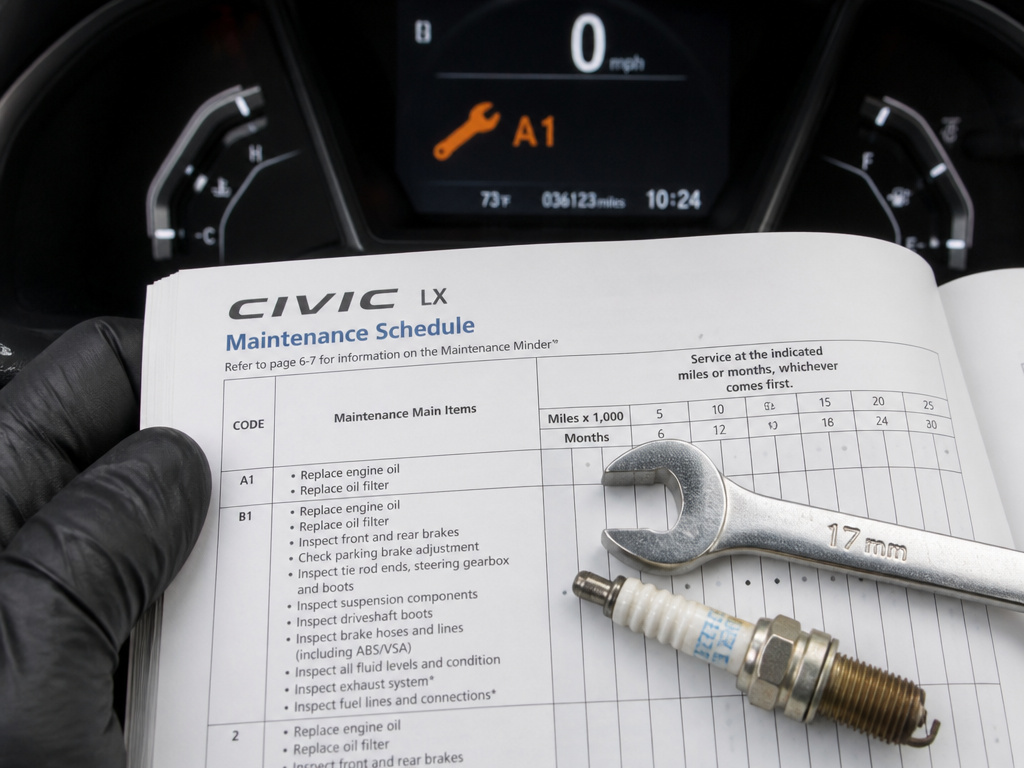
Your Civic LX has two bosses: the printed maintenance schedule and the digital Maintenance Minder. They don’t always agree, and the Minder doesn’t cover everything.
The Maintenance Minder (the little wrench icon on the dashboard) monitors engine oil life, and based on driving conditions, it will also trigger codes for other items: A for an oil change, B for oil and filter plus a tire rotation and inspection. Sub-codes like 1, 2, 3, or 4 appear for other services (air filter, cabin filter, spark plugs, etc.). It’s smart, but it’s not omniscient.
The schedule in the service manual includes items the car cannot self-diagnose: * Brake Fluid: Replace every 3 years. * Coolant: Replace first at 10 years or 120,000 miles, then every 5 years thereafter. * Valve Adjustment: Inspect only if noisy; not a routine interval item. * Idle Speed Inspection: Every 160,000 miles. * Fuel Tank Replacement: 15 years after manufacture date.
That last one is a shocker. It’s in the 2007 manual: “The fuel tank should be replaced 15 years after manufacture.” This is a safety and emissions item. The plastic (HDPE) degrades with exposure to ethanol in modern fuel and temperature cycles. A 2007 Civic’s tank is now over 15 years old. The risk isn’t daily failure; it’s that the plastic becomes brittle and a significant impact could crack it.
The Minder also won’t track wear items that depend on your driving environment. If you live where roads are salted, inspecting and lubricating the brake caliper slide pins annually is non-negotiable. The Minder won’t tell you that. Following only the dashboard lights is how you end up with a comprehensive repair list at 100,000 miles instead of just routine maintenance.
The 4 Tools That Replace a $200 Service Visit
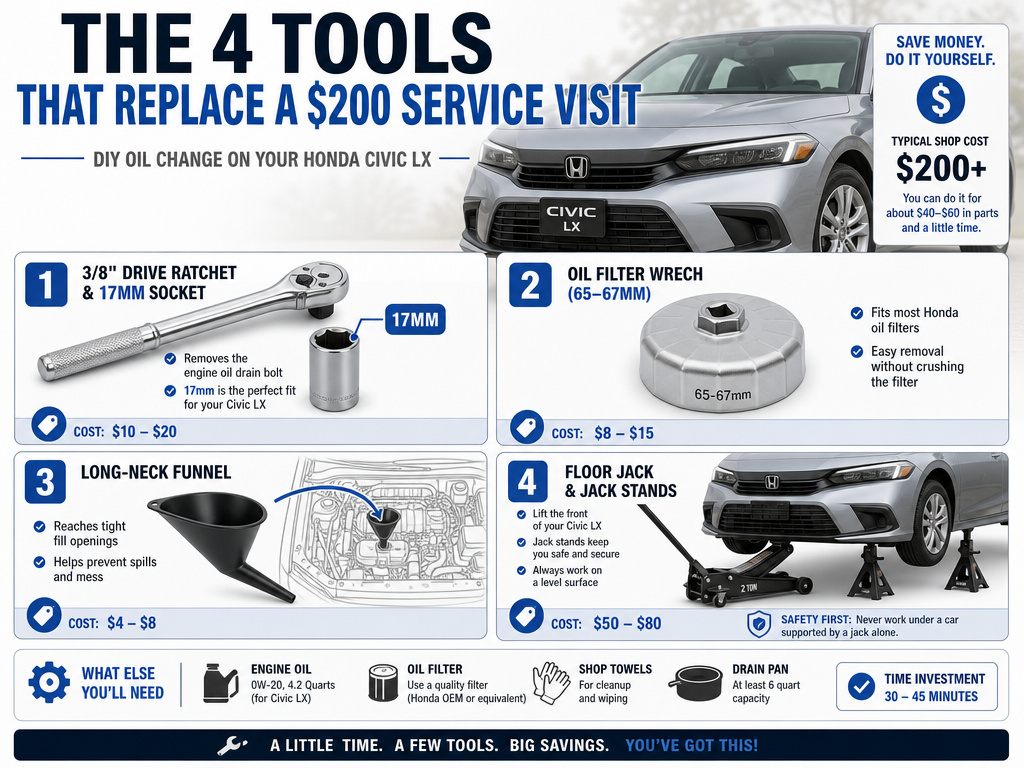
You don’t need a lift to handle most Civic LX maintenance. You need a small set of specific tools that match Honda’s fasteners. Buying these once pays for itself the first time you change your own oil or rotate your tires.
- A 3/8-inch Drive Socket Set with a 17mm Socket. The oil drain plug on both the R18 and K20 engines is a 17mm bolt. A quality six-point socket prevents rounding the soft aluminum oil pan.
- An Oil Filter Wrench (Cap-Style, 65-67mm). Honda uses a canister-style oil filter that screws onto a base on the engine block. A metal cap wrench that fits over the end of the filter is the only tool that reliably removes it without crushing the casing. The Honda oil filter itself is a cartridge that goes inside this canister.
- A Funnel with a Long, Thin Neck. The oil fill hole on these engines is tucked under the intake manifold. A standard wide funnel won’t fit. A long-neck funnel lets you pour directly into the hole without spilling oil all over the valve cover.
- A Quality Floor Jack and Two Jack Stands. The factory scissor jack is for emergency tire changes only. A 1.5-ton floor jack and a pair of jack stands let you safely lift both front wheels off the ground for brake work, tire rotation, or accessing the underbody.
With these, you can perform the majority of the Maintenance Minder’s “A” and “B” services. Add a brake bleeder kit for the 3-year fluid flush, and you’ve covered the basics for the life of the car. This self-sufficiency is the real ownership benefit the LX trim offers, simple engineering you can manage yourself.
How to Read Your Civic’s Service Manual
The factory service manual isn’t a novel. It’s a reference book. You go in with a specific question: “What’s the torque spec for the oil drain plug?” or “How do I bleed the clutch system?” If you try to read it cover to cover, you’ll get lost.
The digital versions from sources like LEMON Manuals preserve the original structure. Find your exact model year, engine, and transmission. The “Quick Lookups: Fluids” section is gold, it has all the capacities and types in one table. The “Maintenance Main Items” section explains what the Maintenance Minder codes mean and what’s legally required for emissions warranty (which on a 2007 Civic is long expired, but the advice is still sound).
Common mistake: Following a YouTube tutorial for a different Civic year. A 2012 Civic has a different engine (R20) and different procedures. Using a 2012 video to service your 2007’s transmission will lead to using the wrong fluid type and quantity.
When the manual says “Honda Long Life Antifreeze/Coolant Type 2,” it means the specific part number OL999-9001. This isn’t brand loyalty; it’s chemistry. Aftermarket “equivalent” coolants often use a different inhibitor technology (phosphate vs. Carboxylate) that can gel when mixed with the residual Honda coolant in your system. The resulting sludge blocks the radiator.
The manual also contains the parking brake adjustment spec: it should hold with 8 to 10 clicks when pulled with 196 N (44 lbf) of force. If it takes more than 10 clicks, the cables have stretched and need adjustment at the rear calipers. This is a 30-minute job with a wrench, but without the manual, you’d never know the precise force measurement.
Frequently Asked Questions
What’s the difference between the R18A1 and K20Z3 engines in the Civic LX?
The R18A1 is a 1.8-liter, single-overhead-cam (SOHC) engine focused on fuel economy. The K20Z3 is a 2.0-liter, dual-overhead-cam (DOHC) engine derived from Honda’s performance line, offering more power and a higher rev limit. They require different amounts of engine oil and have unique service quirks, the K20’s valve adjustment is more involved than the R18’s.
Can I use a universal coolant in my Honda Civic LX?
You can, but you shouldn’t. The factory service manual explicitly warns that using non-Honda coolant can cause corrosion. Universal “Asian vehicle” formulas may claim compatibility, but they can introduce silicate drop-out that clocks the small passages in the engine and radiator. The cost of a flush and refill with the correct Honda coolant is far less than replacing a clogged heater core or radiator.
My Maintenance Minder hasn’t said “B12” in 5 years. Am I fine?
No. The Maintenance Minder tracks items based on algorithms for engine load, temperature, and rpm. It does not track the age of brake fluid, coolant, or the fuel tank. These items have time-based expiration intervals (3 years, 10 years, 15 years respectively) that run regardless of mileage. Your dashboard isn’t broken; it’s just not programmed to monitor those things.
Is the ATF DW-1 fluid okay for my 2005 Civic LX with an automatic?
Yes. According to Honda Technical Service Bulletin A10110H, ATF DW-1 is the replacement fluid for all earlier Honda ATFs, including ATF-Z1. It’s fully backward-compatible and is actually the recommended fluid for a 2005 Civic if you’re doing a drain-and-fill. It provides better cold-temperature shift quality.
What are the first modifications I should consider for my Civic LX?
Start with the tires and brakes. The best all-season tires for Honda Civic models dramatically improve grip and noise over worn factory tires. Fresh, high-quality spark plugs and a cold air intake from a reputable brand can restore lost horsepower and improve throttle response. Before any performance Honda Civic mods, address any deferred maintenance from the factory schedule.
The Bottom Line
Owning a Honda Civic LX is a numbers game. The winning move is knowing your numbers: 3.7 liters of oil, 3 years on the brake fluid, 15 years on the fuel tank. This car’s reputation for reliability is a direct product of following those printed specs, not the dashboard reminders.
The trim level is irrelevant after the sale. What matters is the engine code stamped on the block and the factory manual on your shelf. Use the right Honda oil and filter, the exact coolant, and the specified transmission fluid. Do that, and the only thing you’ll replace before 200,000 miles is the timing chain tensioner, and even that has a diagnostic tick you can hear a year in advance.
Find your manual. Print the fluids page. Tape it inside your garage door. That sheet of paper is the only accessory your Civic LX ever really needed.
