
Driving on Snow Tires in Summer: Risks & 60% Wear Increase
This post contains affiliate links. As an Amazon Associate, we earn from qualifying purchases.
You can drive on snow tires in the summer, but you shouldn’t. It cuts braking distances, melts rubber, drains your wallet, and turns a safety device into a liability. The performance drop isn’t gradual; it’s immediate, measurable, and hides until the moment you need to swerve.
That gap between “can” and “should” is where the real physics lives. Winter rubber softens into mush on hot asphalt. It rolls slower, grips less, and wears down at a rate that halves a tire’s lifespan. This concerns a material science limit, and the numbers from OEM manuals prove it.
What follows: the exact temperature where grip flips, the three ways summer heat eats a winter tire, and what happens if you run summer tires below their own threshold. We’ll use the manufacturer specs most articles skip and the studies that put hard numbers on the risk.
Key Takeaways
- Driving on winter tires above 7°C (45°F) can increase wet-road braking distance by 42% at 70 km/h, a difference measured in car lengths.
- Summer heat accelerates winter tire wear by up to 60%, turning a 5-season tire into a 2-season expense.
- Using summer tires below 7°C risks permanent sidewall cracking as the rubber loses elasticity and hardens.
- The Kia LQ2AH owner’s manual mandates snow tires be installed on all four wheels with 4 psi extra pressure and a 75 mph speed cap.
- The M+S (Mud and Snow) marking is not a performance certification; the Three-Peak Mountain Snowflake (3PMSF) symbol is.
The 7°C Temperature Rule (And What Happens When You Break It)
The 7°C line is the point where the physical properties of summer and winter tire rubber compounds diverge. Winter tires use a softer compound designed to stay flexible in the cold.Above 7°C, that flexibility becomes a flaw.
The soft rubber compound in winter tires that is so effective in the cold becomes overly pliable in hot weather, causing higher rolling resistance. This results in longer braking distances, reduced handling precision, and a noticeable “mushy” feel during cornering.
A 2013 TÜV SÜD test using 205/55 16 H tires demonstrated that certified winter tires (marked with M+S or 3PMSF) are more effective than summer tires below 7°C. The inverse is brutally true above it.
Continental Tires quantified the handling loss. Their study found winter tires showed 15% less accuracy in steering and handling in hotter temperatures. They could perform an avoidance maneuver at a limit of 70 km/h, while summer tires managed the same at 80 km/h.
That 10 km/h gap is the space between a near-miss and a crumpled fender. The why-layer is simple: soft rubber deforms more under load. The tread blocks squirm, reducing the contact patch’s stability. You feel it as vague steering and delayed response.
What about braking? The data gets sharper. At 90 km/h on dry pavement, braking distance increases by up to 19%. On wet pavement at 70 km/h, the increase jumps to 42%. Think about that. A four-car-length stop in the rain becomes a six-car-length slide. Your snow tires in rain performance, already compromised, falls off a cliff in summer heat.
The Unseen Tire Killers: Wear, Fuel, and Warranty Voidance
The safety argument is clear. The financial one is just as stark, and it hits in three places: tread life, fuel pumps, and warranty paperwork.
First, wear. The soft rubber isn’t just poor for grip; it’s fragile against hot, abrasive asphalt. The heat accelerates chemical breakdown. One insurer’s analysis states using winter tires in summer can reduce their lifespan by 60%.
Instead of getting five winters from a set, you’ll be shopping in two. The tread wears down faster and often unevenly because the overheated rubber can’t maintain its shape under cornering forces.
| Cost Factor | Winter Tires in Summer | Correct Seasonal Tires |
|---|---|---|
| Tread Life | Reduced by up to 60% | Full designed lifespan |
| Fuel Economy | Up to 15% higher rolling resistance | Optimal for season |
| Warranty Coverage | Often voided for “improper use” | Fully intact |
| Replacement Cycle | Every 2-3 years | Every 4-5 years |
Second, fuel. That same softness creates higher rolling resistance, the tire deforms more with each revolution, wasting energy. Estimates peg the increase at around 15%. You’re paying a summer fuel tax for the privilege of worse performance.
Third, warranty. This is the quiet killer. Tire companies generally treat issues like tread block edge chipping or cracked tread rubber due to improper use as owner negligence. They rarely cover them. Running a winter tire in 30°C heat is a textbook case of improper use. Your summer use of winter tires just turned a $1,200 set into a disposable item with no safety net.
Where this goes sideways: Assuming tread depth is the only health metric. Cracked tires, even with 8/32″ tread, lose effectiveness. The cracks are stress fractures from the rubber hardening and softening across seasons, and they’re a sure sign the compound is cooked.
What Your Car’s Manual Actually Says (And It’s Specific)
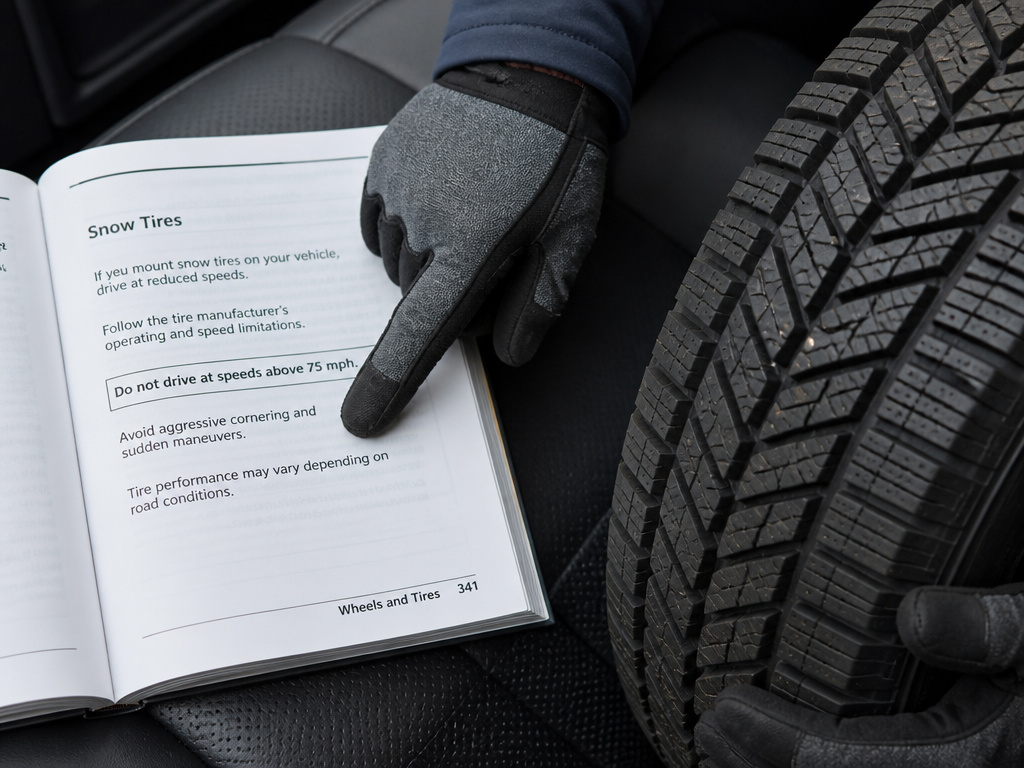
Forget generic advice. The OEM manuals for your exact model have precise rules, and ignoring them can void more than just the tire warranty.
The Kia LQ2AH owner’s manual is brutally direct. If you equip snow tires, they must go on all four wheels. They should carry 4 psi (28 kPa) more air pressure than the standard tire pressure on the door jamb label, or up to the maximum on the sidewall, whichever is less. It then commands: “Do not drive at speeds above 75 mph (120 km/h).”
The Honda HJ0606 manual is just as strict. It states that if you mount snow tires, “make sure they are radial tires of the same size and load range as original tires. Mount snow tires on all four wheels.” It warns that their traction on dry roads may be lower than your original tires and to check for “maximum speed recommendations.”
These are engineering limits based on the tire’s speed rating (which drops when mounted as a snow tire) and its heat dissipation capacity. Exceed them, and you’re operating outside the vehicle’s certified safety parameters.
The manual also warns about the opposite mistake. “Do not use summer tires at temperatures below 45 °F (7 °C) or when driving on snow or ice… Using summer tires at very cold temperatures could cause cracks to form and permanently damage the tires.”
The takeaway is binary. Each tire type has a defined operating window. Stray outside it, and you trade performance for peril. For a deeper look at the trade-offs of keeping one set on permanently, our article on the drawbacks of all-year snow tires breaks down the math.
The Right Tool for the Job: All-Season, All-Weather, or a Seasonal Swap?
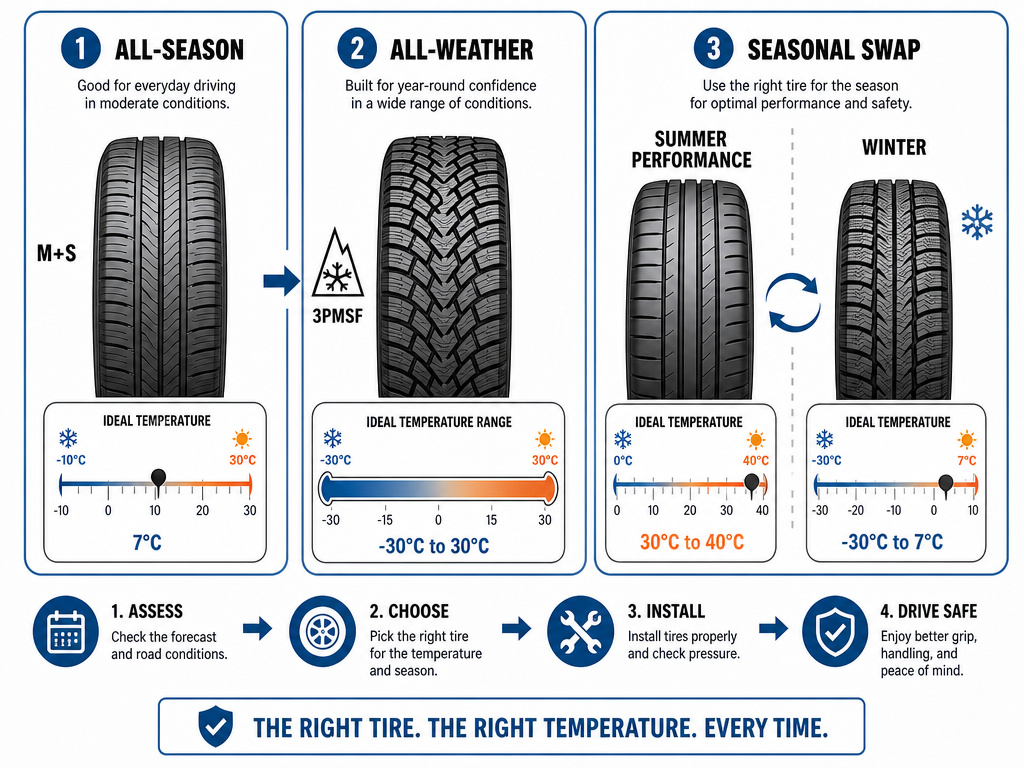
So what should you run when the thermometer dances around that 7°C line for months? You have three real paths, and each fits a different driver.
All-Season Tires are the default compromise. They carry the M+S marking and are designed to be “not terrible” in light snow and competent in warm rain. They won’t match a dedicated winter tire’s ice grip or a summer tire’s dry-road crispness. For most drivers in moderate climates, they’re the pragmatic, set-it-and-forget-it choice. Brands like Michelin Defender and Continental PureContact dominate here.
All-Weather Tires are the upgraded compromise. They earn the 3PMSF symbol, meaning they’ve passed a specific snow traction test. They use a more advanced, temperature-resilient compound than traditional all-seasons. Think of them as a winter tire that doesn’t melt in summer, or a summer tire that won’t crack in mild cold. The Michelin CrossClimate line is the benchmark. If you face occasional snow but mostly wet and dry roads, this is your answer.
The Seasonal Swap is the performance play. You run dedicated summer (or high-performance all-season) tires from spring through fall, and dedicated winter tires from fall through spring. This gives you the absolute best grip, braking, and wear in each season. It requires a second set of wheels or twice-yearly mounting/balancing costs, but for driving enthusiasts or those in severe climates, it’s unbeatable.
Easy to miss: The “all-terrain” label on truck tires. While some, like the BFGoodrich KO2, have the 3PMSF symbol, they are not equivalent to a passenger car winter tire. Their massive tread blocks are for rocks and mud, not necessarily for packed snow or ice on pavement.
When The Law and Physics Collide
Legality is the wild card. In the United Kingdom, there is no law prohibiting driving with winter tires in summer, nor is there legislation making winter tires mandatory in winter. The choice is left to the driver. In parts of Canada, like Quebec, winter tires are mandatory in winter, but the law says nothing about using them in summer.
Physics, however, is universal. Your local studded tire regulations might restrict use to winter months to protect road surfaces, but they don’t protect your tires from heat.
The legal risk shifts to liability. If you’re involved in an accident and were running visibly inappropriate tires for the conditions, bald summer tires in a blizzard or snow tires in a heatwave, an insurance adjuster will note it. It could affect fault determination.
The principle is the same as understanding any vehicle equipment rule: the law sets a minimum floor. Your responsibility for your own safety builds the ceiling. For extreme conditions, knowing the best snow chains for tires might be that ceiling.
Frequently Asked Questions
Are snow tires OK to use year-round?
Technically, yes. Practically, it’s a bad financial and safety decision. You will wear them out 60% faster, use more fuel, and suffer from significantly longer braking distances and poorer handling in warm weather. You’re paying a premium for a winter-specific tool while using it in the wrong season.
What temperature is too cold for summer tires?
The threshold is 7°C (45°F). Below this, summer tire rubber begins to harden and lose elasticity, reducing traction and braking power. Prolonged exposure to very cold temperatures can cause microscopic cracks in the sidewall, permanently damaging the tire. Switch to winter or all-weather tires before the first hard frost.
Can I put snow tires on just the drive wheels?
No. Every major vehicle manufacturer’s manual (Kia, Honda, etc.) explicitly states that snow tires must be installed on all four wheels. Installing them only on the drive wheels creates a dangerous imbalance in handling and braking, especially in corners or on slick surfaces.
How much faster do winter tires wear in summer?
Industry and insurance data points to a reduction in lifespan of up to 60%. If a winter tire normally lasts five winter seasons, using it year-round could see it worn out in two to three years. The hot pavement literally melts the softer rubber away.
What’s the difference between M+S and 3PMSF?
The M+S (Mud and Snow) marking is a self-certified tread pattern claim by the manufacturer. The Three-Peak Mountain Snowflake (3PMSF) symbol is a regulated performance standard. A tire must pass a specific snow traction test on a packed snow surface to earn the 3PMSF symbol. For real winter capability, look for the snowflake.
Before You Go
The question isn’t “can you,” but “why would you?” Driving on snow tires in the summer swaps safety for inconvenience. It turns a precision instrument into a blunt, expensive, and dangerous tool.
The numbers don’t lie: a 42% longer stop in the rain, a 60% shorter tire life, a 15% fuel penalty. Your car’s manual spells out the speed and pressure rules. The only thing left is the decision.
For the majority, a set of modern, high-quality all-weather tires with the 3PMSF symbol is the smartest single-set solution. For those who chase performance or face brutal winters, the seasonal swap remains king. But running a soft winter compound on hot asphalt is a gamble where the house, your safety, your budget, your warranty, always wins.
