
How Good Are Snow Tires in the Rain? Performance & Limits
This post contains affiliate links. As an Amazon Associate, we earn from qualifying purchases.
Snow tires deliver reliable wet-weather grip when the air and pavement are cold, consistently at or below 45°F (7°C). Above that temperature, their soft rubber compound overheats, the tread squirms, and wet braking distances increase. Their tread pattern, optimized for snow, can also reduce water-clearing ability in warm, heavy downpours.
That 45-degree line is not a suggestion. It’s the point where the physics of the rubber compound flips from an advantage to a liability. The same flexible tread that claws at packed snow loses its crispness on warm, wet asphalt. The result is a steering wheel that feels vague and a brake pedal that demands more distance.
What follows is the breakdown of that threshold: the chemical reason the tire works, the tread design trade-offs, and the official guidelines from the people who build and regulate tires. By the end, you’ll know exactly which rain your snow tires can handle and when to swap them out.
Key Takeaways
- Snow tires are excellent in cold rain (at or below 45°F) because their soft compound stays flexible and the sipes wipe away thin water films.
- In warm rain (above 45°F), the same soft rubber overheats, causing mushy handling and longer wet stopping distances.
- Install snow tires on all four wheels, never just the front or rear axle, to maintain balanced vehicle control as mandated by the USTMA Tire Information Service Bulletin.
- The “M+S” marking on a tire does not guarantee winter performance; look for the Three-Peak Mountain Snowflake (3PMSF) symbol for certified snow traction.
- Once daily highs consistently exceed 45°F, plan to switch to all-season or summer tires to preserve the snow tires’ lifespan and your safety.
How Snow Tires Are Built for Cold
A winter tire is a chemical and mechanical package designed for a single environment: cold. Its entire design, from the rubber under your tread to the pattern stamped into it, exists to solve problems that disappear when the thermometer climbs.
The compound itself is the first trick. Summer tire rubber turns hard and slick below freezing. Winter tire rubber uses polymers that stay pliable down to sub-zero temperatures. This flexibility lets the tread conform to icy micro-textures and packed snow. But that same pliability becomes a curse on a 60-degree rainy day. The rubber overheats, the blocks of tread wiggle excessively against the road, a phenomenon called tread squirm, and the tire loses its sharpness.
I won’t recommend a deep-tread mud-terrain tire for winter slush. The blocks are too far apart, the compound is too hard for cold, and on black ice it feels like you’re driving on polished marble. That’s a job for a dedicated winter pattern.
The tread pattern is the second trick. Look at a tire like the Michelin X-Ice Snow or the Nokian Hakkapeliitta. You’ll see wide grooves to channel slush, and hundreds of tiny slits called sipes. Sipes are the secret weapon. They open and close as the tire rolls, creating thousands of biting edges that grip snow and scrape away the thin film of water on cold, damp asphalt. In a cold rain, this sipe action provides measurable traction benefits. Test data from Tire Rack shows performance winter tires stopping from 50 mph in the 105–107 foot range on wet roads in the upper 30s °F.
But there’s a trade-off. All those sipes and wide grooves reduce the amount of actual rubber contacting the road. On a dry, warm highway, you sacrifice some steering crispness and maximum dry grip. In a warm, heavy rain, the same open pattern can struggle to evacuate deep water fast enough, raising the risk of hydroplaning at highway speeds compared to a rain-focused all-season tire.
| Tire Design Feature | Benefit in Cold Rain/Snow | Drawback in Warm Rain |
|---|---|---|
| Soft Rubber Compound | Stays flexible for grip on cold, wet pavement. | Overheats, causing tread squirm and longer stopping distances. |
| High Sipe Density | Wipes away thin water film and grips packed snow. | Reduces road contact area, can hurt steering feel. |
| Open Tread Grooves | Channels slush and moderate water. | May not evacuate deep standing water as quickly as a hydroplaning-resistant pattern. |
The Golden Rule: Temperatures Below 45°F
The performance of a snow tire in rain doesn’t flip with the weather. It flips with the thermometer reading where the rubber meets the road. The industry consensus, from manufacturers like Goodyear to tire engineering bodies, sets that line at 45°F (7°C).
Below this line, the tire’ chemistry works with you. The rubber retains its designed flexibility, providing confident grip on damp roads. The sipes effectively manage the typically lighter, colder water film. This is why late-fall and early-spring rainstorms, when morning temperatures hover in the 30s and 40s, are where snow tires feel secure. They are operating in their intended thermal window.
Cross above 45°F, and the physics work against you. The soft compound gets too hot and gummy. Tread squirm increases dramatically, which a driver feels as a vague, floaty steering response. Braking distances lengthen because the overheated rubber can’t maintain the same level of friction. A study on tire performance evolution noted that wear and temperature significantly affect grip metrics, a finding echoed in the SAE technical paper on tire grip. This isn’t a minor change. It’s the tire telling you it’s in the wrong season.
Where this goes sideways: Driving on snow tires through a sudden summer downpour. The pavement temperature can be 80°F. The tire will feel disconnected, braking will require extra car lengths, and you’ll wear through a $200 set of rubber in a few thousand miles.
This temperature rule also answers a common question about using snow tires year-round. You can, but you pay a price in safety, performance, and cost. The accelerated wear in warm weather makes it an expensive habit, and the compromised wet-weather grip above 45°F introduces an avoidable risk.
So, are all-weather tires a better fit if your winters mix cold rain and occasional snow? Often, yes. They carry the 3PMSF symbol for severe snow service but use a compound that handles warmer wet roads more gracefully. They are the true compromise.
When Rain Turns Dangerous
Not all rain is equal to a snow tire. A chilly drizzle at 38°F is a scenario it’s built for. A warm, torrential downpour at 70°F is its nemesis. The danger point is when standing water depth exceeds the tread’s ability to channel it away.
Hydroplaning is a function of speed, water depth, tread design, and tread depth. The wide, open grooves of a snow tire are good at moving slush and moderate water. However, many studless ice-and-snow tires prioritize tight, multi-angled blocks for ice grip. This can create a tread pattern that is less efficient at clearing deep, standing water at high speeds compared to an asymmetric, high-void all-season tire designed for monsoon conditions.
The legal markings on the tire sidewall tell you what it’s certified for, not how it behaves in every puddle. The “M+S” (Mud and Snow) marking is a manufacturer declaration with no minimum performance standard. The Three-Peak Mountain Snowflake (3PMSF) symbol, governed by standards like ASTM F1805 in the US, means the tire passed a specific snow traction test. As noted in a University of Michigan tire study PDF, an “M+S” tire without the 3PMSF symbol can have a 40% longer stopping distance on snow than an “M+S” tire with the symbol. That certification gap matters for snow, but it says nothing about warm wet braking.
If your winter involves more rain than snow, you have three paths: 1. True Winter Tires (e.g., Goodyear UltraGrip Performance+): Best for cold rain and snow, worst for warm rain. 2. 3PMSF All-Weather Tires: A balanced choice for mixed conditions where temperatures dance around that 45°F line. 3. Strong All-Season Tires: Best for rain, adequate for light snow, poor for ice and sustained cold.
Your local climate chooses for you. Honesty about your typical winter driving temperatures is the most important spec sheet.
The Non-Negotiable Safety Rules
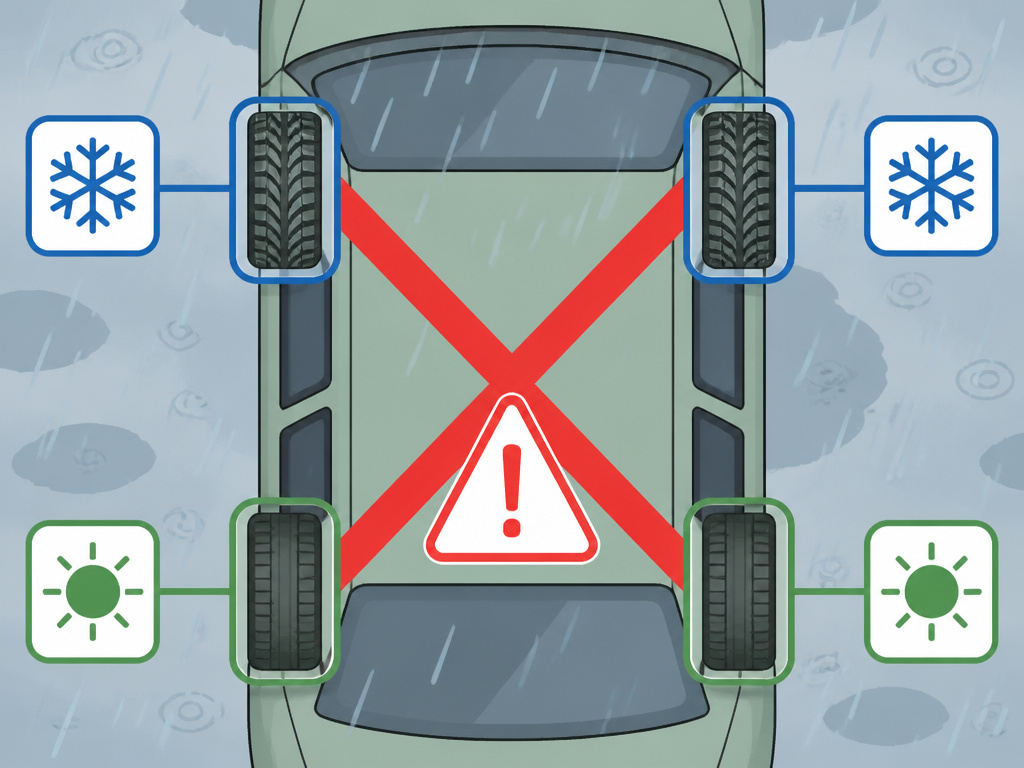
Installing snow tires comes with a set of mechanical commandments. Ignoring them doesn’t just hurt performance, it can create a handling imbalance that leads to a spin.
Rule 1: All Four Wheels. This is not a recommendation; it’s a safety mandate from the U.S. Tire Manufacturers Association. Installing winter tires only on the drive wheels (front for FWD, rear for RWD) creates a dangerous traction imbalance. The end with more grip will try to overtake the end with less grip during cornering or braking, which can induce a sudden oversteer or understeer spin. The tire industry technical service bulletin states it plainly: if they go on the front, they must also go on the rear.
Rule 2: Mind the Speed Rating. Your car’s door jamb placard lists a speed rating (e.g., H, V, W). If you can’t find winter tires with that exact rating, you can install a lower-rated set, but you must then restrict your vehicle’s maximum speed to the lower tire’s capability. Driving 100 mph on S-rated winter tires is asking for a catastrophic failure.
Rule 3: Studs Are All or Nothing. If you opt for studded winter tires like the Nokian Hakkapeliitta 10, the same axle rule applies, but stricter. If studded tires go on the front, they must go on the rear. For optimum handling, they should be on all four corners. Furthermore, studs should only be installed in new tires. Never stud a used tire.
Rule 4: Inflate to Spec, Not the Sidewall. Use the cold tire pressure listed on your vehicle’s door jamb or manual, not the maximum pressure molded on the tire sidewall. Proper inflation ensures the tread contacts the road evenly.
Following these rules turns a set of dedicated winter tires from a simple traction aid into a predictable, balanced safety system. It’s what separates a proper winter setup from a well-intentioned mistake.
Snow Tires vs. The Alternatives
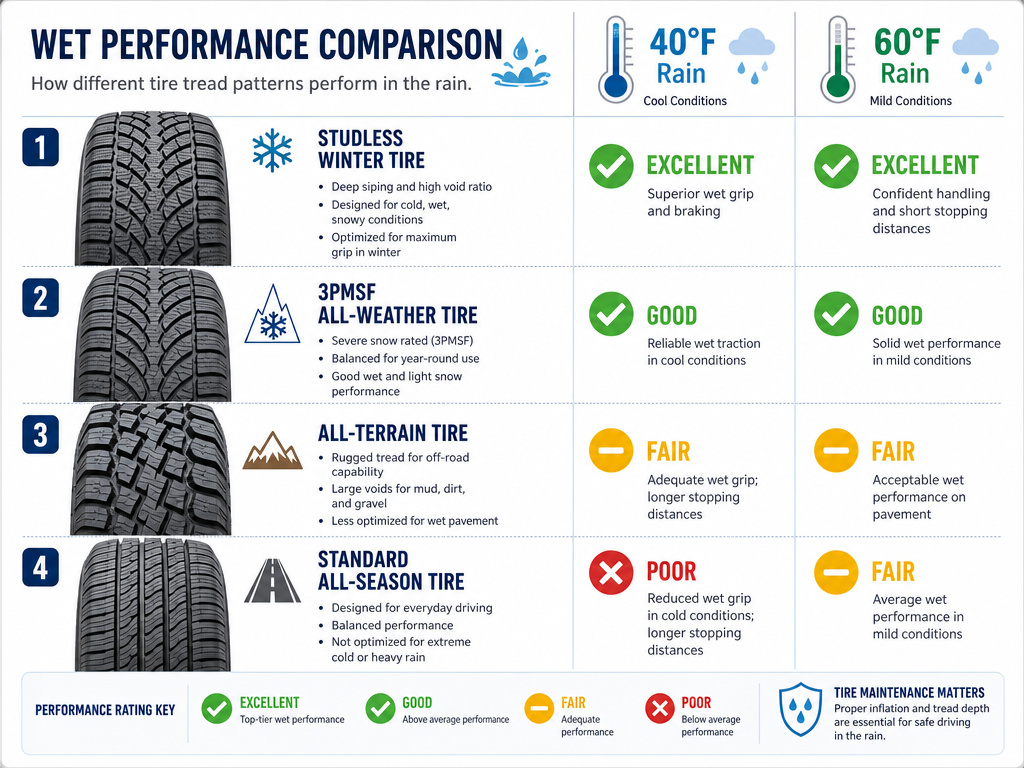
Choosing winter rubber isn’t just about snow tires. It’s about picking the right tool from a box that includes all-terrain, all-weather, and all-season options. Each has a different relationship with rain.
Let’s compare them head-to-head on a rainy, 40°F day and a rainy, 60°F day.
| Tire Type | Performance in Cold Rain (~40°F) | Performance in Warm Rain (~60°F) | Best For |
|---|---|---|---|
| Studless Snow/Winter Tire | Excellent. Flexible compound and sipes provide top grip. | Poor. Becomes mushy, with increased stopping distances. | Regions with sustained cold, frequent snow/ice, and cold rain. |
| 3PMSF All-Weather Tire | Very Good. Balanced compound handles cold well. | Good. Maintains composure and wet grip. | Mixed winters with temps cycling above/below 45°F and moderate snow. |
| All-Terrain Tire (e.g., General Grabber AT2) | Fair. Aggressive tread clears water but hard compound lacks cold grip. | Good. Compound is in its comfort zone. | Trucks/SUVs that see more dirt than winter pavement; mild winters. |
| Standard All-Season Tire | Fair to Poor. Compound hardens, reducing grip. | Excellent. Top hydroplaning resistance and crisp handling. | Regions with predominantly warm, wet winters and rare, light snow. |
The limitations of all-terrain tires in proper winter conditions are clear in that chart. Their hard, durable compound and large tread blocks are designed for rock crawling and dirt, not for gripping freezing rain. They may carry an M+S marking, but without the 3PMSF symbol, their snow and ice performance is not certified.
The takeaway is mechanical, not philosophical. Match the tire’s design temperature range to your actual winter. If you never see 45°F, you don’t need a snow tire. If you never see above freezing, a true winter tire is your only safe choice for rain or shine.
Making the Seasonal Switch
Knowing when to install and remove your snow tires is as important as buying them. That 45°F rule works in both directions.
When to Put Them On: When nighttime temperatures consistently drop to or below 45°F. Don’t wait for the first snowflake. The tire’s cold-weather performance advantage begins the moment the pavement chills.
When to Take Them Off: When daytime highs consistently stay above 45°F. This is the manufacturer-recommended point from brands like Goodyear. Driving on them in warmer weather accelerates wear, you could burn through a season’s worth of tread rubber in a few thousand miles of summer commuting. It also restores your vehicle’s warm-weather handling and braking safety.
Storing them properly matters, too. Clean the tires with mild soap and water to remove road salt and brake dust. Dry them thoroughly. Stack them vertically in a cool, dry, dark place away from direct sunlight, ozone generators (like old electric motors), and petroleum products. Consider a tire storage bag to keep dust off.
This seasonal dance protects your investment in both your winter and summer tires. It’s the final step in treating tires as the critical, wear-limited safety components they are.
Frequently Asked Questions
Are snow tires good for heavy rain?
They are adequate in heavy rain if temperatures are cold (at or below 45°F) and the tread is deep. In warm heavy rain, their performance drops significantly. The open tread pattern of some ice-focused winter tires may not evacuate water as quickly as a hydroplaning-resistant all-season tire, increasing risk at highway speeds.
Can I put snow tires on just the front for rain?
No. Installing winter tires only on the front axle of a front-wheel-drive vehicle is dangerous and explicitly discouraged by tire industry bulletins. It creates a severe handling imbalance where the front has more grip than the rear, which can cause the rear end to swing out unexpectedly during cornering or braking on wet roads.
How do I know if my tires are good for snow and rain?
Look for the Three-Peak Mountain Snowflake (3PMSF) symbol on the sidewall, not just the “M+S” marking. The 3PMSF symbol indicates the tire meets a minimum snow traction performance standard. For rain, check the tire’s wet braking scores in independent tests (like those from Tire Rack) and ensure the tread depth is above 4/32 of an inch.
Do snow tires wear out faster in the rain?
They wear out much faster in warm rain. The soft rubber compound is designed for cold pavement. On warm, wet roads, it overheats and abrades away more quickly. Using them in conditions above 45°F can easily double or triple their wear rate compared to cold, dry winter driving.
What’s better for rainy winters: snow tires or all-weather tires?
For winters with lots of rain and temperatures that frequently rise above 45°F, 3PMSF-rated all-weather tires are generally the better choice. They provide a better balance of cold-weather capability and warm-rain performance than a dedicated snow tire. If temperatures are consistently below 45°F, a true winter tire is superior.
Before You Go
Snow tires are a targeted solution. In the cold rain they’re designed for, they provide security that all-season tires can’t match. In the warm rain of a late spring shower, they become a liability. That 45°F threshold is the entire game.
Your decision hinges on a simple forecast. Graph your winter temperatures. If the line spends most of its time below 45°F, buy the winter tires. If it bounces above and below, look at all-weathers. If it hardly dips below freezing, a strong all-season is your tool. And whatever you choose, mount them in a full set of four. Your safety, and the physics of your car’s handling, depend on it.
