
Are Winter Tires Worth It? The Science & Law of Cold Weather Grip
This post contains affiliate links. As an Amazon Associate, we earn from qualifying purchases.
Winter tires are worth the investment if you regularly drive in temperatures at or below 45°F (7°C), regardless of snow. Their specialized rubber compound retains flexibility for superior traction, braking, and cornering grip on cold, wet, icy, or snowy roads, a performance gap confirmed by standardized testing like ASTM F1805. Installing them on all four wheels is mandatory for vehicle control, and their use can reduce winter collision rates, as observed in regions with mandatory tire laws.
That temperature threshold is the point where the chemistry changes. All-season tire rubber begins to harden, losing its ability to conform to the road’s micro-texture.Winter tire compounds stay pliable, so the tread blocks can actually grip.
The rest walks you through the hard data from transport agencies, the real cost math beyond the sticker price, and the installation rules that keep you from fishtailing into a ditch. By the end, you’ll know exactly where you stand on the law, the science, and your own driveway.
Key Takeaways
- Winter tires provide a measurable safety advantage primarily below 45°F (7°C), a fact backed by manufacturer specs and studies like the TIRF winter tire report.
- Installing winter tires on only two wheels dangerously compromises handling; all four wheels must have matching tires, per NHTSA and U.S. Tire Manufacturers Association guidelines. In regions like Québec, winter tires are legally required from December 1 to March 15, a policy credited with reducing serious crashes.
- The Three-Peak Mountain Snowflake (3PMSF) symbol is the only reliable indicator of a tire’s certified severe snow service performance.
- While the upfront cost is real, the long-term financial equation includes splitting wear between two sets of tires, potential insurance benefits, and avoiding a single winter crash.
The 45°F Threshold. Where Winter Tires Actually Work
Forget the first snowfall. The real trigger for swapping tires is the first sustained drop in the mercury. The specialized rubber in a winter tire is formulated with more natural rubber and silica to resist hardening. An all-season tire’s compound starts to stiffen as temperatures fall, long before any ice forms.
Common mistake: Waiting for snow to install winter tires. The compound advantage activates at 45°F (7°C). On a dry but cold road, your braking distance can be 10-20% shorter with winters versus all-seasons.
This recommendation is printed in owner’s manuals. Ford’s guide, for instance, explicitly recommends switching when temperatures drop below 45°F.The Traffic Injury Research Foundation’s analysis pins the same number. The grip difference comes down to surface contact. A pliable tire conforms to the pavement, even cold blacktop. A hardened all-season tire rides on a smaller, less adhesive footprint.
The “M+S” (Mud and Snow) marking on a tire sidewall is meaningless for guaranteed winter performance. It’s a self-certified label. The only symbol that matters is the Three-Peak Mountain Snowflake (3PMSF). To earn it, a tire must meet specific traction performance standards on packed snow in tests like ASTM F1805 or its European equivalent, ECE R117. A University of Michigan winter tire study found tires without the 3PMSF symbol required 40% longer stopping distances on snow than similar tires with it.
| Tire Type | Optimal Temperature Range | Key Traction Advantage | Reliable Certification |
|---|---|---|---|
| Summer Tire | Above 45°F (7°C) | Dry & wet warm pavement | None required |
| All-Season Tire | ~30°F to 100°F (-1°C to 38°C) | Balanced year-round compromise | M+S (self-certified) |
| Winter Tire (3PMSF) | 45°F (7°C) and below | Cold, wet, icy, snowy surfaces | Three-Peak Mountain Snowflake |
So, are winter tires worth it if you only see a few light snowfalls? If those snowfalls come with weeks of sub-45°F temperatures, absolutely. The safety benefit is daily, not just during flurries.
The Legal Landscape: When “Should You” Becomes “Must You”
In most of North America, using winter tires is a choice weighed against cost and convenience. In Québec, it’s the law. The province’s highway safety code mandates winter tires on all registered light vehicles from December 1 to March 15. Rental cars in the province are included. The result? A reported 5% reduction in serious crashes since the law’s 2008 implementation.
This law underscores a public health stance. It treats tire choice as a community safety issue, not just a personal one. Germany has a similar principle: drivers without winter tires involved in a weather-related crash can be found at fault for the collision itself. Your insurance company sees it the same way, a single-vehicle slide-off on an icy road is an at-fault claim.
The takeaway is that the “worth it” calculation is being made for you in an increasing number of jurisdictions. Even where it’s not law, the standard of care is shifting. If you cause an accident in conditions where winter tires are recommended, your decision not to use them could be a factor in determining liability.
Mixing Tires is a Hard No
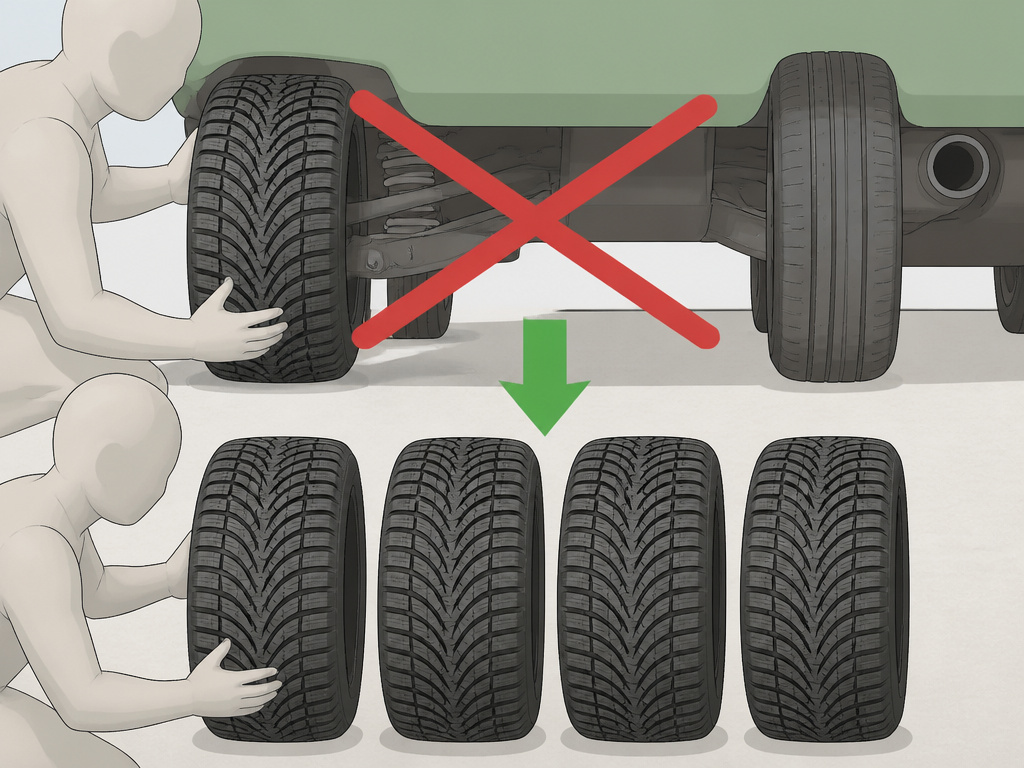
This is the hill the experts will die on. Never install winter tires on only the drive wheels. For a front-wheel-drive car, that means all four corners. For a rear-wheel-drive truck, that means all four corners. For an all-wheel-drive SUV, that emphatically means all four corners.
Installing winter tires only on the front axle may cause the vehicle to experience adverse handling characteristics. This may result in an accident, which could cause serious injury or death. . U.S. Tire Manufacturers Association, TISB 42
The physics are simple but brutal. Putting grippier tires only on the front of a front-wheel-drive car creates a handling imbalance. The front end sticks while the rear, on harder all-season tires, wants to slide. In a corner or during a steering correction, this can cause the car to spin, a loss of control most drivers cannot correct. The reverse is true for rear-wheel-drive vehicles with winters only on the back.
The NHTSA tire maintenance and safety manual is unambiguous: if you put winters on the front, you must put them on the rear. If you put them on the rear, it’s strongly recommended you put them on the front. True control requires all four tires working at the same performance level.
Studded vs. Studless: The Traction Trade-Off
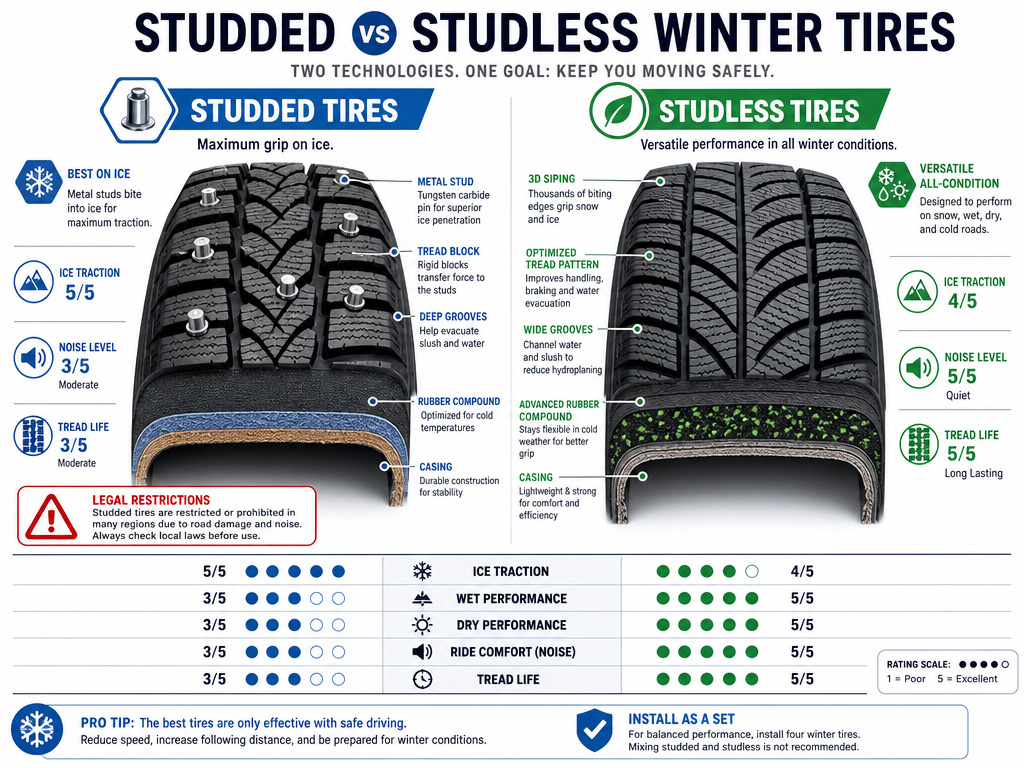
Within the winter tire category, you have a second choice: studded or studless. Studded tires use small metal pins embedded in the tread to dig into ice. Studless tires, like the Bridgestone Blizzak or Michelin X-Ice, rely on advanced rubber compounds and intricate tread designs with thousands of tiny biting edges.
| Aspect | Studded Tires | High-Performance Studless Tires (e.g., Blizzak, X-Ice) |
|---|---|---|
| Best Performance On | Glare ice, hard-packed snow | All cold conditions (dry, wet, slush, snow, ice) |
| Primary Drawback | Damage to clear roads; banned/restricted in many areas; noisy | Wear faster than studded on dry pavement |
| Legal Status | Seasonal use only; often banned spring-fall | Legal year-round (but not recommended in summer) |
| Consider For | Extreme ice dominance; rural areas without pavement damage concerns | Most drivers; urban/suburban areas; all-around winter safety |
A Washington State studded tire overview notes the performance gap has narrowed. Modern studless tires are exceptionally good, making studs overkill for most. Studs also come with baggage: they tear up road surfaces, are banned outside winter months in most provinces and states, and create a distinct whirring noise. For the vast majority of drivers, a premium studless tire like the Nokian Hakkapeliitta is the smarter, more versatile pick.
The Real Cost Equation (It’s Not Just the Sticker Price)
The upfront cost is the biggest hurdle. A set of four winter tires and wheels can easily run into the hundreds of dollars. But the math is more nuanced.
First, you’re splitting your annual mileage between two sets of tires. Your all-seasons last longer because they’re not used half the year. Your winters last multiple seasons because they’re only used during the cold months. Over a five-year period, the per-mile cost can be comparable to running all-seasons year-round and replacing them twice as often.
Second, consider the cost of not having them. A single minor collision, a fender-bender from sliding through a stop sign on cold all-seasons, will dwarf the cost of a tire set through your insurance deductible and premium increase. Some insurers in Canada even offer discounts for winter tire use, recognizing the reduced claim risk.
Third, you can mitigate cost. Buy cheaper steel wheels for your winter set to avoid mounting/balancing fees twice a year. Look for rental options for winter tires if you’re facing a one-time winter trip. Or, consider high-end all-weather tires as a potential compromise, though they won’t match a dedicated winter’s ice performance.
Bottom line: The investment spreads out over years and is insurance against a much larger, immediate loss.
Installation & Maintenance: Don’t Botch the Basics
You’ve bought the right tires. Now install them correctly.
Mount them on all four wheels. This rule bears repeating. Refer to the USTA Tire Information Service Bulletin if you need the official industry stance.
Mind the speed rating. Winter tires often have a lower speed rating (e.g., Q: 99 mph, T: 118 mph) than your summer tires. The U.S. Tire Manufacturers Association bulletin states it’s acceptable to use a lower-rated tire, but you must not exceed its rated speed. Drive accordingly.
Check pressure monthly. Tires lose about 1 psi per month normally, plus another 1 psi for every 10°F drop in temperature. A tire that was 35 psi in September is 30 psi by January’s deep freeze. Underinflation kills traction and causes uneven wear.
Store them properly. When you swap back to all-seasons, clean your winters, bag them in airtight plastic if possible, and store them stacked or on their sidewalls in a cool, dry, dark place. Sun and heat are a tire’s worst enemies during the off-season.
Know when to replace. Winter tires are spent at 6/32-inch tread depth, not the legal minimum of 2/32. Their snow and slush evacuation capability plummets before they’re legally bald. Mark a quarter in the tread, if the top of the caribou’s head is visible, start shopping.
The Verdict on Safety and Peace of Mind
The data has limits. As the TIRF report notes, direct epidemiological studies linking winter tires to fewer collisions are sparse. We know they perform better in controlled tests. We have indirect evidence from insurance claims and regional laws. The link is logical, but not exhaustively proven.
Driving is about managing known risks with the best tools available. A winter tire is a better tool below 45°F.The feel is tangible, the steering is more responsive on cold, wet roads, the braking is more confident, the car feels planted.
For the driver in Minnesota, Michigan, or Maine, the answer is clear. For someone in the Pacific Northwest with constant wet, 40-degree winters, the case is stronger than they might think. For the Southern driver facing one annual ice storm, the cost/benefit may tilt toward caution and all-weather tires.
If you live where winter means months of cold: Buy the tires. Get four of them. Mount them on cheap wheels. The peace of mind, knowing your car is giving you its best possible grip on every frigid morning, is worth the garage space and the seasonal swap.
Frequently Asked Questions
Do I need winter tires if I have all-wheel drive?
Yes. All-wheel drive helps you go by sending power to wheels with grip. It does very little to help you stop or steer. Winter tires improve braking and cornering traction for all vehicles, regardless of drivetrain. An AWD SUV on all-season tires will stop and slide just as far as a front-wheel-drive car on all-seasons.
Can I use winter tires year-round?
You can, but you shouldn’t. The soft compound wears dramatically faster on hot pavement. They also offer less precise handling and longer braking distances in warm, dry conditions. Using them in summer defeats their purpose and wastes your money. See our articles on the detrimental summer performance and risks of year-round snow tires for a deeper breakdown.
Are “all-weather” tires a good substitute for winter tires?
They are a compromise. All-weather tires (like the Michelin CrossClimate2) carry the 3PMSF symbol and are better in snow than standard all-seasons. However, their ice and extreme cold-weather traction typically lags behind a dedicated winter tire. They are an excellent option for regions with mild to moderate winters, but not a full replacement for severe, sustained cold.
How do I know if my winter tires are still good?
Check the tread depth (replace at 6/32″), check the date code on the sidewall (replace at six years old regardless of tread), and inspect for dry rot or cracking. Also, trust your senses. If the car feels noticeably less secure on a known icy patch than it did last season, the compound may have hardened with age.
The Bottom Line
Winter tires are a financial decision, a practical chore, and a safety upgrade. The science supporting their use below 45°F is solid, rooted in rubber chemistry and verified by standardized tests. The legal landscape is increasingly making them mandatory. The operational rule is non-negotiable: all four wheels, every time.
For many, the choice comes down to risk tolerance. You’re betting the cost of a tire set against the probability and cost of a winter incident. Given the proven performance gap, it’s a bet that increasingly favors being prepared. Look at the forecast, look at your current tread, and make the call before the first hard freeze. Your traction, and maybe your deductible, depends on it.
