
State Laws: Are Studded Snow Tires Legal? Penalties Defined
This post contains affiliate links. As an Amazon Associate, we earn from qualifying purchases.
Studded snow tires are legal in most of the U.S., but with severe restrictions: a specific seasonal window, precise stud specifications, and often a defined geographic boundary. The question isn’t a yes-or-no checkmark, it’s a three-part match of dates, dimensions, and jurisdiction.
That seasonal match is where most people trip. The calendar dates are printed in state statutes, not on the tire’s sidewall, and a misread by one day hands you a fine that can exceed a hundred dollars. Each state also dictates the exact millimeters a stud can protrude, how many you can pack into a tread block, and where your registered vehicle can travel while they’re mounted.
What follows is the breakdown the law books assume you’ve read: the four pillars of legality, a state-by-state translation of the legalese, and the hard specs that turn a legal tire into an illegal one the moment you cross a border or let a stud wear past its limit.
Key Takeaways
- Stud legality hinges on three locked variables: permitted dates (usually Nov–Apr), specific stud dimensions (protrusion, diameter, count), and your vehicle’s registration location.
- Out-of-state plates offer no blanket protection; states like Minnesota grant a 30-day grace period, after which you must comply with local law or remove the tires.
- Retractable stud systems are the exception, often allowed year-round provided the studs are fully retracted outside the seasonal window.
- Violations are moving violations, not fix-it tickets, with fines that scale by jurisdiction and potential points on your license.
The 4 Things That Decide If Studded Tires Are Legal
A cop pulling you over isn’t checking for “winter tires.” He’s verifying four distinct points against a mental checklist from the state vehicle code. Get one wrong, and the ticket writes itself.
First, the calendar. Almost every state that allows studs restricts them to a winter window, typically November 1 through April 15 or 30. This isn’t a suggestion. In Maine, operating a vehicle with studs from May 1 to October 1 is a direct violation of Maine statute §1919, full stop. Alaska splits its state by latitude, with different cutoffs north and south of 60 degrees.
Second, your stud specs. Lawmakers care about road wear, so they legislate the studs themselves. Maryland’s code, Maryland COMAR 11.13.02.10, is a masterclass in specificity: stud protrusion must be between 1/32 inch (0.031″) and 2/32 inch (0.062″), the pin core diameter must be 0.062–0.125 inches, and you cannot pack more than 150 studs per tire. A tire wearing past that 0.062″ protrusion limit is illegal, even if it’s still within the date window.
Third, where your vehicle is registered. Some states, like Maryland, restrict stud use to vehicles registered within specific counties. You can’t buy studded tires in most of Maryland, and if your plates are from outside the five western counties, you cannot legally run them there at all.
Fourth, the condition of the roadway. This is the wild card. Statutes often include a clause allowing the state’s commissioner of transportation or public safety to extend the legal season via emergency order due to persistent ice or snow. Conversely, running studs on dry pavement is explicitly called out as damaging in many codes, and an officer can use observed dry conditions as supporting evidence for a citation.
A tire with studs protruding more than 0.062 inches outside the seasonal window violates two separate clauses in most state codes. You’ll be cited for the equipment violation and for using the tires outside the permitted dates, which can double the fine.
Your Stud Specs Are as Important as Your Dates
You bought the tires legally. The dates on your calendar are correct. But your tires can still be illegal the day you mount them if the physical studs don’t match the state’s blueprint.
Forget manufacturer claims. The law deals in measurements. Here is what a state trooper or vehicle inspector is trained to look for, directly from the codes:
| State | Maximum Stud Protrusion | Key Dimension Limits | Where This Comes From |
|---|---|---|---|
| Maryland | 2/32 inch (0.062 in) | Max 150 studs/tire; Stud casing diameter 0.187–0.250 in | COMAR 11.13.02.10 |
| Alaska | 1/4 inch (0.250 in) | Defined as “studded tire” in statute | Alaska Sec. 28.35.155 |
| Minnesota | 7/64 inch (~0.109 in) | Stud diameter ≤ 5/16 in; Stud count ≤ 2% of contact area | MN Statutes 169.72 |
| California | Not Explicitly Defined | Metal contact ≤ 3% of tire area (studs) | VEH 27454 (Research Summary) |
Protrusion is the first thing to wear illegal. A new stud sits within its casing. As the rubber tread wears down, the stud exposes more of its metal pin. Once that exposed length exceeds the state’s limit, 0.062 inches in Maryland, 0.109 inches in Minnesota, the tire is out of spec. You cannot legally shave down a stud; the tire is considered non-compliant equipment.
Stud count and placement matter just as much. Packing a tread block with extra studs for “more grip” is a direct violation. Minnesota’s “2% of total net contact area” rule is a geometric calculation. A typical passenger tire has a contact patch of about 30 square inches; 2% of that is 0.6 square inches. If your studs have a combined cross-sectional area larger than that, they’re illegal.
Where this goes sideways: Assuming all “studded” tires are created equal. A performance-oriented studded ice tire like the Nokian Hakkapeliitta 9 may have a stud count and pattern designed for Nordic conditions that, while legal there, could exceed the stud-density limits in a state like Minnesota if not specifically approved for sale there.
State-by-State Rules: It’s Not Just the Northeast
The blanket statement “studs are legal in winter” is dangerously incomplete. Legality fractures into a mosaic of state-specific rules, and the penalties for guessing wrong are concrete.
Let’s translate the legalese. The following table strips the formal language from the statutes and lays out what you actually need to know before driving in or through these states.
| State | Permitted Use Dates | Critical Restrictions & Notes | Penalty Framework |
|---|---|---|---|
| Maine | Oct 1 – May 1 | Retractable studs OK year-round if retracted May–Oct. Special permits ($3–$15) can be issued by the Commissioner of Transportation. | Fine per violation; equipment misdemeanor. |
| Alaska | Varies by Latitude | South of 60°N: Apr 15 – Sep 30. North of 60°N: May 1 – Sep 15. Special individual traction permit available. | Presumed fine; possible permit revocation. |
| Maryland | Nov 1 – Mar 31 | Only legal in 5 counties (Allegany, Carroll, Frederick, Garrett, Washington). Vehicle must be registered in one of those counties. | Sale & use prohibited outside designated area; fines for both seller and driver. |
| Minnesota | No in-state season for residents | Out-of-state vehicles: 30-day grace period per 6 months. Stud specs must comply with MN dimension limits. | After 30 days, treated as in-state violation; fine and possible equipment order. |
| Washington | Nov 1 – Mar 31 | Retractable studs allowed year-round if retracted outside dates. DOT can extend season. | Moving violation; fine based on local jurisdiction. |
| Michigan | Nov 1 – Apr 1 | Historical restriction effective post-1975. Referenced in Michigan Compiled Law 257.710. | Standard traffic fine. |
The “Out-of-State Plate” Trap
This is the most common error for travelers. Your studs are legal year-round in Colorado? Great. That means nothing in Minnesota after your first 30 days there in any six-month period. The Minnesota Statutes 169.72 are explicit: use beyond 30 days is not “occasional,” and your vehicle becomes subject to Minnesota’s equipment laws. For a resident, that means no studs at all unless you’re a postal worker with a permit.
The Localized Sales Law
Maryland’s rule is the most restrictive model. You cannot even purchase studded snow tires in most of the state. Retailers in the five western counties can sell them, but only to customers who can prove vehicle registration within those counties. This creates a supply-chain block that physically prevents most drivers from violating the use law.
If you’re navigating the complex California studded tire laws, remember the metal-contact-area rule is as important as the dates. For specific rules on the West Coast, our guide on studded tires in Washington details the retractable-stud exception.
Why Retractable Studs Are the Legal Hack
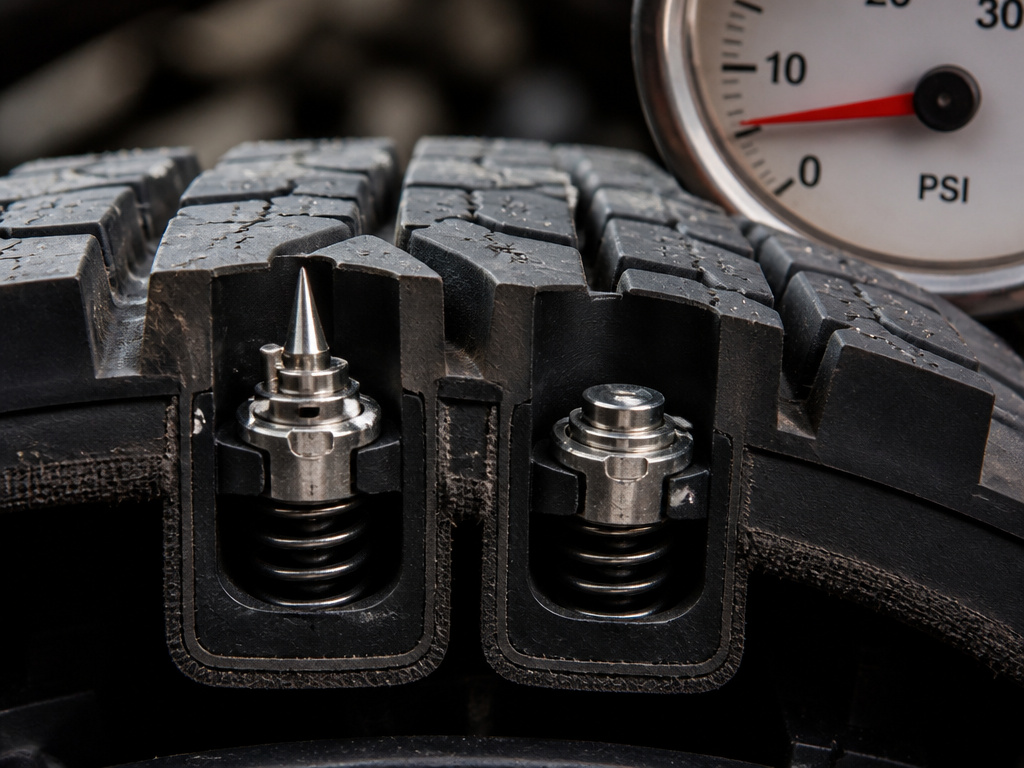
Retractable stud systems, like those from Nokian, are the exception written into almost every seasonal law. They work on a simple principle: the stud sits within a sealed chamber in the tread block. When tire pressure is high (summer driving), the stud retracts. When you lower the tire pressure for winter, the stud extends.
The legal advantage is absolute. Because the stud can be mechanically withdrawn below the tread surface, these tires are often exempt from seasonal date restrictions. Maine’s law is clear: “Pneumatic tires that feature embedded blocks, studs… That are retractable may be used any time of the year, except that the protuberances may not be engaged or extended from the first day of May to the first day of October.”
You must retract them. The legality hinges on the stud being physically unable to contact the road outside the season. If you forget to reinflate your tires to the “summer” pressure setting, the studs remain extended. An observant officer or a roadside inspection can see this, and you’re now violating the equipment code just as if you had fixed studs mounted in July.
The trade-off is cost and complexity. Retractable stud systems are a premium feature on already premium winter tires. You’re also adding a maintenance step, changing tire pressures with the seasons, that most drivers never consider. But for someone who lives in a mountainous pass area where black ice can appear in October or linger into May, they eliminate the calendar anxiety.
For performance in severe conditions, a curated selection of studded winter tires includes models featuring this technology.
Studded vs. Studless: The Real-World Grip Gap
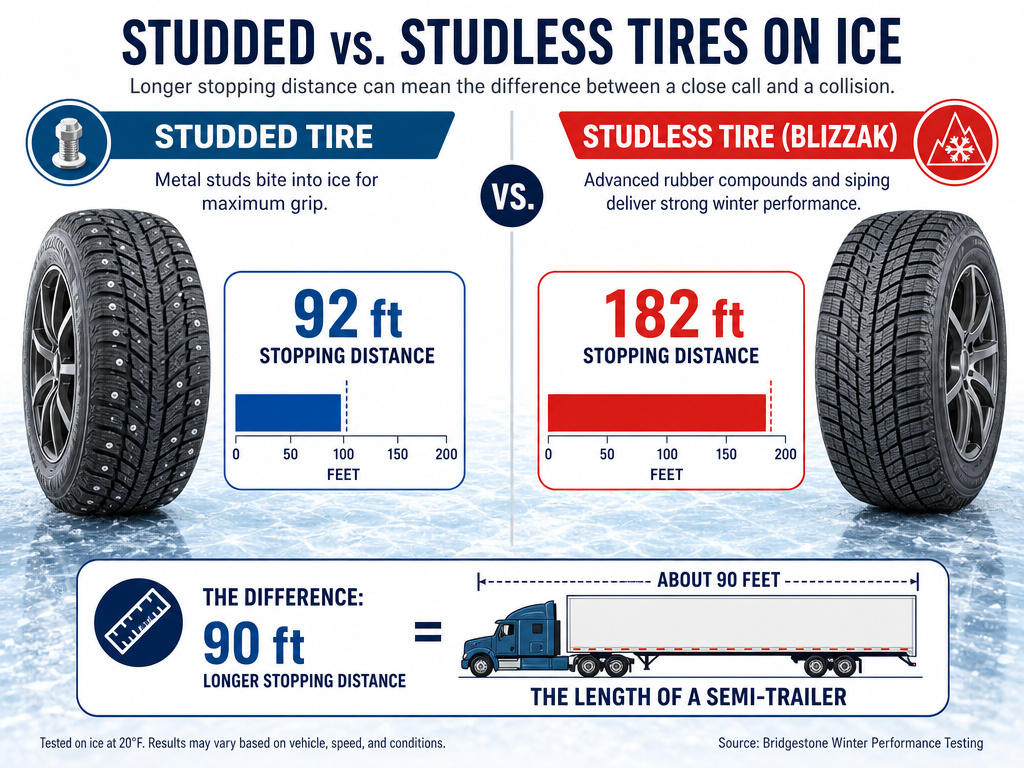
The legal headache begs the question: are studs worth it? The data from controlled, icy conditions says yes, decisively, but only on a specific surface.
In that YouTube test on the frozen lake, the studded tire stopped from 30 mph in 92 feet. The high-end studless tire, a Bridgestone Blizzak WS90, took 182 feet. That’s not a small difference; it’s the length of a semi-trailer. In acceleration, the studded car hit 30 mph in 4.8 seconds; the studless tire took 9.3 seconds. On sheer, wet ice, studs win because the metal pins physically penetrate the surface.
But the other test revealed the critical caveat. The rally driver noted the gap “shrinks dramatically on snow.” The studless tire’s sophisticated siping and snow-trapping tread compounds work almost as well when there’s a softer medium for the tread to bite into. On plowed, salted, or merely cold dry pavement, the studless tire is quieter, smoother, and doesn’t tear up the road surface.
The part nobody mentions: Studs are single-condition specialists. Their superiority is almost entirely isolated to smooth, wet ice. On anything else, packed snow, slush, dry pavement, a modern studless winter tire like the Michelin X-Ice or Nokian Hakkapeliitta R5 is within a few percentage points, and far better in every other measure like noise, wear, and wet braking.
So, should you buy studs? Only if your daily drive involves untreated, icy hills or lake-effect ice sheets. For everyone else, a modern studless winter tire is the better, simpler, and legally foolproof choice. You can drive them from October through April without a second thought about state borders or calendar flip-days. For truck owners comparing options, understanding the differences between all-terrain and snow tires is a crucial first step before considering studs.
How to Check Your Local Laws (And Get a Permit)
Don’t rely on word of mouth or last year’s knowledge. Statutes get amended. Follow this sequence to get a definitive answer.
- Search for “[Your State] vehicle code studded tires”. Use the .gov or .state domain. Look for sections titled “Vehicle Equipment,” “Tire Restrictions,” or “Protuberances.”
- Find the numeric code. You’re looking for a section number like “Alaska Sec. 28.35.155” or “Maine Title 29-A §1919.” This is the authoritative text.
- Note the dates, specs, and geography. Write them down. Pay special attention to any mention of “retractable studs” or “commissioner may extend.”
- Check for permit applications. If you have a demonstrable need (e.g., a steep, private, ice-covered driveway, a postal route), some states allow you to apply for a special permit through the Department of Transportation or Motor Vehicles. The Maine statute §1919 explicitly provides for this, with a permit fee set between three and fifteen dollars.
If the legal text is overwhelming, your local tire shop that specializes in winter tires is often a reliable resource. They risk losing their business license if they sell illegal equipment, so they stay current on the laws. You can also call your state’s Department of Motor Vehicles non-emergency information line.
Before investing, research the best studded snow tires or studded winter tires for trucks to see which top-performing models are designed and certified for use in your region.
Frequently Asked Questions
What happens if I drive with studded tires just one day outside the legal season?
You will likely receive a moving violation ticket, not a simple fix-it notice. Fines vary by state and jurisdiction but often start over one hundred dollars. This violation may also add points to your driver’s license, potentially affecting your insurance rates.
Can I use studded tires if I am only driving through a restrictive state?
Merely passing through does not grant an automatic exemption. Your vehicle must comply with the laws of the state you are physically driving in. Some states offer a short grace period for out-of-state vehicles, but this is typically limited to 30 days or less before full compliance is required.
Are there any studded tires that can be used legally year-round?
Yes, certain retractable stud systems are an exception in many areas. These tires are designed so the metal studs can be fully withdrawn into the tread. They are often permitted outside the standard seasonal window provided the studs are completely retracted when not in active use for winter conditions.
How do I find the exact stud specifications for my state?
The precise dimensions for stud length, diameter, and quantity per tire are defined in your state’s vehicle code or administrative regulations. You must consult the official government website or legal statutes for your state, as this information is not provided by tire manufacturers and can change.
The Bottom Line
Studded snow tire legality is a conditional yes. The condition is a perfect alignment of calendar dates, physical stud specifications, and jurisdictional boundaries. Assume nothing.
Check your state’s vehicle code for the exact statute. Measure your studs’ protrusion if they’re older than one season. Understand that out-of-state plates offer only a brief grace period, if any. And if your winter driving is mostly on plowed roads or dry winter pavement, skip the legal limbo and invest in a premium studless winter tire. Their performance is nearly as good on ice, better everywhere else, and you’ll never have to check a calendar before you drive.
