
Are Studded Tires Legal in Washington State? Rules & Fines
This post contains affiliate links. As an Amazon Associate, we earn from qualifying purchases.
Studded tires are legal for use on Washington State public highways only from November 1 through March 31. Driving with them outside this 4-month window is a traffic infraction punishable by a $137 fine. They are an approved traction device, but they do NOT satisfy mandatory chain requirements during severe weather—failing to install chains when posted carries a $500 penalty.
That’s the simple, statewide rule. It applies to every vehicle and every driver inside Washington’s borders, with no personal exemptions or out-of-state waivers. The Washington State Patrol enforces it, and the Washington State Department of Transportation (WSDOT) publishes annual reminders as the March 31 deadline approaches. The law behind this is RCW 46.37.420, and the specific technical standards for the tires are laid out in WAC 204-24-030.
The real conversation starts with what “approved traction device” actually means on a mountain pass in February, and what happens when your studded tires meet a “Chains Required” sign. It also hinges on a handful of specific, written exemptions that change the game for certain vehicles. The rest of this guide breaks down the legal dates, the exact fines, the critical difference between studs and chains, and the few vehicles that play by a different set of rules.
Key Takeaways
- Studded tires are only legal from November 1 to March 31. Driving on them outside this period risks a $137 fine from the Washington State Patrol.
- Studded tires do NOT meet chain requirements. Even with studs, you must carry and install chains if signs demand them, or face a $500 fine.
- Retractable studs are legal year-round if the studs retract below the tire’s wear bar when disengaged. They can only be engaged between November 1 and April 1.
- School buses and fire department vehicles are exempt from the 10,000-pound gross vehicle weight restriction for studded tires and may use them within the legal season.
- To be legal, studded tires must have a minimum of 56 metal studs tipped with tungsten carbide, installed only in tires specifically molded with pin-holes for studs.
When Can You Legally Use Studded Tires in Washington?
The season is fixed in state law: November 1 through March 31. Mark those dates. The Washington State Department of Transportation cannot change the season itself, but it does have the authority to grant a statewide extension if severe winter conditions warrant it. As noted in their March 2026 news release, such extensions are rare and are announced publicly.
WSDOT states that beginning April 1, Washington State Patrol may issue tickets to drivers still using studded tires. There are no individual exceptions or “out-of-state waivers” to these dates.
The enforcement is straightforward. If you’re driving on public highways with studded tires on April 1, you are violating Washington state RCW 46.37.420. The fine is $137. The rule applies equally to Washington residents and visitors from other states. Oregon shares the same March 31 deadline, but drivers crossing from Idaho or other states with different rules must comply with Washington law while here.
The Two Vehicle Exceptions You Might Actually Need
The law carves out explicit exemptions for two specific situations that override the general rules.
Retractable Studs: If your vehicle is equipped with tires featuring retractable studs, you can drive on them year-round. The catch is twofold. First, the studs must retract pneumatically or mechanically to below the wear bar of the tire when not in use. Second, you may only engage the studs between November 1 and April 1. This technology exists but is niche.
School Buses and Fire Department Vehicles: These vehicles are exempt from the rule that bans metal studs in tires on vehicles with a gross vehicle weight of 10,000 pounds or more. Furthermore, the law states they may use studded tires between November 1 and April 1, “any law or regulation to the contrary notwithstanding.” This is a powerful exemption written directly into the Revised Code.
What Makes a Studded Tire Legal? The State’s Spec Sheet
It’s not enough to just have metal bits in your tires. To be a legal “studded tire” under Washington law, the tire must meet precise manufacturing and installation standards defined in Washington Administrative Code 204-24-030.
| Requirement | Legal Specification | Consequence if Not Met |
|---|---|---|
| Stud Material | Metal, tipped with tungsten carbide. | Tire is not a legal studded tire; subject to fine. |
| Tire Type | Studs must be inserted only in a new tire or newly-recapped tire with molded “pin-holes.” Never in a used tire driven without studs. | Improper installation; studs can tear out, damaging tire and road. |
| Minimum Studs (At Sale/Install) | At least 70 metal studs, evenly spaced. | Tire cannot be legally sold or installed as a studded tire. |
| Minimum Studs (In Use) | At least 56 metal studs at all times. | Tire no longer qualifies as a legal studded traction device. |
| Vehicle Weight Limit | Not allowed on any vehicle with a gross vehicle weight of 10,000 lbs or over (exempts school buses/fire vehicles). | Illegal installation; potential for excessive road damage. |
These aren’t suggestions. They are the administrative rules that give teeth to the broader law. A shop installing studs in a used tire, or a driver running a tire down to 30 studs, is operating outside the legal definition. This matters because if your traction device isn’t legal, you can’t claim its benefits during a traction advisory—and you’re driving on illegally modified equipment.
The $137 Fine vs. The $500 Fine: Don’t Confuse Them
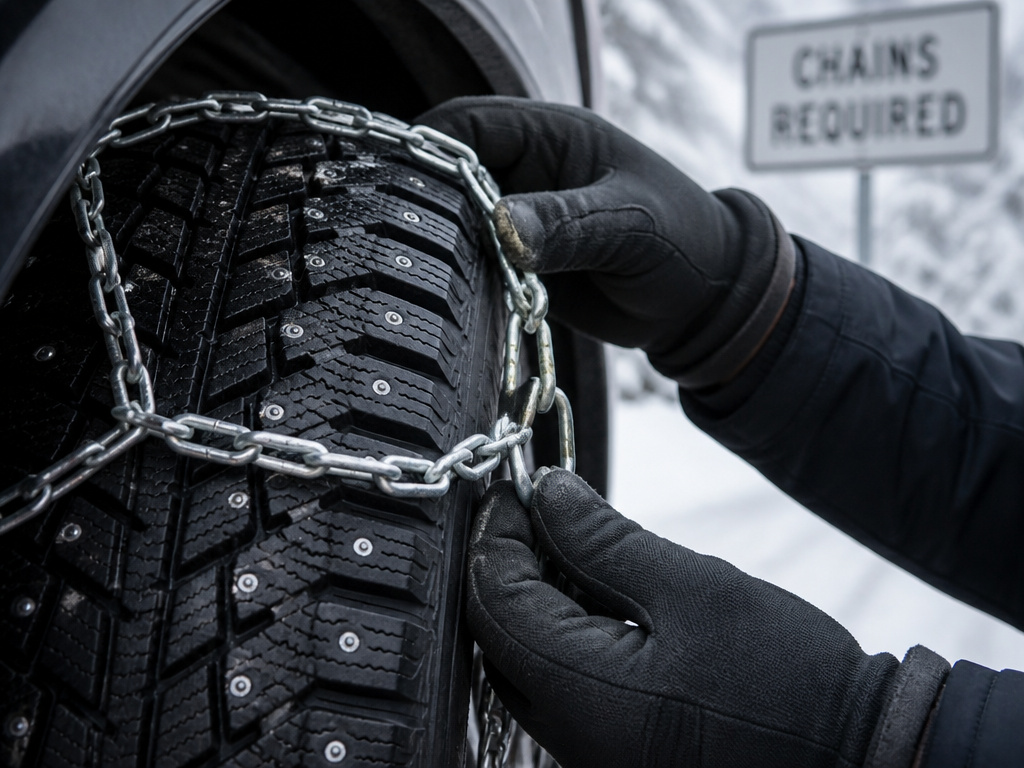 Washington drivers face two distinct, expensive penalties related to winter traction. Mixing them up is a costly mistake.
The $137 fine is for using studded tires outside the legal season (April 1 – October 31). It’s a straightforward violation of the calendar. The Washington State Patrol enforces this.
The $500 fine is for failing to obey a chain requirement. This is a different law (RCW 47.36.250) and a different scenario entirely. When WSDOT determines conditions are severe enough to require chains, they post signs. If you drive past a “Chains Required” sign without installing them, you are subject to a $500 penalty. This is true even if you have studded tires.
Where this goes sideways: Assuming studded tires let you ignore chain signs. They don’t. When chains are required, the requirement applies to all tire types, including studded tires. You must install chains over them.
The mechanism is simple: chains bite into ice and compact snow in a way that studs, which primarily provide micro-penetration on hard ice, cannot match for sheer lateral grip under heavy braking or on steep grades. The law recognizes that distinction.
Studded Tires vs. Chains vs. Winter Tires: A Quick Comparison
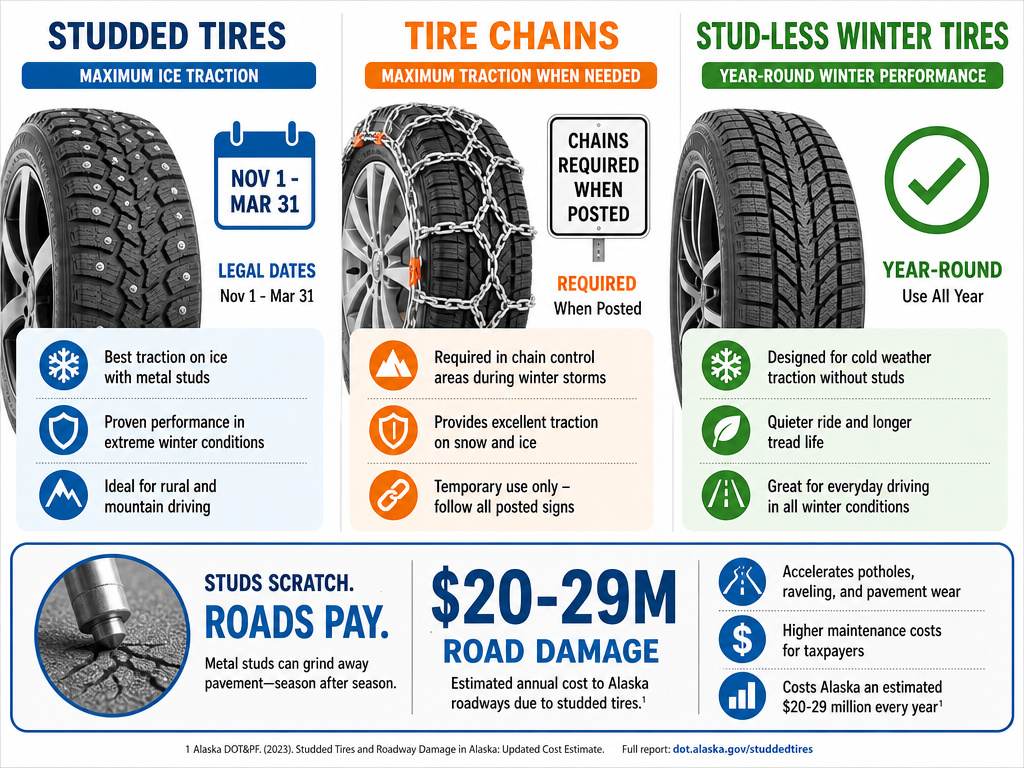 You have three main tools for winter traction in Washington: studded tires, traditional tire chains (or approved alternatives like AutoSock), and modern stud-less winter tires. They are not interchangeable.
| Traction Device | Best For | Legal When? | Meets Chain Requirement? |
|---|---|---|---|
| Studded Tires | Hard-pack ice & cold, dry roads. The metal studs penetrate the ice surface for braking and acceleration. | Nov 1 – Mar 31 only. | No. Must still carry/install chains if posted. |
| Tire Chains / Approved Alternatives | Severe, deep snow & ice on steep grades. Provide maximum bite for low-speed control. | When required by posted signs. | Yes. This is what the sign demands. |
| Stud-less Winter Tires | Most common winter conditions (slush, wet snow, cold pavement). Use advanced rubber compounds and tread designs for cold-weather grip. | Year-round. No seasonal restriction. | No. Like studded tires, they do not satisfy a “Chains Required” order. |
Modern studdable winter tires offer a hybrid path. Brands like the Nokian Hakkapeliitta series or certain Blizzak models are designed to accept studs. You can run them as aggressive, soft-rubber winter tires all season, and if you choose, a tire dealer can install studs into the pre-molded holes for the legal winter period. This flexibility makes them a popular choice for drivers who want a top-tier studdable winter tires option. When comparing best studded tires, also look at the best studded winter tires for trucks if you drive a heavier vehicle, as the weight changes the traction dynamics.
Why the state cares: WSDOT estimates studded tires cause $20 million to $29 million in damage to state-owned asphalt and concrete roadways each winter. The studs scrape and gouge the pavement. This is the primary reason for the strict seasonal limitation and the state’s promotion of effective, less-damaging alternatives like advanced winter tires.
What About Chains and Traction Advisories?
Washington uses a tiered system of traction advisories for its mountain passes. Understanding these is crucial for safe—and legal—winter travel.
- Traction Tires Advised: A recommendation. Oversize vehicles are prohibited. Your studded tires or winter tires are sufficient here.
- Traction Tires Required: A mandate. All passenger vehicles must have approved traction tires (M+S, All-Season, or mountain/snowflake symbol with sufficient tread). Chains are required on vehicles over 10,000 lbs GVWR.
- Tire Chains Required: A stricter mandate. All vehicles must install approved tire chains, except 4WD/AWD vehicles with approved traction tires on all wheels (though they must still carry chains).
- Chains Required On All Vehicles: The highest level. Every vehicle must install chains, no exceptions.
Your studded tires are considered “approved traction tires” under the Traction Tires Required level. But the moment the sign escalates to Tire Chains Required, your studs are no longer enough. You must pull over and install chains. This is non-negotiable and is spelled out in the WSDOT Winter Driving Guide.
This is also where knowing your vehicle’s capabilities matters. An all-wheel-drive SUV with dedicated studded snow tires might handle a “Traction Tires Required” zone with ease, but the driver is still obligated to carry chains in the vehicle during winter months. The law expects preparedness.
Frequently Asked Questions
Can I get a ticket for studded tires on April 1?
Yes. The law changes at midnight. Washington State Patrol officers can and do issue $137 citations to drivers using studded tires on April 1 and beyond.
Do studded tires count as chains in Washington?
No. They are legally distinct. Studded tires are an approved traction device, but they explicitly do not meet a posted chain requirement. You must install chains over them if the sign says “Chains Required.”
Are there any studded tires that are legal year-round?
Only tires with retractable studs that fully retract below the tire’s wear bar can be driven on year-round. However, the studs themselves may only be engaged between November 1 and April 1.
I’m visiting from another state. Do the rules apply to me?
Yes. All drivers operating a vehicle on Washington public highways must follow Washington law. There are no exemptions for out-of-state plates.
What’s the difference between “studded” and “studdable” tires?
Studded tire has the metal studs already installed. A studdable tire** has the pre-molded holes but is sold without studs; a dealer can install them later. Both must meet the same legal standards (tungsten carbide tips, minimum stud count, proper installation in a new/recapped tire) to be legal studded tires in California or any other state with similar rules.
Before You Go
The law on studded tires in Washington is specific, numeric, and strictly enforced. It grants a 4-month window of use, attaches a $137 penalty for calendar violations, and draws a bright line between studs and chains—with a $500 fine for crossing it. Your best move is to mark November 1 and March 31 on your calendar, confirm your tires meet the WAC specs if you run studs, and always, always carry chains in your vehicle from fall to spring. For most drivers navigating wet Washington winters, a set of high-quality stud-less winter tires provides excellent year-legal traction without the road damage or calendar anxiety.
