
Can I Replace Wider Tire to Rav4 | What Fits & What Breaks
This post contains affiliate links. As an Amazon Associate, we earn from qualifying purchases.
Yes, you can replace wider tires on a 2019 RAV4, but the margin for error is thin. The swap hinges on matching three non-negotiable specs: the 5×114.3 bolt pattern, the factory-recommended overall tire diameter, and the correct wheel offset. Deviating from Toyota’s published limits voids warranties and can trigger the tire pressure warning system.
The factory manual draws a hard line for a reason. Wheel and tire geometry isn’t just about looks; it’s a calculated system of clearances, load paths, and sensor communication. A change in one variable sends a ripple through steering effort, ABS calibration, and fuel economy.
What follows is the intersection of Toyota’s engineering mandates and real-world owner experimentation. We’ll map the factory specs, show you the tested outer limits, and walk through the mechanical checklist that separates a successful upgrade from a safety recall.
Key Takeaways
- Toyota’s manual explicitly warns against non-OEM wheel sizes, citing a loss of handling control. Warranty and liability shift to you.
- The tire pressure warning valves and transmitters must be reinstalled on any new wheel; skipping this disables a critical safety system.
- Wheel nut torque is 76 ft-lb (103 Nm); nuts must be installed with the tapered end facing inward. An outward-facing nut can crack the wheel.
- Owner forums show a practical max of a 245/65R17 or a 29.5-inch tall tire, but these push against suspension and fender liners at full lock.
- Never use an inner tube in a tubeless wheel designed for the RAV4, and never lubricate wheel bolts—both can cause catastrophic failure.
The Factory Specs & Owner’s Manual Verdict
Start with the manual. The 2019 Toyota RAV4 owner’s manual isn’t suggesting—it’s instructing. On page 5877-3, it states: “Do not use wheels that are a different size from those recommended in the Owner’s Manual, as this may result in a loss of handling control.” It adds that Toyota does not recommend using wheels of different sizes or types, used wheels, or bent wheels that have been straightened.
This isn’t corporate legalese. It’s the engineering baseline. Your RAV4’s anti-lock brakes, stability control, and all-wheel-drive system (if equipped) are calibrated to a specific rolling diameter. Change that diameter by more than a few percent, and those systems receive data that doesn’t match their programming. The result isn’t always immediate failure. It’s often a gradual, insidious loss of precision in how the vehicle manages traction.
When replacing wheels, ensure they are equivalent to those removed in load capacity, diameter, rim width, and inset (offset). Vehicles with a tire pressure warning system require tire pressure warning valves and transmitters to be installed whenever wheels are replaced.
| Factory Tire Size | Wheel Size | Bolt Pattern & Center Bore | Cold Inflation Pressure (AWD/Hybrid) |
|---|---|---|---|
| 225/65R17 102H | 17x7J | 5×114.3, 60.1 mm | 36 psi (250 kPa) |
| 225/60R18 100H | 18x7J | 5×114.3, 60.1 mm | 33 psi (230 kPa) |
| 235/55R19 101V | 19×7.5J | 5×114.3, 60.1 mm | 35 psi (240 kPa) |
The bolt pattern is your first gate. Every 2019 RAV4, regardless of trim or market, uses a 5×114.3 pattern with a 60.1 mm center bore. An aftermarket wheel must match this exactly. A wrong pattern simply won’t bolt on; a mismatched center bore will cause vibration as the wheel isn’t hub-centric.
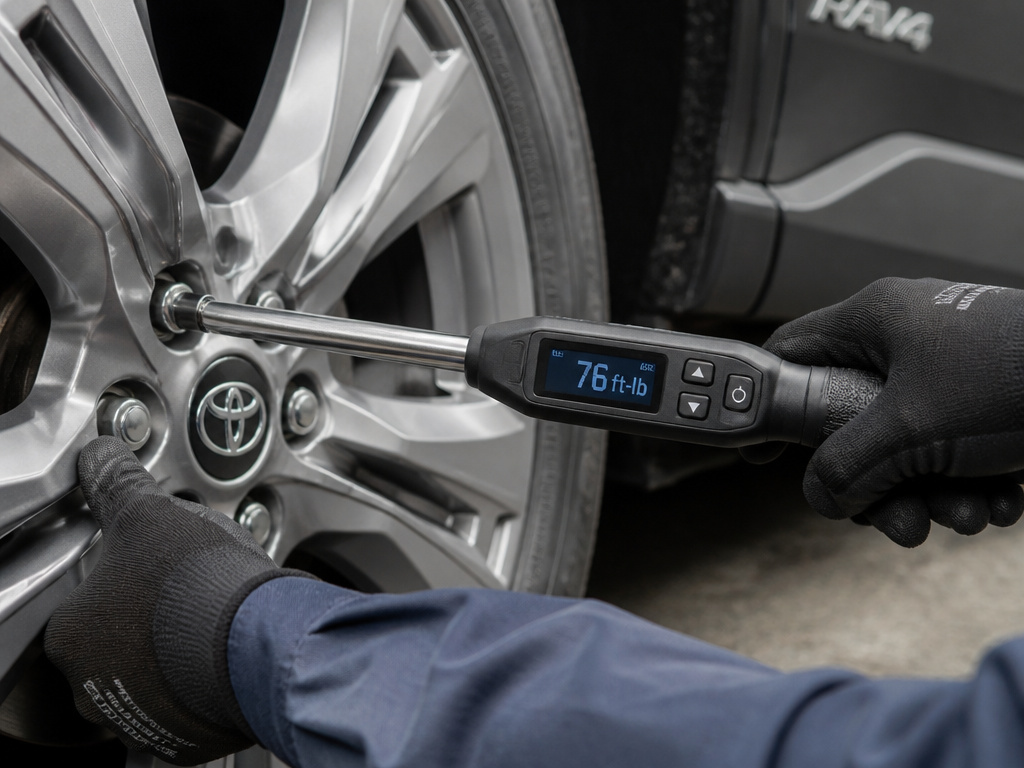
The wheel nut torque spec is 76 ft-lb (103 Nm). Use a calibrated torque wrench. The manual has a separate, critical warning: install wheel nuts with the tapered ends facing inward. Installing them outward concentrates stress on a small part of the wheel seat, which can crack the aluminum. Also, never use oil or grease on the bolts or nuts. Lubrication changes the friction in the joint, leading to overtightening (which can strip threads or warp the brake rotor) or, paradoxically, cause the nut to loosen under vibration.
Owner-Tested Limits: What Actually Fits
The manual gives the safe zone. Real owners on forums like RAV4World have mapped the frontier. These are not recommendations—they’re documented, user-reported data points showing what has physically been mounted without immediate rubbing or failure.
One owner running a 2019 RAV4 Adventure successfully installed 245/65R17 Cooper Discoverer A/T tires. They reported no rubbing at full lock and a few inches of clearance all around. This setup increased the overall diameter by about an inch, making the speedometer read roughly 3% slow. The feel was “more stable and sure-footed,” but fuel economy dropped by 1-2 MPG.
Where this goes sideways: Assuming a taller, wider tire automatically improves snow performance. A wider tire can float on top of snow instead of cutting through to the pavement. For true winter conditions, a dedicated narrow winter tire often outperforms a wide all-terrain. The question of wider tires in snow has a counterintuitive answer.
Another owner fitted 16-inch Toyota Highlander alloy wheels with 225/75R16 tires on a 2021 model (sharing the XA50 platform). This is a key insight: smaller-diameter wheels with a higher sidewall can allow for a larger overall tire while improving ride comfort and airing-down capability for off-road use. Their estimated maximum for the RAV4 platform was a 29.5-inch tall tire, no wider than 9.6 inches.
This highlights the core trade-off. You can go wider, or you can go taller, but each choice has a cost. – Wider: Increases grip and stability on dry pavement, but can increase steering effort, accelerate wear on suspension components, and hurt fuel economy. – Taller: Increases ground clearance and can improve off-road articulation, but alters final drive ratio (making the vehicle feel slower) and moves the speedometer further off calibration.
The impact of tire size is holistic, changing how the vehicle accelerates, brakes, and consumes fuel.
The Three Critical Fitment Dimensions
Moving from “it bolts on” to “it works correctly” requires checking three interlocking dimensions: width, offset, and overall diameter.
1. Section Width: This is the first number in the tire size (e.g., 225 in 225/65R17). The factory wheels are 7 inches wide. A common rule is that a wheel should be 70-90% of the tire’s section width. A 7-inch rim is about 178mm wide, making it ideally suited for a 225mm tire. Stretching a 255mm tire onto that same rim risks the tire bead not sealing correctly or the sidewall bulging awkwardly, destabilizing the contact patch. If you’re considering wider tires on stock rims, this is your primary constraint.
2. Wheel Offset (ET): This is the distance from the wheel’s mounting surface to its centerline. A positive offset (like the factory ET35) tucks the wheel deeper into the wheel well. A lower or negative offset pushes the wheel outward. Changing offset drastically changes suspension geometry. A wheel with too little positive offset pushes the tire outward, where it can rub the fender liner during compression or steering. More critically, it increases the lever arm acting on the wheel bearing, accelerating its wear. Always match the factory offset unless you’re prepared for compensatory modifications.
3. Overall Diameter: Use a tire size calculator. Plug in your factory size (e.g., 225/65R17 has a diameter of about 28.5 inches) and your proposed size. Stay within 3% of the original diameter to keep speedometer and electronic systems relatively happy. A change beyond that affects the impact of tire width on gearing and fuel economy exponentially.
| Proposed Change | Effect on Diameter | Speedometer Error | Primary Risk |
|---|---|---|---|
| 235/65R17 | +0.8″ (~2.8%) | Reads ~2 mph slow at 70 mph | Mild fender liner contact at full lock |
| 245/65R17 | +1.2″ (~4.2%) | Reads ~3 mph slow at 70 mph | Rubbing likely, increased bearing load |
| 225/75R16 | +0.9″ (~3.2%) | Reads ~2 mph slow at 70 mph | Requires 16″ wheel; brake caliper clearance? |
Step-by-Step Safety Checklist for the Swap
If you’ve checked the numbers and are proceeding, this checklist is non-negotiable. Skip one item and you’re driving a compromised vehicle.
- Source TPMS Sensors: Before mounting tires on new wheels, purchase new tire pressure warning valves and transmitters from a Toyota dealer or a reputable supplier that guarantees compatibility. Non-genuine sensors often fail to pair or report inaccurate data.
- Dry-Fit & Clearance Check: With the vehicle on a lift and the new tire/wheel assembly mounted, have an assistant turn the steering wheel lock-to-lock while you watch for contact. Then, compress the suspension (simulate a big bump) and check again. Look for wear marks on the inner fender liner and the strut spring perch.
- Torque in a Star Pattern: Once cleared, hand-thread all wheel nuts. Using a torque wrench, tighten in a star pattern to 76 ft-lb (103 Nm). Double-check the tapered end faces inward.
- Relearn TPMS System: After driving for a few minutes, the TPMS light may blink and then stay on. Follow the vehicle’s procedure (usually found in the manual) to reset and relearn the sensor IDs. This step is critical for tires designed for crossover SUVs, which rely on accurate pressure monitoring for their handling balance.
- Re-Torque After 60 Miles: Friction settles. Drive approximately 60 miles, then re-torque all nuts to the same 76 ft-lb specification with the wheels on the ground.
Common mistake: Using a liquid sealant instead of reinstalling TPMS sensors. The sealant can gum up the sensor, causing permanent failure. The system will then be inoperative, and you won’t know about a slow leak until the tire is visibly flat.
Wider vs. Taller: Choosing Your Upgrade Path
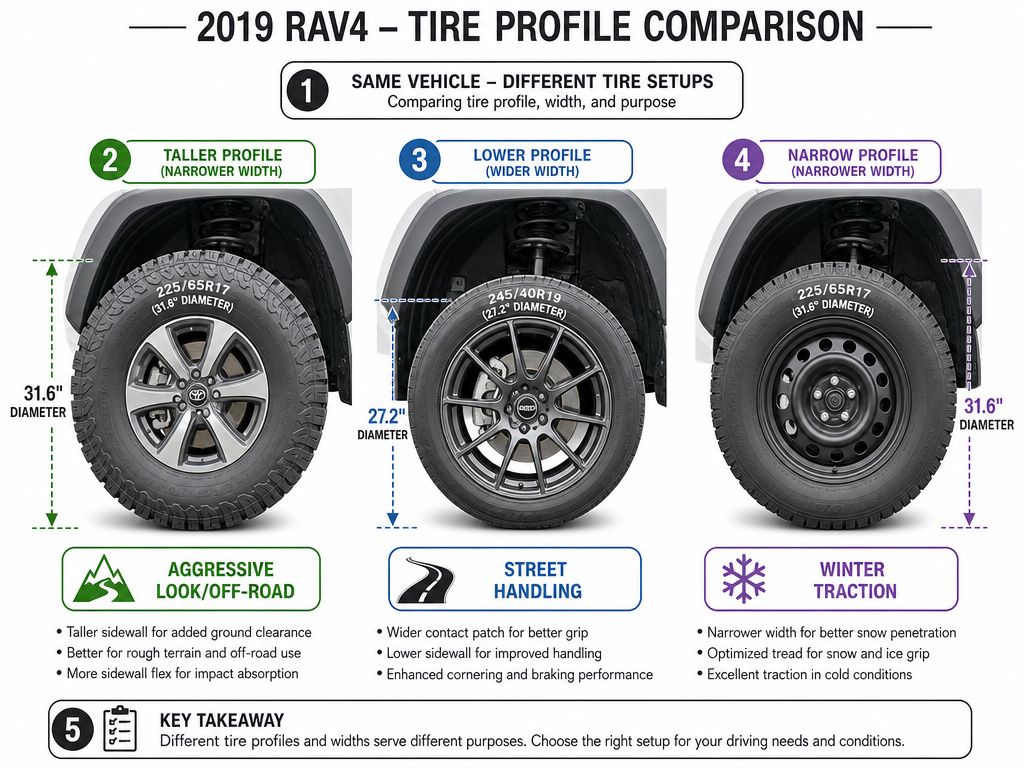
Your goal dictates your choice. Are you seeking looks, off-road capability, or street performance?
For a more aggressive look and marginal off-road gain, a slightly taller all-terrain tire like the 245/65R17 is the common frontier. Models like the Falken Wildpeak A/T3W or the Cooper Discoverer AT3 4S are popular all-terrain tires for RAV4 choices in this size. Remember, this will likely degrade on-road noise and fuel economy.
For improved street handling and dry grip, a wider tire on a properly sized aftermarket wheel with the correct offset is the path. Think of a 235-width performance-oriented crossover tire on an 8-inch wide wheel. This maximizes the benefits of a 235 tire over a 215 by providing a stiffer sidewall and a larger contact patch. The trade-off is a harsher ride and increased susceptibility to hydroplaning.
For true winter capability, ignore width. Fit the narrowest recommended winter tire on cheap steel wheels. The narrow tread cuts through snow to the pavement below, providing far better traction than a wide tire that floats on top.
Frequently Asked Questions
What is the widest tire I can put on a 2019 RAV4 without a lift?
Based on owner reports, a 245/65R17 (about 29.5 inches tall, 9.6 inches wide) is the practical limit. This may still cause minor rubbing on the front fender liner at full steering lock, especially if the wheel offset is not close to factory. A 255mm width is almost certain to rub and is not advised.
Will wider tires ruin my fuel economy?
Yes, expect a decrease. A wider tire has more rolling resistance and a larger frontal area disrupting airflow. The drop is usually 1-3 MPG, depending on the tire’s tread compound and weight. Aggressive all-terrain tread patterns compound the loss.
Can I just put wider tires on my existing wheels?
You can, but with strict limits. The factory 17x7J rim is approved for tire widths typically from 215mm to 235mm. Going to a 245mm tire on a 7-inch rim is at the extreme edge of what tire manufacturers deem safe for mounting. It can cause unstable handling and irregular wear. Always consult the tire manufacturer’s rim width range chart before attempting mounting wider tires on your rims.
Do I need an alignment after changing tire size?
Yes. Any change in tire diameter or width alters the scrub radius and can affect toe and camber settings. A post-installation alignment ensures your new tires wear evenly and the vehicle tracks straight.
What about switching from a 255 to a 265 tire?
This is a more nuanced step than it appears. A 265-section tire is 10mm wider, but it also often comes with a different aspect ratio. You must calculate the new overall diameter. Furthermore, a 265mm tire almost certainly requires a wheel wider than 7 inches. The considerations for replacing 255 tires with 265 involve more than just clearance; it’s a complete recalibration of fitment.
The Bottom Line
Replacing the tires on your 2019 RAV4 with wider ones is a technical exercise, not an aesthetic one. The factory manual provides the only guaranteed-safe parameters. Venturing beyond them shifts all risk to you. If you proceed, ground your decision in the owner-tested maximums—like the 245/65R17—and follow the mechanical checklist religiously. The goal isn’t just to make them fit today; it’s to ensure they work reliably for the next 30,000 miles. Your choice ultimately sits between Toyota’s engineered certainty and the enthusiast’s calculated gamble. Pick the path that matches your tolerance for consequence.
