
Can You Replace 255 Tires with 265? | Size Swap Mechanics
This post contains affiliate links. As an Amazon Associate, we earn from qualifying purchases.
You can replace 255 tires with 265s if three conditions are met: you have at least 10mm of clearance on each side, the new tire’s load index meets or exceeds the original, and the speed rating matches or upgrades the OEM spec. The 10mm width jump changes more than just looks—it affects stability, wear, and, on 4WD vehicles, can burn out a differential within months.
That clearance number isn’t a guess. It’s the gap between your current tire sidewall and the nearest suspension component or fender liner, measured with the wheels turned lock-to-lock. Most factory setups have less than 15mm to play with. A 10mm wider tire eats two-thirds of that margin, and the first full-compression bump on a loaded vehicle is where the sidewall gets shredded.
What follows: the math to check clearance, the load-capacity trap for SUVs, and the one measurement that decides whether your all-wheel-drive system survives the swap.
Key Takeaways
- A 255 to 265 swap adds 10mm (0.4 inches) of width. You need at least that much extra clearance on the inboard side, near the strut or control arm.
- For SUVs and trucks using P-metric tires (like P265/75R16), the load capacity is secretly reduced by 10% per Federal Motor Vehicle Safety Standards (FMVSS). A 265 tire must cover that discount.
- On AWD or 4WD vehicles, a total diameter difference greater than 3% (about 0.8 inches) strains the center differential. The viscous coupling overheats, and the unit fails within 5,000 to 10,000 miles.
- Speed rating is non-negotiable. A lower-rated tire can overheat and delaminate at sustained highway speeds your vehicle is designed for.
- > Where this goes sideways: Assuming a 265 tire labeled with a higher load index automatically carries more weight. On an SUV, a P-metric 265 might actually carry less than your original 255 LT tire once the 10% de-rating is applied.
The 255 vs. 265 Math: Clearance is Just the Start
The numbers 255 and 265 refer to the tire’s cross-sectional width in millimeters. A 265 tire is 10mm wider, or about 0.4 inches. That seems trivial until you realize the tire doesn’t just get wider outward—it typically widens symmetrically, adding 5mm to each sidewall.
Before you start: This task involves your vehicle’s suspension and braking systems. Never work on a vehicle supported only by a jack. Use jack stands on level, solid ground. The steering system is under tension at full lock; keep hands clear of the tie rods when turning the wheel for clearance checks.
Grab a ruler and turn the wheels. Park on level ground, chock the opposite wheels, and lift the front end securely. Rotate the steering to full left lock. Measure the gap between your current 255 tire‘s sidewall and the closest point—usually the spring perch on the strut or the upper control arm. Record it. Repeat at full right lock, and check the rear tire’s clearance to the inner fender liner or frame rail. The smallest number you find is your available clearance.
If your smallest clearance is 12mm, a 265 tire will reduce it to 2mm. That’s a problem. Tire flex under cornering or load can exceed 5mm. The result is a rhythmic grinding sound that appears only when the suspension is loaded in a turn, followed by a sudden loss of air pressure.
The load index is the next hurdle. This two- or three-digit number on the tire’s sidewall (like 110 or 121) indicates its maximum load capacity at a specific inflation pressure. A higher number is better, right? Not always.
For SUVs, pickups, and minivans fitted with P-metric tires (tires without an “LT” prefix), the FMVSS mandates a 1.1 load reduction factor. The Toyo Tires technical document states it plainly: a P265/75R16 with a load index of 114 has a maximum load of 2,601 lbs for a passenger car. On an SUV, that drops to 2,364 lbs (2,601 ÷ 1.1). Your vehicle’s door placard lists the required weight per tire. If your original 255 tire met that number, your new 265 must meet the reduced number, not the one printed on its sidewall.
| Tire Size & Type | Load Index | Max Load (Passenger Car) | Max Load (SUV/Truck) | Notes |
|---|---|---|---|---|
| P265/75R16 (P-metric) | 114 | 2,601 lbs | 2,364 lbs | 10% reduction applies |
| LT265/75R16 ‘C’ (LT-metric) | 112 | 2,470 lbs | 2,470 lbs | No reduction for LT tires |
| Original 255 Tire (Example) | 110 | 2,403 lbs | 2,403 lbs (if LT) | Baseline for comparison |
If your original tire was an LT model, this de-rating does not apply. This trap catches owners who see a bigger tire with a higher load index and assume it’s a direct upgrade. It might be a downgrade for their specific vehicle.
Why Load Capacity and Speed Rating Aren’t Suggestions
The sidewall numbers are engineering mandates, not marketing. A tire’s load index is validated against inflation pressure tables published by The Tire and Rim Association. These tables are the industry’s common language.
Increasing inflation pressure beyond the level needed to support the tire’s maximum load does not increase its load capacity. This is noted in the Bridgestone Americas Tire Replacement Manual. Pumping a 265 tire to its max psi of 51 won’t let it carry more weight than its rated index allows.
Speed rating works the same way. A tire rated “T” (118 mph) has its structural integrity and heat dissipation validated up to that speed. Sustained driving at 125 mph on a “T”-rated tire builds heat faster than the casing can shed it. The belts can separate, leading to a sudden tread loss. This isn’t scare talk. It’s the predictable outcome of exceeding a material’s engineered limits.
Match or upgrade the speed rating. If your original 255 tire is “V” (149 mph), your 265 replacement should be “V” or higher (“W”, “Y”). Downgrading to “H” (130 mph) is a calculated risk only acceptable for dedicated winter tires, and only if you consciously limit your highway speed. The Toyo Tires document acknowledges this practice for winter tires but stresses the consumer must be informed.
The Deal-Breaker for AWD and 4WD Vehicles
This is where a simple width change can become a four-figure repair. All-wheel-drive and four-wheel-drive systems are designed around matched tire diameters. The differentials and transfer case allow for tiny speed differences between wheels. A 265 tire that is even slightly taller or shorter than its mates creates a constant speed difference.
Attention! Toyo Tires’ technical service bulletin warns: “4WD and AWD vehicles require special attention to insure that all four tires are closely matched in diameter to avoid strain and possible damage to the vehicle’s differentials and/or viscous couplings.”
The strain isn’t theoretical. A mismatched diameter forces the center differential to work constantly to compensate. In a system with a viscous coupling, the fluid overheats. The coupling seizes or fails outright. In modern electronically-controlled AWD systems, the clutch packs in the transfer case wear out prematurely. The repair bill often exceeds the cost of a proper matched set of four tires.
How close is close enough? The industry consensus is a maximum of 3% difference in rolling diameter. For a typical 32-inch tire, that’s just under an inch. A 255 to 265 width change often comes with aspect ratio changes that affect height. You must calculate the new overall diameter. 1. Find the overall diameter of your original 255 tire (e.g., 255/70R18). 2. Find the overall diameter of the proposed 265 tire (e.g., 265/65R18). 3. Calculate the difference: (New Diameter – Old Diameter) / Old Diameter. If the result is over 0.03 (3%), don’t proceed without planning to replace all four tires.
The Right Way to Size a 265 Replacement Tire
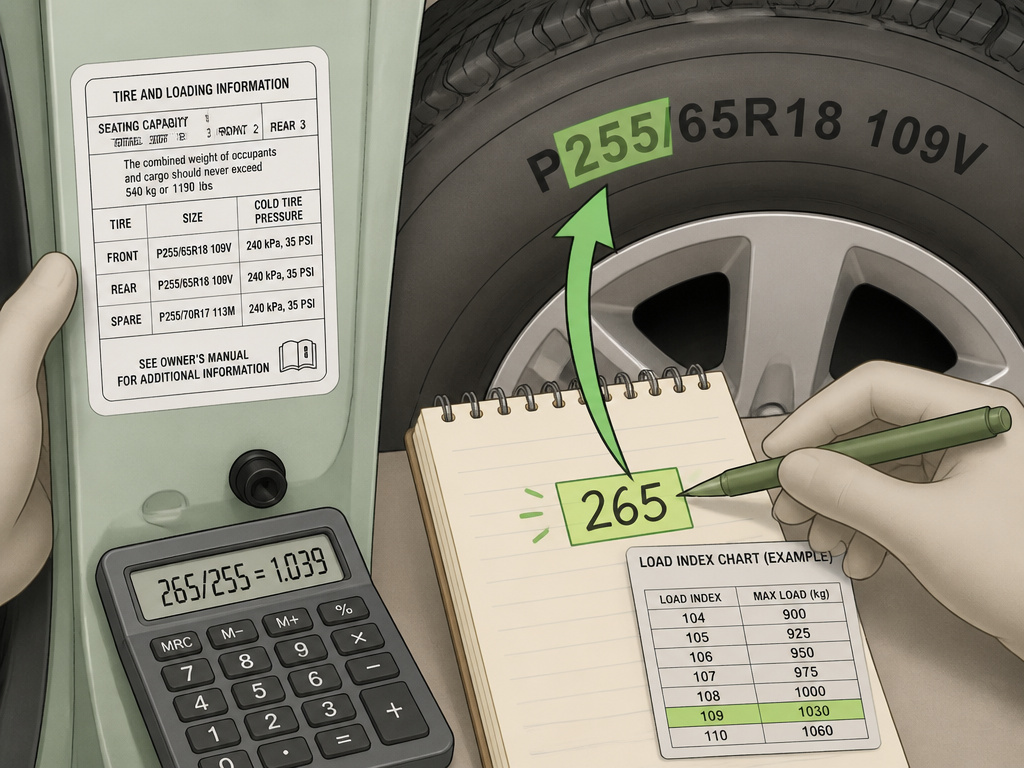
Don’t just buy a 265. Buy the correct 265. This means matching three specifications from your vehicle’s door jamb sticker: the original size, the load index, and the speed symbol. The sticker is law.
- Decode your current tire. A code like “P255/65R18 109V” breaks down as:
- P = P-metric (Passenger). Could also be LT (Light Truck) or no prefix (Euro-metric).
- 255 = Section width in mm.
- 65 = Aspect ratio (sidewall height as % of width).
- R18 = Rim diameter in inches.
- 109 = Load Index (see TRA table for capacity).
- V = Speed Rating (149 mph).
- Find a compatible 265 size. You need a 265/??R18. The aspect ratio (??) will likely be different to keep the overall diameter close. A common swap is 255/65R18 to 265/60R18. Online tire size calculators do this math instantly.
- Verify Load Index. Using a 265/60R18, find its load index. Cross-reference it with the TRA load table to get its maximum load in pounds. If your vehicle uses P-metric tires, apply the 1.1 de-rating factor. Does the de-rated load meet or exceed the requirement on your door sticker? If yes, proceed. If no, reject that specific 265 model.
- Confirm Speed Rating. It must be equal or higher. A “V” must be replaced with a “V”, “W”, or “Y”.
This process turns a vague question into a verifiable checklist. It’s the difference between a successful upgrade and a roadside disaster.
When to Walk Away from the 265 Swap
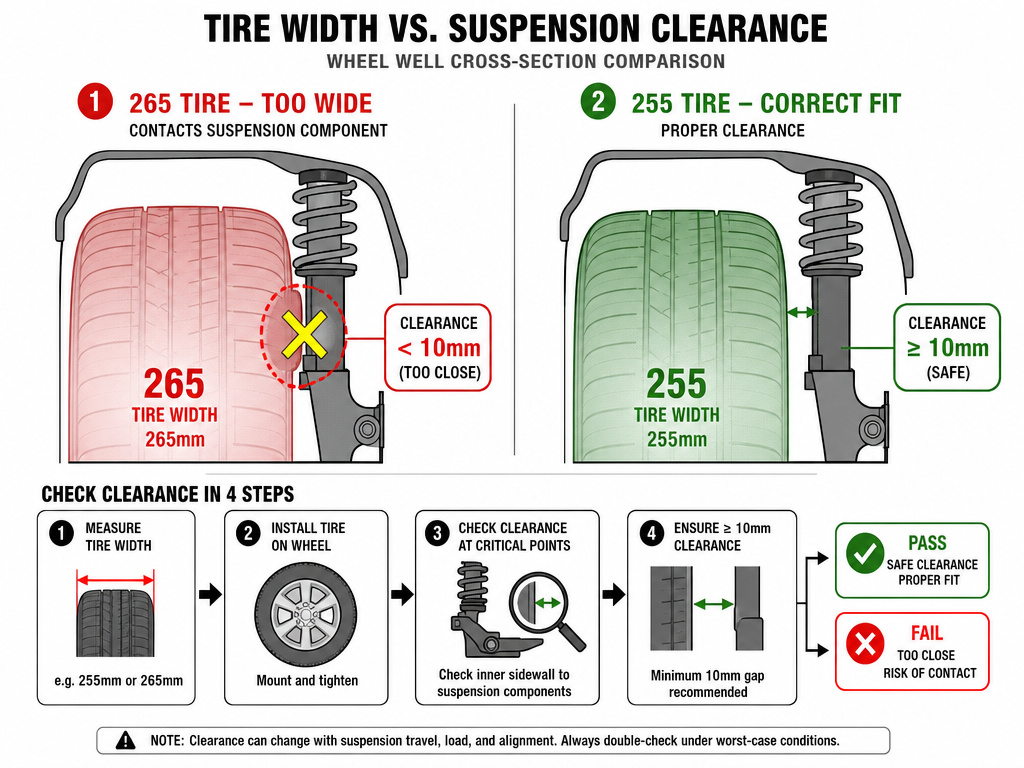
Some vehicles are poor candidates from the factory. If your measured clearance is under 10mm, stop. Forcing a 265 tire will lead to contact. The wear pattern will be a smooth, polished strip on the inner sidewall. You’ll see it during a routine rotation.
If your vehicle has a full-size spare that’s part of a rotating five-tire regimen, a 265 swap commits you to buying five new tires to keep the diameters matched. That changes the financial equation.
And if you drive a performance AWD car (like a Subaru WRX or Audi S4), the manufacturer’s tolerance for diameter variance is often below 2%. The stability control and ABS systems use wheel speed sensors. A mismatch can trigger false activation lights and degrade the system’s responsiveness. The repair for a damaged differential in these cars starts at $3,000.
The bottom line: A 255 to 265 tire replacement is a technical exercise, not an aesthetic one. It succeeds when you follow the data from your door jamb and the tire manufacturer’s load tables. It fails when you assume bigger is always better. For most daily drivers, the performance gain is marginal. The risk of getting the load or diameter wrong is real. When in doubt, stick with the original equipment size. It’s the one spec the vehicle engineers signed off on.
Frequently Asked Questions
Will 265 tires fit the same rims as 255 tires?
Usually, yes. A 265 tire is designed to fit a rim width range that often overlaps with the recommended range for a 255 tire. For example, a common 255 tire fits an 8.0 to 9.5-inch rim. A 265 tire typically fits an 8.5 to 10.0-inch rim. If your wheels are 8.5 inches wide, they likely work for both. Always check the tire manufacturer’s specific rim width chart for the exact 265 model you’re buying.
Do 265 tires affect gas mileage?
Yes, typically for the worse. A wider 265 tire has a larger contact patch, which increases rolling resistance. The weight of a larger tire also increases rotational mass, requiring more energy to accelerate. The combined effect can reduce fuel economy by 1-3 MPG, depending on the vehicle and driving style. The impact is more noticeable in city driving than on the highway.
Is a 265 tire taller than a 255 tire?
Not necessarily. The tire’s overall diameter is determined by both its width (255/265) and its aspect ratio (the middle number, like 65 or 70). A 265/60R18 can be shorter than a 255/65R18. You must calculate the diameter using a tire size calculator. The goal when swapping widths is to find a 265 aspect ratio that results in a diameter within 3% of your original 255 tire’s diameter.
Can I put just two 265 tires on my vehicle?
It’s strongly discouraged, especially for front-wheel-drive, rear-wheel-drive, or part-time 4WD vehicles. The different width (and potentially different diameter) between the axles can upset the vehicle’s handling balance, causing unpredictable oversteer or understeer. For AWD vehicles, it’s a definitive no—it will damage the drivetrain. If you must replace only two tires, they should be installed on the rear axle to promote stability, and they should be the same brand, model, and size as the existing tires.
Do I need to recalibrate my speedometer for 265 tires?
If the overall diameter of your new 265 tire setup differs from the original 255 tires, yes. A larger diameter tire rotates fewer times per mile, causing your speedometer to read slower than your actual speed. A smaller diameter tire does the opposite. A change of more than 3% can make your speedometer noticeably inaccurate and will also throw off your odometer. Some modern vehicles allow for tire size recalibration through the onboard computer; others require aftermarket calibration tools.
